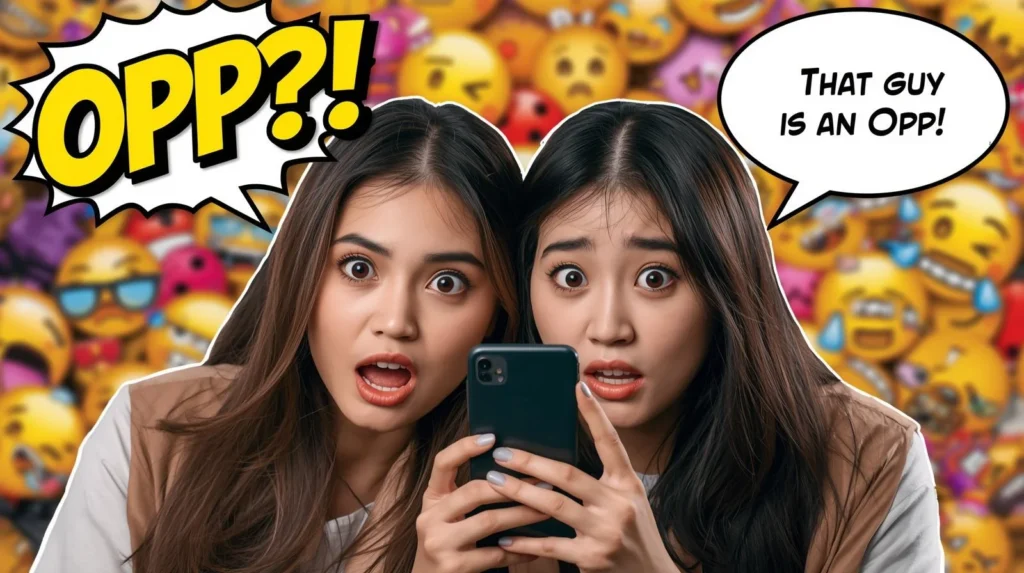

OPP in slang usually means “opposition” or “enemy.” In texting and online chat, it refers to someone who is against you, competing with you, or not on your side. People commonly use it in casual conversations, especially on social media platforms.
Meaning & Explanation of OPP in Slang
OPP Meaning in Text
The OPP meaning in text typically refers to a person who is an opponent, rival, or enemy. It is widely used in casual messaging and internet conversations.
For example:
- “Don’t trust him, he’s an opp.”
- “We saw our opps at the party last night.”
In simple terms, when someone calls another person an opp, they mean that person is not on their side or may even be working against them.
This internet slang term became popular through music culture, online communities, and social media, where quick and short expressions are common.
OPP Slang Meaning
The OPP slang meaning comes from the word “opposition.”
In modern internet slang, it can refer to:
- A rival
- Someone from a competing group
- A person you dislike
- Someone who is against you
Originally, the term appeared in street slang and hip-hop culture, but today it is widely used in digital communication, memes, and casual chat.
What Does OPP Mean in Chat?
In chat conversations, OPP usually means someone you’re in conflict with.
Example:
A: Did you see Mark talking about you online?
B: Yeah, he’s been acting like an opp lately.
In this context, the word expresses tension or disagreement.
OPP Meaning on Snapchat
On Snapchat, OPP often appears in stories, captions, or chats.
Examples:
- “Keep your circle small. Too many opps around.”
- “Running into my opps tonight.”
Users often use the word humorously or dramatically when talking about rivals or people they dislike.
OPP Meaning on Instagram, TikTok, and WhatsApp
Across social media platforms, the meaning remains similar.
- Used in captions, memes, and comments.
TikTok
- Often used in humorous videos or trending slang explanations.
- Appears in group chats when talking about rivals or disagreements.
In many cases, the term is playful rather than serious.
Is OPP an Acronym or Abbreviation?
OPP is technically a shortened slang form of the word “opposition.”
It is not exactly:
- ❌ An acronym
- ❌ A typo
Instead, it is a short form used in casual language.
Because texting culture favors quick communication, shortened words like OPP became popular in online messaging.
Tone & Context Variations
Like many internet slang terms, the meaning of OPP can change depending on tone.
Funny Tone
Sometimes people use OPP jokingly when talking about minor disagreements.
Example conversation:
A: You ate the last slice of pizza again.
B: Relax, it’s just pizza.
A: Nah, you’re officially my opp now.
Here the word is clearly playful.
Sarcastic Tone
People may also use the term sarcastically.
Example:
A: Did you like my new haircut?
B: It’s… interesting.
A: Wow, acting like an opp today.
The speaker isn’t actually accusing someone of being an enemy.
Romantic Tone
Sometimes couples jokingly use the word during playful arguments.
Example:
A: You forgot our movie night again.
B: I’ll make it up to you.
A: Hmm… sounds like something an opp would say.
In this case, the tone is teasing.
Angry Tone
In serious contexts, OPP can express real conflict.
Example:
A: He’s been spreading rumors about you.
B: Yeah, he’s definitely an opp.
Here the word carries a stronger emotional meaning.
Playful Tone
Friends sometimes use it casually in group chats.
Example:
A: Whoever took my charger is an opp.
B: Relax, I borrowed it for five minutes.
A: That’s exactly what an opp would say.
Real Chat Examples (Natural & Relatable)
Here are realistic texting conversations showing how people actually use the term.
Conversation 1
A: Did Jake unfollow you too?
B: Yeah, I guess I’m an opp now.
A: That escalated quickly.
Conversation 2
A: Don’t trust Kevin with secrets.
B: Why not?
A: He’s low-key an opp.
Conversation 3
A: Bro you took my fries again.
B: They were just sitting there.
A: That’s some opp behavior.
Conversation 4
A: Our team lost again.
B: The other team played really well.
A: Yeah, those opps were ready.
Conversation 5
A: Did she block you?
B: Yep.
A: Wow… straight opp move.
Conversation 6
A: Someone told the teacher about the prank.
B: Who was it?
A: Probably one of the opps.
Conversation 7
A: Why are you defending him?
B: I’m just being fair.
A: Hmm… sounding like an opp.
Conversation 8
A: Don’t tag me in that picture.
B: Too late.
A: Wow, you’re my biggest opp today.
Conversation 9
A: They canceled the concert.
B: No way!
A: The weather is acting like an opp.
Conversation 10
A: Did you hear what they said about us?
B: Yeah.
A: Looks like we got new opps.
Conversation 11
A: I beat you in the game again.
B: You’re turning into an opp.
Conversation 12
A: Stop stealing my snacks.
B: Finders keepers.
A: Classic opp behavior.
Grammar & Language Role
Part of Speech
In most conversations, OPP functions as a noun.
Example:
- “He’s an opp.”
Sentence Position
It can appear:
- At the end of a sentence
- In the middle
- As a standalone label
Examples:
- “Watch out for the opps.”
- “That guy is an opp.”
Does It Replace a Full Sentence?
Sometimes, yes.
Example:
A: Did he talk behind your back?
B: Opp.
This short reply communicates the idea that the person is an enemy.
Tone Impact
The tone can range from:
- Serious
- Sarcastic
- Funny
Tone depends heavily on context and the relationship between speakers.
Formal vs Informal Use
OPP is extremely informal.
It should not be used in:
- Academic writing
- Workplace emails
- Professional communication
It is best suited for casual chat and social media.
How to Reply When Someone Says OPP
When someone uses the term OPP, your response depends on context.
Funny Reply
- “Guess I’m the villain now.”
- “I didn’t know we had opps today.”
Serious Reply
- “What happened between you two?”
- “Why do you think they’re an opp?”
Flirty Reply
- “If I’m your opp, does that mean I still get your attention?”
Neutral Reply
- “Oh, I see.”
- “That makes sense.”
Comparison Table
| Term | Meaning | Formal/Informal | Tone | Popularity | Risk of Misunderstanding |
|---|---|---|---|---|---|
| OPP | Enemy or rival | Informal | Playful or serious | Growing | Medium |
| IDK | I don’t know | Informal | Neutral | Very high | Low |
| ION | I don’t | Informal | Casual | Moderate | Medium |
| Dunno | Don’t know | Informal | Relaxed | Medium | Low |
| IDC | I don’t care | Informal | Dismissive | High | Medium |
Who Uses This Term?
Age Group
The slang term OPP is most popular among:
- Teenagers
- Young adults
- Gen Z users
Millennials sometimes use it, but usually less frequently.
Gen Z vs Millennials
Gen Z
- Uses slang like OPP more often
- Popular on TikTok and online communities
Millennials
- May recognize the term
- Use it mostly jokingly
Regions
The slang appears mostly in:
- United States
- United Kingdom
- Global internet communities
However, social media has helped spread it worldwide.
Platforms Where It’s Most Common
You’ll see OPP frequently on:
- TikTok
- Snapchat
- Twitter/X
- Discord
Origin & Internet Culture Insight
The word OPP comes from “opposition” and became popular in street slang and hip-hop culture.
Several factors helped it spread online:
TikTok Influence
TikTok slang trends often introduce new vocabulary. Videos explaining slang terms helped popularize OPP among younger audiences.
Meme Culture
Memes frequently exaggerate situations by calling someone an opp, even in harmless scenarios.
Example:
- “The alarm clock is my biggest opp.”
Fast Typing Culture
Texting encourages short, quick words. Instead of typing “enemy” or “opponent,” people use OPP because it’s faster.
Safety & Appropriateness
Is OPP Rude?
Not necessarily.
However, calling someone an opp could sound negative depending on tone.
Is It a Bad Word?
No.
It is not offensive language, but it may imply conflict.
Should You Use It in School or Office?
Probably not.
Because it is informal slang, it is best used only in:
- Casual conversations
- Social media chats
- Friendly texting
Experience-Based Insight
In everyday online conversations, OPP is often used humorously rather than seriously. Many people call their friends “opps” when joking about small things like stealing food, winning a game, or teasing each other. This playful use shows how internet slang evolves beyond its original meaning.
FAQ About OPP Slang
What does OPP mean in text?
In texting, OPP means an enemy, rival, or someone who is against you.
Is OPP rude?
It can sound negative, but most people use it jokingly among friends.
What does OPP mean on Snapchat?
On Snapchat, OPP refers to someone you dislike, compete with, or consider a rival.
Is OPP the same as IDK?
No. IDK means “I don’t know,” while OPP refers to an enemy or rival.
Can adults use OPP?
Yes, but it is mostly popular among Gen Z and younger internet users.
How do you respond to OPP?
You can respond with humor, curiosity, or agreement depending on the conversation.
Does OPP always mean enemy?
Not always. Sometimes it’s used jokingly to describe someone who disagrees with you.
Is OPP common on TikTok?
Yes. TikTok slang and meme culture helped spread the term widely.
Summary
The slang term OPP refers to an opponent, rival, or enemy, especially in casual online conversations. It originated from the word opposition and became popular through internet culture, music, and social media.
Usage Tips
- Use OPP in casual chats only.
- It works best in humorous or playful conversations.
- Avoid using it in professional communication.
Common Mistakes
- Assuming it always means a serious enemy
- Using it in formal writing
- Misinterpreting playful sarcasm
When to Use It
Use OPP when joking with friends or discussing rivals casually online.
When to Avoid It
Avoid it in:
- Workplace messages
- Academic writing
- Professional emails