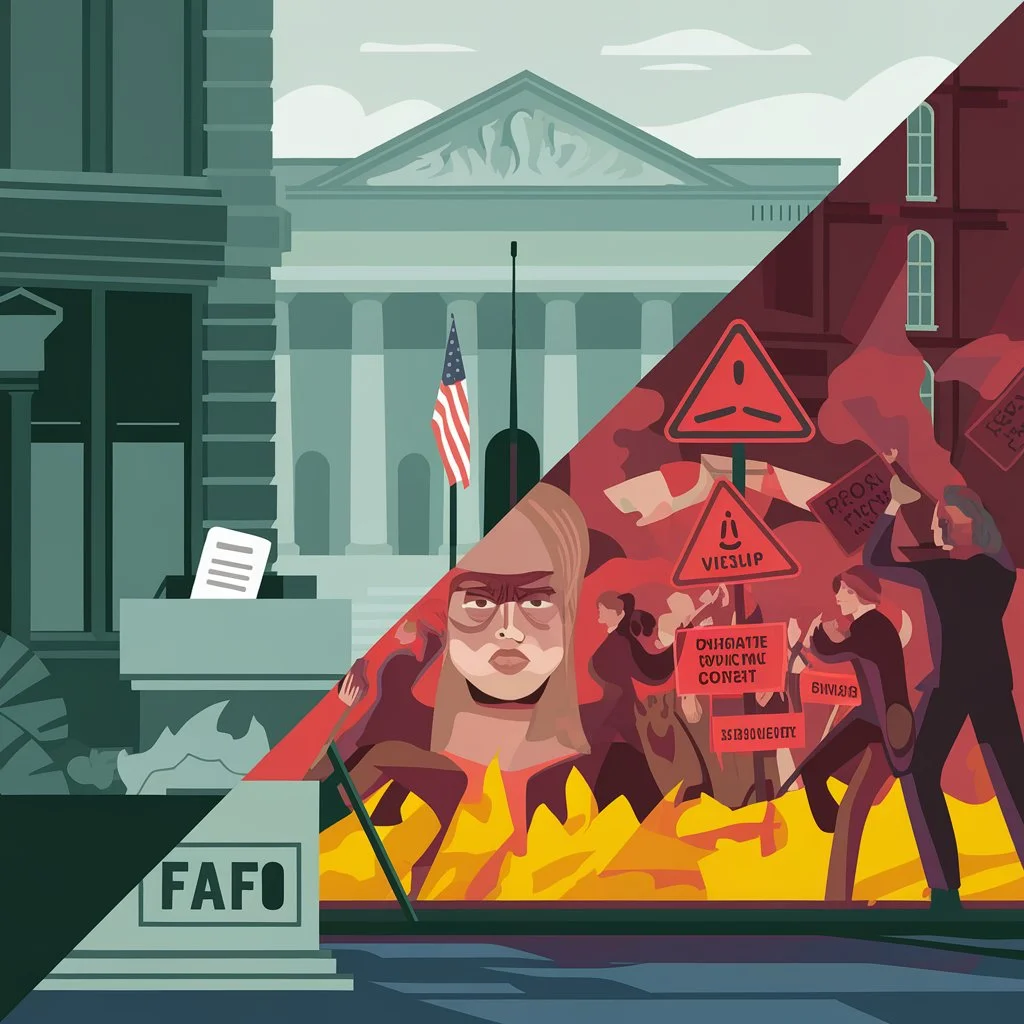

If you’ve spent any time on political Twitter, TikTok, or Instagram comment threads, you’ve probably seen someone reply with just four letters:
FAFO.
It’s short. It’s blunt. And it carries a punch.
People search for “what does FAFO mean in politics” because they see it used in heated debates, campaign discussions, or reactions to controversial decisions—and they’re not always sure whether it’s humorous, threatening, sarcastic, or serious.
Let’s break it down clearly, without hype or confusion.
What Does FAFO Mean in Politics? – Quick Meaning
FAFO stands for: “F* Around and Find Out.”**
In political conversations, it usually means:
- If someone makes reckless decisions, they will face consequences.
- Actions have results—sometimes harsh ones.
- A warning that consequences are coming.
In politics, it’s often used as:
- A reaction to controversial laws or policies
- A response to political overreach
- A way to express “You chose this, now deal with it”
Simple Examples
“They ignored public protests? FAFO.”
“Voters stayed home. FAFO.”
“You pushed that bill through without compromise? FAFO.”
It’s essentially a modern, sharper way of saying:
“You made your choice. Now live with the consequences.”
Origin & Background
FAFO did not start in politics.
The phrase “F*** Around and Find Out” originated in street slang and online culture. It gained traction on platforms like:
- Twitter (now X)
- TikTok
- Gaming communities
The meaning was always rooted in cause and effect. It reflected a simple idea: If someone pushes boundaries, provokes others, or behaves recklessly, they shouldn’t be surprised by the outcome.
Over time, the phrase shortened into the acronym FAFO, making it easier to post in comment sections without triggering moderation filters.
During politically polarized moments—elections, court rulings, protests—the term moved heavily into political discourse. It became shorthand for:
- Political accountability
- Public backlash
- Electoral consequences
- Policy blowback
In modern online politics, FAFO is often a reaction, not a detailed argument. It’s emotional. It’s direct. And it’s meant to sting.
Real-Life Conversations (How People Actually Use It)
Here’s how FAFO naturally appears in everyday political conversations.
1️⃣ WhatsApp Group Chat
Ayesha:
Did you see the new tax announcement?
Bilal:
Yeah, small businesses are going to suffer.
Hamza:
They voted for this party knowing their policies. FAFO.
2️⃣ Instagram Comment Section
Commenter 1:
Why are fuel prices so high again?
Commenter 2:
You can’t demand subsidies and cut taxes at the same time. FAFO.
3️⃣ TikTok Political Clip
Creator:
This senator blocked climate funding for years.
User:
And now their state is facing massive damage. FAFO.
Notice something?
FAFO usually ends the conversation. It signals judgment. It implies the consequences are deserved.
Emotional & Psychological Meaning
Beyond its literal definition, FAFO carries emotional weight.
It reflects:
- Frustration
- Impatience
- A sense of justice
- “I told you so” energy
Psychologically, people use FAFO when they feel:
- Their warnings were ignored
- Their side was dismissed
- Someone made a predictable mistake
It’s not neutral. It’s emotionally charged.
In political spaces, it can reflect:
- Anger toward leadership
- Disappointment in voters
- A desire for accountability
- Satisfaction when consequences unfold
At its core, FAFO represents belief in consequences—especially when someone refuses to listen.
Usage in Different Contexts
1️⃣ On Social Media
This is where FAFO thrives.
- Short
- Punchy
- Memorable
- Easy to type
It’s often used in viral political moments.
2️⃣ Among Friends
In private conversations, it may sound half-joking:
“He ignored every economic warning. FAFO.”
Here, it’s more commentary than attack.
3️⃣ Professional or Work Settings
This is where caution is necessary.
Using FAFO in professional emails, meetings, or workplace political discussions can:
- Sound aggressive
- Appear unprofessional
- Escalate conflict
It’s rarely appropriate in formal settings.
4️⃣ Casual vs Serious Tone
- Casual: Used humorously or sarcastically
- Serious: Used as a direct warning or condemnation
Tone depends entirely on context.
Common Misunderstandings
❌ Misunderstanding 1: It’s Always a Threat
Not necessarily.
It can simply mean consequences are inevitable.
❌ Misunderstanding 2: It’s Only Used by One Political Side
FAFO is bipartisan online. Both conservatives and liberals use it.
❌ Misunderstanding 3: It Encourages Violence
In most political contexts, it refers to political or social consequences—not physical harm.
However, tone matters. In heated debates, it can sound more aggressive than intended.
❌ When You Should NOT Use It
- In sensitive discussions about tragedy
- In professional political analysis
- When trying to build bridges
- During emotionally vulnerable conversations
It can shut down dialogue instead of encouraging it.
Comparison Table
| Term | Meaning | Tone | Context |
|---|---|---|---|
| FAFO | Actions lead to consequences | Aggressive / blunt | Political debates |
| Karma | What goes around comes around | Spiritual / calm | General life |
| Consequences | Neutral cause and effect | Formal | Academic / legal |
| Accountability | Responsibility for actions | Professional | Policy discussions |
| Play stupid games, win stupid prizes | Similar warning phrase | Sarcastic | Internet slang |
Key Insight
FAFO is sharper and more confrontational than traditional terms like “accountability” or “consequences.” It’s emotionally charged shorthand.
Variations & Related Expressions
Here are common variations or similar phrases:
- FAFO Season
Period where consequences are unfolding publicly. - Soft FAFO
Minor consequences instead of dramatic ones. - Delayed FAFO
Consequences that arrive later. - Political FAFO
Electoral backlash. - Policy FAFO
Laws producing unintended outcomes. - Voter FAFO
Regret after elections. - Economic FAFO
Market reaction to decisions. - International FAFO
Diplomatic consequences. - Judicial FAFO
Court rulings as outcomes. - Public FAFO Moment
Viral exposure of mistakes.
How to Respond When Someone Uses FAFO
Casual Replies
- “Fair point.”
- “You might be right.”
- “Time will tell.”
Funny Replies
- “We’re all in the ‘find out’ stage now.”
- “Guess we’re about to find out together.”
Mature / Confident Replies
- “Consequences are part of governance.”
- “Let’s analyze the outcomes objectively.”
- “Accountability matters, regardless of party.”
Private or Respectful Replies
- “I understand your frustration.”
- “Let’s discuss what constructive solutions look like.”
Choosing your response depends on whether you want to escalate or de-escalate.
Regional & Cultural Usage
Western Culture
In the U.S. and parts of Europe, FAFO is widely recognized in online political spaces. It’s often sarcastic, sometimes aggressive, and deeply tied to internet culture.
Asian Culture
In many Asian political contexts, the phrase may feel too blunt. Political conversations often emphasize respect and hierarchy, so FAFO might seem overly confrontational.
Middle Eastern Culture
Political discussions can be sensitive. Using slang like FAFO publicly may be perceived as disrespectful, especially in formal discourse.
Global Internet Usage
Globally, FAFO spreads through memes. Even where English is a second language, users adopt it because it’s short and expressive.
However, cultural tone interpretation varies significantly.
FAQs
1. What does FAFO stand for in politics?
It stands for “F*** Around and Find Out,” meaning actions lead to consequences.
2. Is FAFO offensive?
It contains profanity, so yes, it can be considered vulgar or aggressive depending on context.
3. Is FAFO a threat?
Usually no. In politics, it typically refers to social, legal, or electoral consequences.
4. Who uses FAFO in political debates?
People across the political spectrum use it during heated online discussions.
5. Can FAFO be used professionally?
It’s not recommended in formal or professional environments.
6. Does FAFO always mean something negative?
It implies consequences, which are often negative—but technically, it refers to cause and effect.
7. Why is FAFO trending in politics?
Because modern political conversations are fast-paced, emotional, and heavily influenced by internet slang.
Conclusion
So, what does FAFO mean in politics?
At its core, it’s a blunt reminder that actions carry consequences. It reflects frustration, accountability, and sometimes satisfaction when outcomes unfold exactly as predicted.
But like many viral phrases, its power lies in tone. Used carelessly, it shuts down conversation. Used thoughtfully, it signals belief in responsibility.
Political discussions today move quickly. Slang spreads faster than policy analysis. Understanding phrases like FAFO isn’t just about decoding internet language—it’s about recognizing the emotional undercurrent behind modern political debate.
In the end, whether you agree with the sentiment or not, one principle remains timeless:
Choices matter.