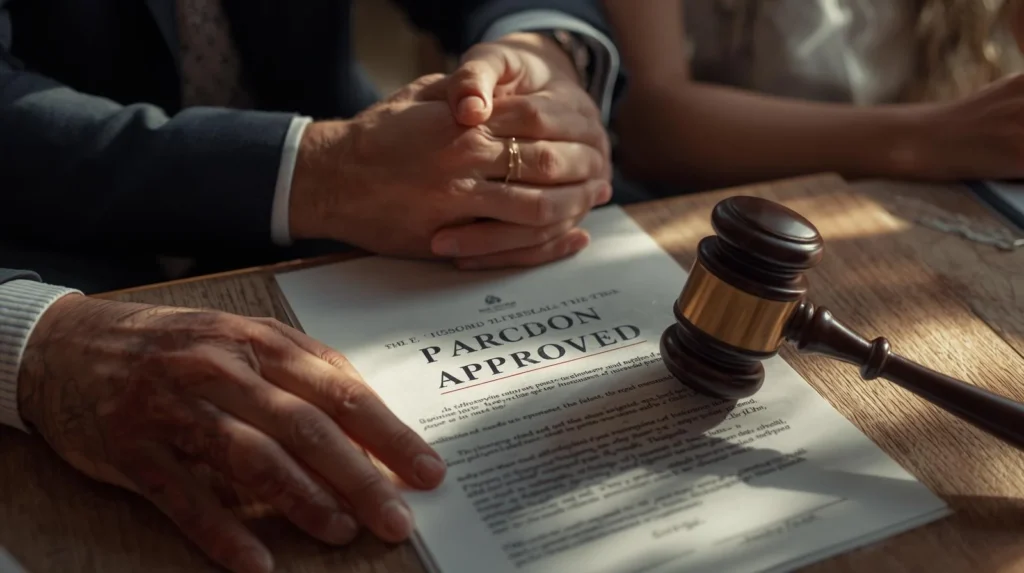

You’ve probably heard the word “pardon” in different situations.
A president pardoning someone.
A judge granting a pardon.
Or even someone casually saying, “I beg your pardon?”
So what does it actually mean?
When people search what does it mean to pardon someone, they’re usually confused about whether it’s the same as forgiveness, whether it erases a crime, or whether it’s just a polite phrase.
The word sounds formal. Almost dramatic.
But the meaning is simpler than it seems — and it works in both legal and everyday life.
Let’s break it down clearly.
What Does It Mean to Pardon Someone – Quick Meaning
To pardon someone means:
- To officially forgive a crime or wrongdoing
- To release someone from punishment
- To excuse someone for an offense
In simple terms:
A pardon removes or reduces the consequences of a wrongdoing.
Quick examples:
“The governor pardoned him after new evidence came out.”
“She pardoned her friend for missing the event.”
“I beg your pardon?” (used as polite clarification)
In legal terms, a pardon is powerful.
In personal life, it reflects forgiveness or mercy.
Origin & Background
The word pardon comes from the Latin perdonare, meaning “to give completely” or “to grant freely.”
In medieval times, kings had the authority to pardon criminals. This was known as “royal clemency.” It symbolized mercy from the highest authority.
Over time, the power to pardon became part of modern legal systems. Presidents and governors in many countries still hold this authority.
Meanwhile, in everyday English, “pardon” evolved into:
- A polite expression
- A formal way of saying “excuse me”
- A strong word for forgiveness
Today, it carries both legal weight and emotional depth.
Real-Life Conversations
WhatsApp Chat
Person A: I heard he got pardoned. What does that mean?
Person B: It means the government officially forgave his crime.
Person A: So he’s free now?
Person B: Yes, or his punishment was reduced.
Instagram DM
Person A: She said she pardoned me. Is that just forgiveness?
Person B: Yeah, it’s a formal way of saying she forgives you.
Text Message
Person A: The president pardoned someone today. Does that erase the crime?
Person B: Not always. It removes punishment, but the record may still exist.
Emotional & Psychological Meaning
Pardoning someone carries emotional weight.
It reflects:
- Mercy
- Authority
- Compassion
- Letting go
In personal life, pardoning can feel empowering. It allows someone to release resentment.
Psychologically, forgiving — or pardoning — benefits the person granting it. It reduces stress, anger, and emotional tension.
However, pardoning does not mean:
- Forgetting
- Approving behavior
- Excusing harm
It means choosing not to hold punishment over someone.
Usage in Different Contexts
Legal Context
In law, a pardon:
- Is granted by a government authority
- May reduce or eliminate punishment
- Does not always erase conviction
It’s an official act of clemency.
Friends & Relationships
People sometimes say:
“I pardon you.”
It sounds formal, but it means:
“I forgive you.”
Work or Professional Settings
Rarely used casually.
Instead of saying “I pardon you,” professionals usually say:
“No problem.”
“That’s okay.”
Casual vs Serious Tone
Serious:
“The governor issued a full pardon.”
Casual:
“Oh, pardon me.” (polite interruption)
Tone changes meaning significantly.
Common Misunderstandings
| Misunderstanding | Reality |
|---|---|
| A pardon erases a crime | Not always |
| Pardon means forgetting | It means forgiving |
| Only presidents can pardon | Governors can too |
| It’s the same as parole | Different legal processes |
| It means innocence | It means mercy |
Important distinction:
A pardon does not necessarily declare someone innocent. It forgives the punishment.
Comparison Table
| Term | Meaning | Key Difference |
|---|---|---|
| Pardon | Official forgiveness | Removes punishment |
| Forgive | Personal emotional release | No legal power |
| Amnesty | Forgiveness for groups | Often political |
| Parole | Early release from prison | Still under supervision |
| Clemency | General mercy power | Broader category |
Key Insight: A pardon is a specific legal form of clemency, while forgiveness is personal and emotional.
Variations / Types of Pardon
- Full Pardon – Completely removes punishment
- Partial Pardon – Reduces sentence
- Conditional Pardon – Requires certain conditions
- Executive Pardon – Issued by president or governor
- Posthumous Pardon – Granted after death
- Political Pardon – Related to political offenses
- Judicial Clemency – Court-recommended mercy
- Informal Pardon – Personal forgiveness
- Religious Pardon – Spiritual forgiveness
- Mass Pardon – Granted to multiple individuals
How to Respond When Someone Uses It
If someone says, “I pardon you”:
Casual Replies
- “Thank you, I appreciate that.”
- “That means a lot.”
Funny Replies
- “Your mercy is appreciated, Your Majesty.”
Mature / Confident Replies
- “I’m grateful for your understanding.”
Private / Respectful Replies
- “I take responsibility and value your forgiveness.”
If discussing legal pardons:
- “It was an act of clemency.”
- “The authority chose to grant mercy.”
Regional & Cultural Usage
Western Culture
Common in political discussions and news.
Used formally in legal systems like the United States and United Kingdom.
Asian Culture
Legal pardons exist but may be less publicly discussed.
Personal forgiveness is often expressed differently and more indirectly.
Middle Eastern Culture
Religious and cultural concepts of forgiveness are strong.
Legal pardons may exist under different legal frameworks.
Global Internet Usage
People often ask:
“Does pardon mean innocent?”
“Does pardon erase records?”
The confusion is universal.
FAQs
What does it mean to pardon someone legally?
It means an authority officially forgives a crime and removes or reduces punishment.
Does a pardon erase a criminal record?
Not always. It removes punishment but may not delete records.
Is a pardon the same as forgiveness?
Legally no. Emotionally yes, in personal use.
Who can issue a pardon?
Usually presidents, governors, or heads of state.
Can someone refuse a pardon?
Yes. In some legal systems, a pardon can be declined.
Does a pardon mean someone is innocent?
No. It means they are forgiven, not necessarily proven innocent.
Conclusion
If you’ve been wondering what does it mean to pardon someone, here’s the clear answer:
A pardon is an official act of forgiveness that removes or reduces punishment. In everyday life, it reflects mercy and emotional release.
Legally, it carries authority.
Personally, it carries compassion.
Understanding the difference between pardon, forgiveness, and innocence helps avoid confusion.
At its core, pardoning is about choosing mercy over punishment.
And whether in courtrooms or relationships, mercy is a powerful decision.