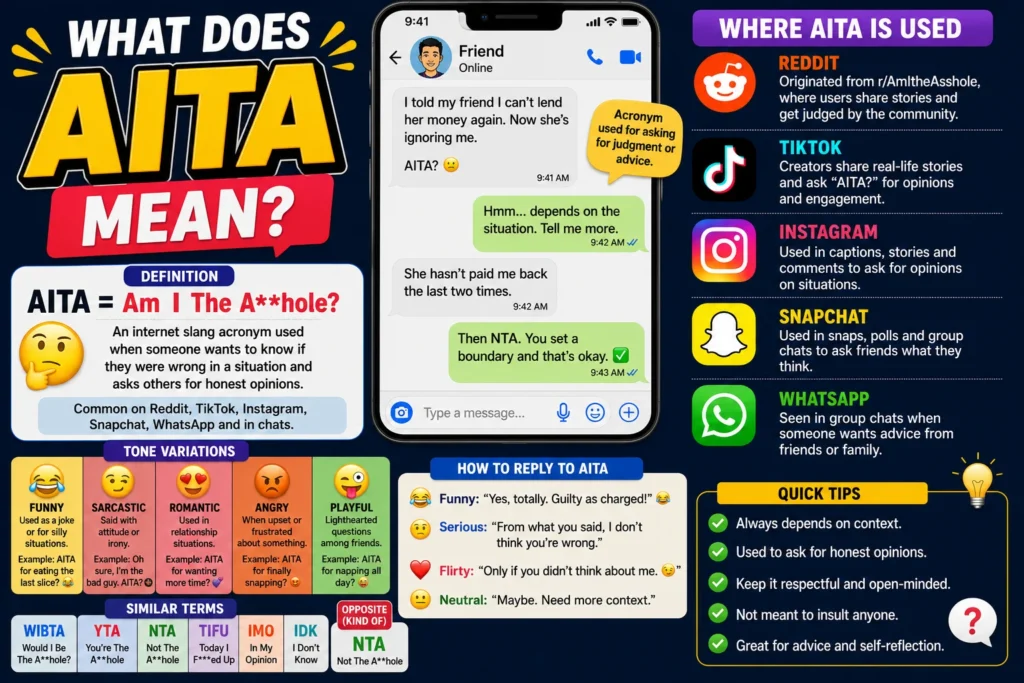

AITA means “Am I The Ahole?”** It is a popular internet acronym people use when asking others to judge whether they were wrong in a situation. The phrase became famous through online forums and is now widely used in texts, chats, TikTok videos, Snapchat stories, and social media discussions.
Many people search for the AITA meaning because they see it in Reddit posts, comments, TikTok captions, or group chats and aren’t sure whether it is an insult, a joke, or a genuine request for advice. Understanding the term helps you follow online conversations and internet culture more easily.
AITA Meaning Explained
AITA Meaning in Text
In texting, AITA usually stands for “Am I The Ahole?”**
People use it when they want an honest opinion about their actions.
Example:
A: I refused to lend my brother money again.
B: AITA?
In this example, the person wants others to judge whether their behavior was reasonable.
AITA Slang Meaning
The slang meaning of AITA remains the same:
Am I The Ahole?**
It is an internet slang term used when someone presents a situation and asks whether they behaved badly.
Unlike many texting abbreviations, AITA is not used as a reaction. It is usually used to start a discussion.
What Does AITA Mean in Chat?
In chats, AITA acts as a quick way of saying:
- Was I wrong?
- Was I rude?
- Did I overreact?
- Was my behavior unfair?
Example:
A: My friend canceled on me three times, so I stopped inviting them.
B: AITA?
The question invites feedback from others.
AITA Meaning on Snapchat
On Snapchat, AITA often appears in:
- Story captions
- Polls
- Friend discussions
- Screenshots of conversations
Example:
“AITA for leaving the group chat after all the drama?”
Users frequently ask followers for opinions.
AITA Meaning on Instagram, TikTok, and WhatsApp
On social platforms, AITA is commonly used in:
- Story posts
- Reels
- TikTok storytelling videos
- WhatsApp group discussions
Many creators tell personal stories and then ask:
“AITA?”
This encourages audience engagement and comments.
Is AITA an Acronym, Short Form, or Slang?
AITA is:
| Type | Answer |
|---|---|
| Acronym | Yes |
| Short Form | Yes |
| Phonetic Spelling | No |
| Typo Turned Slang | No |
It is a genuine acronym created from the phrase “Am I The A**hole?”
Tone and Context Variations
The meaning of AITA stays mostly the same, but the tone changes depending on context.
Funny Tone
People sometimes use AITA humorously.
Example
A: I ate the last slice of pizza at 2 a.m.
B: Seriously?
A: AITA?
The person already knows the answer and is joking.
Sarcastic Tone
Sometimes AITA is used sarcastically.
Example
A: My coworker took credit for my work.
B: That’s awful.
A: But apparently I’m the bad guy for mentioning it. AITA?
The speaker expects support rather than criticism.
Romantic Tone
AITA can appear in relationship discussions.
Example
A: I forgot our anniversary dinner.
B: Ouch.
A: AITA?
The speaker is seeking reassurance or honesty.
Angry Tone
When emotions run high, AITA may sound defensive.
Example
A: They blamed me for everything.
B: What happened?
A: AITA for finally standing up for myself?
Playful Tone
Friends often use AITA casually.
Example
A: I beat my friend in Mario Kart ten times in a row.
B: Brutal.
A: AITA?
Real Chat Examples of AITA
Example 1
A: I muted the group chat.
B: Why?
A: It was nonstop notifications. AITA?
Example 2
A: I left the party early.
B: Did something happen?
A: Nope, I was tired. AITA?
Example 3
A: I didn’t answer for two days.
B: That’s a while.
A: AITA?
Example 4
A: I canceled plans because I needed rest.
B: Self-care matters.
A: Good, because I felt guilty.
Example 5
A: I reported my neighbor for loud music.
B: Was it late?
A: 2 a.m.
B: Definitely not.
Example 6
A: I refused to share my notes.
B: Why?
A: They never attend class. AITA?
Example 7
A: I unfollowed my ex.
B: Makes sense.
A: Just checking.
Example 8
A: I ate all the cookies.
B: That’s criminal.
A: AITA?
Example 9
A: I told my friend the truth.
B: Did they ask?
A: Yes.
B: Then probably not.
Example 10
A: I skipped the meeting.
B: Why?
A: It was scheduled on my day off.
Example 11
A: I turned off read receipts.
B: That’s normal.
A: Some people disagree.
Example 12
A: I didn’t lend my car.
B: Fair enough.
A: That’s what I thought.
Example 13
A: I deleted a toxic contact.
B: Good move.
A: Needed that confirmation.
Example 14
A: I asked for my money back.
B: How long had they owed you?
A: Six months.
Example 15
A: I refused overtime.
B: You deserve balance.
A: Exactly.
Grammar and Language Role of AITA
Part of Speech
AITA functions as an acronym phrase rather than a traditional part of speech.
Sentence Position
Most commonly:
- At the beginning
- In the middle
- At the end
Examples:
- AITA for saying no?
- So, AITA here?
- I refused, AITA?
Does It Replace a Full Sentence?
Yes.
Instead of saying:
“Am I the bad person in this situation?”
Someone may simply write:
“AITA?”
Tone Impact
AITA often adds:
- Curiosity
- Vulnerability
- Humor
- Self-reflection
Formal vs Informal Use
| Formal | Informal |
|---|---|
| Rarely used | Very common |
| Professional writing | Text messages |
| Business emails | Social media |
| Academic discussions | Online forums |
How to Reply When Someone Says AITA
Funny Reply
- Depends how good the pizza was.
- Jury is still out.
- Sounds guilty to me.
Serious Reply
- Based on the details, I don’t think you were wrong.
- You handled that reasonably.
- More context would help.
Flirty Reply
- Maybe, but you’re still my favorite person.
- I’d need to hear your side over coffee.
Neutral Reply
- Tell me the whole story.
- What happened exactly?
- Let’s hear both sides.
Comparison Table
| Term | Meaning | Usage Context | Tone | Popularity | Confusion Risk |
|---|---|---|---|---|---|
| AITA | Am I The A**hole? | Asking for judgment | Reflective | Very High | Medium |
| TIFU | Today I F***ed Up | Admitting mistakes | Humorous | High | Low |
| WIBTA | Would I Be The A**hole? | Future decisions | Curious | Medium | High |
| YTA | You’re The A**hole | Judging someone | Critical | High | Medium |
| NTA | Not The A**hole | Defending someone | Supportive | High | Medium |
| IDK | I Don’t Know | Uncertainty | Neutral | Very High | Low |
| IMO | In My Opinion | Giving views | Neutral | High | Low |
Who Uses AITA?
Age Groups
Most common among:
- Teens
- Gen Z
- Millennials
Gen Z vs Millennials
Gen Z
- Uses AITA on TikTok and Snapchat
- Uses it casually in texting
Millennials
- More likely to use it on Reddit and forums
Regions
AITA is popular in:
- United States
- Canada
- United Kingdom
- Australia
It is also recognized globally due to social media.
Platforms
Most common on:
- TikTok
- Snapchat
- Discord
Origin and Internet Culture Insight
Possible Origin
AITA became popular through Reddit’s famous r/AmITheAsshole community.
Users post stories and ask strangers to judge their actions.
TikTok Influence
TikTok expanded AITA’s reach dramatically.
Creators often post:
- Relationship stories
- Family disputes
- Friendship drama
Then ask viewers:
“AITA?”
Meme Culture Role
AITA became part of meme culture because:
- People enjoy judging situations
- Stories create debate
- The format encourages engagement
Fast Typing Culture
The acronym is efficient.
Instead of typing a long question, users simply write:
AITA?
Why People Say AITA on TikTok
People use AITA on TikTok because:
- It boosts comments
- It sparks arguments
- It increases engagement
- It invites audience participation
Is AITA Rude or Appropriate?
Is AITA Rude?
Not usually.
The phrase itself is not rude, though it contains a censored profanity reference.
Is It a Bad Word?
The acronym is generally considered acceptable online.
However, it originates from a phrase containing profanity.
Should You Use It at School?
Usually acceptable in casual student conversations.
Should You Use It at Work?
Avoid it in formal professional communication.
Use clearer language instead.
Experience-Based Insight
In everyday online conversations, AITA is rarely used as an insult. Most people use it when they genuinely want feedback or validation. On social media, it’s often less about finding the truth and more about starting a discussion. That’s why AITA posts frequently attract hundreds or thousands of comments.
FAQs
What does AITA mean in text?
AITA means “Am I The Ahole?”** and is used when someone wants others to judge whether their actions were wrong.
What does AITA mean on Snapchat?
On Snapchat, AITA is usually used in stories, chats, or polls asking friends for opinions on a situation.
Is AITA rude?
Not generally. However, it comes from a phrase containing mild profanity.
Is AITA the same as IDK?
No. AITA asks for judgment, while IDK means “I don’t know.”
Can adults use AITA?
Yes. Adults, Millennials, and Gen Z users all commonly use AITA online.
How do you respond to AITA?
You can give your opinion, ask for more details, or explain why you think the person was right or wrong.
What does AITA mean on TikTok?
On TikTok, AITA is often used in storytelling videos where creators ask viewers to judge a personal situation.
Where did AITA originate?
The term became famous through Reddit’s Am I The A**hole community and later spread across social media.
Does AITA always mean Am I The A**hole?
Almost always in internet slang and social media contexts.
Is AITA a texting abbreviation?
Yes. It is a popular texting abbreviation and internet slang term.
Why is AITA so popular online?
People enjoy sharing opinions, debating situations, and giving advice.
Can AITA be used as a joke?
Absolutely. Many people use it humorously in everyday conversations.
Is AITA only used on Reddit?
No. It is now common across TikTok, Snapchat, Instagram, WhatsApp, and Discord.
What is the opposite of AITA?
There is no direct opposite, but responses like NTA (Not The Ahole)** often serve that role.
Summary: What Does AITA Mean?
AITA means “Am I The Ahole?”** and is one of the internet’s most recognizable slang acronyms. It is used when someone wants feedback about whether their behavior was wrong, rude, unfair, or justified.
Usage Tips
- Use it when seeking opinions.
- Use it in casual online discussions.
- Use it on social media, forums, and chats.
Common Mistakes
- Assuming it is an insult.
- Confusing it with IDK or IMO.
- Using it in formal business communication.
When to Use It
- Casual conversations
- Online discussions
- Social media debates
- Text messages
When to Avoid It
- Professional emails
- Formal reports
- Academic writing
- Business presentations