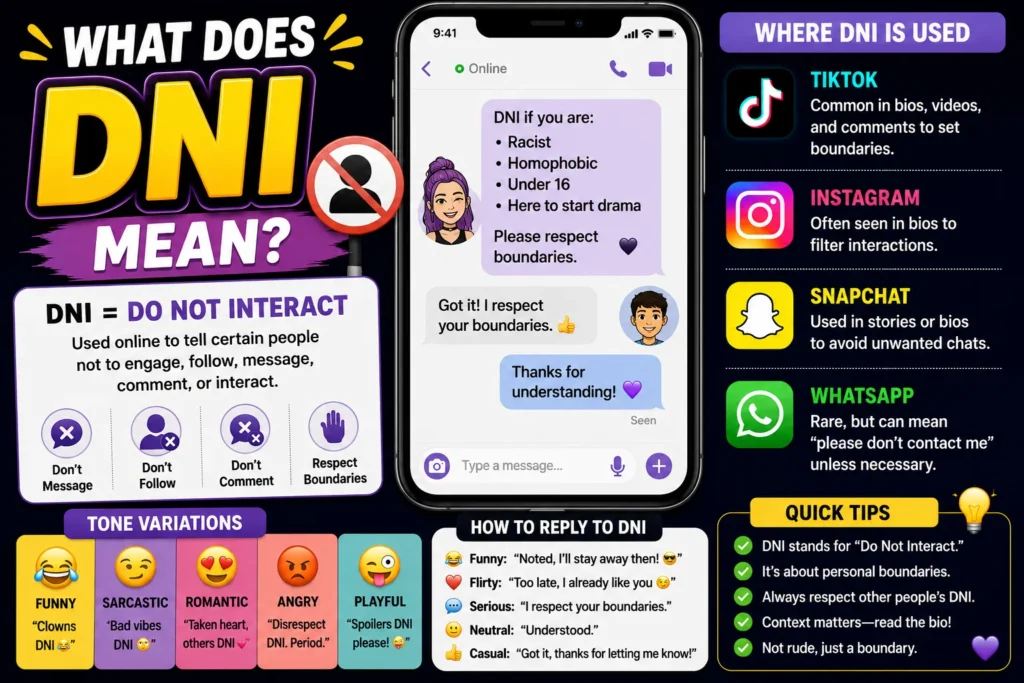

DNI means “Do Not Interact.” It is a popular internet slang term used on social media platforms like TikTok, Instagram, X (Twitter), Tumblr, and Discord to tell specific people not to engage, follow, comment, or message.
If you’ve seen “DNI” in a profile bio, comment section, or online community, you may wonder whether it’s rude, what it means in chat, or who uses it. The confusion comes from the fact that DNI is rarely used in everyday texting but is very common in online communities and fandom culture. This guide explains exactly what DNI means, how people use it, and how to respond when you encounter it online.
What Does DNI Mean?
DNI Meaning in Text
In text and online communication, DNI stands for “Do Not Interact.”
It is a request or boundary statement telling certain people not to engage with the person posting it.
Examples:
- “If you’re here to argue, DNI.”
- “Minors DNI.”
- “DNI if you spread misinformation.”
The phrase is often used to filter interactions and create personal boundaries online.
DNI Slang Meaning
As an internet slang term, DNI functions as a quick warning or boundary marker.
Instead of writing:
“Please don’t comment, message, or interact with me if you belong to this group.”
People simply write:
“DNI.”
This makes communication faster and easier, especially in bios and profiles.
What Does DNI Mean in Chat?
In chat conversations, DNI usually means:
- Don’t message me
- Don’t reply to me
- Don’t engage with this discussion
- Don’t participate in this conversation
Example:
A: Why is everyone arguing in the comments?
B: The creator literally said “DNI if you’re here to start drama.”
A: Makes sense.
DNI Meaning on Snapchat
On Snapchat, DNI is uncommon but can appear in:
- User bios
- Public stories
- Community posts
It generally means:
“Please don’t add me or message me if you meet certain criteria.”
Example:
“DNI if you’re just trying to start drama.”
DNI Meaning on Instagram
Instagram users often place DNI in their bio.
Examples:
- “DNI if you’re rude.”
- “DNI if you’re under 16.”
- “Spam accounts DNI.”
It helps users establish personal boundaries.
DNI Meaning on TikTok
TikTok is one of the biggest platforms where DNI appears.
Users frequently write:
- “DNI if you support hate.”
- “DNI if you’re here to bully.”
- “DNI if you’re not respecting boundaries.”
On TikTok, it often reflects community rules or personal preferences.
DNI Meaning on WhatsApp
DNI is rarely used on WhatsApp.
When it appears, it usually means:
“Please don’t contact me unless necessary.”
or
“I don’t want interaction from certain people.”
Is DNI an Acronym, Short Form, or Something Else?
| Type | Does DNI Fit? |
|---|---|
| Acronym | Yes |
| Short Form | Yes |
| Phonetic Spelling | No |
| Typo Turned Slang | No |
DNI is primarily an acronym formed from:
D = Do
N = Not
I = Interact
Tone and Context Variations
The meaning of DNI can change depending on tone and context.
Funny Tone
Sometimes people use DNI jokingly.
Example:
A: I put pineapple on pizza.
B: Pineapple pizza lovers DNI 😂
The intention is humor, not an actual boundary.
Sarcastic Tone
Example:
A: I accidentally deleted my project.
B: People who don’t save their work DNI.
The speaker is joking while expressing frustration.
Romantic Tone
Sometimes users jokingly use DNI in relationship posts.
Example:
A: I miss my boyfriend.
B: Happy couples DNI 😭
This usually expresses playful jealousy.
Angry Tone
DNI can become more serious during conflicts.
Example:
A: Stop commenting on my posts.
B: Fine.
A: Seriously, DNI from now on.
This indicates a genuine boundary.
Playful Tone
Example:
A: I beat your score again.
B: Winners DNI 😤
This is usually lighthearted teasing.
Real Chat Examples of DNI
Example 1
A: Why is your bio so long?
B: It includes my DNI list.
A: Oh, got it.
Example 2
A: What does “Minors DNI” mean?
B: It means people under 18 shouldn’t interact.
A: Thanks.
Example 3
A: Did you see their TikTok?
B: Yeah, they put “Drama accounts DNI.”
A: Smart move.
Example 4
A: Why won’t they respond?
B: You’re on their DNI list.
A: Oh.
Example 5
A: What’s your biggest online pet peeve?
B: People ignoring DNI requests.
A: Same.
Example 6
A: Why is everyone talking about DNI?
B: It’s common in fandom communities.
A: Makes sense.
Example 7
A: I commented anyway.
B: Their bio literally says DNI.
A: Oops.
Example 8
A: Is DNI rude?
B: Not necessarily.
A: Good to know.
Example 9
A: Why did they block me?
B: You ignored their DNI.
A: That explains it.
Example 10
A: What’s your rule?
B: Trolls DNI.
A: Fair.
Example 11
A: Can I follow them?
B: Check their DNI first.
A: Will do.
Example 12
A: I love fandom culture.
B: Then you’ve definitely seen DNI lists.
A: Everywhere.
Example 13
A: Why are comments disabled?
B: Too many people ignored the DNI.
A: Wow.
Example 14
A: Is DNI only on TikTok?
B: Nope, it’s all over social media.
A: Interesting.
Example 15
A: What’s the opposite of DNI?
B: Probably open interaction.
A: True.
Grammar and Language Role
Part of Speech
DNI functions as an abbreviation or acronym.
Sentence Position
It can appear:
- At the beginning
- In the middle
- At the end
Examples:
- “DNI if you’re here to argue.”
- “Troll accounts DNI.”
- “Please respect my boundaries, DNI.”
Does It Replace a Full Sentence?
Yes.
Instead of writing:
“Please do not interact with me.”
People simply write:
“DNI.”
Tone Impact
DNI can sound:
- Neutral
- Firm
- Protective
- Humorous
- Serious
depending on context.
Formal vs Informal Use
| Style | Appropriate? |
|---|---|
| Casual texting | Yes |
| Social media | Yes |
| TikTok | Yes |
| Yes | |
| Workplace emails | No |
| Academic writing | No |
How to Reply When Someone Says DNI
Funny Reply
- “Noted, I’ll keep scrolling 😄”
- “Mission understood.”
- “Message received.”
Serious Reply
- “I respect your boundaries.”
- “Understood.”
- “Thanks for clarifying.”
Flirty Reply
Only appropriate if the context is clearly playful:
- “Guess I’ll admire from afar then.”
- “Fair enough 😅”
Neutral Reply
- “Okay.”
- “Got it.”
- “Understood.”
Comparison Table
| Slang Term | Meaning | Usage Context | Tone | Popularity | Confusion Risk |
|---|---|---|---|---|---|
| DNI | Do Not Interact | Bios, profiles, communities | Firm | High | Medium |
| DNF | Did Not Finish | Gaming, books | Neutral | Medium | High |
| IDK | I Don’t Know | Texting | Casual | Very High | Low |
| IMO | In My Opinion | Discussions | Neutral | High | Low |
| BYF | Before You Follow | Social media bios | Informative | Medium | Medium |
| OI (Opposite Concept) | Open Interaction | Community engagement | Friendly | Low | Low |
Who Uses This Term?
Age Group
DNI is most common among:
- Teens
- Gen Z
- Young adults
Gen Z vs Millennials
Gen Z uses DNI significantly more often.
Millennials may recognize it but use it less frequently.
Region
DNI is used globally, especially in English-speaking online communities.
Popular regions include:
- United States
- Canada
- United Kingdom
- Australia
Platforms Where It’s Most Common
- TikTok
- Tumblr
- Discord
- X (Twitter)
- Reddit communities
Origin and Internet Culture Insight
Possible Origin
DNI emerged from online forums, fandom spaces, and social media communities.
It became popular as users wanted quick ways to establish boundaries.
TikTok Influence
TikTok accelerated the popularity of DNI because creators needed short, clear ways to manage interactions.
Meme Culture Role
Many users now use DNI humorously.
Examples:
- “People who hate dogs DNI.”
- “Homework lovers DNI.”
These jokes helped spread the term.
Fast Typing Culture
Internet users prefer short abbreviations.
DNI is much faster than writing:
“Please do not interact with me.”
Why People Say DNI on TikTok
People use DNI on TikTok to:
- Avoid drama
- Set boundaries
- Protect personal spaces
- Filter audiences
- Create safer communities
Is DNI Rude?
Not usually.
Most people use it as a boundary statement rather than an insult.
However, the wording around it can sometimes sound harsh.
Is DNI a Bad Word?
No.
DNI is not profanity and is generally considered safe language.
Should You Use DNI in School or the Office?
School
Generally acceptable in casual online communication.
Workplace
Less appropriate.
Professional communication usually requires clearer wording.
Instead of DNI, use:
“Please contact the appropriate department.”
or
“Please direct inquiries elsewhere.”
Experience-Based Insight
In real online communities, DNI is most often used by people trying to manage their audience rather than offend others. Across TikTok, Instagram, Discord, and fandom spaces, it functions more like a digital boundary sign than an attack. Most users view it as a practical tool for setting expectations before interactions occur.
FAQ
What does DNI mean in text?
DNI means “Do Not Interact.” It tells certain people not to engage, comment, follow, or message.
Is DNI rude?
Not usually. It’s generally used to set personal boundaries online.
What does DNI mean on Snapchat?
It means the user does not want interaction from specific groups or individuals.
Is DNI the same as IDK?
No.
- DNI = Do Not Interact
- IDK = I Don’t Know
They have completely different meanings.
Can adults use DNI?
Yes. People of all ages use DNI online.
How do you respond to DNI?
A respectful response is:
- “Understood.”
- “Got it.”
- “I respect your boundaries.”
Why do people put DNI in their bio?
To set expectations and control who interacts with them online.
Is DNI common on TikTok?
Yes. TikTok is one of the platforms where DNI is most frequently used.
What does DNI stand for on social media?
DNI stands for Do Not Interact.
What is a DNI list?
A DNI list identifies groups or behaviors the user does not want interacting with them.
Does DNI mean blocked?
No. It is a request, not necessarily a block.
Why do fandoms use DNI?
Fandom communities often use DNI to reduce conflict and establish boundaries.
Is DNI only for TikTok?
No. It’s also common on Instagram, Tumblr, Discord, and X.
Can businesses use DNI?
Generally no. Businesses typically use more professional communication methods.
Summary
DNI stands for “Do Not Interact.” It is an internet slang term and texting abbreviation commonly used on TikTok, Instagram, Discord, Tumblr, and other social platforms. People use it to establish boundaries, reduce unwanted interactions, and manage online communities.
Usage Tips
- Use DNI in casual online spaces.
- Keep your instructions clear.
- Be respectful when responding to someone else’s DNI.
Common Mistakes
- Assuming DNI is an insult.
- Confusing it with IDK or DNF.
- Ignoring clearly stated DNI requests.
When to Use It
✅ Social media bios
✅ Community guidelines
✅ Personal boundaries online
When to Avoid It
❌ Professional emails
❌ Workplace communication
❌ Formal documents