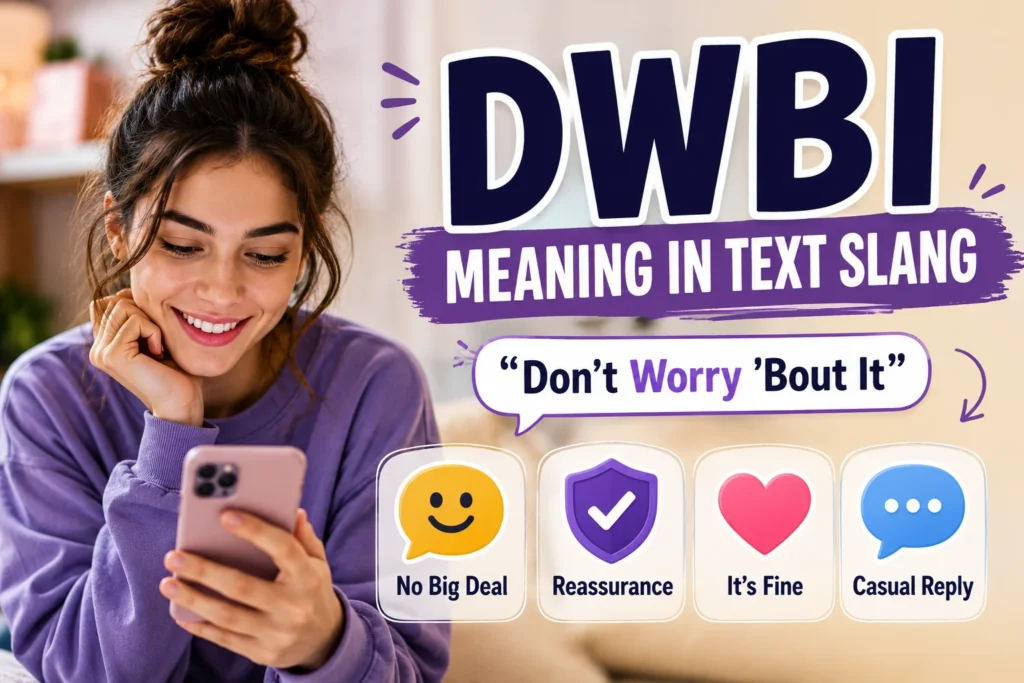

DWBI means “Don’t Worry ‘Bout It” (also written “Don’t Worry About It”) — a casual texting abbreviation used to reassure someone that a mistake, delay, or concern isn’t a big deal. It’s a shortened way of brushing off small worries without sounding dismissive.
People search for this term because DWBI isn’t as instantly recognizable as LOL, BRB, or NP — it shows up just often enough in texts, comments, and DMs to cause a pause, but not often enough for everyone to already know it. This guide covers the real meaning, how tone changes its impact, and how to use or respond to it naturally.
Meaning & Explanation
The Core Meaning
DWBI is an abbreviation — not a formal acronym, since it isn’t pronounced as a standalone word in most cases, though some people do voice it out loud as “dew-bee.” It stands in for a full reassurance phrase: “don’t worry about it” or the more casual contraction “don’t worry ’bout it.”
It’s used any time someone wants to:
- Tell a friend a small mistake doesn’t matter
- Brush off an apology that wasn’t necessary
- Reassure someone who’s stressed about something minor
- Close out a minor issue without dragging out the conversation
There isn’t a second, equally common meaning worth treating as a genuine alternative. A handful of low-traffic sites and TikTok joke posts have floated alternate expansions like “Don’t Worry, Be Inspired” or playful nonsense readings — these aren’t real, widely used meanings; they’re SEO filler or meme humor, not something you’ll actually encounter in a real conversation. If you see DWBI in a normal text exchange, “don’t worry about it” is what’s meant, essentially without exception.
Where DWBI Actually Shows Up
DWBI appears mainly in direct texting and a handful of casual social platforms — it’s not a term you’ll see everywhere.
Texting (SMS/iMessage)
— its most common home, typically as a short standalone reply to an apology or a worried message.
Snapchat and WhatsApp
— used the same way as texting: quick, casual reassurance between people who already know each other well.
Instagram DMs and comments
— appears in replies to comments where someone’s overexplaining or apologizing for something small.
Gaming chat (Discord, in-game chat)
— used to brush off a teammate’s mistake or missed play without making it a bigger deal than it needs to be.
DWBI isn’t a term with a strong presence on X or in TikTok captions specifically — it’s a private, conversational phrase more than a public posting one, so treating it as a major hashtag or caption trend would be overstating its reach.
Tone & Context Variations
The letters stay the same, but tone changes what DWBI is actually communicating.
Funny
A: I accidentally called you “boss” instead of your name in front of everyone. B: DWBI 😂 I kind of liked it honestly. A: Don’t get used to it. B: Too late, boss.
Sarcastic
A: Sorry I ate the last slice of pizza you were saving. B: DWBI. Really. Totally fine. A: You sound mad. B: I said DWBI, didn’t I?
Playful
A: I may or may not have spoiled the movie ending for you. B: DWBI, I’ll just pretend I didn’t hear that. A: You’re being way too chill about this. B: Save your energy for the real crimes.
Serious
A: I’m really sorry for missing your call earlier, I know it was important. B: DWBI, it wasn’t urgent. I just wanted to check in. A: Still, I should’ve called you back sooner. B: Honestly, don’t stress about it — we’re good.
Real Chat Examples
1 — Apology between roommates
A: Sorry I left dishes in the sink again. B: DWBI, I’ll grab them later.
2 — Reassuring a nervous coworker
A: I think I sent that email with a typo in it. B: DWBI, nobody’s going to notice. A: I really hope not. B: You’re overthinking it.
3 — Group chat, missed plans
A: Guys I can’t make it tonight, something came up. B: DWBI, we’ll catch up next time. C: Yeah don’t stress, we’ll plan something later.
4 — Gaming chat after a missed shot
A: My bad, I totally whiffed that. B: DWBI, we still won.
5 — Texting a partner about being late
A: Running like 15 minutes late, sorry! B: DWBI, take your time.
6 — Instagram comment reply
A: Sorry for the late reply on this, been slammed at work. B: DWBI, no rush at all!
7 — Sibling texting about a forgotten errand
A: I forgot to grab the thing you asked for. B: DWBI, I’ll just get it myself tomorrow.
8 — Reassuring after a mistake at work (WhatsApp)
A: I think I sent that file to the wrong client. B: DWBI, I already caught it and fixed it. A: Thank you, I owe you one.
9 — Friend cancelling a hangout
A: Can we reschedule for tomorrow? Not feeling great today. B: DWBI, feel better first.
10 — Snapchat exchange, minor accident
A: I think I broke your charger, sorry. B: DWBI, it was already dying anyway.
11 — Classmate apologizing for a late group project part
A: Sorry my section is coming in late, ran out of time. B: DWBI, we’ve got a little buffer before it’s due.
12 — Text after an awkward moment
A: That was kind of embarrassing back there, sorry you had to see that. B: DWBI, we’ve all had worse moments.
Grammar & Language Role
DWBI functions as a standalone abbreviation for a full sentence — it isn’t a noun, verb, or modifier on its own, but a compressed reassurance statement.
Sentence position:
almost always used at the start of a reply, often as the entire message by itself, sometimes followed by a short clarifying phrase (“DWBI, it’s fine” or “DWBI, take your time”).
Can it replace a full sentence?
Yes, completely. “DWBI” on its own carries the same meaning as typing out “don’t worry about it” in full — no extra words are needed for the message to land.
Formal vs. informal register:
strictly informal. It belongs in texting, DMs, and casual chat, and would read as oddly casual or unclear in an email, school assignment, or workplace document.
How to Reply to DWBI
Funny:
“Oh good, because I was two seconds from writing an apology essay.”
Serious:
“Thanks, I appreciate you saying that.”
Flirty:
“You’re too nice to me, you know that?”
Neutral/unbothered:
“Okay, cool.”
DWBI vs. Similar Terms
| Term | Meaning | Usage Context | Tone | Popularity | Confusion Risk |
|---|---|---|---|---|---|
| DWBI | Don’t Worry ‘Bout It | Reassurance after a minor issue | Warm, casual | Medium | Low |
| NP | No Problem | Response to thanks or a small favor | Neutral | Very High | Low |
| NBD | No Big Deal | Downplaying something’s importance | Casual | High | Low |
| IDC | I Don’t Care | Indifference (can read as dismissive) | Flat, sometimes cold | High | Medium |
| TBH | To Be Honest | Prefacing an honest opinion | Neutral | Very High | Low |
| IDGAF | I Don’t Give A —- | Extreme indifference (opposite tone) | Blunt, harsh | High | Medium |
The key distinction: DWBI is specifically reassuring, while terms like IDC or IDGAF signal indifference that can come across as cold rather than comforting — the opposite emotional effect even though all of them are short dismissive-sounding replies.
Who Uses This Term
Age Group Breakdown
DWBI is used mostly by teens and young adults comfortable with texting shorthand — it’s less common among older adults, who tend to type the phrase out in full or use more universally recognized options like NP.
Gen Z vs. Millennials
Gen Z texters are more likely to use DWBI as a quick, casual full reply on its own. Millennials, when they use it at all, more often pair it with a fuller sentence (“DWBI, we’re all good”) rather than sending the abbreviation by itself — though this is a general tendency rather than a strict rule, and plenty of exceptions exist in both directions.
Regional and Platform Notes
There’s no well-documented evidence of DWBI being regionally distinct to a specific country or English-speaking market — it functions as a general texting abbreviation rather than a regional slang term. Across platforms, the meaning stays consistent; only the setting (texting vs. gaming chat vs. DMs) changes.
Origin & Internet Culture
DWBI doesn’t have a single, well-documented origin point the way some slang terms do. Like many texting abbreviations, it appears to have developed simply from shortening a common spoken phrase — “don’t worry about it” — as SMS character limits and faster typing habits pushed users toward abbreviating everyday reassurances. This mirrors how NP, NBD, and similar comfort-phrase abbreviations came about.
It isn’t tied to a specific cultural movement, region, or platform-driven meme trend — unlike terms that trace clearly back to a single viral video or online subculture, DWBI’s growth looks more like the slow, everyday evolution of texting shorthand than a single traceable moment of internet virality. Any claim of an exact founding date or platform should be treated skeptically, since no verifiable original source exists.
Safety & Appropriateness
Is it rude or offensive? No. DWBI is not offensive on its own — its entire function is to reassure, not criticize.
Does it contain profanity? No, it’s a clean abbreviation with no vulgar language involved.
School or workplace appropriateness: fine for casual conversations with classmates or coworkers you’re friendly with, but not appropriate in formal emails, reports, or academic writing, where it should be written out in full.
Cultural sensitivity notes: none — it’s a neutral, general-use reassurance phrase without ties to any specific group that would require particular sensitivity.
Real-World Observation
What makes DWBI durable, even as a lesser-known abbreviation, is that it fills a specific emotional gap other short replies don’t quite cover. “NP” answers a thank-you; “NBD” downplays significance; but DWBI specifically closes the loop on someone else’s guilt or anxiety — it’s less about the situation itself and more about telling the other person to stop feeling bad. That small distinction is why it keeps reappearing in apology-heavy exchanges (roommates, coworkers, partners) rather than in the broader meme or caption ecosystem where flashier slang tends to spread.
Frequently Asked Questions
What does DWBI mean in a text message?
DWBI stands for “Don’t Worry ‘Bout It” or “Don’t Worry About It.” It’s used to reassure someone that a mistake, delay, or minor issue isn’t worth stressing over, usually sent as a quick, casual reply.
Does DWBI have more than one meaning?
Not in genuine everyday use. Some low-quality sites and joke TikTok posts have floated alternate expansions, but these aren’t real, widely recognized meanings — in an actual conversation, “don’t worry about it” is what’s intended.
Is DWBI the same as NP or NBD?
They’re closely related but not identical. NP responds to thanks, NBD downplays how significant something is, and DWBI specifically reassures someone who’s feeling guilty or anxious about a situation.
Is DWBI rude to send without more explanation?
It can read as a little flat if sent completely alone with no punctuation or emoji, but it isn’t inherently rude — tone and relationship context usually make the intent clear.
Where did DWBI come from?
There’s no single documented origin. It appears to have developed the same way as similar reassurance abbreviations (NP, NBD) — as texting culture pushed people to shorten everyday spoken phrases.
Is DWBI appropriate for work messages?
It’s fine for casual messages with coworkers you’re friendly with, but you should write the full phrase out in formal emails or professional documentation.
Can DWBI be used flirtatiously?
It’s not inherently flirty, but tone and context can shift it that way — a reassuring DWBI paired with warmth or playfulness can read as affectionate between people who are close.
Why don’t more people recognize DWBI compared to LOL or BRB?
It’s a lower-frequency abbreviation used mainly in one-on-one reassurance contexts rather than in public posts, captions, or group content, so it simply gets far less exposure than terms designed for broader, public-facing use.
Conclusion
DWBI means “Don’t Worry ‘Bout It” — a casual, reassuring way to tell someone that a small mistake or concern isn’t worth stressing over. It’s mainly used in texting, DMs, and casual chat, not in public captions or posts, and its meaning stays consistent regardless of which platform it appears on.
Usage tips:
- Pair it with a short follow-up (“DWBI, take your time”) if you want to avoid sounding flat
- Save it for genuinely minor issues — using it for something serious can come across as dismissive
- Match the tone of the conversation before sending it alone
Common mistakes:
- Assuming it has several equally common alternate meanings (it doesn’t)
- Using it in professional or formal writing
- Sending it with no context in a conversation where the other person is genuinely upset
When to use it:
casual texts, DMs, and chats with people you know well, especially after a small mistake or unnecessary apology.
When to avoid it:
formal communication, situations involving genuine hurt or serious concerns, and any context where clarity matters more than brevity.