
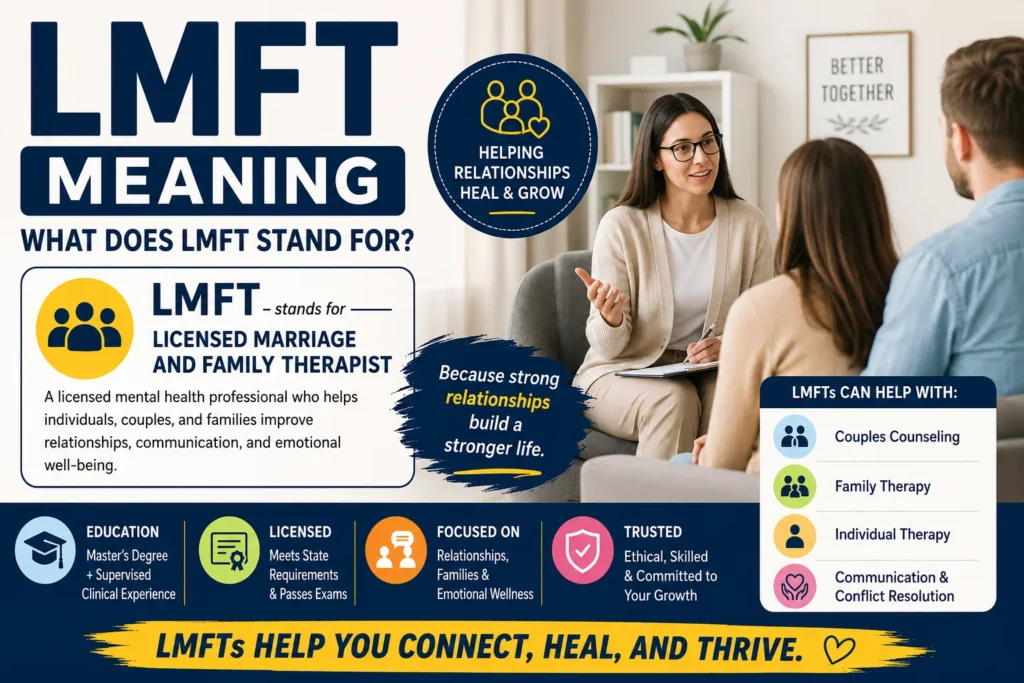

LMFT stands for Licensed Marriage and Family Therapist, a mental health professional trained to help individuals, couples, and families improve relationships, communication, and emotional well-being.
If you’ve seen the letters LMFT after a therapist’s name, you’re probably wondering what they mean and whether an LMFT is the right professional to help with your situation. Many people search for “LMFT meaning” because they’re exploring therapy options, looking for relationship counseling, or trying to understand the credentials listed on a therapist’s website.
This guide explains exactly what LMFT means, what an LMFT does, how they differ from other mental health professionals, and when you should consider working with one.
What Does LMFT Mean?
LMFT stands for:
Licensed Marriage and Family Therapist
An LMFT is a licensed mental health professional who specializes in helping:
- Married couples
- Dating partners
- Families
- Parents and children
- Individuals experiencing relationship challenges
Although the title includes “marriage and family,” LMFTs work with much more than just married couples. They can help individuals address emotional, behavioral, and interpersonal issues as well.
What Is a Licensed Marriage and Family Therapist?
A Licensed Marriage and Family Therapist is trained to understand how relationships influence mental health.
Unlike some therapists who focus primarily on individual symptoms, LMFTs often examine:
- Family dynamics
- Communication patterns
- Relationship conflicts
- Emotional connections
- Behavioral cycles
Their goal is to help clients build healthier relationships and improve overall functioning.
Why Do People Search for LMFT Meaning?
People commonly search for LMFT meaning when:
- Looking for a therapist
- Comparing mental health professionals
- Seeking marriage counseling
- Understanding insurance provider directories
- Researching therapy credentials
The credential can seem confusing because many mental health professionals use different abbreviations.
Examples include:
- LMFT
- LPC
- LCSW
- PsyD
- PhD
- Psychiatrist
Understanding what each credential means helps you choose the right professional for your needs.
What Does an LMFT Do?
LMFTs help clients navigate a wide range of challenges.
Relationship Counseling
One of the most common services LMFTs provide is relationship therapy.
Topics may include:
- Communication problems
- Trust issues
- Conflict resolution
- Infidelity recovery
- Premarital counseling
- Emotional intimacy
Family Therapy
Families often seek LMFT support when dealing with:
- Parent-child conflict
- Divorce transitions
- Blended family challenges
- Behavioral concerns
- Family stress
Individual Therapy
Many people are surprised to learn that LMFTs also work with individuals.
They frequently help clients with:
- Anxiety
- Depression
- Stress
- Self-esteem concerns
- Life transitions
- Relationship difficulties
Couples Counseling
Couples therapy remains one of the most recognized areas of LMFT practice.
An LMFT may help couples:
- Improve communication
- Rebuild trust
- Develop healthier conflict-management skills
- Strengthen emotional connections
Is LMFT a Medical Doctor?
No.
An LMFT is not a medical doctor.
They cannot:
- Perform medical procedures
- Prescribe medication in most jurisdictions
- Diagnose physical health conditions
However, they are licensed mental health professionals qualified to assess and treat many emotional and behavioral concerns.
Education Requirements for LMFTs
Becoming an LMFT requires significant education and supervised clinical experience.
Step 1: Earn a Bachelor’s Degree
Future therapists often study:
- Psychology
- Sociology
- Human Development
- Social Sciences
Step 2: Complete a Master’s Degree
Most LMFTs earn a master’s degree in:
- Marriage and Family Therapy
- Counseling
- Psychology-related fields
Graduate programs typically include:
- Clinical training
- Family systems theory
- Relationship counseling techniques
- Mental health assessment
Step 3: Supervised Clinical Experience
After graduation, candidates complete thousands of supervised clinical hours.
This hands-on experience allows them to develop practical therapy skills under professional supervision.
Step 4: Licensing Examination
Candidates must pass state licensing exams before becoming fully licensed.
Licensing requirements vary by state and country.
LMFT vs Psychologist
One of the most common questions people ask is whether an LMFT is the same as a psychologist.
The answer is no.
| LMFT | Psychologist |
|---|---|
| Focuses heavily on relationships and family systems | Often focuses on assessment, diagnosis, and broader mental health concerns |
| Master’s degree typically required | Doctoral degree typically required |
| Relationship-focused treatment | Broader psychological specialization |
| Couples and family expertise | May specialize in many areas |
Both can be highly effective depending on your goals.
LMFT vs LPC
Another common comparison is LMFT versus LPC.
LPC stands for:
Licensed Professional Counselor
LMFT
Focuses on:
- Relationships
- Family systems
- Couples counseling
LPC
Focuses on:
- Individual counseling
- Mental health treatment
- Personal growth
Many services overlap, but LMFTs often receive more specialized training in relationship dynamics.
LMFT vs LCSW
LCSW stands for:
Licensed Clinical Social Worker
Both LMFTs and LCSWs provide therapy.
However:
LMFT
Specializes in:
- Family relationships
- Marriage counseling
- Systemic approaches
LCSW
Often specializes in:
- Community resources
- Social systems
- Individual and family support
Both credentials are highly respected.
Common Issues Treated by LMFTs
An LMFT may help clients address:
Anxiety
Symptoms can include:
- Excessive worry
- Nervousness
- Relationship stress
Depression
Therapy can help clients:
- Understand emotional patterns
- Improve coping skills
- Strengthen support systems
Parenting Challenges
Parents often seek support for:
- Discipline concerns
- Communication issues
- Family transitions
Life Changes
Major transitions may include:
- Marriage
- Divorce
- Career changes
- Relocation
- Becoming a parent
LMFTs help clients navigate these challenges more effectively.
When Should You See an LMFT?
Many people assume LMFTs only help married couples in crisis. In reality, they support individuals, couples, and families facing a wide variety of challenges.
You may benefit from seeing an LMFT if you’re experiencing:
Relationship Conflict
Frequent arguments, communication breakdowns, or unresolved disagreements can place significant stress on a relationship.
An LMFT helps identify unhealthy patterns and teaches practical communication skills.
Family Tension
Families often face challenges related to:
- Parenting disagreements
- Teen behavior issues
- Blended family adjustments
- Caregiving responsibilities
- Generational conflicts
Family therapy can improve understanding and strengthen relationships.
Premarital Counseling
Many couples seek guidance before marriage.
Premarital counseling helps partners discuss:
- Financial expectations
- Parenting goals
- Communication styles
- Conflict resolution strategies
- Long-term plans
Divorce or Separation
Relationship transitions can be emotionally difficult.
An LMFT can help individuals and families:
- Process emotions
- Improve co-parenting
- Reduce conflict
- Support children during changes
Mental Health Concerns
LMFTs also work with individuals experiencing:
- Anxiety
- Depression
- Stress
- Grief
- Self-esteem challenges
They often explore how relationships impact emotional well-being.
Benefits of Working With an LMFT
Marriage and family therapists provide unique advantages because of their relationship-focused training.
Improved Communication
Many relationship problems stem from communication difficulties.
LMFTs help clients:
- Express feelings effectively
- Listen actively
- Reduce misunderstandings
- Navigate difficult conversations
Better Conflict Resolution
Conflict itself is not the problem.
The way people handle conflict often determines relationship success.
Therapy can teach healthier ways to:
- Disagree respectfully
- Manage emotions
- Find solutions collaboratively
Stronger Relationships
Many clients report improvements in:
- Trust
- Emotional intimacy
- Family connections
- Relationship satisfaction
Enhanced Emotional Awareness
Therapy often increases self-awareness.
Clients learn to recognize:
- Emotional triggers
- Behavioral patterns
- Relationship habits
- Personal strengths
What Happens During an LMFT Session?
One of the most common questions people have is what therapy sessions actually look like.
While every therapist has a unique approach, most sessions follow a similar structure.
Initial Assessment
The first session often involves:
- Discussing concerns
- Reviewing personal history
- Identifying goals
- Exploring relationship dynamics
The therapist gathers information to better understand the situation.
Goal Setting
Clients and therapists work together to establish goals.
Examples may include:
- Improving communication
- Reducing conflict
- Managing anxiety
- Strengthening family relationships
Ongoing Sessions
Future sessions focus on:
- Exploring challenges
- Developing coping strategies
- Practicing new skills
- Tracking progress
Therapy is collaborative rather than prescriptive.
Homework and Practice
Some LMFTs provide activities between sessions.
Examples include:
- Communication exercises
- Journaling
- Reflection questions
- Relationship-building activities
These exercises help reinforce progress outside therapy.
How Much Does an LMFT Cost?
Therapy costs vary depending on:
- Location
- Experience level
- Session length
- Insurance coverage
Typical session fees may range from:
- $75–$300+ per session
Highly experienced therapists in major cities may charge more.
Does Insurance Cover LMFT Services?
Many insurance plans cover LMFT services.
Coverage depends on:
- Your provider
- Your policy
- State regulations
Before scheduling, ask:
- Is the therapist in-network?
- What is my copay?
- Are telehealth sessions covered?
Understanding coverage can help reduce unexpected expenses.
Online Therapy and LMFTs
Telehealth has made therapy more accessible than ever.
Many LMFTs now offer:
- Video sessions
- Phone sessions
- Secure online platforms
Benefits include:
- Greater convenience
- Reduced travel time
- Increased accessibility
- More scheduling flexibility
For many clients, online therapy is just as effective as in-person counseling.
Career Outlook for LMFTs
Marriage and family therapy continues to be a growing profession.
Several factors contribute to increased demand:
- Greater mental health awareness
- Expanded insurance coverage
- Increased interest in relationship counseling
- Growing acceptance of therapy
LMFT Salary
Income varies based on:
- Geographic location
- Clinical specialty
- Experience
- Practice setting
LMFTs may work in:
- Private practice
- Hospitals
- Community agencies
- Schools
- Mental health clinics
Many experienced therapists eventually establish private practices.
Common Myths About LMFTs
Myth #1: LMFTs Only Work With Married Couples
This is one of the biggest misconceptions.
LMFTs work with:
- Individuals
- Families
- Couples
- Children
- Teenagers
Marriage counseling is only one aspect of their work.
Myth #2: Therapy Means Something Is Wrong
Many people attend therapy for growth and self-improvement.
Therapy can help strengthen healthy relationships and prevent future problems.
Myth #3: LMFTs Give Advice All Session
Therapists typically guide conversations rather than tell clients what to do.
Their role is to help clients develop insight and make informed decisions.
Myth #4: Therapy Works Immediately
Meaningful change takes time.
While some clients notice benefits quickly, long-term improvement usually develops gradually.
Experience-Based Insight
In real-world practice, people often seek an LMFT after relationship problems have already become overwhelming. However, therapists consistently observe that early intervention produces better outcomes. Couples, families, and individuals who seek support before issues escalate often experience faster progress and healthier long-term relationships.
Frequently Asked Questions
What does LMFT stand for?
LMFT stands for Licensed Marriage and Family Therapist.
Is an LMFT a licensed therapist?
Yes.
LMFTs are licensed mental health professionals who meet education, training, supervision, and examination requirements.
Can an LMFT diagnose mental health conditions?
In many jurisdictions, yes.
LMFTs are often qualified to assess and diagnose mental health conditions within their scope of practice.
Can an LMFT prescribe medication?
Generally, no.
LMFTs are not medical doctors and typically cannot prescribe medication.
Is an LMFT the same as a psychologist?
No.
Psychologists usually hold doctoral degrees, while LMFTs typically hold master’s degrees and specialize in relationship and family systems.
Is an LMFT covered by insurance?
Many insurance plans cover LMFT services, though coverage varies by provider and policy.
Can an LMFT help with anxiety and depression?
Yes.
Many LMFTs work with clients experiencing anxiety, depression, stress, and emotional challenges.
Should I see an LMFT or a counselor?
Both can be excellent options.
If your concerns involve relationships, family dynamics, or couples issues, an LMFT may be particularly beneficial.
What is the difference between an LMFT and a therapist?
An LMFT is a type of therapist with specialized training in relationships and family systems.
What qualifications does an LMFT have?
Most LMFTs hold a master’s degree, complete supervised clinical hours, and pass licensing examinations.
Can an LMFT provide individual therapy?
Yes.
Many LMFTs regularly work with individual clients.
What does LMFT mean after a therapist’s name?
It indicates that the therapist is a Licensed Marriage and Family Therapist.
Are LMFTs mental health professionals?
Yes.
LMFTs are licensed mental health professionals trained to provide psychotherapy.
Is an LMFT a good career?
For individuals interested in helping others improve relationships and mental well-being, LMFT can be a rewarding and growing profession.
Conclusion
Understanding the LMFT meaning is important when choosing a mental health professional. LMFT stands for Licensed Marriage and Family Therapist, a licensed clinician trained to help individuals, couples, and families improve communication, strengthen relationships, and navigate life’s challenges.
Key Takeaways
- LMFT means Licensed Marriage and Family Therapist.
- LMFTs work with individuals, couples, and families.
- They specialize in relationship and family dynamics.
- They are licensed mental health professionals.
- Many insurance plans cover LMFT services.
Common Mistakes to Avoid
- Assuming LMFTs only help married couples.
- Confusing LMFTs with psychiatrists.
- Waiting too long before seeking support.
- Choosing a therapist without considering specialization.
When to Work With an LMFT
Consider an LMFT if you need help with:
- Relationship concerns
- Family conflict
- Parenting challenges
- Anxiety or stress linked to relationships
- Communication difficulties
When Another Professional May Be Better
Depending on your needs, you may also consider:
- Psychologists
- Psychiatrists
- Licensed Professional Counselors (LPCs)
- Licensed Clinical Social Workers (LCSWs)
The best choice depends on your goals and circumstances.