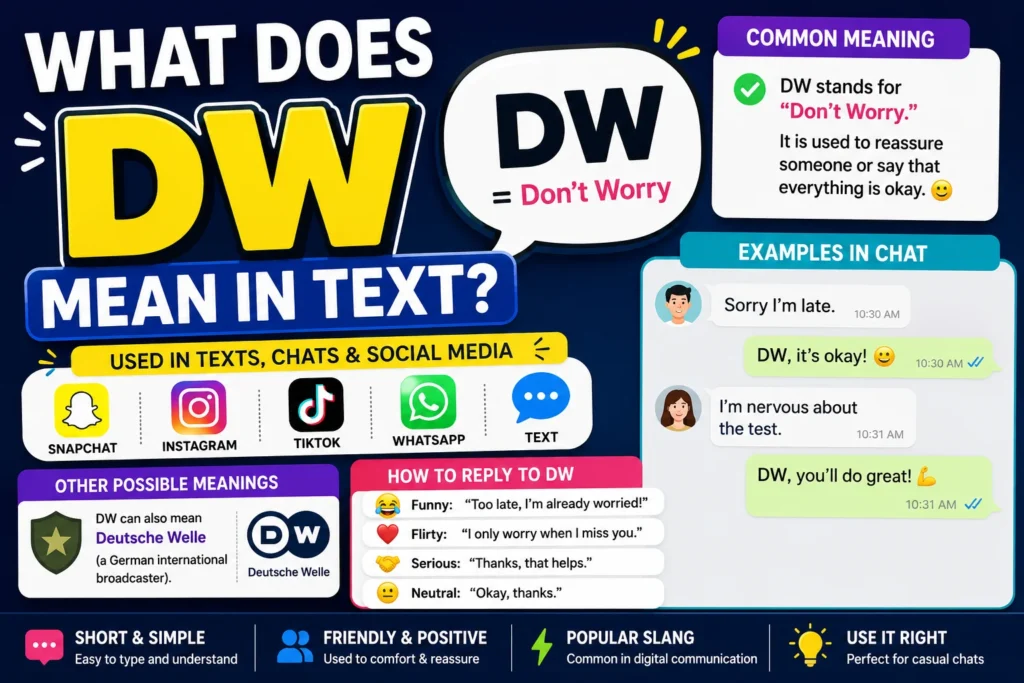

DW means “Don’t Worry” in text messages, chats, and social media conversations. It is a popular texting abbreviation used to reassure someone, reduce concern, or communicate that everything is okay.
If you’ve received a message containing “DW” on Snapchat, Instagram, TikTok, WhatsApp, or in a text conversation, you may be wondering exactly what it means. Many people search for this phrase because internet abbreviations can be confusing, especially when they have different meanings in different contexts.
The good news is that DW is usually simple and friendly. In most online conversations, it means “Don’t Worry.” It’s a quick way to reassure someone, ease tension, or let another person know that a situation is under control.
This guide explains what DW means in text, chat, social media, and everyday digital communication. You’ll also learn how to respond to DW, see real conversation examples, and understand when to use it appropriately.
What Does DW Mean in Text?
The most common meaning of DW is:
DW = Don’t Worry
People use it to reassure someone or tell them not to stress about something.
Examples:
- “DW, I’ve got it covered.”
- “DW about being late.”
- “DW, everything worked out.”
Because texting favors speed and convenience, DW has become a common abbreviation in digital communication.
Why People Search for DW Meaning
Many people encounter DW in:
- Text messages
- Snapchat chats
- Instagram DMs
- TikTok comments
- WhatsApp conversations
- Gaming chats
Since the abbreviation is short, people often want confirmation that they’re interpreting it correctly.
What Does DW Mean in Text Meaning in Text?
When users search what does dw mean in text meaning in text, they’re usually trying to decode a message they received.
Example:
A: Sorry I couldn’t answer earlier.
B: DW, it’s okay.
In this conversation, DW means “Don’t Worry.”
The sender is reassuring the other person that there is no problem.
What Does DW Mean in Text Slang Meaning?
Regarding what does dw mean in text slang meaning, DW is considered an internet abbreviation rather than traditional slang.
However, it functions similarly to slang because it’s widely understood online.
DW is:
- Casual
- Informal
- Friendly
- Common in online messaging
Unlike some slang terms, DW has remained consistent in meaning for years.
What Does DW Mean in Chat?
If you’re wondering what does what does dw mean in text mean in chat, the answer is usually the same.
In chat conversations, DW means:
- Don’t worry
- No problem
- It’s okay
- Everything is fine
Examples:
A: I think I made a mistake.
B: DW, we can fix it.
Or:
A: Sorry I’m late.
B: DW.
In both situations, DW reassures the other person.
What Does DW Mean on Snapchat?
DW is very common on Snapchat.
Because Snapchat conversations are fast and casual, users often shorten phrases.
Example:
Snap Message: “DW, I’ll explain later.”
Meaning:
“Don’t worry, I’ll explain later.”
On Snapchat, DW usually signals reassurance rather than urgency.
What Does DW Mean on Instagram, TikTok, and WhatsApp?
DW Meaning on Instagram
Instagram users frequently use DW in:
- DMs
- Story replies
- Comments
Example:
“DW, you’ll get there eventually.”
DW Meaning on TikTok
TikTok comments often contain supportive or reassuring language.
Example:
“DW, everyone starts somewhere.”
DW Meaning on WhatsApp
WhatsApp is one of the most common places to see DW.
Examples:
- Family chats
- Friend groups
- School discussions
- Work conversations
Example:
“DW, I’ll send the details later.”
Is DW an Acronym, Short Form, or Slang?
Is DW an Acronym?
Yes.
DW is an acronym formed from:
Don’t Worry
Is DW a Short Form?
Yes.
It shortens a longer phrase into two letters.
Is DW a Phonetic Spelling?
No.
DW is not based on pronunciation.
Is DW a Typo Turned Slang?
No.
It was intentionally created as a texting abbreviation.
How DW Changes Based on Tone
The phrase “Don’t Worry” can sound very different depending on tone.
Funny Tone
A: I accidentally ate your fries.
B: Seriously?
A: DW, I left two.
B: How generous.
Sarcastic Tone
A: I forgot your birthday.
B: DW, only waited all year.
The words are reassuring, but the tone is sarcastic.
Romantic Tone
A: Sorry I missed your call.
B: DW ❤️
A: You’re sweet.
Angry Tone
A: Are you upset?
B: DW about it.
Depending on context, this version may sound dismissive.
Playful Tone
A: I think I’m lost.
B: DW, adventure mode activated.
The phrase becomes lighthearted and fun.
15 Real Chat Examples Using DW
Example 1
A: Sorry I’m late.
B: DW, I just got here too.
Example 2
A: I forgot the homework.
B: DW, the teacher extended it.
Example 3
A: I think I messed up.
B: DW, we’ll figure it out.
Example 4
A: Did I bother you?
B: DW, not at all.
Example 5
A: I’m nervous.
B: DW, you’ll do great.
Example 6
A: I missed the meeting.
B: DW, I’ll update you.
Example 7
A: Sorry for texting so late.
B: DW.
Example 8
A: Is everything okay?
B: DW, all good.
Example 9
A: I lost the file.
B: DW, I have a copy.
Example 10
A: Thanks for helping.
B: DW about it.
Example 11
A: Did I offend you?
B: DW, we’re fine.
Example 12
A: I’m stressed.
B: DW, tomorrow is a new day.
Example 13
A: I forgot your coffee.
B: DW, it happens.
Example 14
A: Will this work?
B: DW, trust the process.
Example 15
A: Sorry again.
B: DW. Seriously.
Grammar and Language Role of DW
Part of Speech
DW functions as an abbreviation representing an entire phrase.
Sentence Position
DW can appear:
- At the beginning
- In the middle
- At the end
Examples:
- “DW, I’ve got this.”
- “You can DW about that.”
- “It’s handled, DW.”
Does DW Replace a Full Sentence?
Yes.
Example:
A: Is everything okay?
B: DW.
The abbreviation alone communicates a complete thought.
Tone Impact
DW often creates a:
- Friendly tone
- Reassuring tone
- Supportive tone
- Casual tone
Formal vs Informal Use
Informal:
- Texts
- Social media
- Chat apps
Formal:
- Usually avoided in professional documents
- Acceptable in casual workplace messaging
How to Reply When Someone Says DW
Funny Replies
- “Too late, I’m already worried.”
- “That’s not how my brain works.”
- “Mission impossible.”
Serious Replies
- “Thank you.”
- “I appreciate that.”
- “Good to know.”
Flirty Replies
- “I only stop worrying when you’re around.”
- “Okay, if you say so 😉”
- “Now I feel better.”
Neutral Replies
- “Got it.”
- “Okay.”
- “Sounds good.”
- “Thanks.”
DW Comparison Table
| Term | Meaning | Usage Context | Tone | Popularity | Confusion Risk |
|---|---|---|---|---|---|
| DW | Don’t Worry | Texting, social media | Reassuring | Very High | Low |
| NVM | Never Mind | Chat | Casual | High | Medium |
| IDC | I Don’t Care | Texting | Neutral | High | Medium |
| IDK | I Don’t Know | Messaging | Casual | Very High | Low |
| BRB | Be Right Back | Chat | Neutral | High | Low |
| TBH | To Be Honest | Social media | Casual | High | Low |
Contrasting Term
| Term | Meaning | Usage Context | Tone | Popularity | Confusion Risk |
| Worry | Express concern | Everyday conversation | Serious | High | Low |
Who Uses DW?
Age Groups
DW is used by:
- Teenagers
- College students
- Young adults
- Adults
Gen Z vs Millennials
Gen Z
Uses DW frequently in:
- Snapchat
- TikTok
Millennials
Uses DW in:
- Text messages
- Facebook Messenger
Regional Usage
DW is widely used across:
- United States
- United Kingdom
- Canada
- Australia
- Global English-speaking communities
Common Platforms
- Snapchat
- TikTok
- Discord
- Messenger
Origin and Internet Culture Insight
DW emerged from early texting culture.
As SMS character limits encouraged shorter messages, users began shortening common phrases.
“Don’t Worry” naturally became “DW.”
Why People Say DW on TikTok
TikTok encourages short communication.
Creators and commenters often use DW because:
- It saves space.
- It’s widely understood.
- It sounds supportive.
Many TikTok comments use DW to encourage others.
Meme Culture and Fast Typing
Internet culture rewards speed.
DW survives because it is:
- Easy to type
- Easy to understand
- Positive in tone
Unlike many trends, DW has remained relevant for years.
Is DW Rude?
Usually no.
DW is generally polite and reassuring.
Is DW a Bad Word?
No.
DW is completely family-friendly.
Should You Use DW in School?
Yes.
Most teachers and students understand it.
Should You Use DW at Work?
In casual workplace chats, yes.
In formal reports or professional documents, writing “Don’t Worry” may be better.
Experience-Based Insight
In real-world texting, DW is one of the most positive abbreviations people use. Unlike slang that can sound confusing or exclusive, DW usually reduces tension and helps conversations feel more relaxed. It appears frequently in group chats, social media messages, and everyday texting because reassurance is a common part of digital communication.
Frequently Asked Questions
What does what does dw mean in text mean in text?
It usually means “Don’t Worry.”
Is DW rude?
No. It is generally considered friendly and reassuring.
What does DW mean on Snapchat?
On Snapchat, DW almost always means “Don’t Worry.”
Is DW the same as IDK?
No.
DW means “Don’t Worry.”
IDK means “I Don’t Know.”
Can adults use DW?
Absolutely.
People of all ages use DW.
How do you respond to DW?
You can reply with:
- Thanks
- Okay
- Got it
- I appreciate it
Is DW slang?
It’s more accurately described as a texting abbreviation or internet shorthand.
Why do people use DW?
Because it’s faster than typing “Don’t Worry.”
Does DW always mean Don’t Worry?
In most texting situations, yes.
Is DW used on TikTok?
Yes. It’s common in comments and direct messages.
Can DW be used professionally?
In casual workplace chats, yes.
Is DW positive or negative?
Usually positive.
What is the opposite of DW?
Expressions that encourage concern or caution are considered opposites.
Why is DW popular?
It’s short, supportive, and easy to understand.
Final Thoughts
If you’re wondering what does DW mean in text, the answer is usually simple: DW means “Don’t Worry.”
It is one of the most common texting abbreviations used in digital communication, social media, and chat conversations.
Usage Tips
- Use DW to reassure someone.
- Use it in casual conversations.
- Keep the tone friendly.
Common Mistakes
- Assuming DW has a negative meaning.
- Confusing it with other abbreviations.
- Using it where formal language is required.
When to Use DW
Use DW when:
- Someone is concerned.
- You want to reassure someone.
- You’re texting casually.
When to Avoid DW
Avoid it when:
- Writing formal business documents.
- Communicating with people unfamiliar with texting abbreviations.
- Clarity is critical.
DW remains one of the simplest and most useful abbreviations in modern online communication because it instantly communicates reassurance, support, and friendliness.