
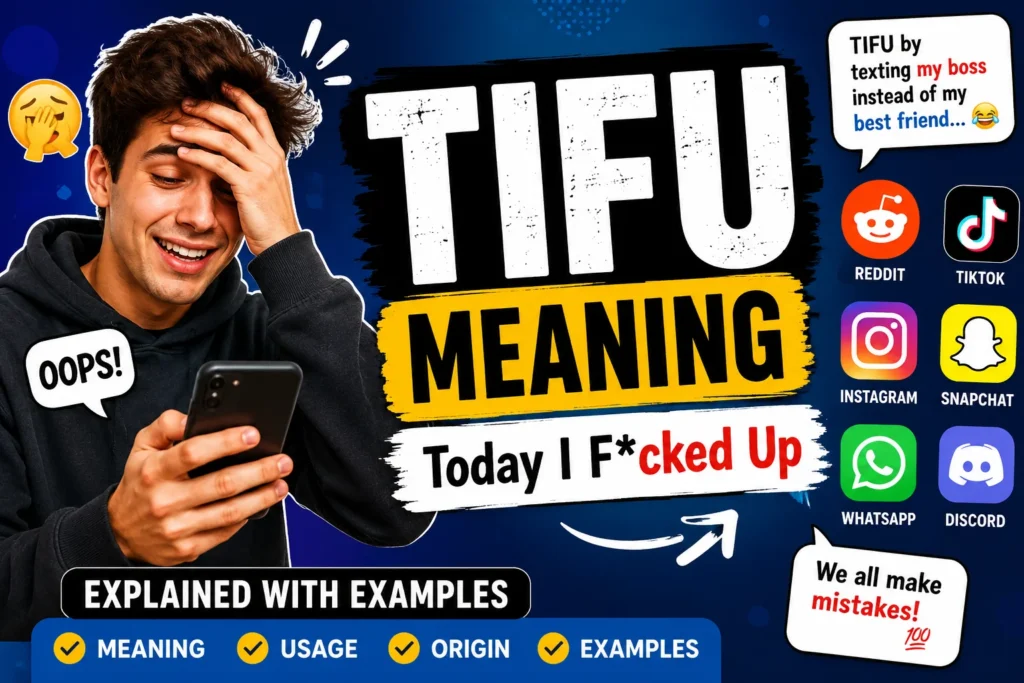

TIFU means “Today I F*cked Up.” It is a popular internet slang abbreviation people use when admitting they made a mistake, embarrassed themselves, or caused an unexpected problem.
If you’ve seen TIFU on Reddit, TikTok, Snapchat, Instagram, or in a text message, you may wonder exactly what it means and why people use it so often. The term has become one of the internet’s most recognizable storytelling abbreviations, especially when someone wants to share a funny, awkward, or unfortunate mistake.
In this guide, you’ll learn the exact TIFU meaning, how it is used across social media platforms, its origins, examples from real conversations, and why it remains popular in online culture.
What Does TIFU Mean?
TIFU stands for:
Today I F*cked Up
People use it when they want to admit that they made a mistake, created an embarrassing situation, or experienced an unfortunate outcome because of their actions.
Unlike many texting abbreviations that simply replace common phrases, TIFU often introduces a story.
Example
TIFU by sending a screenshot to the person I was talking about.
In this example, the writer is admitting a mistake that will likely lead to an embarrassing story.
The phrase has become so common online that many people instantly recognize it as a signal that an amusing or awkward story is about to follow.
TIFU Meaning in Text Messages
In text messages, TIFU is usually used when someone wants to confess a mistake.
Example
A: TIFU.
B: What happened?
A: I accidentally emailed my teacher the wrong assignment.
Here, TIFU acts as a shorthand way of saying:
“I messed up today.”
Another Example
A: TIFU by forgetting my girlfriend’s birthday.
B: Oh no. Good luck.
The abbreviation immediately communicates regret and self-awareness.
TIFU Meaning on Snapchat
On Snapchat, TIFU often appears in:
- Private chats
- Story captions
- Screenshots
- Friend group conversations
Users typically use it before explaining something embarrassing.
Example
Snap Caption:
“TIFU by leaving my microphone on during class.”
The audience immediately understands that a funny or embarrassing story follows.
TIFU Meaning on Instagram
Instagram users frequently use TIFU:
- In captions
- Story posts
- Meme pages
- Comment sections
Example Caption
“TIFU by wearing two different shoes to work.”
The phrase attracts attention because people naturally want to know what happened next.
TIFU Meaning on TikTok
TikTok has introduced TIFU to a newer generation of users.
Many videos begin with:
- “TIFU by…”
- “My biggest TIFU ever…”
- “Storytime: TIFU at work.”
The abbreviation works perfectly for storytelling content because it creates curiosity.
Example
“TIFU by accidentally texting my boss instead of my best friend.”
Viewers instantly want to hear the rest of the story.
TIFU Meaning on WhatsApp
On WhatsApp, TIFU is commonly used among friends and family.
Example
A: TIFU.
B: What now?
A: I locked my keys inside the car.
In this context, it functions as a casual chat phrase that quickly communicates a mistake.
Is TIFU an Acronym?
Yes.
TIFU is an acronym because each letter represents a word:
- T = Today
- I = I
- F = F*cked
- U = Up
Unlike phonetic spellings such as “gonna” or “wanna,” TIFU is a true abbreviation formed from the initial letters of a phrase.
Is It a Short Form?
Yes, it can also be considered a short form because it condenses a longer sentence into four letters.
Is It a Phonetic Spelling?
No.
TIFU is not a phonetic spelling.
Is It a Typo Turned Slang?
No.
It was intentionally created as an abbreviation and later became widespread internet slang.
Why Do People Use TIFU?
People use TIFU because it quickly communicates three things:
- A mistake happened.
- The speaker admits responsibility.
- A story is probably coming.
This combination makes it perfect for internet storytelling.
Instead of writing:
“Today I made a really embarrassing mistake.”
People simply write:
“TIFU.”
TIFU Slang Meaning
As internet slang, TIFU has evolved beyond its literal definition.
Today, it often means:
- I made a mistake.
- I embarrassed myself.
- Something went terribly wrong.
- I have a funny story to tell.
In many situations, the mistake isn’t serious.
The phrase is frequently used humorously.
Example
“TIFU by trying to impress someone and falling into a fountain.”
The focus is often on entertainment rather than genuine disaster.
Tone Variations of TIFU
The exact meaning can change depending on tone and context.
Funny Tone
This is the most common use.
Example
A: TIFU by trying to jump over a puddle.
B: What happened?
A: I landed in the puddle.
The phrase introduces a humorous mistake.
Sarcastic Tone
Sometimes people use TIFU sarcastically when the outcome was predictable.
Example
A: TIFU by eating spicy food before a five-hour road trip.
B: That sounds like a bad decision.
A: It absolutely was.
The speaker knows the mistake could have been avoided.
Romantic Tone
TIFU occasionally appears in dating stories.
Example
A: TIFU on my first date.
B: What happened?
A: I called her by my ex’s name.
The phrase signals an awkward romantic situation.
Angry Tone
Sometimes users express frustration through TIFU.
Example
A: TIFU by trusting my computer not to crash.
B: Let me guess.
A: Three hours of work disappeared.
Here, the tone is less humorous and more annoyed.
Playful Tone
Friends often use TIFU jokingly.
Example
A: TIFU by challenging my little brother to a video game.
B: Did he beat you?
A: By a lot.
The phrase creates a playful atmosphere.
Real Chat Examples Using TIFU
Example 1
A: TIFU.
B: Again?
A: Yes.
Example 2
A: TIFU by oversleeping.
B: How late?
A: Two hours.
Example 3
A: TIFU by forgetting my wallet.
B: That’s rough.
A: Very rough.
Example 4
A: TIFU at work.
B: What happened?
A: I sent the wrong file to everyone.
Example 5
A: TIFU by trying to cook.
B: Did something burn?
A: Everything burned.
Example 6
A: TIFU by liking a photo from 2017.
B: Time to disappear.
A: Exactly.
Example 7
A: TIFU in class.
B: How?
A: My phone started playing music at full volume.
Example 8
A: TIFU by trusting autocorrect.
B: Never trust autocorrect.
A: Lesson learned.
Example 9
A: TIFU by forgetting an important meeting.
B: That’s not good.
A: Not good at all.
Example 10
A: TIFU by trying a new haircut.
B: How bad is it?
A: Let’s not talk about it.
Example 11
A: TIFU by locking myself out.
B: Of your account?
A: My house.
Example 12
A: TIFU by waving back at someone.
B: And?
A: They weren’t waving at me.
Example 13
A: TIFU at the gym.
B: Injury?
A: Embarrassment.
Example 14
A: TIFU by forgetting my presentation.
B: What did you do?
A: Improvised.
Example 15
A: TIFU.
B: Tell me everything.
A: It’s a long story.
Grammar and Language Role of TIFU
Although TIFU originated as an acronym, it now functions as a complete internet expression.
Part of Speech
TIFU is most commonly used as:
- An acronym
- An interjection
- A storytelling introduction
- A conversation starter
Unlike standard nouns or verbs, TIFU usually signals that a mistake or embarrassing situation occurred.
Sentence Position
TIFU can appear at the beginning of a sentence:
“TIFU by sending a message to the wrong person.”
It can also appear as a standalone statement:
“TIFU.”
In internet storytelling, it is almost always placed at the beginning.
Does TIFU Replace a Full Sentence?
Yes.
Instead of saying:
“Today I made a serious mistake.”
Someone can simply write:
“TIFU.”
Readers automatically understand that a mistake occurred.
Tone Impact
Using TIFU creates a tone that is:
- Self-aware
- Honest
- Humorous
- Informal
- Story-focused
The phrase often softens embarrassment because the speaker is openly admitting their mistake.
Formal vs Informal Use
| Context | Appropriate? |
|---|---|
| Text Messages | Yes |
| Snapchat | Yes |
| Yes | |
| TikTok | Yes |
| Yes | |
| Discord | Yes |
| Gaming Chats | Yes |
| Work Emails | No |
| Business Reports | No |
| Academic Writing | No |
TIFU is strongly associated with informal internet communication.
How to Reply When Someone Says TIFU
The best response depends on the situation and the tone of the story.
Funny Replies
A: TIFU.
B: Sounds like a story I need to hear.
A: TIFU by locking myself out.
B: Speedrunning adulthood, I see.
A: TIFU again.
B: At least you’re consistent.
Serious Replies
A: TIFU at work.
B: What happened?
A: TIFU and missed an important deadline.
B: Can you still fix it?
Flirty Replies
A: TIFU on our date.
B: Depends. Was it cute or catastrophic?
A: TIFU trying to impress you.
B: You still got my attention.
Neutral Replies
A: TIFU.
B: Tell me more.
A: TIFU.
B: What happened this time?
A: TIFU.
B: I’m listening.
TIFU Comparison Table
Many users confuse TIFU with other internet slang terms.
| Term | Meaning | Usage Context | Tone | Popularity | Confusion Risk |
|---|---|---|---|---|---|
| TIFU | Today I F*cked Up | Admitting mistakes | Humorous/Embarrassed | Very High | Low |
| FML | F*** My Life | Frustration and bad luck | Negative | High | Medium |
| Oops | Simple mistake | Everyday conversation | Light | High | Low |
| SMH | Shaking My Head | Disapproval | Critical | Very High | Low |
| RIP | Expression of loss or failure | Memes and reactions | Varies | High | Medium |
| LOL | Laugh Out Loud | Humor | Positive | Very High | Low |
| W | Win/Success | Opposite outcome | Positive | High | Low |
Biggest Difference
TIFU focuses on:
“I made a mistake.”
FML focuses on:
“Something bad happened to me.”
W focuses on:
“Something went well.”
Who Uses TIFU?
Age Groups
TIFU is commonly used by:
- Teenagers
- College students
- Millennials
- Gen Z users
- Reddit users
- Social media communities
Gen Z vs Millennials
Gen Z
Gen Z users often encounter TIFU through:
- TikTok
- Instagram Reels
- Meme pages
- YouTube Shorts
Millennials
Millennials largely recognize TIFU because of Reddit and early internet forums.
Many millennials were already familiar with TIFU before TikTok existed.
Regional Usage
TIFU is common in:
- United States
- United Kingdom
- Canada
- Australia
- Internet communities worldwide
Because English-language internet culture is global, TIFU is widely understood across countries.
Platforms Where TIFU Is Most Common
- TikTok
- Discord
- X (Twitter)
- Facebook groups
- Gaming communities
Origin of TIFU
One reason TIFU became famous is its connection to Reddit.
Reddit Influence
The abbreviation became massively popular through the subreddit:
r/TIFU (Today I F*cked Up)
The community is dedicated to people sharing:
- Embarrassing moments
- Accidental mistakes
- Funny disasters
- Regrettable decisions
A typical post starts with:
“TIFU by…”
Then the author explains what happened.
Over time, internet users adopted the abbreviation outside Reddit.
Why TIFU Became Popular
TIFU succeeded because it combines:
Storytelling
People naturally enjoy stories.
Humor
Most TIFU stories contain unexpected comedy.
Relatability
Everyone makes mistakes.
Curiosity
When someone says:
“TIFU by accidentally…”
Readers instantly want to know the ending.
Why People Say TIFU on TikTok
TikTok thrives on short-form storytelling.
TIFU fits perfectly because it immediately creates curiosity.
Examples:
- TIFU by texting my teacher the wrong message.
- TIFU at the gym.
- TIFU during a job interview.
- TIFU on my first date.
The abbreviation acts as a hook that encourages viewers to keep watching.
Meme Culture and TIFU
TIFU has become part of internet meme culture.
Many users exaggerate mistakes for comedic effect.
Examples:
- TIFU by opening my camera accidentally.
- TIFU by trying to cook.
- TIFU by trusting autocorrect.
The phrase works because people enjoy laughing at harmless human mistakes.
Is TIFU Rude?
Not usually.
However, the full phrase contains a profanity.
The word represented by “F” is a swear word.
Because the abbreviation hides most of the word, many people consider it milder than writing the phrase in full.
Context Matters
Among friends:
✅ Usually acceptable.
Professional settings:
❌ Usually inappropriate.
Is TIFU a Bad Word?
The acronym itself is not a bad word.
However, it contains an abbreviation of profanity.
Many websites and social platforms allow it because it is widely recognized internet slang.
Should You Use TIFU at School or Work?
School
Generally acceptable in casual conversations with friends.
Workplace
Use caution.
Professional alternatives include:
- I made a mistake.
- I messed up.
- I overlooked something.
- I made an error.
These options sound more professional.
Experience-Based Insight
Based on years of observing online communities, TIFU is rarely used to describe truly serious failures.
Most people use it when they want to laugh at themselves.
The phrase allows users to admit mistakes without appearing overly negative. Instead of focusing on embarrassment, TIFU turns awkward situations into entertaining stories. This is one reason the acronym has remained popular for so many years.
FAQ
What does TIFU mean in text?
TIFU means “Today I F*cked Up.” It is used when someone admits making a mistake or experiencing an embarrassing situation.
What does TIFU mean on Snapchat?
On Snapchat, TIFU usually introduces a story about a mistake, accident, or awkward moment.
What does TIFU mean on Instagram?
Instagram users often use TIFU in captions and stories to describe funny or embarrassing situations.
Is TIFU the same as IDK?
No.
IDK means “I Don’t Know,” while TIFU means “Today I F*cked Up.”
Can adults use TIFU?
Yes.
The abbreviation is commonly used by both younger and older internet users.
How do you respond to TIFU?
You can ask what happened, offer support, or respond with humor depending on the situation.
Is TIFU offensive?
Generally no, but it contains an abbreviation of a swear word, making it informal.
What does TIFU mean on TikTok?
On TikTok, TIFU is often used as a storytelling hook before sharing a mistake or embarrassing experience.
Why do people say TIFU?
People use TIFU to quickly explain that they made a mistake and are about to share the story.
Where did TIFU come from?
TIFU became popular through Reddit, especially the r/TIFU community.
Is TIFU still popular?
Yes. It remains widely used across Reddit, TikTok, Instagram, Discord, and other online communities.
Can TIFU be used jokingly?
Absolutely. Most TIFU stories are humorous rather than serious.
What is the opposite of TIFU?
There is no official opposite, but internet slang like W (win) is often used to indicate success instead of failure.
Is TIFU only used on Reddit?
No. While Reddit helped popularize it, TIFU is now common across many social media platforms.
Conclusion
TIFU stands for “Today I F*cked Up” and is one of the internet’s most recognizable storytelling abbreviations. Originally popularized by Reddit, it has spread across TikTok, Instagram, Snapchat, Discord, and texting culture.
People use TIFU when they want to admit a mistake, share an embarrassing experience, or tell a funny story about something that went wrong.
Usage Tips
✅ Use it in casual conversations.
✅ Use it for funny or awkward stories.
✅ Use it on social media and forums.
Common Mistakes
❌ Assuming it means bad luck alone.
❌ Using it in professional communication.
❌ Confusing it with abbreviations like IDK or FML.
When to Use TIFU
- Storytelling
- Humor
- Self-deprecating jokes
- Social media posts
When to Avoid TIFU
- Professional emails
- Academic writing
- Formal business communication
When used correctly, TIFU is a quick, memorable way to admit a mistake while turning it into a story others can relate to.