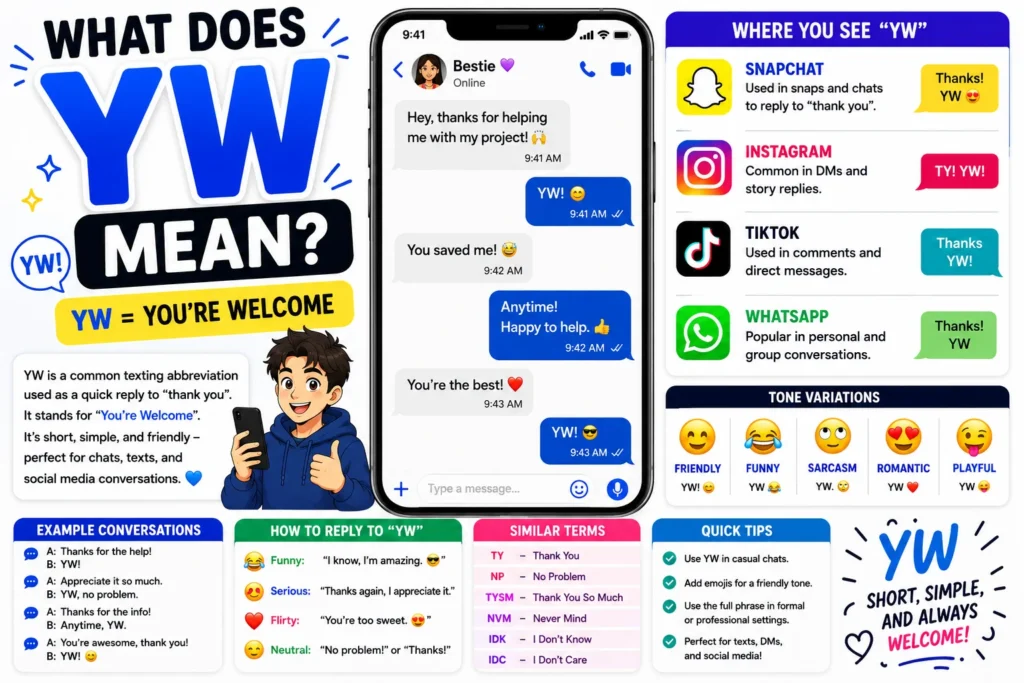

YW means “You’re Welcome.” In texting, social media, and online chats, people use YW as a quick response after someone says “thank you.” It is one of the most common texting abbreviations used in digital communication.
If you’ve seen YW on Snapchat, Instagram, TikTok, WhatsApp, or in a text message, you’re probably wondering whether it means “you’re welcome,” something else, or even slang. This guide explains all possible meanings, how people use it, examples, replies, and when you should (or shouldn’t) use it.
YW Meaning Explained
The most common YW meaning is:
YW = You’re Welcome
It is a shortened version of the phrase people use after receiving thanks or appreciation.
Example
A: Thanks for helping me with my homework.
B: YW!
In this example, “YW” simply means “you’re welcome.”
Is YW an Acronym?
Yes.
YW is:
- An acronym
- A texting abbreviation
- An internet slang term
- A shortcut used in digital communication
It is not:
- A phonetic spelling
- A typo turned slang
- A complete sentence replacement in all situations
Instead, it functions as a shortened response.
YW Meaning in Text
When people search for yw meaning in text, they usually want to know what it means in everyday texting.
In text messages:
YW = You’re Welcome
People use it when replying to:
- Thank you
- Thanks
- Appreciate it
- Thx
- TY
Example
A: Thanks for picking me up.
B: YW, no problem.
The meaning remains friendly and polite.
YW Slang Meaning
As internet slang, YW is still short for You’re Welcome.
Unlike some slang terms that develop multiple meanings, YW has remained fairly consistent across platforms.
However, tone can change depending on context.
For example:
Friendly YW
- “YW 😊”
Sarcastic YW
- “YW I guess 🙄”
The letters stay the same, but the attitude changes.
What Does YW Mean in Chat?
In online chats, YW is often used because typing is faster.
Gaming Chat Example
Player 1: Thanks for the revive.
Player 2: YW.
Group Chat Example
Friend: Thanks for sharing the notes.
You: YW!
Because chat conversations move quickly, abbreviations like YW save time.
YW Meaning on Snapchat
On Snapchat, YW almost always means:
You’re Welcome
Snapchat Example
Friend: Thanks for sending me the snap.
You: YW 😊
Because Snapchat conversations are casual, users often choose abbreviations instead of full phrases.
YW Meaning on Instagram
Instagram users commonly use YW in:
- DMs
- Story replies
- Comment sections
Example
Follower: Thanks for the recommendation.
Creator: YW!
It’s simply a quick and friendly response.
YW Meaning on TikTok
On TikTok, YW is frequently seen in comments.
Example
Commenter: Thanks for the tutorial!
Creator: YW ❤️
TikTok users often combine YW with emojis to make it feel warmer.
YW Meaning on WhatsApp
WhatsApp users frequently use YW in private conversations.
Example
A: Thanks for the address.
B: YW.
The meaning is identical to standard texting.
Tone & Context Variations
Even though YW usually means “You’re Welcome,” the tone can change dramatically.
Funny Tone
People sometimes use YW jokingly.
Example
A: Thanks for losing the game for us.
B: YW 😂
The response is playful and humorous.
Sarcastic Tone
YW can sound sarcastic when used after an annoying situation.
Example
A: I finally fixed the mistake you made.
B: YW 🙄
The meaning stays the same, but the tone becomes sarcastic.
Romantic Tone
YW can be used affectionately between partners.
Example
A: Thanks for making my day better.
B: YW ❤️
The abbreviation feels sweet and personal.
Angry Tone
Sometimes YW is used with frustration.
Example
A: You didn’t have to be rude.
B: YW.
In this context, the tone can sound cold.
Playful Tone
Friends often use YW casually.
Example
A: Thanks for reminding me.
B: YW bestie 😎
The response feels fun and relaxed.
Real Chat Examples
Here are realistic texting conversations showing how people use YW.
Example 1
A: Thanks for the ride.
B: YW!
A: Really appreciate it.
Example 2
A: Thanks for the movie recommendation.
B: YW.
A: It was amazing.
Example 3
A: Thank you for helping me study.
B: YW 😊
A: I passed the test.
Example 4
A: Thanks for covering my shift.
B: YW.
A: You’re a lifesaver.
Example 5
A: Thanks for sending the notes.
B: YW.
A: They helped a lot.
Example 6
A: Appreciate your advice.
B: YW.
A: It worked perfectly.
Example 7
A: Thanks for the gift.
B: YW ❤️
A: I love it.
Example 8
A: Thanks for the coffee.
B: YW ☕
A: You’re the best.
Example 9
A: Thanks for introducing me.
B: YW.
A: Nice meeting everyone.
Example 10
A: Thanks for helping with my project.
B: YW.
A: Couldn’t have done it alone.
Example 11
A: Thanks for the support.
B: YW ❤️
A: Means a lot.
Example 12
A: Thank you!
B: YW 😊
A: You’re awesome.
Grammar & Language Role
What Part of Speech Is YW?
YW acts as a shortened conversational response.
It represents the phrase:
“You’re welcome.”
Sentence Position
Usually it appears:
- At the beginning
- By itself
- At the end of a sentence
Examples
- YW!
- YW, happy to help.
- No worries, YW.
Does It Replace a Full Sentence?
Yes.
Many users treat YW as a complete response.
Example:
A: Thanks.
B: YW.
Tone Impact
Using YW feels:
- Casual
- Efficient
- Friendly
Using “You’re welcome” feels:
- More formal
- More professional
Formal vs Informal Use
| Style | Example |
|---|---|
| Informal | YW |
| Neutral | You’re welcome |
| Professional | You’re welcome, happy to help |
How to Reply When Someone Says YW
Many users search how to respond after receiving YW.
Funny Reply
- “I know I’m worth it 😂”
- “You’re too kind.”
Serious Reply
- “I appreciate it.”
- “Thanks again.”
Flirty Reply
- “You’re always so sweet ❤️”
- “Guess I owe you one 😉”
Neutral Reply
- “Got it.”
- “Thanks again!”
- “Appreciate the help.”
Comparison Table
| Term | Meaning | Usage Context | Tone | Popularity | Confusion Risk |
|---|---|---|---|---|---|
| YW | You’re Welcome | Reply to thanks | Friendly | High | Low |
| TY | Thank You | Showing gratitude | Friendly | High | Low |
| NP | No Problem | Alternative response | Casual | High | Low |
| NVM | Never Mind | Dropping topic | Neutral | High | Medium |
| IDK | I Don’t Know | Expressing uncertainty | Casual | Very High | Low |
| IDC | I Don’t Care | Showing indifference | Negative | High | Medium |
Who Uses This Term?
Age Group
YW is common among:
- Teens
- Young adults
- Adults
Gen Z vs Millennials
Both generations use YW regularly.
Gen Z often combines it with emojis.
Millennials often use it in straightforward text conversations.
Regions
YW is popular in:
- United States
- Canada
- United Kingdom
- Australia
- Global English-speaking communities
Platforms
Most common on:
- Snapchat
- TikTok
- Discord
- Text messaging
Origin & Internet Culture Insight
YW emerged during the rise of texting culture.
As SMS messages became shorter, users began replacing common phrases with abbreviations.
Examples include:
- TY = Thank You
- YW = You’re Welcome
- BRB = Be Right Back
Why People Say YW on TikTok
TikTok encourages quick communication.
Creators receive thousands of comments.
Typing “YW” is much faster than repeatedly typing “You’re welcome.”
Meme Culture Influence
While YW itself is not a meme, it often appears in humorous comment threads and reaction posts.
Fast Typing Culture
The biggest reason for YW’s popularity is convenience.
Typing two letters is faster than typing twelve.
Is YW Rude?
No.
YW is generally polite.
However, it may sound:
- Short
- Abrupt
- Less warm
depending on context.
Is YW a Bad Word?
No.
YW is not offensive.
It is safe for:
- Schools
- Workplaces
- Social media
- Family conversations
Should You Use It in School or Office?
School
Yes.
Perfectly acceptable.
Office
Sometimes.
In professional emails, writing “You’re welcome” is usually better.
Experience-Based Insight
In everyday online conversations, people use YW mainly because it’s quick and familiar. Most users don’t see it as slang anymore—they treat it like a standard texting abbreviation similar to TY, LOL, or IDK. On social media, adding an emoji often makes it feel warmer and friendlier.
FAQ
What does YW mean in text?
YW means “You’re Welcome.”
Is YW rude?
No. It’s generally polite, though it can feel brief.
What does YW mean on Snapchat?
It means “You’re Welcome” in response to thanks.
Is YW the same as IDK?
No.
YW = You’re Welcome
IDK = I Don’t Know
Can adults use YW?
Absolutely. People of all ages use it.
How do you respond to YW?
You can say:
- Thanks again
- Appreciate it
- No problem
- You’re awesome
Does YW mean anything else?
In most texting situations, it means “You’re Welcome.”
Is YW professional?
Not usually. Writing the full phrase is more professional.
What does YW stand for?
YW stands for “You’re Welcome.”
Why do people say YW instead of You’re Welcome?
Because it’s quicker and easier to type.
Is YW common on TikTok?
Yes. It’s frequently used in comments and direct messages.
Can YW be sarcastic?
Yes, depending on context and emojis.
Is YW internet slang?
Yes, it is a common internet slang abbreviation.
Do Gen Z users still say YW?
Yes. It remains widely used.
Final Summary
YW means “You’re Welcome.” It’s one of the most common texting abbreviations used across Snapchat, Instagram, TikTok, WhatsApp, and traditional text messaging.
Usage Tips
- Use it in casual conversations.
- Add emojis for warmth.
- Use the full phrase in formal settings.
Common Mistakes
- Assuming it has a hidden meaning.
- Using it in professional emails.
- Misreading it as another acronym.
When to Use It
✅ Text messages
✅ Social media
✅ Group chats
✅ Casual conversations
When to Avoid It
❌ Formal business emails
❌ Professional reports
❌ Academic writing