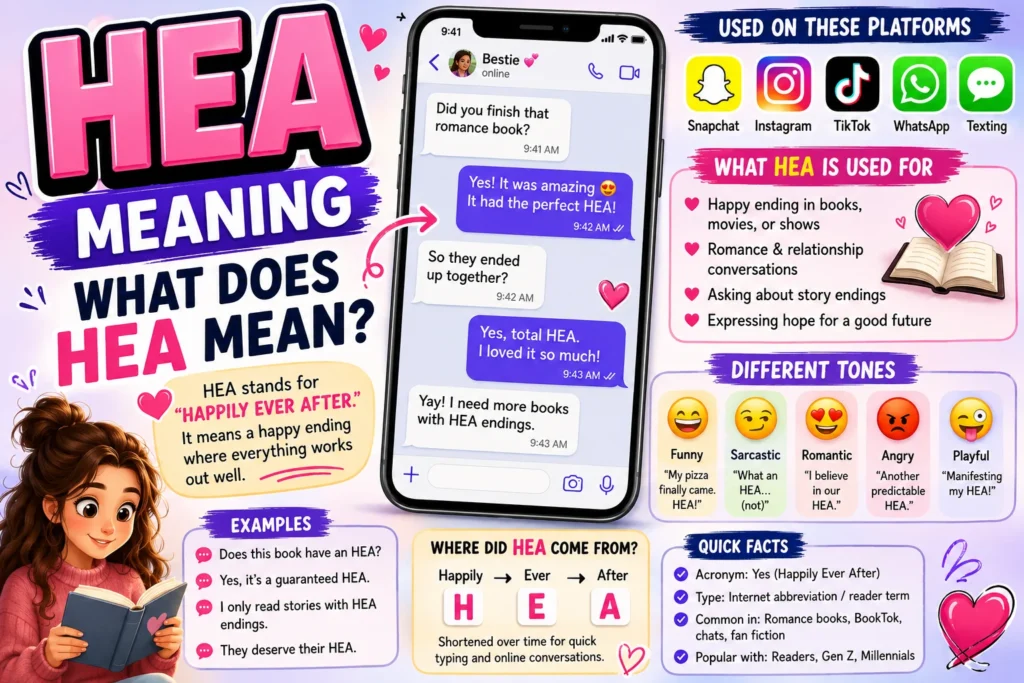

HEA stands for “Happily Ever After.” In texting, social media, romance novels, and online conversations, it refers to a happy ending where characters, couples, or situations end positively and successfully.
If you’ve seen HEA on TikTok, Snapchat, Instagram, WhatsApp, BookTok, or in online discussions about romance books, you may have wondered what it means. While some internet abbreviations have multiple interpretations, HEA most commonly means Happily Ever After, especially in relationship-related conversations and storytelling communities.
This guide explains the HEA meaning in text, HEA slang meaning, how people use it in chat, and what it means on social media platforms. You’ll also learn how the tone changes in different situations, how to respond when someone uses HEA, and why this abbreviation has become popular across modern digital communication.
What Does HEA Mean?
HEA stands for:
Happily Ever After
It describes a happy ending where the main characters achieve lasting happiness, usually in romantic relationships.
The term is especially common in:
- Romance novels
- Fan fiction
- TikTok book communities
- Instagram book reviews
- Online storytelling discussions
- Text conversations about movies and books
Example
A: Does the book have an HEA?
B: Yes, the couple ends up together.
In this conversation, HEA means the story ends positively for the romantic couple.
HEA Meaning in Text
In texting, HEA usually refers to a happy ending.
People often use it when discussing:
- Movies
- TV shows
- Books
- Relationships
- Fictional characters
Example
A: I just finished that romance novel.
B: Did it have an HEA?
A: Yes, thankfully!
The abbreviation helps people communicate quickly without repeatedly typing “Happily Ever After.”
HEA Slang Meaning
Although HEA is technically an abbreviation rather than traditional slang, many internet users treat it as an internet slang term because it is widely used in casual conversations.
The slang meaning remains:
A happy ending where everything works out well.
It often carries emotional or romantic implications.
For example:
“I’m only reading books with HEA endings this year.”
This means the person prefers stories that conclude positively.
What Does HEA Mean in Chat?
When someone uses HEA in chat, they are usually talking about a successful or satisfying ending.
Examples include:
Relationship Discussions
A: Do they stay together?
B: Yep, it’s HEA.
Movie Discussions
A: Is the ending sad?
B: No, definitely HEA.
Friend Conversations
A: I hope things work out for them.
B: Same. They deserve an HEA.
In chat environments, the abbreviation saves time while remaining widely understood among readers.
HEA Meaning on Snapchat
On Snapchat, HEA often appears in conversations about:
- Relationships
- Dating stories
- Book recommendations
- TV shows
- Celebrity couples
Example
Snap Message:
“Finally found a romance series with a guaranteed HEA.”
The sender is saying the series provides a happy ending.
Snapchat users frequently shorten phrases, making HEA a convenient texting abbreviation.
HEA Meaning on Instagram
Instagram users commonly use HEA in:
- Book review captions
- Relationship posts
- Reels
- Story discussions
Example Caption
“Five romance books with the best HEA endings.”
This tells followers the books conclude happily.
The term is especially popular among readers and romance enthusiasts.
HEA Meaning on TikTok
TikTok has significantly increased awareness of HEA.
BookTok creators often categorize books according to whether they contain:
- HEA (Happily Ever After)
- HFN (Happy For Now)
- Tragic endings
- Cliffhangers
Example TikTok Comment
“Does this book have an HEA?”
Many viewers ask this question before investing time in a story.
For romance readers, the answer can influence whether they decide to read the book.
HEA Meaning on WhatsApp
WhatsApp users may use HEA in casual conversations about:
- Relationships
- Books
- Movies
- Friends’ love lives
Example
A: Think they’ll get married?
B: Looks like an HEA to me.
This suggests the relationship is likely headed toward a happy future.
Is HEA an Acronym, Short Form, or Slang?
Many users wonder how HEA should be classified.
HEA Is an Acronym
HEA is primarily an acronym.
Each letter represents a word:
- H = Happily
- E = Ever
- A = After
The abbreviation directly comes from the full phrase.
Is HEA a Short Form?
Yes.
HEA is also a shortened version of a longer phrase.
Instead of typing three words, users type three letters.
Is HEA a Phonetic Spelling?
No.
A phonetic spelling mimics how a word sounds.
Examples include:
- Gonna
- Wanna
- Lemme
HEA does not fall into this category.
Is HEA a Typo-Turned Slang?
No.
Unlike some internet terms that originated from typing mistakes, HEA was intentionally created as an abbreviation.
Its usage comes from literary communities rather than accidental misspellings.
Tone and Context Variations of HEA
The meaning of HEA remains generally consistent, but the emotional tone can change depending on context.
Funny Tone
Sometimes HEA is used humorously.
Example
A: My pizza finally arrived after two hours.
B: Sounds like a true HEA.
A: Best ending ever.
The term is jokingly applied to a non-romantic situation.
Sarcastic Tone
People occasionally use HEA sarcastically.
Example
A: The printer broke again.
B: Wow, what an HEA.
A: Definitely not.
Here, the speaker is intentionally using the opposite of the literal meaning.
Romantic Tone
This is the most common usage.
Example
A: Do they get together?
B: Yes, it’s a perfect HEA.
A: That’s exactly what I wanted.
The term emphasizes emotional satisfaction.
Angry Tone
HEA is rarely used angrily, but context can create frustration.
Example
A: Another romance with a predictable HEA.
B: I’m getting tired of those endings.
The frustration is directed at the story rather than the abbreviation itself.
Playful Tone
HEA often appears playfully in relationship discussions.
Example
A: Think we’ll get our HEA?
B: Only if you keep buying me coffee.
A: Deal.
The term becomes a lighthearted reference to future happiness.
Mini Real-Life Conversation Examples
Example 1
A: Is the ending happy?
B: Yep, total HEA.
A: Good. I needed that.
Example 2
A: I don’t want another sad romance.
B: This one has an HEA.
A: Perfect.
Example 3
A: Did your favorite couple stay together?
B: Yes, they got their HEA.
A: Finally.
Example 4
A: Is that movie worth watching?
B: Depends. It has an HEA.
A: Then I’m interested.
Example 5
A: What are you reading?
B: A romance novel with a guaranteed HEA.
A: Sounds relaxing.
Example 6
A: Do you believe in HEA in real life?
B: I’d like to think so.
A: Same.
Example 7
A: Did the show end well?
B: Pretty much an HEA.
A: Nice.
Example 8
A: Why do romance readers care so much about HEA?
B: Because happy endings feel rewarding.
A: Fair point.
Example 9
A: Is this another tragedy?
B: Nope, full HEA.
A: Thank goodness.
Example 10
A: What does HEA mean?
B: Happily Ever After.
A: Got it.
continue
Real Chat Examples of HEA
The best way to understand HEA is to see how people actually use it in conversations. Below are realistic examples you might encounter in texts, group chats, TikTok comments, or online book communities.
Example 1
A: I just finished that romance novel.
B: Did it have an HEA?
A: Yes, and it was worth the wait.
Example 2
A: Should I watch that movie?
B: If you like HEA endings, definitely.
A: Sold.
Example 3
A: I’m tired of sad books.
B: Then stick to authors who promise an HEA.
A: Great advice.
Example 4
A: Do the main characters get together?
B: Yep, complete HEA.
A: Perfect.
Example 5
A: I cried during chapter 20.
B: Trust me, the HEA makes it worth it.
A: I hope so.
Example 6
A: Why is everyone talking about HEA?
B: Because nobody wants their favorite couple to break up.
A: Fair enough.
Example 7
A: I need a feel-good story.
B: This book has one of the best HEAs I’ve read.
A: Adding it to my list.
Example 8
A: Is the ending predictable?
B: Kind of, but the HEA is satisfying.
A: That’s what matters.
Example 9
A: Think we’ll get our HEA someday?
B: Only if you stop being late.
A: I’ll work on it.
Example 10
A: I finished the series.
B: Happy ending?
A: Yep, total HEA.
Example 11
A: That couple belongs together.
B: Hopefully the writer gives them an HEA.
A: Fingers crossed.
Example 12
A: Is this a romance or a tragedy?
B: Romance with HEA.
A: Exactly what I wanted.
Example 13
A: BookTok keeps recommending this novel.
B: Because the HEA is amazing.
A: Now I’m curious.
Example 14
A: Does every romance book need an HEA?
B: Not necessarily, but many readers expect one.
A: Makes sense.
Example 15
A: I just got engaged.
B: Real-life HEA unlocked!
A: That’s one way to put it.
Grammar and Language Role of HEA
Understanding how HEA functions in language can help you use it naturally.
Part of Speech
HEA is generally used as a noun phrase abbreviation.
It refers to:
- A happy ending
- A successful romantic outcome
- A satisfying conclusion
Example
“The book delivers a strong HEA.”
In this sentence, HEA acts like a noun.
Sentence Position
HEA can appear in different parts of a sentence.
At the End
“The story ends with an HEA.”
In the Middle
“Readers looking for an HEA usually enjoy this book.”
As a Standalone Response
A: Happy ending?
B: HEA.
Can HEA Replace a Full Sentence?
Sometimes.
Example
A: Do they end up together?
B: HEA.
The single abbreviation answers the entire question.
Tone Impact
HEA generally creates a positive tone.
It often communicates:
- Hope
- Satisfaction
- Happiness
- Emotional reward
Readers frequently associate the term with comfort and optimism.
Formal vs Informal Use
HEA is primarily informal.
Appropriate Contexts
✅ Text messages
✅ Social media
✅ Book reviews
✅ Online discussions
✅ Reader communities
Less Appropriate Contexts
❌ Academic papers
❌ Formal business communication
❌ Professional reports
In formal writing, it’s usually better to write out “Happily Ever After.”
How to Reply When Someone Says HEA
The best response depends on the conversation.
Funny Replies
Example 1
Them: It has an HEA.
You: Good, my emotions can’t handle another tragedy.
Example 2
Them: HEA guaranteed.
You: My stress level just dropped.
Serious Replies
Example 1
Them: The book ends with an HEA.
You: That’s exactly what I was hoping for.
Example 2
Them: Yes, there’s an HEA.
You: Thanks for letting me know.
Flirty Replies
Example 1
Them: Every romance needs an HEA.
You: Maybe we’re writing ours right now.
Example 2
Them: Do you believe in HEA?
You: Depends. Are you in the story?
Neutral Replies
Example 1
Them: HEA.
You: Nice.
Example 2
Them: The ending is HEA.
You: Sounds good.
Example 3
Them: Readers loved the HEA.
You: I’ll check it out.
HEA vs Similar Terms
Many readers and social media users confuse HEA with other storytelling abbreviations.
Comparison Table
| Term | Meaning | Usage Context | Tone | Popularity | Confusion Risk |
|---|---|---|---|---|---|
| HEA | Happily Ever After | Romance books, chats | Positive | Very High | Low |
| HFN | Happy For Now | Romance stories | Optimistic | High | Medium |
| OTP | One True Pairing | Fan communities | Romantic | High | Medium |
| Endgame | Couple that stays together | TV and fandom culture | Positive | High | Medium |
| Canon | Official storyline | Fan discussions | Neutral | High | Low |
| Tragic Ending | Opposite of HEA | Literature and movies | Negative | High | Very Low |
HEA vs HFN
This is the comparison readers search most often.
HEA (Happily Ever After)
- Long-term happiness
- Stable future implied
- Traditional romance ending
HFN (Happy For Now)
- Happy at the moment
- Future remains uncertain
- More realistic or open-ended
Many romance readers specifically look for HEA because it provides stronger emotional closure.
Who Uses HEA?
Age Groups
HEA is most commonly used by:
- Teen readers
- Young adults
- Romance novel fans
- Online book communities
However, readers of all ages recognize the term.
Gen Z vs Millennials
Gen Z
Gen Z frequently encounters HEA through:
- TikTok
- BookTok
- Instagram Reels
- Fan fiction
Millennials
Millennials often know HEA from:
- Romance novels
- Goodreads reviews
- Online book forums
Both groups use the term regularly.
Regions Where HEA Is Common
HEA is widely recognized in:
- United States
- United Kingdom
- Canada
- Australia
- Global English-speaking communities
The abbreviation has become international thanks to social media and online reading platforms.
Platforms Where HEA Is Most Common
You are most likely to see HEA on:
- TikTok (especially BookTok)
- Goodreads
- Reddit book communities
- Facebook reading groups
- WhatsApp chats
- Text messages
In the final section, the article would cover:
- Origin and Internet Culture Insight
- Why People Say HEA on TikTok
- Is HEA Rude or Offensive?
- Experience-Based Insight
- SEO FAQ Section
- PAA (People Also Ask) FAQs
- Conclusion
- Meta Title
- Meta Description
continue
Origin and Internet Culture Insight
Understanding where HEA comes from helps explain why it has become such a common term in online conversations, especially among readers and social media users.
Where Did HEA Originate?
The phrase “Happily Ever After” has existed for centuries.
It is commonly associated with:
- Fairy tales
- Children’s stories
- Folklore
- Romance novels
Classic stories often ended with phrases like:
“And they lived happily ever after.”
Over time, readers and writers shortened the phrase to HEA for convenience.
As online forums, book blogs, and reader communities grew, the abbreviation became a standard part of internet vocabulary.
How HEA Became Popular Online
The growth of online reading communities helped HEA spread rapidly.
Popular platforms included:
- Goodreads
- Romance book forums
- Fan fiction websites
- Book blogs
- Reddit communities
Origin and Internet Culture Insight
Understanding where HEA comes from helps explain why it has become such a common term in online conversations, especially among readers and social media users.
Where Did HEA Originate?
The phrase “Happily Ever After” has existed for centuries.
It is commonly associated with:
- Fairy tales
- Children’s stories
- Folklore
- Romance novels
Classic stories often ended with phrases like:
“And they lived happily ever after.”
Over time, readers and writers shortened the phrase to HEA for convenience.
As online forums, book blogs, and reader communities grew, the abbreviation became a standard part of internet vocabulary.
How HEA Became Popular Online
The growth of online reading communities helped HEA spread rapidly.
Popular platforms included:
- Goodreads
- Romance book forums
- Fan fiction websites
- Book blogs
- Reddit communities
Instead of repeatedly typing “Happily Ever After,” users simply wrote “HEA.”
This saved time and quickly became a recognized shorthand among readers.
The Influence of TikTok and BookTok
One major reason HEA has become more visible is BookTok.
BookTok is the reading community on TikTok where users:
- Review books
- Share recommendations
- Discuss favorite characters
- Debate story endings
Many viewers specifically ask:
- Does it have an HEA?
- Is it HFN or HEA?
- Is the ending worth it?
As a result, millions of TikTok users now recognize the abbreviation.
Example TikTok Comment
User 1: Is there an HEA?
User 2: Yes, and it’s one of the best endings I’ve read.
This type of conversation appears constantly on BookTok.
HEA and Meme Culture
Although HEA is not primarily a meme, internet users often apply it humorously to everyday situations.
Example
“My food finally arrived after two hours. HEA achieved.”
Example
“Finished all my assignments. Personal HEA unlocked.”
In these cases, HEA becomes a playful way to describe a successful outcome.
Fast Typing Culture
Like many texting abbreviations, HEA benefits from internet users’ preference for speed.
Instead of writing:
“Happily Ever After”
People type:
“HEA”
This fits naturally into modern digital communication where short, recognizable abbreviations are preferred.
Why People Say HEA on TikTok
Many users discover HEA through TikTok before seeing it anywhere else.
Book Recommendations
TikTok creators frequently categorize books by ending type.
Examples:
- HEA
- HFN (Happy For Now)
- Sad Ending
- Cliffhanger
Readers often want to know what emotional experience they are getting before starting a book.
Relationship Discussions
TikTok users also use HEA in relationship-related videos.
Example
“Manifesting my HEA.”
This means the person hopes for a successful, happy relationship.
Character Shipping
Fans discussing fictional couples frequently use HEA.
Example
“They deserve an HEA.”
This means viewers want the characters to end up happy together.
Emotional Comfort
One reason HEA remains popular is that many readers enjoy stories that provide emotional closure.
After investing hours in a book or series, people often want reassurance that the ending will feel rewarding.
HEA represents that promise.
Is HEA Rude?
No.
HEA is not considered rude.
It is generally viewed as:
- Positive
- Friendly
- Harmless
- Appropriate
Most people associate it with happiness and successful endings.
Is HEA a Bad Word?
No.
HEA is not offensive, vulgar, or inappropriate.
Unlike some internet abbreviations that contain profanity, HEA is completely family-friendly.
This makes it suitable for:
- Schools
- Libraries
- Educational discussions
- Reading communities
- Workplace conversations about books
Should You Use HEA at School or Work?
Usually yes.
Because HEA simply means “Happily Ever After,” it is acceptable in most environments.
Appropriate Examples
✅ Book clubs
✅ Literature discussions
✅ Classroom conversations
✅ Reading assignments
✅ Casual workplace chats about books
Less Appropriate Examples
In highly formal writing, it may be better to spell out the full phrase:
“Happily Ever After.”
Experience-Based Insight
Based on how readers and social media users actually communicate, HEA is rarely used as a standalone internet slang term unrelated to stories.
Instead, it almost always appears when discussing:
- Romance books
- TV shows
- Movies
- Fan fiction
- Relationships
In reader communities, asking whether a book has an HEA is often one of the first questions people ask before deciding whether to read it.
Many romance readers specifically seek books with HEA endings because they enjoy stories that provide emotional satisfaction and closure.
Frequently Asked Questions
What Does HEA Mean in Text?
HEA stands for Happily Ever After. In text messages, it usually refers to a happy ending in a story, relationship, movie, or life situation.
What Does HEA Mean on Snapchat?
On Snapchat, HEA typically means Happily Ever After and is often used when discussing books, relationships, or positive outcomes.
What Does HEA Mean on TikTok?
On TikTok, especially within BookTok communities, HEA means Happily Ever After and describes a story where the characters end up happy together.
What Does HEA Mean on Instagram?
Instagram users often use HEA in:
- Book reviews
- Reading recommendations
- Relationship content
- Romance-related posts
The meaning remains Happily Ever After.
Is HEA the Same as HFN?
No.
HEA means Happily Ever After, suggesting long-term happiness.
HFN means Happy For Now, suggesting happiness in the present without guaranteeing the future.
Can Adults Use HEA?
Absolutely.
HEA is commonly used by:
- Teen readers
- Adults
- Romance authors
- Reviewers
- Publishers
The term is not age-specific.
How Do You Respond to HEA?
Possible responses include:
- “That’s good to hear.”
- “I love happy endings.”
- “Perfect, I’ll read it.”
- “Exactly what I was hoping for.”
The best response depends on the context.
Does Every Romance Novel Need an HEA?
Not necessarily.
However, traditional romance publishing generally expects a happy ending or emotionally satisfying conclusion.
Many readers actively seek books with HEA endings.
What does HEA stand for?
HEA stands for Happily Ever After, a phrase commonly used in romance novels, fan fiction, movies, and online discussions.
Why do romance readers care about HEA?
Many readers enjoy emotional closure and want reassurance that the main characters end up happy together.
Is HEA only used in books?
No.
While HEA is most common in literature discussions, it is also used on TikTok, Instagram, Snapchat, WhatsApp, and general online conversations.
What is the difference between HEA and a happy ending?
HEA is a specific type of happy ending that strongly implies long-term happiness and relationship success.
Why do people ask if a book has an HEA?
Some readers prefer avoiding sad or tragic endings and want to know whether the story concludes positively.
Is HEA considered internet slang?
It is more accurately described as an acronym or abbreviation, though many people treat it as internet slang due to its widespread online use.
Can HEA refer to real-life relationships?
Yes.
People sometimes jokingly use HEA to describe marriages, engagements, or successful relationships.
Is HEA popular on BookTok?
Yes.
HEA is one of the most commonly used abbreviations in BookTok communities and romance-reading circles.
Final Thoughts
HEA stands for Happily Ever After, a widely recognized abbreviation used in texting, social media, romance novels, fan fiction, and online reader communities.
Whether you encounter it on TikTok, Snapchat, Instagram, WhatsApp, Goodreads, or Reddit, the meaning is usually the same: a happy and satisfying ending where characters achieve lasting happiness.
Quick Recap
- HEA = Happily Ever After
- Most common in romance books and online reading communities
- Popular on TikTok and BookTok
- Positive and family-friendly
- Often used when discussing happy endings
Common Mistakes to Avoid
❌ Assuming HEA is negative slang
❌ Confusing HEA with HFN
❌ Thinking it only applies to books
❌ Treating it as a rude abbreviation
When to Use HEA
✅ Discussing romance novels
✅ Talking about movies or TV shows
✅ Discussing fictional couples
✅ Referring to happy endings
When to Avoid HEA
❌ Highly formal academic writing
❌ Professional reports where abbreviations are unclear
In most casual conversations, HEA is a simple and widely understood way to refer to a happy ending.