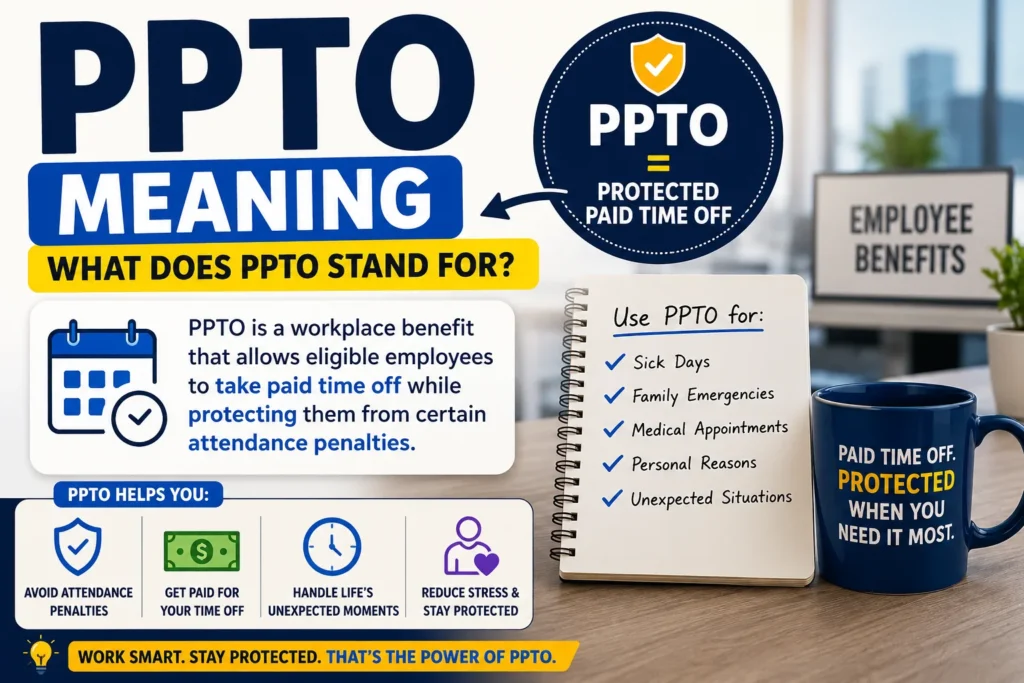

PPTO stands for Protected Paid Time Off, a workplace benefit that allows eligible employees to take paid time away from work while protecting them from certain attendance-related penalties.
If you’ve searched for “PPTO meaning,” you’re probably trying to understand what PPTO stands for, how it differs from PTO, whether you can use it when you’re sick, and how employers handle attendance when PPTO is applied.
Unlike internet slang or texting abbreviations, PPTO is an employment and human resources term commonly used in workplaces across the United States. It is especially associated with large employers that offer attendance protection systems alongside paid leave benefits.
This guide explains the meaning of PPTO, how it works, when employees use it, how it differs from regular PTO, and why it has become such an important workplace benefit.
What Does PPTO Mean?
PPTO stands for:
Protected Paid Time Off
It is a type of paid leave that allows employees to miss work while still receiving pay and, in many workplace systems, avoiding attendance penalties that would normally occur for an absence.
The key word is “Protected.”
While standard PTO simply provides paid time away from work, PPTO often includes additional attendance protection when used according to company policy.
In simple terms:
- PTO = Paid time off
- PPTO = Protected paid time off
Many employees use PPTO when unexpected situations arise.
Examples include:
- Personal illness
- Family emergencies
- Medical appointments
- Transportation issues
- Childcare emergencies
- Unexpected personal situations
Why People Search for PPTO Meaning
PPTO has become a popular search term because many employees encounter it during onboarding, employee training, attendance reviews, or payroll discussions.
Common questions include:
- What does PPTO mean?
- Is PPTO different from PTO?
- Can PPTO prevent attendance points?
- How do I use PPTO?
- Does PPTO expire?
- How much PPTO can I earn?
Because policies vary by employer, many workers search online to understand the general concept before reviewing their company’s specific rules.
PPTO Meaning Explained in Simple Words
Imagine you wake up feeling sick.
Normally, missing work might result in:
- Attendance points
- Absence records
- Disciplinary action
However, if you have available PPTO hours and use them according to company policy, the absence may be protected.
You still receive compensation for the missed time and may avoid attendance-related consequences.
This protection is what makes PPTO different from traditional paid leave.
Is PPTO an Acronym?
Yes.
PPTO is an acronym.
Each letter represents a word:
- P = Protected
- P = Paid
- T = Time
- O = Off
Together, the letters form the phrase:
Protected Paid Time Off
Is PPTO a Short Form?
Yes.
PPTO serves as a shortened version of a longer workplace term.
Human resources departments, payroll systems, and employee portals often use PPTO because it is easier to display and track.
Is PPTO Internet Slang?
No.
PPTO is not internet slang.
Unlike abbreviations such as:
- LOL
- BRB
- TY
- FML
PPTO is a formal workplace abbreviation used in employment settings.
Is PPTO Used on Snapchat, TikTok, Instagram, or WhatsApp?
Generally, no.
Most searches for PPTO are related to employment, scheduling, attendance, and payroll rather than social media communication.
However, employees may discuss PPTO in workplace-related conversations on:
- TikTok
- Facebook Groups
- Workplace forums
- Employee communities
Example:
“I used PPTO today because I woke up sick.”
In this case, the person is discussing a work benefit rather than using internet slang.
How PPTO Works
The exact process varies by employer, but PPTO usually follows a similar structure.
Step 1: Employees Earn PPTO
Many companies allow employees to accumulate PPTO hours over time.
Hours may accrue based on:
- Hours worked
- Length of employment
- Company policy
- Employment classification
Step 2: Employee Needs Time Off
An unexpected situation occurs.
Examples:
- Illness
- Emergency
- Family obligation
- Personal issue
Step 3: PPTO Is Applied
The employee submits PPTO through:
- Scheduling software
- Employee portal
- HR system
- Time-off application
Step 4: Attendance Protection Applies
If the request follows company policy, attendance consequences may be reduced or eliminated.
PPTO vs PTO: What’s the Difference?
This is one of the most common questions employees ask.
| Feature | PTO | PPTO |
|---|---|---|
| Paid Leave | Yes | Yes |
| Scheduled Vacation Use | Yes | Yes |
| Emergency Absences | Sometimes | Often |
| Attendance Protection | Usually No | Usually Yes |
| Policy Restrictions | Varies | Varies |
| Workplace Protection | Limited | Higher |
The primary difference is that PPTO often provides attendance protection in addition to compensation.
Examples of PPTO in Real Life
Example 1: Sick Day
Sarah wakes up with a fever.
Instead of receiving an attendance point, she uses available PPTO hours.
Her absence is protected according to company policy.
Example 2: Family Emergency
John receives a call that his child needs to be picked up from school.
He leaves work early and uses PPTO to cover the remaining shift.
Example 3: Car Trouble
Emma’s car won’t start.
She cannot make it to work.
She applies PPTO to cover her missed hours.
Example 4: Medical Appointment
David has an unexpected medical appointment.
He uses PPTO for part of the day.
Example 5: Personal Emergency
An urgent personal issue arises.
PPTO allows the employee to focus on the situation without immediately worrying about attendance penalties.
Tone and Context Variations
Although PPTO is a workplace term rather than slang, conversations about it can still vary in tone.
Serious Tone
Manager:
“Did you submit your PPTO request?”
Employee:
“Yes, I entered it this morning.”
Frustrated Tone
Employee:
“My car broke down.”
Coworker:
“Good thing you still have PPTO available.”
Humorous Tone
Employee:
“Monday morning already? Time to use PPTO.”
Coworker:
“Nice try.”
Sarcastic Tone
Employee:
“Another mandatory meeting?”
Coworker:
“If only PPTO covered meetings.”
Playful Tone
Employee:
“Coffee machine is broken.”
Coworker:
“Sounds like a PPTO emergency.”
Real Workplace Conversation Examples
Example 1
Employee:
I woke up sick today.
Coworker:
Do you have PPTO available?
Employee:
Yes, thankfully.
Example 2
Manager:
Will you be in tomorrow?
Employee:
I may need to use PPTO.
Manager:
Just submit the request.
Example 3
Employee:
My babysitter canceled.
Coworker:
That’s stressful.
Employee:
I’m probably using PPTO.
Example 4
Employee:
My flight got delayed.
Manager:
Use PPTO if needed.
Employee:
Will do.
Example 5
Employee:
I need to leave early.
Manager:
Do you have enough PPTO?
Employee:
Yes.
Example 6
Employee:
I forgot I had a doctor’s appointment.
Coworker:
PPTO can help with that.
Employee:
Exactly.
Example 7
Employee:
I have several PPTO hours saved up.
Coworker:
Nice. That’s useful for emergencies.
Example 8
Employee:
My child is sick.
Manager:
Take care of your family and submit PPTO.
Employee:
Thank you.
Why Employers Offer PPTO
Companies recognize that unexpected life events happen.
Without attendance protection, employees may feel pressured to work when they should stay home.
PPTO helps create balance between:
- Business operations
- Employee well-being
- Attendance accountability
- Workplace flexibility
It can also reduce workplace stress and improve employee satisfaction.
Grammar and Language Role of PPTO
Unlike slang terms used in texting, PPTO is a workplace acronym that functions as a noun in most conversations.
Part of Speech
PPTO is generally used as a noun because it refers to a specific employment benefit.
Examples:
- “I still have 12 hours of PPTO.”
- “My PPTO balance increased this month.”
- “I’m using PPTO tomorrow.”
Sentence Position
PPTO can appear:
At the beginning of a sentence
- “PPTO helped me avoid an attendance issue.”
In the middle of a sentence
- “I submitted my PPTO request this morning.”
At the end of a sentence
- “I’m covering the absence with PPTO.”
Does PPTO Replace a Full Sentence?
No.
Unlike texting abbreviations such as LOL or TY, PPTO does not usually replace an entire sentence.
Instead, it functions as a workplace term within a larger sentence.
Tone Impact
PPTO itself is neutral.
However, the surrounding conversation determines the tone.
Examples:
- Professional: “I used PPTO for a medical appointment.”
- Casual: “Glad I saved some PPTO.”
- Frustrated: “Good thing I had PPTO left.”
Formal vs Informal Use
| Context | Appropriate? |
|---|---|
| HR Meetings | Yes |
| Employee Handbooks | Yes |
| Payroll Discussions | Yes |
| Workplace Emails | Yes |
| Casual Conversations | Yes |
| Academic Writing | Sometimes |
| Social Media Slang | Rarely |
How to Reply When Someone Mentions PPTO
Many people search for ways to respond when coworkers discuss PPTO.
Neutral Reply
- “Got it.”
- “That makes sense.”
- “Hope everything works out.”
Professional Reply
- “Thanks for letting me know.”
- “Please submit the request through the system.”
- “I appreciate the update.”
Supportive Reply
- “Take care of yourself.”
- “Hope everything is okay.”
- “Wishing you a quick recovery.”
Friendly Reply
- “Good thing you had PPTO available.”
- “That’s exactly what PPTO is for.”
Humorous Reply
- “Sounds like PPTO came to the rescue.”
- “Your PPTO balance is today’s hero.”
PPTO vs Similar Workplace Terms
Many employees confuse PPTO with other leave-related terms.
| Term | Meaning | Usage Context | Tone | Popularity | Confusion Risk |
|---|---|---|---|---|---|
| PPTO | Protected Paid Time Off | Workplace leave | Neutral | High | Medium |
| PTO | Paid Time Off | Vacation and leave | Neutral | Very High | High |
| Sick Leave | Paid illness leave | Health-related absences | Neutral | High | Low |
| Personal Leave | Time away for personal reasons | Workplace leave | Neutral | Medium | Medium |
| Vacation Time | Planned time off | Travel and leisure | Positive | High | Low |
| Unpaid Leave | Time off without pay | Extended absences | Neutral | Medium | Low |
| Overtime | Extra working hours | Opposite concept | Professional | High | Low |
Who Uses PPTO?
Age Groups
PPTO is used by working adults rather than specific internet generations.
Common users include:
- Young employees
- Full-time workers
- Part-time workers
- Retail employees
- Warehouse workers
- Corporate employees
Gen Z vs Millennials
Both generations commonly encounter PPTO in the workplace.
Gen Z workers often learn about PPTO during their first jobs, while Millennials and older employees typically use it as part of ongoing employment benefits.
Geographic Usage
PPTO is primarily associated with:
- United States workplaces
- Large employers
- Retail organizations
- Distribution centers
- Corporate environments
Platforms Where PPTO Is Discussed
Employees frequently discuss PPTO on:
- TikTok
- Facebook Groups
- Workplace forums
- Employee discussion boards
- YouTube workplace advice channels
Origin of PPTO
The concept behind PPTO emerged from evolving attendance-management systems.
Traditionally, employees could receive penalties for missing work, even when facing legitimate emergencies.
To create a more balanced approach, many employers introduced protected leave systems that allowed workers to use accrued paid time without receiving attendance penalties.
As digital scheduling systems became common, the acronym PPTO became widely recognized among employees.
Why People Talk About PPTO on TikTok
TikTok has become a major source of workplace discussions.
Employees frequently post content about:
- Attendance policies
- Scheduling concerns
- Workplace benefits
- Time-off strategies
- Employee experiences
Many viral videos discuss:
- How PPTO works
- When to use PPTO
- Differences between PTO and PPTO
- Attendance point systems
This online discussion has significantly increased searches for “PPTO meaning.”
PPTO and Workplace Culture
PPTO reflects a broader shift in workplace culture.
Modern employers increasingly recognize that employees occasionally face:
- Illness
- Family emergencies
- Transportation problems
- Mental health needs
- Unexpected personal responsibilities
Protected leave policies help employees manage these situations while maintaining workplace accountability.
Is PPTO Rude?
No.
PPTO is not rude.
It is simply a workplace acronym used in employment discussions.
Is PPTO a Bad Word?
No.
PPTO is entirely professional and appropriate.
It appears in:
- Employee handbooks
- HR documents
- Payroll systems
- Workplace policies
Can You Use PPTO at School?
The term itself is fine to mention.
However, PPTO specifically relates to employment benefits rather than educational attendance systems.
Can You Use PPTO in the Office?
Absolutely.
In fact, workplace environments are where PPTO is most commonly used.
Experience-Based Insight
Based on real-world workplace observations, employees most often discuss PPTO when unexpected situations arise. Rather than using it for planned vacations, many workers save PPTO for emergencies, illnesses, childcare issues, transportation problems, and last-minute scheduling conflicts. This practical use explains why searches for “PPTO meaning” continue to grow among employees trying to understand their benefits.
Frequently Asked Questions
What does PPTO mean?
PPTO stands for Protected Paid Time Off, a type of paid leave that may protect employees from certain attendance penalties when used according to company policy.
Is PPTO the same as PTO?
No.
PTO means Paid Time Off, while PPTO generally includes additional attendance protection features.
Can PPTO be used for sickness?
In many workplaces, yes.
Employees commonly use PPTO for illness, though specific policies vary by employer.
Does PPTO prevent attendance points?
Often, yes.
However, the exact rules depend on company policy and how PPTO is submitted.
Is PPTO paid?
Yes.
PPTO is paid leave.
Employees typically receive compensation for approved PPTO hours.
Do all companies offer PPTO?
No.
Some companies offer PTO only, while others provide PPTO or similar protected leave programs.
Can part-time employees earn PPTO?
This depends on employer policy.
Many companies allow eligible part-time workers to accrue PPTO.
Does PPTO expire?
Some employers allow rollover, while others place limits on accrual or annual balances.
Always check your company’s policy.
What is the full form of PPTO?
Protected Paid Time Off.
Why do employees use PPTO?
To take paid leave while potentially avoiding attendance penalties.
Is PPTO better than PTO?
Neither is universally better, but PPTO generally provides additional attendance protection.
Can managers deny PPTO?
Policies vary by employer, so employees should review official guidelines.
How do I check my PPTO balance?
Most employers provide balance information through employee portals, payroll systems, or HR departments.
Is PPTO only for emergencies?
Not always. Usage rules differ by company.
Does PPTO affect payroll?
PPTO hours are usually paid similarly to regular working hours.
Why is PPTO important?
It provides flexibility and protection during unexpected life events.
Final Thoughts
PPTO, or Protected Paid Time Off, is one of the most valuable workplace benefits available to employees. Unlike standard PTO, PPTO often provides both compensation and attendance protection when unexpected situations arise.
Whether you’re dealing with illness, a family emergency, transportation problems, or another personal issue, understanding how PPTO works can help you make informed decisions about your employment benefits.
Quick Usage Tips
- Learn your employer’s specific PPTO policy.
- Monitor your available balance regularly.
- Save some PPTO for unexpected emergencies.
- Submit requests correctly and on time.
- Understand how PPTO differs from PTO.
Common Mistakes to Avoid
- Assuming every employer uses the same PPTO rules.
- Confusing PPTO with standard PTO.
- Waiting too long to submit requests.
- Not checking attendance policy details.
- Using unofficial information instead of company guidelines.
When to Use PPTO
- Illness
- Family emergencies
- Medical appointments
- Unexpected personal situations
- Transportation problems
When to Avoid Using PPTO
- When another leave category is more appropriate.
- When company policies require a different process.
- When you have not reviewed workplace guidelines.