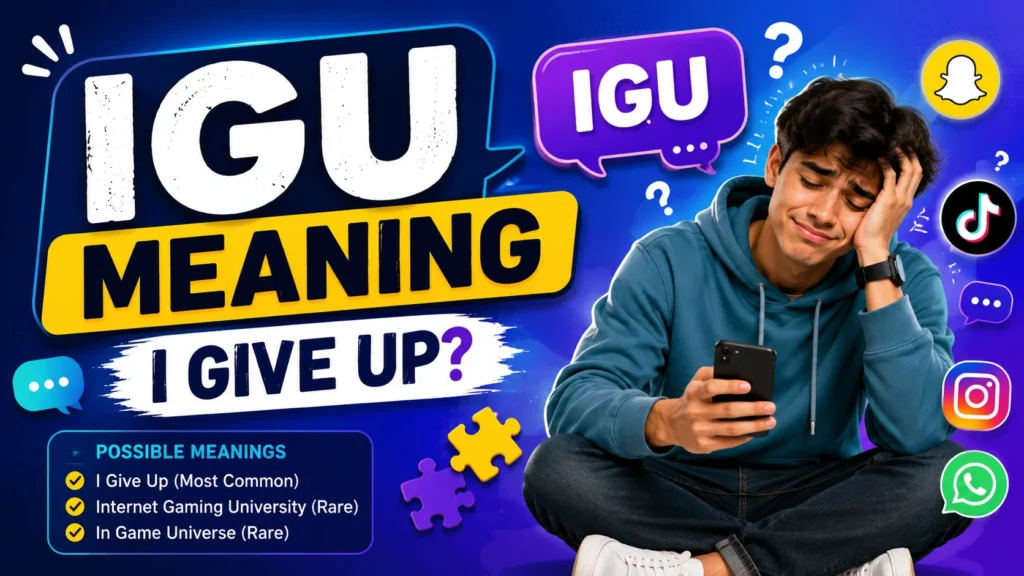

IGU usually means “I Give Up” in texting and online chats. It’s a popular internet abbreviation used when someone feels frustrated, defeated, overwhelmed, or jokingly admits they have no answer. People often search for IGU because it’s easy to confuse with similar abbreviations like IDK, ILY, and IKR.
While IGU can occasionally have niche meanings in specific communities, “I Give Up” is by far the most common meaning in texting, social media, and casual online conversations.
Meaning & Explanation
What Does IGU Mean in Text?
The most widely used meaning of IGU is:
IGU = I Give Up
People use it when:
- They’re frustrated
- They can’t solve a problem
- They’re joking about a difficult situation
- They’ve run out of ideas
- They’re overwhelmed
Examples:
- “I’ve been trying to fix this for two hours. IGU.”
- “IGU, this math problem wins.”
- “Nobody knows the answer? IGU.”
The phrase often carries a lighthearted tone rather than genuine defeat.
Is IGU an Acronym, Abbreviation, or Slang Word?
IGU is:
- An acronym
- A texting abbreviation
- Internet slang
Each letter represents a word:
- I = I
- G = Give
- U = Up
Because it originated in digital communication and casual texting culture, it’s considered internet slang as well.
Why Do People Use IGU?
People use IGU because it quickly expresses frustration without typing an entire sentence.
Instead of writing:
“I give up trying to figure this out.”
Users simply write:
“IGU.”
The abbreviation feels casual, relatable, and expressive.
Other Meanings of IGU
Although “I Give Up” is the most common interpretation, IGU may occasionally have specialized meanings in certain industries or online groups.
However, when seen in:
- Text messages
- Snapchat chats
- TikTok comments
- Instagram DMs
- Group chats
it almost always means “I Give Up.”
IGU Meaning on Different Platforms
IGU Meaning on TikTok
On TikTok, IGU commonly appears in:
- Reaction comments
- Funny videos
- Challenge posts
Examples:
- “IGU, this trend is impossible.”
- “I’ve watched this five times and IGU.”
TikTok users often use it humorously.
IGU Meaning on Instagram
Instagram users frequently use IGU in:
- Reel comments
- Story replies
- Direct messages
Example:
“IGU trying to understand this caption.”
It often signals playful confusion.
IGU Meaning on Snapchat
Snapchat is one of the most common places to see IGU.
Examples:
A: Did you finish the puzzle?
B: IGU after the first hour.
The abbreviation fits Snapchat’s quick conversational style.
IGU Meaning on WhatsApp
WhatsApp users often use IGU in:
- Friend group chats
- Family chats
- Casual conversations
Example:
“IGU trying to decide where to eat.”
IGU Meaning on X (Twitter)
On X, IGU appears in reaction posts and humorous commentary.
Examples:
- “IGU trying to understand this plot twist.”
- “IGU, the internet wins again.”
The abbreviation is often used to emphasize disbelief or exhaustion.
Tone & Context Variations
Funny Tone
A: Did you beat the game?
B: IGU after the third boss.
A: That bad?
B: Worse.
Sarcastic Tone
A: The website crashed again.
B: Amazing service.
A: IGU.
B: Honestly, same.
Playful Tone
A: Can you guess my favorite movie?
B: I’ve tried twenty times.
A: And?
B: IGU.
Serious Tone
A: Have you figured out your career decision?
B: Not yet. Some days I feel like IGU.
A: That’s understandable.
B: It’s a lot to process.
Real Chat Examples
Example 1
A: Did you solve the crossword?
B: IGU after clue number six.
A: That hard?
B: Apparently.
Example 2
A: Why are you laughing?
B: This meme broke my brain.
A: Really?
B: IGU.
Example 3
A: Did your computer finally work?
B: Nope.
A: What now?
B: IGU.
Example 4
A: Have you picked a restaurant?
B: I’ve looked at fifty menus.
A: And?
B: IGU.
Example 5
A: What happened in the movie?
B: IGU trying to explain it.
A: That confusing?
B: Extremely.
Example 6
A: Did you understand the assignment?
B: Not even a little.
A: Seriously?
B: IGU.
Example 7
A: Have you finished shopping?
B: I can’t decide.
A: Still?
B: IGU.
Example 8
A: Did you beat your friend in chess?
B: No chance.
A: Not even close?
B: IGU halfway through.
Example 9
A: Why are there so many tabs open?
B: I was researching something.
A: Found the answer?
B: IGU before I got there.
Example 10
A: Have you planned your vacation?
B: Too many choices.
A: That’s a good problem.
B: IGU anyway.
Example 11
A: Did you finish the puzzle?
B: The puzzle finished me.
A: So that’s a no?
B: IGU.
Grammar & Language Role
Part of Speech
IGU functions as:
- A phrase abbreviation
- A standalone statement
- A reaction expression
Sentence Position
IGU commonly appears:
- Alone as a response
- At the beginning of a sentence
- At the end of a sentence
Examples:
- IGU.
- IGU trying to understand this.
- I’ve tried everything, IGU.
Can IGU Replace a Full Sentence?
Yes.
Examples:
A: Did you solve it?
B: IGU.
The abbreviation works naturally as a complete response.
Formal vs Informal Register
| Context | Appropriate? |
|---|---|
| Texting | Yes |
| Snapchat | Yes |
| TikTok | Yes |
| Group Chats | Yes |
| Business Emails | No |
| Academic Writing | No |
IGU is strongly informal.
How to Reply When Someone Says IGU
Funny Reply
“The challenge wins this round.”
“At least you tried.”
Serious Reply
“Maybe take a break and come back later.”
“Want some help with it?”
Flirty Reply
“Good thing I’m here to save the day.”
“Need a personal problem-solver?”
Neutral Reply
“Fair enough.”
“That happens.”
Comparison Table
| Term | Meaning | Usage Context | Tone | Popularity | Confusion Risk |
|---|---|---|---|---|---|
| IGU | I Give Up | Frustration, reactions | Casual | High | Medium |
| IDK | I Don’t Know | Uncertainty | Neutral | Very High | Low |
| IKR | I Know, Right? | Agreement | Friendly | Very High | Low |
| SMH | Shaking My Head | Disapproval | Frustrated | High | Low |
| FML | Expressing frustration | Strong frustration | Dramatic | High | Medium |
| IGTG | I Got This Going | Opposite confidence | Positive | Low | High |
Who Uses This Term?
Age Group Breakdown
IGU is most common among:
- Teenagers
- Gen Z
- Young Millennials
Gen Z vs Millennials
Gen Z
- Uses IGU frequently in texting
- Often uses it humorously
Millennials
- More likely to use it when genuinely frustrated
- Common in group chats and social media
Regional Usage
IGU appears throughout:
- United States
- Canada
- United Kingdom
- Australia
- Global English-speaking communities
It isn’t tied to any specific region.
Platforms
| Platform | Usage Frequency |
|---|---|
| TikTok | High |
| High | |
| Snapchat | Very High |
| High | |
| X | Moderate |
Origin & Internet Culture
Where Did IGU Come From?
IGU emerged from the broader texting abbreviation trend that produced:
- LOL
- BRB
- IDK
- IKR
As messaging became faster, users shortened common expressions to save time.
Role in Internet Culture
The phrase “I give up” naturally lends itself to memes and reactions.
People often use IGU when:
- Technology fails
- A challenge seems impossible
- Something becomes confusing
TikTok and Meme Influence
TikTok helped keep IGU relevant through reaction culture.
Examples include:
- Puzzle videos
- Impossible challenges
- Confusing life hacks
Comment sections frequently contain responses like:
“IGU, I could never do this.”
Evolution of Usage
Originally used to express genuine frustration, IGU now often appears in a humorous or exaggerated way.
Many users aren’t truly giving up—they’re simply emphasizing how difficult or ridiculous something seems.
Safety & Appropriateness
Is IGU Rude?
No.
IGU is generally harmless and non-offensive.
Is IGU Profanity?
No.
The abbreviation contains no swear words or explicit language.
Is IGU Appropriate for School?
Yes in casual conversations.
Teachers may prefer full wording in formal assignments.
Is IGU Appropriate for Work?
It’s acceptable in informal chats among coworkers but should be avoided in professional emails and reports.
Cultural Sensitivity Notes
IGU has no known cultural sensitivity concerns and is widely understood as general internet slang.
Real-World Observation
One reason IGU remains popular is that it captures a universal feeling: reaching a point where continuing no longer seems worth the effort. Whether someone is struggling with a difficult game, a confusing app, or an endless online debate, IGU communicates frustration instantly. Its flexibility allows it to be used seriously, sarcastically, or humorously, helping it remain relevant across platforms and generations.
Frequently Asked Questions
What does IGU mean in text?
IGU most commonly means “I Give Up.” It’s used when someone feels frustrated, defeated, confused, or overwhelmed.
What does IGU mean on Snapchat?
On Snapchat, IGU usually stands for “I Give Up.” Users often send it when discussing problems, challenges, or difficult situations.
Is IGU slang?
Yes. IGU is considered internet slang and a texting abbreviation.
Is IGU the same as IDK?
No. IDK means “I Don’t Know,” while IGU means “I Give Up.” One expresses uncertainty and the other expresses surrender or frustration.
Can adults use IGU?
Absolutely. Although it’s especially popular among younger users, adults frequently use it in texts and social media.
How do you respond to IGU?
You can offer help, make a joke, or simply acknowledge the person’s frustration depending on the situation.
Is IGU rude?
No. IGU is generally neutral and non-offensive.
Why do people use IGU?
People use IGU because it’s a quick and expressive way to communicate frustration or defeat.
What does IGU mean on TikTok?
On TikTok, IGU usually means “I Give Up” and often appears in reaction comments and challenge videos.
Is IGU a real abbreviation?
Yes. IGU is a widely recognized internet abbreviation used in texting and online communication.
When should you use IGU?
Use IGU in casual conversations when you want to express frustration, confusion, or humorous defeat.
Is IGU popular among Gen Z?
Yes. Gen Z frequently uses IGU across TikTok, Snapchat, Instagram, and messaging apps.
Conclusion
IGU stands for “I Give Up” and remains a popular texting abbreviation because it’s short, expressive, and relatable. Whether used seriously or jokingly, it instantly communicates frustration, confusion, or surrender in a way that feels natural in digital conversations.
Usage Tips
- Use IGU in casual texts and chats.
- It works as a complete response.
- Great for expressing frustration humorously.
- Common across social media platforms.
Common Mistakes
- Confusing IGU with IDK.
- Assuming it has multiple common meanings.
- Using it in formal writing.
- Misreading the tone without context.
When to Use IGU
- Text messages
- Snapchat chats
- TikTok comments
- Informal conversations
When to Avoid IGU
- Professional emails
- Academic papers
- Business reports
- Formal communication