
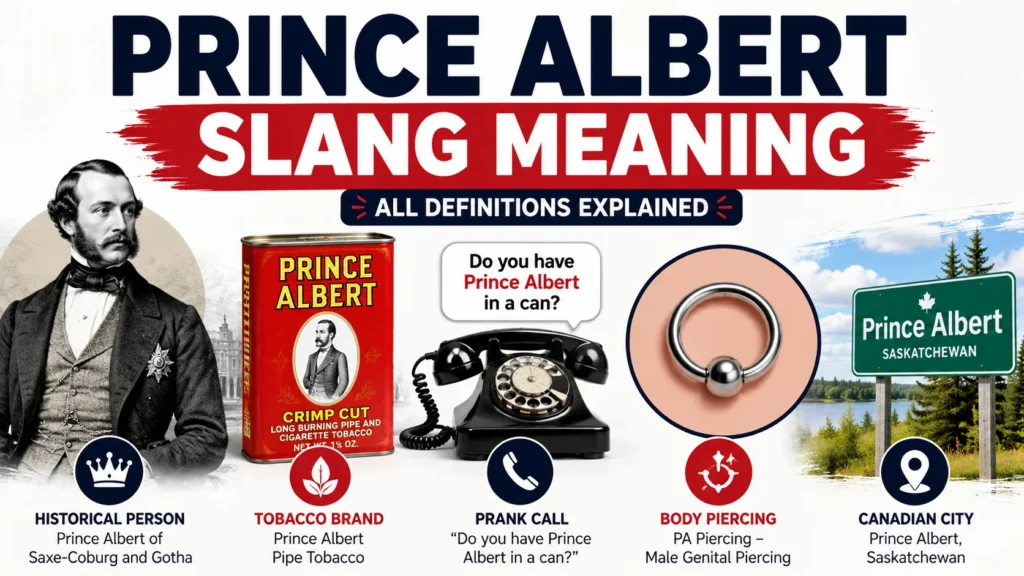

“Prince Albert” in slang most commonly refers to a specific male genital piercing — a ring or barbell passed through the urethra and exiting through the underside of the penis head. It is also known as a PA piercing. Beyond that, the name carries several other meanings depending entirely on context.
People search “Prince Albert slang” because they saw the phrase in a meme, a group chat, a forum, or a comment section — and the combination of a very formal royal name with an unmistakably NSFW meaning creates genuine confusion. This guide explains all real meanings clearly, in order of how commonly they are searched, without sensationalising any of them.
All the Meanings of “Prince Albert” — A Clear Overview
Before going into depth, here are all the real meanings this phrase carries:
- Body piercing — a male genital piercing (PA piercing), the most searched slang meaning
- The prank call — “Do you have Prince Albert in a can?” — one of the oldest telephone pranks in North American history
- Tobacco brand — Prince Albert pipe tobacco, which the prank call references
- City in Canada — Prince Albert, Saskatchewan, often shortened to “PA”
- Historical person — Prince Albert of Saxe-Coburg and Gotha, husband of Queen Victoria
Context tells you everything here. Someone texting you about Prince Albert in a group chat after someone mentioned piercings is using meaning one. Someone referencing a vintage prank is using meanings two and three. A Canadian mentioning “PA” is talking about the city.
The Primary Slang Meaning — The PA Piercing
What Is a Prince Albert Piercing?
In body modification and adult slang culture, a Prince Albert — commonly shortened to PA — refers to a male genital piercing. Specifically, it involves jewelry (typically a captive bead ring, curved barbell, or circular barbell) inserted through the urethral opening and exiting through a pierced hole on the underside of the glans, which is the head of the penis.
It is consistently cited as one of the most common male genital piercings in body modification communities worldwide. According to body piercing resources, the most common starter jewelry is implant-grade titanium or surgical steel, and healing time ranges from four weeks to six months depending on aftercare quality and individual factors.
Why Is It Called a Prince Albert?
The naming origin is disputed and unclear — which is actually very common with body modification terminology. The most frequently cited theory links it to Prince Albert of Saxe-Coburg and Gotha, consort of Queen Victoria, with various unverified claims about Victorian fashion or anatomy. However, no historical documentation directly connects the actual Prince Albert to the piercing.
The more reliable explanation is that the name spread through body modification culture in the 1970s and 1980s as a memorable, incongruous label — a formal, aristocratic name attached to something decidedly unregal, which made it stick in conversation and word of mouth.
The Princess Albertina
For completeness: there is a female equivalent called the Princess Albertina piercing, which passes through the female urethra. It is significantly less common than the male version and rarely referenced in mainstream slang conversation.
The Prank Call — The Other Famous Prince Albert
“Do You Have Prince Albert in a Can?”
Long before the internet, one of North America’s most famous prank calls went like this:
Caller: “Do you have Prince Albert in a can?” Shopkeeper: “Yes, we do.” Caller: “Well, you better let him out!”
The joke targets Prince Albert pipe tobacco, which was — and still is — sold in a distinctive red tin can. The prank is entirely family-friendly, plays on the literal image of a person trapped in a tin, and has been documented in American culture since at least the 1940s.
This prank predates the NSFW piercing meaning by decades. When older generations mention “Prince Albert,” this is often the first reference that comes to mind — which adds another layer to why the phrase causes so much confusion across different age groups.
Prince Albert, Saskatchewan — The Canadian Meaning
In Canada, particularly in Saskatchewan, “Prince Albert” or “PA” refers to the city of Prince Albert — the third-largest city in the province, located north of Saskatoon. Canadians from Saskatchewan use “PA” as an entirely normal geographic shorthand with zero NSFW connotation.
If you are in a conversation with Canadians and someone mentions PA or Prince Albert, this is almost certainly what they mean. Context — specifically, whether anyone has been discussing piercings, body modification, or anything NSFW — is your clearest guide.
Tone and Context Variations
Confused / Discovering the Meaning Tone
A: Someone just mentioned Prince Albert in the group chat and I’m afraid to Google it B: Your instinct is correct. Don’t Google it at work. A: That bad? B: Not bad, just… not what you’re expecting from that name.
Funny / Ironic Tone
A: My history teacher asked us to research Prince Albert for homework B: And? A: Let’s just say I had a very educational afternoon that was not about Victorian history B: The algorithm has failed you 😭
Body Modification Community — Serious / Informational Tone
A: Thinking about getting a PA. Worth it? B: Healing was easier than I expected. The first few days are intense but after week two it’s fine. A: How long before you could wear whatever jewelry you wanted? B: About three months for me. Started with a CBR, switched to a curved barbell after.
Prank Call / Nostalgic Tone
A: My dad just explained the Prince Albert in a can prank and I think it’s the funniest thing invented before the internet B: It’s so simple but it actually works A: He said they used to call every tobacco shop in the phone book B: Pre-internet chaos honestly
Canadian / Geographic Context
A: Where are you from originally? B: PA A: …PA? B: Prince Albert. Saskatchewan. Sorry, everyone from there calls it PA. A: That’s genuinely the least NSFW meaning of those letters I’ve encountered today.
Real Chat Conversation Examples
1 — Search Results Surprise
A: Googled “Prince Albert definition” for a history quiz B: Oh no A: The first three results were NOT about Victorian royalty B: I could have warned you if you’d asked first
2 — Body Mod Forum Discussion
A: Just got my PA done yesterday B: How was the actual procedure? A: Two seconds of genuine intensity and then it was over B: Everyone says that. The anticipation is worse than the thing itself
3 — Group Chat Confusion
A: What’s a Prince Albert?? Someone just mentioned it and now the whole group is reacting B: It’s a piercing. A very specific kind. A: WHERE B: I’m going to need you to lower your expectations about the location
4 — Vintage Prank Reference
A: My grandpa taught me the Prince Albert in a can prank B: Does that even work anymore? Who has a landline to call tobacco shops? A: He said it works fine if you call a joke hotline with it B: Your grandpa is ahead of his time honestly
5 — Canadian Explaining to Non-Canadian
A: I grew up in Prince Albert B: Oh I know what that is A: It’s a city in Saskatchewan B: Right. Yes. The city. That’s what I meant.
6 — Body Mod Research
A: Reading about PA piercings for an article I’m writing B: The naming origin is genuinely unclear — nobody can pin it down historically A: Which makes the Prince Albert connection even more random B: Welcome to body modification etymology
7 — Reaction After Seeing a Meme
A: Why is this meme about Prince Albert blowing up on Reddit B: Because the phrase sounds impossibly formal for what it’s describing A: “Prince Albert” is such a dignified name B: The Victorians could never have predicted this legacy
8 — Healing Discussion
A: Week three post-PA and honestly healing much faster than people warned me B: Aftercare makes a massive difference A: Saline spray twice a day, no touching it otherwise B: That’s exactly the protocol. You’re going to be fine.
9 — History Class Moment
A: My teacher said we’re doing a unit on Prince Albert this semester B: …which one A: Queen Victoria’s husband apparently B: Okay good. I was worried for a second.
10 — The Name Irony
A: It’s genuinely funny that something so associated with Victorian formality became slang for this B: That’s basically how all the best slang works A: What would Prince Albert of Saxe-Coburg and Gotha think B: He would be horrified and that’s what makes it perfect
11 — Friend Getting One
A: My friend just announced he’s getting a Prince Albert this weekend B: Big commitment A: He’s been researching it for months apparently B: If you’re going to do it, doing your homework first is exactly right
12 — Tobacco and Prank Context
A: Prince Albert tobacco is still sold in actual cans B: So the prank technically still works A: Someone tried it on a shop last week apparently B: A classic never dies
Grammar and Language Role
Part of Speech
“Prince Albert” is a proper noun — specifically a noun phrase. In slang usage it functions as:
- A noun (the piercing itself): “He has a Prince Albert”
- A noun modifier: “Prince Albert piercing,” “PA jewelry,” “PA healing”
Sentence Position
It appears most naturally:
- As a direct object: “She’s getting a Prince Albert next month”
- As a subject: “A Prince Albert takes several weeks to heal”
- In abbreviated form: “His PA healed faster than expected”
Can It Replace a Full Sentence?
No. Unlike reactive slang (YNS, OOF, BET), “Prince Albert” is a specific noun phrase that always needs context. You would not respond to a question with just “Prince Albert.” as a standalone reaction.
Formal vs Informal Register
The phrase itself sounds completely formal — it is a proper royal name. The slang meaning is entirely informal and NSFW. This contrast between the name’s formal sound and its informal meaning is a significant part of why the term generates curiosity and online searches.
How to Reply in Different Situations
When Someone Asks What Prince Albert Means (Not Knowing)
Gentle / informative:
“It’s a body piercing. A specific one. Google it when you’re not at work or school.”
Funny:
“You’re about to have a very educational moment. Prepare yourself.”
Neutral:
“It’s either a Victorian prince, a tobacco prank, or a body modification. Which context did you see it in?”
When Someone Mentions Getting One
Supportive:
“Research your piercer thoroughly, use implant-grade materials, and do saline aftercare. You’ll be fine.”
Funny:
“Brave. Genuinely brave. I respect the commitment.”
When Someone References the Prank Call
Nostalgic:
“An absolute classic. The simplest premise and it still works.”
Playful:
“Did they actually fall for it? Some things never get old.”
Comparison Table: Prince Albert and Related Terms
| Term | Meaning | Usage Context | Tone | Popularity | Confusion Risk |
|---|---|---|---|---|---|
| Prince Albert | Male genital piercing / prank call / tobacco / Canadian city / historical prince | Body mod, humour, history, geography | Varies wildly | Very High | Very High — multiple unrelated meanings |
| PA Piercing | Specific term for the Prince Albert piercing | Body modification communities | Clinical / Informational | High | Low — specific and clear |
| Frenum Piercing | Male genital piercing on the underside of the shaft | Body modification | Clinical | Moderate | Low |
| Dydoe Piercing | Piercing through the ridge of the penis head | Body modification | Clinical | Low-Moderate | Low |
| Jacob’s Ladder | Series of frenum piercings along the underside | Body modification | Clinical / Slang | Moderate | Medium |
| PA in a Can | Reference to the vintage prank call | Humour, nostalgia | Playful | Moderate | Medium — confused with piercing PA |
| Unpierced | Having no genital piercing — opposite state | General conversation | Neutral | N/A | Low |
Who Uses “Prince Albert” in the Slang Sense?
Age Groups
- Gen Z (16–27) — encounter it primarily through internet memes, Reddit, TikTok, and body modification communities
- Millennials (28–42) — often know both the piercing meaning and the prank call meaning; more likely to have encountered body modification communities during the early internet era
- Gen X and Boomers — most likely to associate the phrase with the prank call or the tobacco brand rather than the piercing; frequently confused by the slang meaning
- Body modification community — uses the term clinically and specifically across all age groups
Gen Z vs Millennials
Gen Z typically discovers “Prince Albert” through meme culture and online forums where the juxtaposition of formal name and NSFW meaning is inherently funny. Millennials who were active on early internet forums in the 2000s were exposed to body modification communities earlier, making them more likely to know the piercing meaning from a practical standpoint rather than through meme discovery.
Regional Usage
- USA — the piercing meaning and the prank call meaning are both well-known; the tobacco brand reference is recognised by older generations
- Canada (Saskatchewan) — PA as a city abbreviation is dominant; the NSFW meaning is also known but PA-the-city comes first in local conversation
- UK — primarily the piercing meaning; less cultural familiarity with the Prince Albert tobacco brand prank
- Global — the piercing meaning is internationally understood in body modification communities regardless of location
Platforms
- Reddit — the highest volume platform for Prince Albert slang discussion; body modification communities like r/malegenitalpiercings and r/piercing use it clinically and frequently
- TikTok — videos explaining the meaning, piercing process, and healing are widely viewed; the “wait what does that mean?” reaction format performs well
- Instagram — body modification accounts use the term in educational content; meme accounts reference the formal-name-NSFW-meaning contrast
- Snapchat — private group chat confusion is common; the “someone said this in the chat and I’m afraid to Google it” experience
- WhatsApp — same as Snapchat — group chat confusion driving people to search the meaning
Origin and Internet Culture Insight
The Historical Prince Albert
Prince Albert of Saxe-Coburg and Gotha (1819–1861) was the husband of Queen Victoria and one of the most influential figures of the Victorian era. He is credited with popularising the Christmas tree tradition in Britain, supporting the Great Exhibition of 1851, and being a significant patron of the arts and sciences. He died at age 42, likely from typhoid fever.
The connection between the actual historical Prince Albert and the slang meanings that bear his name is largely indirect, coincidental, or based on unverified legend.
Prince Albert Tobacco — The Prank Call Foundation
Prince Albert pipe tobacco was introduced by the R.J. Reynolds Tobacco Company in 1907 and became one of the most recognised tobacco brands in American history. It was sold in a distinctive red tin can, which became the literal setup for the prank call: “Do you have Prince Albert in a can? You better let him out!”
Folklorists have documented this prank being used across North America from at least the 1940s, making it one of the earliest documented telephone prank formats. Its cultural longevity is remarkable — the joke was still being made in the 1980s and 1990s despite being decades old.
The Piercing Term — Body Modification Culture
The PA piercing as a named practice emerged prominently in the body modification underground of the 1970s and 1980s in the United States. Gauntlet, the first professional body piercing studio in America, helped document and standardise terminology for genital piercings during this era. The name “Prince Albert” for this specific piercing spread through word of mouth, early body modification publications, and eventually the internet.
By the 1990s and early 2000s, the term was widely documented on body modification websites and forums. The contrast between its formal Victorian name and its subject matter made it memorable and easily spreadable — which is probably the most honest explanation for why it stuck.
TikTok and Meme Culture
On TikTok, the phrase performs well in a specific format: someone encounters the phrase in an unexpected context (a history lesson, a crossword puzzle, a shop name, a relative’s conversation) and records their reaction to discovering the slang meaning. The formal-name-meets-NSFW-reality gap is the entire joke.
Search volumes for “Prince Albert meaning” spike regularly on Google, suggesting ongoing curiosity driven by meme exposure, group chat mentions, and casual encounters with the phrase in non-NSFW contexts.
Safety and Appropriateness
Is “Prince Albert” Offensive?
The phrase itself is not offensive — it is a proper name with multiple meanings, most of which are completely benign. The body piercing meaning is adult in nature but is discussed openly in medical, body modification, and educational contexts without controversy.
Does It Contain Profanity?
No. The phrase contains no profanity or explicit language. The slang meaning is adult in subject matter, but the name itself is formal and unambiguous.
School Appropriateness
Mentioning Prince Albert in a school context is almost always going to cause distraction given widespread awareness of the slang meaning. Students and teachers alike will likely be aware of it, making it awkward to use as a historical reference without acknowledging the elephant in the room.
Workplace Appropriateness
In professional settings, avoid using “Prince Albert” casually unless the context is clearly historical or geographic. In a body modification, healthcare, or piercing professional context, the clinical terminology is entirely appropriate.
Cultural Sensitivity
No significant cultural sensitivity concerns attach to the phrase in its slang meaning. The historical Prince Albert’s name being associated with the piercing is widely understood to be an informal naming convention rather than any commentary on the historical figure.
Real-World Observation: How People Actually Use This Phrase
In practice, “Prince Albert” in its slang sense exists in a very particular cultural space: people who know the meaning find the formal-name-NSFW-reality gap inherently funny, while people who don’t know the meaning are frequently caught off guard when they encounter the phrase in an unexpected context.
The phrase has unusual longevity because it sits at the intersection of several completely unrelated reference points — Victorian history, vintage Americana, body modification culture, and Canadian geography — all sharing the same name. This means new audiences keep discovering it through entirely different pathways, which keeps it in circulation across generations and platforms in a way that most slang terms don’t sustain.
What makes it interesting linguistically is that the “formal name, informal meaning” structure is genuinely memorable. A technical clinical term would not generate the same search traffic. The incongruity is the entire point — and it ensures the phrase continues to generate curiosity long after the initial discovery.
Frequently Asked Questions
What does Prince Albert mean in slang?
In slang, Prince Albert most commonly refers to a male genital piercing — specifically a ring or barbell passed through the urethral opening and exiting on the underside of the glans. It is widely discussed in body modification communities and is one of the most searched NSFW definitions online.
Why is it called a Prince Albert piercing?
The exact origin of the name is historically unverified. The most frequently cited theory loosely connects it to Prince Albert of Saxe-Coburg and Gotha, Queen Victoria’s husband, but no direct documentation supports this. The name spread through body modification culture in the 1970s and 1980s and stuck because the formal-name-NSFW-meaning contrast was memorable.
Is Prince Albert slang always NSFW?
No. The phrase has multiple meanings. In prank call culture it refers to the classic joke about Prince Albert tobacco in a can, which is entirely family-friendly. In Canada, PA or Prince Albert refers to a city in Saskatchewan. In historical contexts it refers to the Victorian prince himself. Only the body piercing meaning is NSFW.
What does PA mean in the context of piercings?
PA is the standard shorthand for the Prince Albert piercing used in body modification communities, forums, and aftercare discussions. It is used clinically and informally to avoid repeatedly using the full phrase.
Is the Prince Albert piercing common?
It is consistently cited as one of the most common male genital piercings in body modification culture. Its relative accessibility in terms of placement and healing time compared to other genital piercings makes it a frequent choice for people entering that area of body modification.
How did the Prince Albert prank call work?
The prank involved calling a tobacco shop and asking “Do you have Prince Albert in a can?” When the shopkeeper confirmed they did, the caller responded “You better let him out!” The joke references the Prince Albert pipe tobacco brand sold in a tin can. It is one of the oldest telephone prank formats in North American culture, documented from at least the 1940s.
What is Prince Albert, Saskatchewan?
Prince Albert is the third-largest city in Saskatchewan, Canada, located north of Saskatoon. It is commonly shortened to “PA” by Canadians, particularly those from Saskatchewan. This meaning has no connection to the slang or body modification usage of the same name.
Is it safe to search “Prince Albert” at work?
With SafeSearch on, most results will be the historical figure, the tobacco brand, or the Canadian city. Body modification results may appear depending on your search engine settings. To be safe, searching in a private context is advisable given the variety of results the phrase can generate.
What is a Prince Albert piercing?
A Prince Albert piercing is a male genital piercing in which a ring or barbell is inserted through the urethral opening and exits through a hole pierced on the underside of the glans (penis head). It is commonly abbreviated as a PA piercing and is one of the most discussed male genital piercings in body modification communities. Healing time varies from four weeks to six months depending on aftercare and individual factors.
What does “do you have Prince Albert in a can” mean?
This is a classic North American prank call joke. The caller asks a tobacco shop whether they stock Prince Albert pipe tobacco (which was sold in a tin can). When the shopkeeper confirms, the caller says “You better let him out!” The joke imagines a person being trapped inside a can. It has been documented since at least the 1940s and is one of the earliest known telephone prank formats.
Who was the real Prince Albert?
Prince Albert of Saxe-Coburg and Gotha (1819–1861) was the German-born consort of Queen Victoria of the United Kingdom. He was known for promoting education, science, and the arts, and is credited with helping popularise the Christmas tree tradition in Britain. He died at age 42, likely from typhoid fever. His name has since been associated with several products, a city in Canada, and — through an entirely unrelated cultural pathway — the body modification term covered in this article.
Is the Prince Albert piercing painful?
Body modification resources and community accounts consistently describe the piercing procedure itself as brief and intense but shorter than anticipated. The healing period involves more sustained discomfort than the procedure. Individual experience varies significantly, and choosing an experienced, licensed piercer and following proper aftercare protocols are the most important factors in outcome.
Summary, Usage Tips, and When to Avoid It
Summary
“Prince Albert” in slang primarily refers to a specific male genital piercing known as a PA piercing — named through an unverified historical connection to Queen Victoria’s consort. The phrase also carries three other entirely unrelated meanings: a vintage North American prank call about Prince Albert pipe tobacco, the city of Prince Albert in Saskatchewan, Canada, and the historical Victorian prince himself. Context, platform, and the surrounding conversation will almost always make clear which meaning is intended.
Usage Tips
- When discussing the piercing, “PA piercing” is the clearer and less confusing term to use
- When the geographic meaning is intended, specify “Prince Albert, Saskatchewan” or “PA, Saskatchewan” to avoid ambiguity
- When referencing the prank call, the full context (“Prince Albert in a can”) makes the meaning immediately obvious
- In any professional or formal context, be specific about which Prince Albert you mean
Common Mistakes
- Assuming “Prince Albert” always means the piercing — the phrase has multiple entirely legitimate and benign meanings
- Googling the phrase without SafeSearch at work or school
- Using “PA” without geographic context with someone who might interpret it differently
- Treating the historical connection as verified history — it is a naming tradition, not a documented fact
When to Use It
- In body modification communities when discussing the specific piercing by its common name
- In historical or educational contexts when discussing the actual Victorian prince
- When referencing the prank call tradition in appropriate humorous contexts
- When discussing the Canadian city with people familiar with Saskatchewan geography
When to Avoid It
- Professional emails or formal communication where any ambiguity could be distracting
- School or classroom settings where the slang meaning is well known
- Casual conversation with people unfamiliar with body modification terminology
- Any context where you cannot immediately clarify which of the four meanings you intend