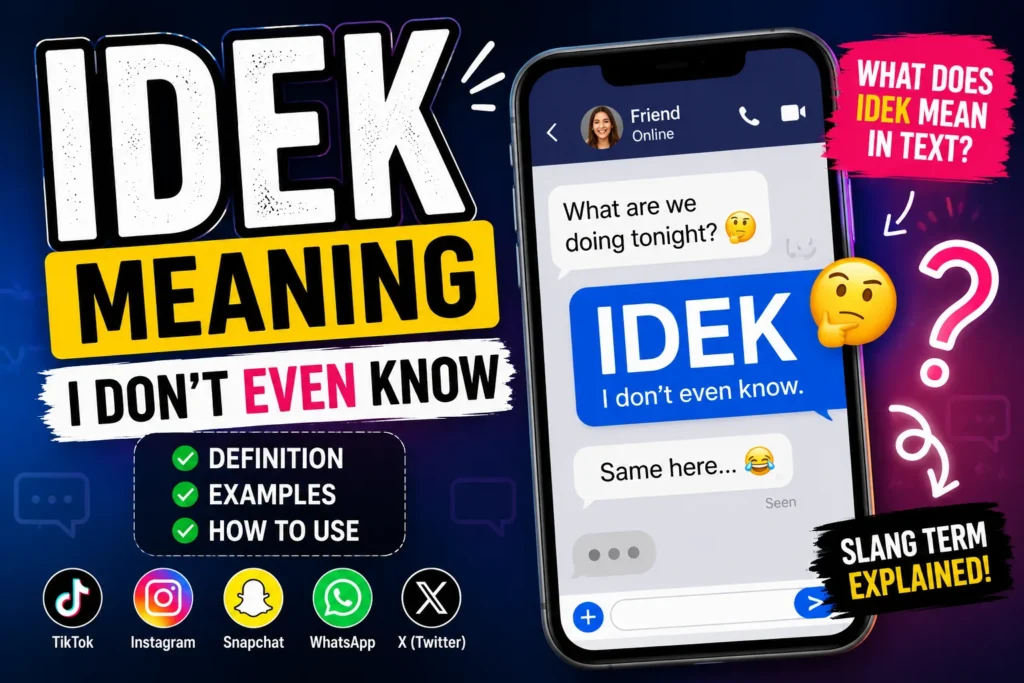

IDEK means “I Don’t Even Know.” It’s a popular texting abbreviation used when someone is confused, surprised, frustrated, overwhelmed, or simply doesn’t have an answer. People often search for IDEK meaning after seeing it in texts, TikTok comments, Snapchat chats, or social media posts and wondering what it stands for.
Unlike some slang terms that have multiple meanings, IDEK almost always means “I Don’t Even Know.” The phrase adds extra emphasis compared to simply saying “I don’t know” (IDK), making it useful when someone is especially unsure, shocked, or speechless.
Meaning & Explanation
What Does IDEK Mean?
IDEK stands for “I Don’t Even Know.”
It’s an internet slang abbreviation that expresses stronger uncertainty or confusion than the more common abbreviation IDK (I Don’t Know).
Examples:
- “IDEK what happened.”
- “IDEK why I agreed to this.”
- “IDEK anymore.”
The word “even” adds emotional emphasis, making the statement sound more dramatic, frustrated, amused, or overwhelmed.
Is IDEK an Acronym, Abbreviation, or Slang Word?
IDEK is technically both:
- An abbreviation
- An internet slang term
Each letter represents a word:
- I = I
- D = Don’t
- E = Even
- K = Know
Because it originated in digital communication and texting culture, it’s widely considered internet slang as well.
Why Do People Use IDEK Instead of IDK?
The difference is subtle but important.
IDK = Simple uncertainty
Example:
“IDK what time the meeting starts.”
IDEK = Stronger uncertainty or emotional reaction
Example:
“IDEK how this happened.”
IDEK often suggests:
- Frustration
- Confusion
- Exhaustion
- Disbelief
- Overwhelm
IDEK Meaning in Text Messages
In texting, IDEK usually communicates that someone feels lost, confused, or unable to explain something.
Example:
A: Why is the group chat arguing?
B: IDEK at this point.
The speaker isn’t just uncertain—they’ve given up trying to understand.
IDEK Meaning on TikTok
TikTok users frequently use IDEK in:
- Video captions
- Comment sections
- Reaction videos
Examples:
- “IDEK why this is so funny.”
- “IDEK how I ended up on this side of TikTok.”
On TikTok, IDEK often accompanies humorous confusion or unexpected discoveries.
IDEK Meaning on Instagram
Instagram users commonly use IDEK in:
- Story replies
- Reel comments
- Captions
Example:
“IDEK what to caption this.”
It’s often used casually and humorously.
IDEK Meaning on Snapchat
On Snapchat, IDEK appears regularly in private chats and streak conversations.
Example:
A: What are you doing today?
B: IDEK yet.
The abbreviation helps keep messages quick and conversational.
IDEK Meaning on WhatsApp
WhatsApp users employ IDEK in everyday conversations among friends and family.
Example:
“IDEK if I’ll make it tonight.”
It’s commonly used in informal discussions.
IDEK Meaning on X (Twitter)
On X, IDEK is frequently used in reaction posts.
Examples:
- “IDEK what I just watched.”
- “IDEK why this is trending.”
The abbreviation fits the platform’s fast-paced style.
Tone & Context Variations
Funny Tone
A: Why is your cat sitting inside the sink?
B: IDEK anymore.
A: That’s not a normal answer.
B: Neither is the cat.
Sarcastic Tone
A: Why did the website crash again?
B: IDEK. Maybe it got tired of working.
A: Honestly, same.
B: Fair.
Playful Tone
A: What are we doing this weekend?
B: IDEK, but it better involve food.
A: That’s a solid plan.
B: It’s my best work.
Serious Tone
A: Have you decided what career path you want?
B: IDEK right now. I’m still exploring options.
A: That’s understandable.
B: I’m trying not to rush it.
Real Chat Examples
Example 1
A: Did you finish the assignment?
B: IDEK where I saved it.
A: That’s stressful.
B: Extremely.
Example 2
A: Why is everyone talking about that show?
B: IDEK. I haven’t watched it.
A: Same here.
B: We seem to be the only ones.
Example 3
A: Are you going to the concert?
B: IDEK yet. Tickets are expensive.
A: That’s fair.
B: I’m still deciding.
Example 4
A: How did your phone battery die already?
B: IDEK. It was fully charged this morning.
A: That’s suspicious.
B: Very.
Example 5
A: Why did Jake leave the group chat?
B: IDEK what happened.
A: Nobody knows?
B: Apparently not.
Example 6
A: What should we order for dinner?
B: IDEK. Everything sounds good.
A: That’s the worst kind of problem.
B: Exactly.
Example 7
A: Why are you laughing?
B: IDEK. I’m tired.
A: That explains a lot.
B: It usually does.
Example 8
A: What time does the event start?
B: IDEK. Check the website.
A: Good idea.
B: That’s where I’d look.
Example 9
A: Why is your room so clean today?
B: IDEK. I suddenly got motivated.
A: That’s impressive.
B: Don’t expect it again soon.
Example 10
A: How did that rumor start?
B: IDEK. It spread overnight.
A: That’s wild.
B: Completely.
Example 11
A: What should I wear?
B: IDEK. Depends on the weather.
A: Helpful.
B: I’m doing my best.
Grammar & Language Role
Part of Speech
IDEK functions as a phrase abbreviation.
It often replaces the full phrase:
“I don’t even know.”
Sentence Position
IDEK commonly appears:
- At the beginning of a sentence
- Mid-sentence
- As a standalone response
Examples:
- IDEK what happened.
- Honestly, IDEK.
- IDEK anymore.
Can IDEK Replace a Full Sentence?
Yes.
Examples:
A: Why did that happen?
B: IDEK.
The abbreviation works as a complete response.
Formal vs Informal Register
| Context | Appropriate? |
|---|---|
| Texting | Yes |
| Social Media | Yes |
| Group Chats | Yes |
| Workplace Emails | No |
| Academic Writing | No |
| Business Reports | No |
IDEK is considered informal digital language.
How to Reply When Someone Says IDEK
Funny Reply
“At least you’re honest.”
“Glad we’re both confused.”
Serious Reply
“That’s okay. We can figure it out.”
“No worries, let’s find the answer together.”
Flirty Reply
“Maybe I can help you figure it out 😉”
“Good thing I’m here then.”
Neutral Reply
“Fair enough.”
“Got it.”
Comparison Table
| Term | Meaning | Usage Context | Tone | Popularity | Confusion Risk |
|---|---|---|---|---|---|
| IDEK | I Don’t Even Know | Texting, social media | Confused | Very High | Low |
| IDK | I Don’t Know | General texting | Neutral | Extremely High | Low |
| IDC | I Don’t Care | Casual chat | Dismissive | High | Medium |
| TBH | To Be Honest | Social media, texting | Honest | High | Low |
| SMH | Shaking My Head | Reactions | Frustrated | High | Low |
| IK | I Know | Opposite response | Confident | Medium | Low |
Who Uses This Term?
Age Groups
IDEK is most popular among:
- Teens
- Gen Z
- Young Millennials
However, many older internet users understand it as well.
Gen Z vs Millennials
Gen Z
- Uses IDEK frequently in texting and social media
- Often uses it humorously
Millennials
- More likely to use both IDK and IDEK interchangeably
- Common in group chats and messaging apps
Regional Usage
IDEK is widely understood across:
- United States
- United Kingdom
- Canada
- Australia
- English-speaking online communities
It is not tied to a specific region.
Platforms
| Platform | Usage |
|---|---|
| TikTok | Very Common |
| Common | |
| Snapchat | Very Common |
| Common | |
| X | Common |
Origin & Internet Culture
Where Did IDEK Come From?
IDEK emerged naturally from internet shorthand culture.
As users shortened phrases like:
- LOL
- BRB
- IDK
adding “even” created a stronger version of IDK.
Relationship to Texting Culture
The abbreviation became popular because it saves typing while conveying emotion.
Instead of writing:
“I don’t even know.”
People could simply write:
“IDEK.”
Meme and Social Media Influence
Memes helped spread IDEK because confusion is a common source of online humor.
Examples include:
- Unexpected videos
- Strange news stories
- Viral trends
Users frequently react with:
“IDEK what I just watched.”
Evolution of Usage
Originally, IDEK mainly expressed uncertainty.
Today it also conveys:
- Shock
- Amusement
- Disbelief
- Emotional exhaustion
without changing its basic meaning.
Safety & Appropriateness
Is IDEK Rude?
No.
IDEK is generally harmless and non-offensive.
Is IDEK Profanity?
No.
It contains no swear words or explicit language.
Is IDEK Appropriate for School?
Usually yes in casual conversations.
However, teachers generally prefer complete words in formal assignments.
Is IDEK Appropriate for Work?
In casual team chats, it may appear occasionally.
For professional emails and reports, it’s better to write the full phrase.
Cultural Sensitivity Notes
IDEK has no known cultural sensitivity concerns and is widely understood as general internet slang.
Real-World Observation
One reason IDEK remains popular is that it captures a very specific feeling that many people experience online: being unable to explain something. Whether reacting to a confusing TikTok video, a surprising news headline, or a chaotic group chat, IDEK communicates uncertainty with personality. That combination of brevity and emotion helps keep it relevant even as internet slang evolves.
Frequently Asked Questions
What does IDEK mean in text?
IDEK means “I Don’t Even Know.” It expresses stronger confusion or uncertainty than simply saying IDK.
Is IDEK the same as IDK?
Not exactly. IDK means “I Don’t Know,” while IDEK adds emphasis through the word “even,” making it sound more emotional or frustrated.
What does IDEK mean on Snapchat?
On Snapchat, IDEK usually means “I Don’t Even Know.” It’s commonly used in casual chats and streak conversations.
Is IDEK rude?
No. IDEK is generally considered neutral and non-offensive.
Can adults use IDEK?
Absolutely. While it’s especially popular among Gen Z, adults frequently use IDEK in texting and social media conversations.
How do you respond to IDEK?
You can respond seriously, humorously, or neutrally depending on the conversation. Most replies simply acknowledge the uncertainty.
Is IDEK a real word?
No. IDEK is an internet abbreviation rather than a dictionary word.
Why do people use IDEK?
People use IDEK because it’s faster to type than the full phrase and better conveys confusion, disbelief, or frustration.
What is the difference between IDEK and IDK?
IDEK means “I Don’t Even Know,” while IDK means “I Don’t Know.” IDEK adds extra emotional emphasis.
What does IDEK mean on TikTok?
On TikTok, IDEK is commonly used in comments, captions, and reactions when users are confused or surprised by content.
Is IDEK slang?
Yes. IDEK is considered internet slang and a texting abbreviation.
Can IDEK be used as a full reply?
Yes. Many people respond with simply “IDEK” when they genuinely do not know the answer.
Conclusion
IDEK stands for “I Don’t Even Know” and is one of the internet’s most useful expressions for confusion, disbelief, frustration, or uncertainty. It builds on the familiar IDK abbreviation while adding emotional emphasis that feels natural in texting and social media conversations.
Usage Tips
- Use IDEK when confusion feels stronger than a simple “I don’t know.”
- Great for texting and casual online conversations.
- Works as a complete response or within a sentence.
- Common across TikTok, Snapchat, Instagram, WhatsApp, and X.
Common Mistakes
- Assuming IDEK has multiple meanings.
- Using it in professional emails.
- Confusing it with IDK in tone and intensity.
- Overusing it in formal writing.
When to Use IDEK
- Casual chats
- Text messages
- Social media comments
- Group conversations
When to Avoid IDEK
- Professional documents
- Academic essays
- Business communications
- Formal presentations