
Eiffel Tower slang refers to an adult, NSFW expression used in internet culture, jokes, and pop-culture references. While the Eiffel Tower is best known as the famous Paris landmark, the slang meaning is entirely different and often surprises people who encounter it online.
Many people search for “Eiffel Tower slang” after seeing it in a meme, social media comment, movie quote, podcast discussion, or viral video. The confusion comes from the fact that the phrase sounds harmless but carries a completely different meaning in adult slang contexts. This guide explains what it means, where it appears, how people use it online, and when it’s appropriate—or inappropriate—to use it.
What Does Eiffel Tower Mean in Slang?
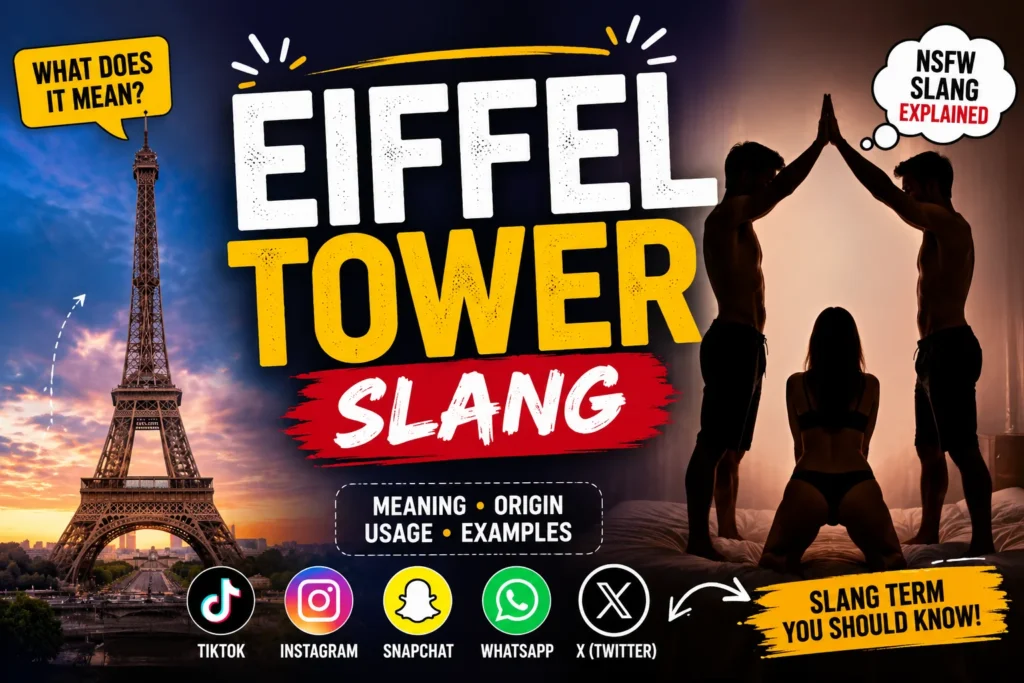
In internet slang, Eiffel Tower is an adult expression that refers to a specific sexual scenario involving three people. The term comes from the visual shape created by the participants, which resembles the silhouette of the Eiffel Tower.
Because the phrase refers to an explicit sexual act, it is generally considered:
- NSFW (Not Safe For Work)
- Adult-oriented slang
- A crude joke or punchline
- Informal internet language
Today, many people encounter the term through memes, comedy podcasts, movies, television references, and social media discussions rather than through serious conversations.
Why Do People Search for Eiffel Tower Slang?
Most searches happen because someone unexpectedly encounters the phrase online.
Common situations include:
- Seeing it in a TikTok comment section
- Hearing it in a comedy podcast
- Reading it on Reddit
- Watching a movie or TV show reference
- Hearing friends joke about it
- Seeing “Don’t Google Eiffel Tower slang” posts
The phrase often appears as a shock-value joke because many people initially think it refers to the Paris monument.
Is Eiffel Tower an Acronym, Abbreviation, or Slang Term?
Is It an Acronym?
No.
“Eiffel Tower” is not an acronym because the letters do not stand for separate words.
Is It an Abbreviation?
No.
It is not a shortened version of another phrase.
Is It a Slang Expression?
Yes.
The term is classified as slang because it uses the name of a well-known landmark to represent a completely different meaning in informal adult conversations.
Eiffel Tower Meaning on Different Platforms
Eiffel Tower Meaning on TikTok
TikTok users often reference the phrase indirectly.
Because of platform moderation rules, creators rarely explain the meaning outright. Instead, they might:
- Make reaction videos
- Use “don’t search this” jokes
- Reference it in comedy content
- Use coded language
Many users end up searching the term after seeing these references.
Eiffel Tower Meaning on Instagram
Instagram comments sometimes contain the phrase as a joke or meme reference.
It’s most common in:
- Meme pages
- Comedy accounts
- Viral comment threads
Most people encountering it on Instagram are trying to understand an inside joke.
Eiffel Tower Meaning on Snapchat
On Snapchat, the phrase usually appears in private conversations among friends rather than public content.
It’s often used:
- As a joke
- As a reference to a meme
- In conversations about dating or relationships
Eiffel Tower Meaning on WhatsApp
WhatsApp usage tends to be similar to Snapchat.
People generally use it:
- In group chats
- Among close friends
- As part of internet humor
Eiffel Tower Meaning on X (Formerly Twitter)
X is one of the places where the term appears most openly.
Users may reference it in:
- Viral jokes
- Meme discussions
- Sports banter
- Pop-culture commentary
Because X allows more open discussion than some platforms, users are more likely to encounter the phrase there.
Tone and Context Variations
The meaning stays the same, but the tone changes depending on how it’s used.
Funny Tone
A: Someone told me not to Google Eiffel Tower slang.
B: And you immediately Googled it, didn’t you?
A: Worst decision of the day.
B: That’s exactly how everyone learns it.
Sarcastic Tone
A: I finally understand the joke everyone keeps making.
B: Welcome to the internet.
A: I wish I could go back five minutes.
B: Unfortunately, that’s not how Google works.
Playful Tone
A: Why is everyone laughing at that comment?
B: You don’t know what Eiffel Tower slang means?
A: Should I?
B: Maybe not.
Serious Tone
A: My teenager asked what this term means.
B: It’s adult slang, so I’d explain that it’s an inappropriate joke.
A: That’s probably the best approach.
B: Definitely better than letting social media explain it.
Real Chat Examples
Example 1
A: Why is everyone saying “don’t Google Eiffel Tower slang”?
B: Because people know curiosity will win.
A: It definitely did.
B: It always does.
Example 2
A: I thought they meant the monument.
B: That’s what makes the joke work.
A: Sneaky.
B: Very.
Example 3
A: I saw it in a TikTok comment.
B: That’s where a lot of people discover it.
A: Now I understand the reactions.
B: Exactly.
Example 4
A: Someone used it in a podcast.
B: Comedy podcasts love references like that.
A: The audience laughed immediately.
B: Most of them already knew the meaning.
Example 5
A: Is Eiffel Tower slang common?
B: Online, yes.
A: In everyday conversation?
B: Not really.
Example 6
A: My friend said I was too innocent for that joke.
B: Then they probably meant Eiffel Tower slang.
A: They absolutely did.
B: Mystery solved.
Example 7
A: Why does the phrase trend every few months?
B: New people keep discovering it.
A: Makes sense.
B: Internet curiosity never ends.
Example 8
A: I heard it in a movie.
B: That’s probably why it sounded familiar.
A: I missed the joke at the time.
B: You’re not alone.
Example 9
A: Is it okay to say at work?
B: Definitely not.
A: Good to know.
B: Very good to know.
Example 10
A: I asked my friend what it meant.
B: What happened?
A: They laughed for two minutes.
B: That’s usually a sign.
Example 11
A: My group chat won’t stop making Eiffel Tower jokes.
B: Welcome to modern internet humor.
A: I wish I didn’t understand them now.
B: Too late.
Grammar and Language Role
Part of Speech
“Eiffel Tower” typically functions as:
- A noun phrase
- A slang reference
- A cultural joke reference
Sentence Position
It commonly appears:
- As the subject of a sentence
- As an object
- As a quoted expression
Examples:
- “The Eiffel Tower joke went viral.”
- “I finally understood the Eiffel Tower reference.”
Can It Replace a Full Sentence?
Not usually.
Unlike expressions such as “LOL” or “OMG,” it generally requires surrounding context.
Formal vs Informal Register
| Context | Appropriate? |
|---|---|
| Casual texting | Sometimes |
| Friend groups | Often |
| Social media jokes | Common |
| Workplace communication | No |
| Academic writing | No |
| Professional emails | No |
How to Reply When Someone Says Eiffel Tower
Funny Reply
“I miss the person I was before I learned that.”
“Some Google searches really change your life.”
Serious Reply
“It’s adult slang, so context matters.”
“That’s not really appropriate for every audience.”
Flirty Reply
If the conversation is between consenting adults and already playful:
“That’s definitely not a topic I expected today.”
Keep responses light and non-explicit.
Neutral Reply
“I know what you’re referring to.”
“Got it.”
Comparison Table
| Term | Meaning | Usage Context | Tone | Popularity | Confusion Risk |
|---|---|---|---|---|---|
| Eiffel Tower | Adult slang expression | Memes, jokes, internet culture | Crude/Humorous | High | Very High |
| Dirty Sanchez | Adult slang term | Internet slang | Crude | Medium | High |
| Golden Shower | Adult slang term | Internet slang | Explicit | High | High |
| Netflix and Chill | Suggestive slang phrase | Dating culture | Playful | Very High | Medium |
| Friends With Benefits | Casual relationship term | Dating | Neutral | Very High | Low |
| Family-Friendly Joke | Clean humor | General conversation | Neutral | High | Very Low |
Who Uses This Term?
Age Groups
Most users are:
- Older Gen Z
- Millennials
- Adults familiar with internet culture
The phrase is generally not intended for children.
Gen Z vs Millennials
Gen Z
- Often discovers the term through TikTok
- Encounters it through memes and reaction videos
Millennials
- More likely to know it from older internet forums, movies, and comedy culture
Regional Usage
The phrase appears primarily in:
- United States
- United Kingdom
- Canada
- Australia
It is also recognized in many English-speaking online communities worldwide.
Platform Usage
| Platform | Usage Frequency |
|---|---|
| TikTok | High |
| X | High |
| Very High | |
| Medium | |
| Snapchat | Medium |
| Medium |
Origin and Internet Culture
Where Did the Term Come From?
The slang meaning developed because people noticed a visual resemblance between the arrangement being referenced and the shape of the Eiffel Tower.
The exact first use is difficult to verify, but the term has circulated in adult humor and internet slang communities for many years.
Meme Culture’s Role
Meme culture helped popularize the phrase beyond adult communities.
Many users now recognize it not because of its original meaning but because of jokes about:
- Accidentally searching it
- Not understanding references
- Discovering it through memes
Why TikTok Boosted Its Popularity
TikTok’s reaction-content format created ideal conditions for the phrase.
Videos often feature:
- Shock reactions
- “Don’t search this” trends
- Comment-section mysteries
This creates curiosity, which leads people to search the term.
Evolution of Usage
Over time, the phrase shifted from being primarily an adult slang term to becoming a broader internet joke.
Today, many people know it as:
- A meme reference
- A punchline
- A piece of internet trivia
without actively using the original meaning.
Is Eiffel Tower Slang Rude or Offensive?
Is It Rude?
Potentially.
Because it refers to an adult sexual scenario, many people consider it inappropriate in formal settings.
Is It a Bad Word?
No.
The phrase itself is not profanity.
However, the meaning is sexual in nature.
Is It Safe for School or Work?
Generally no.
Because of its adult meaning, it’s best avoided in:
- Schools
- Workplaces
- Professional communication
- Family settings
Cultural Sensitivity Notes
The term is slang, not a cultural reference to French people or Parisian culture. However, many people unfamiliar with the slang meaning may be surprised by its use.
Real-World Observation
One of the most interesting things about Eiffel Tower slang is that many people learn it accidentally. Unlike common abbreviations such as LOL or BRB, the phrase often spreads through curiosity rather than everyday communication. Someone sees a joke, notices people laughing, looks up the meaning, and suddenly understands years of internet references. That cycle of confusion, discovery, and shared humor is a major reason the term remains culturally recognizable online.
Frequently Asked Questions
What does Eiffel Tower mean in slang?
Eiffel Tower is an adult slang term referring to a specific sexual scenario. Most people encounter it through memes, jokes, social media references, or pop culture rather than direct conversations.
Why do people say “don’t Google Eiffel Tower slang”?
The phrase became a common internet joke because many people assume it only refers to the famous landmark. The surprise factor makes it a popular curiosity-based meme.
Is Eiffel Tower slang common?
It is recognizable online, especially among people familiar with internet culture. However, it is not a term most people use in everyday conversation.
Is Eiffel Tower slang offensive?
The phrase itself is not profanity, but its meaning is sexual and can be inappropriate depending on the audience and setting.
What does Eiffel Tower mean on TikTok?
TikTok users often reference the term indirectly through jokes, reactions, or curiosity-driven content. Many viewers search for the meaning after seeing these references.
Can you say Eiffel Tower slang at work?
It’s generally best not to. Because the meaning is adult-oriented, it isn’t appropriate for professional environments.
Why is Eiffel Tower slang trending?
It trends because of social media jokes, reaction videos, and viral curiosity posts that encourage people to search the meaning.
Is Eiffel Tower slang a meme?
Yes. While it originated as adult slang, it has evolved into a broader internet meme and cultural reference.
Where do people usually hear the term?
Most people encounter it on TikTok, Reddit, X, comedy podcasts, movies, and online discussion forums.
Does Eiffel Tower always mean the slang term?
No. In most contexts, Eiffel Tower simply refers to the famous landmark in Paris. Context determines which meaning is intended.
Conclusion
The slang term Eiffel Tower is an adult internet expression that became widely known through memes, jokes, social media references, and pop culture. While its original meaning remains the same, many people now recognize it primarily as an internet joke rather than a term used in everyday conversation.
Usage Tips
- Consider your audience before using it.
- Expect many people to recognize the internet joke.
- Remember that it has an adult meaning.
- Use caution in public or professional settings.
Common Mistakes
- Assuming it only refers to the Paris landmark.
- Using it in workplace conversations.
- Explaining it without considering the audience.
- Treating it as family-friendly slang.
When to Use It
- Internet culture discussions
- Meme conversations
- Adult social settings
- Pop-culture analysis
When to Avoid It
- Workplace communication
- School environments
- Family conversations
- Professional content
Meta Title
Eiffel Tower Slang: Meaning, Origin & Internet Usage
Meta Description
Most people don’t know the hidden meaning of Eiffel Tower slang. Discover why this internet term keeps appearing in memes and social media.