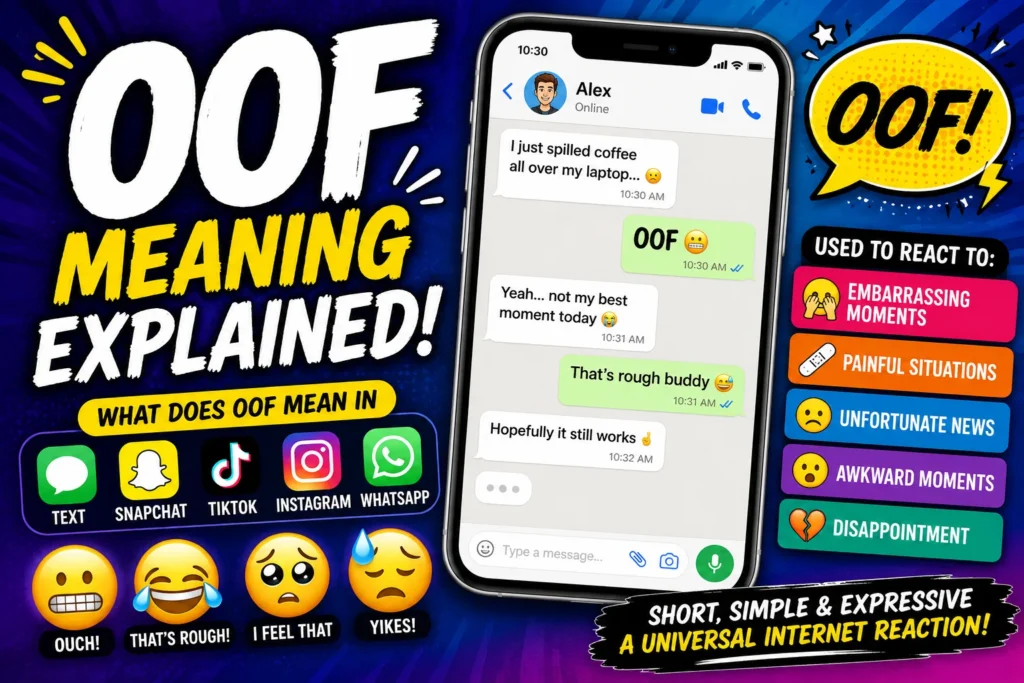

OOF is an internet slang expression used to react to something painful, awkward, embarrassing, unfortunate, or disappointing. In texting and social media, it’s the digital equivalent of saying “ouch,” “that’s rough,” or “I feel that.”
If you’ve seen someone reply with “oof” on Snapchat, TikTok, Instagram, WhatsApp, or in a text message, you’re probably wondering what they mean. The good news is that OOF is usually easy to understand once you know the context. This guide explains every common meaning, how it’s used in online conversations, when it’s appropriate, and how to respond naturally.
What Does OOF Mean?
OOF is an internet slang term people use to express a reaction to something negative or uncomfortable.
It often communicates:
- Sympathy
- Second-hand embarrassment
- Disappointment
- Surprise
- Emotional pain
- Physical pain (sometimes jokingly)
Think of it as a quick emotional response rather than a complete sentence.
For example:
Friend: I studied all night and still failed the exam.
You: Oof… that’s rough.
Here, “oof” shows empathy without needing a long explanation.
Unlike many texting abbreviations, OOF isn’t an acronym. It’s simply an expressive word that imitates the sound someone might make after getting hurt or hearing bad news.
OOF Meaning in Text
In text messages, OOF usually means:
- “That hurts.”
- “That’s unfortunate.”
- “I feel bad for you.”
- “That’s embarrassing.”
- “Yikes.”
People use it as a quick emotional reaction instead of typing a longer response.
Examples
A: My phone fell into the pool.
B: Oof… that’s expensive.
A: I accidentally sent the message to my teacher.
B: Oof 😂
A: I missed my flight.
B: Oof, that’s the worst.
In each example, OOF shows empathy, surprise, or amusement without being overly dramatic.
OOF Slang Meaning
As slang, OOF has become one of the internet’s favorite reaction words.
It doesn’t have one strict definition.
Instead, it expresses an emotional response to something unfortunate, awkward, or painful.
Depending on the situation, OOF can mean:
- That’s unfortunate.
- I feel sorry for you.
- That must hurt.
- That’s embarrassing.
- Oh no.
- Yikes.
Because it’s so flexible, you’ll see OOF across nearly every social media platform.
What Does OOF Mean in Chat?
In online chats, OOF usually acts as a quick reaction.
Someone may send it after hearing bad news, seeing an embarrassing mistake, or reacting to an unexpected event.
Example
Alex: I forgot today was the deadline.
Jordan: Oof…
Jordan doesn’t need to write an entire sentence.
The single word already expresses sympathy and disappointment.
That’s why OOF has become so popular in digital communication.
OOF Meaning on Snapchat
On Snapchat, OOF is extremely common in private conversations.
Friends often use it when reacting to:
- Relationship drama
- School problems
- Family issues
- Embarrassing moments
- Funny accidents
Snapchat Example
A: I opened his message and forgot to reply.
B: Oof… you’re definitely getting another text.
Here, OOF suggests the situation could become awkward while keeping the tone light.
OOF Meaning on Instagram
Instagram users frequently comment “OOF” under:
- Fails
- Funny videos
- Embarrassing stories
- Relationship posts
- Sports mistakes
For example:
Missed the winning penalty…
Comment:
OOF 😭
The commenter acknowledges the disappointment without writing a long response.
OOF Meaning on TikTok
TikTok helped make OOF even more popular.
Creators and viewers use it when reacting to:
- Cringe videos
- Funny fails
- Unexpected endings
- Awkward moments
- Emotional storytimes
Example:
Video: Someone accidentally waves back at a stranger who wasn’t waving at them.
Top comment:
OOF 💀
Here, OOF means:
“That was painfully awkward.”
OOF Meaning on WhatsApp
On WhatsApp, OOF is commonly used in conversations between friends and family.
Someone might send it after hearing bad news or reading about a frustrating experience.
Example
Friend: My laptop stopped working the night before my presentation.
You: Oof… hopefully it can be fixed quickly.
It’s short, supportive, and conversational.
Is OOF an Acronym?
No.
Unlike abbreviations such as:
- LOL
- BRB
- IDK
- IMO
OOF is not an acronym.
Each letter doesn’t stand for a separate word.
Instead, OOF is an expressive internet slang word.
Is OOF a Short Form?
Not exactly.
OOF isn’t shortened from another English word.
Instead, it’s an independent expression that imitates a sound people naturally make when reacting to pain or disappointment.
Is OOF a Phonetic Spelling?
Yes—this is the closest description.
OOF represents the sound someone might make after:
- Stubbing a toe
- Hearing shocking news
- Watching an embarrassing moment
- Feeling sympathy for another person
Because it imitates a spoken reaction, linguists often consider it an onomatopoeic expression or a phonetic representation of a natural sound.
Is OOF a Typo Turned Slang?
No.
OOF wasn’t created by a typing mistake.
Its popularity grew through:
- Online gaming communities
- Meme culture
- Internet forums
- Social media
- Text messaging
The famous “OOF” sound effect from the online game Roblox also helped introduce the word to millions of younger internet users, although the expression existed long before Roblox became popular.
Today, OOF is recognized as a mainstream internet slang term used across digital communication worldwide.
Tone and Context Variations
Although OOF always expresses a reaction, its emotional tone changes depending on the conversation. Sometimes it shows sympathy, while other times it adds humor or highlights an awkward moment.
Understanding the tone helps you respond naturally.
Funny Tone
Friends often use OOF after something silly or embarrassing happens.
Example
Alex: I walked into the wrong classroom today.
Ben: OOF 😂 Did anyone notice?
Alex: Unfortunately… everyone did.
Here, OOF makes the conversation playful rather than serious.
Sarcastic Tone
OOF can also be used sarcastically when someone makes an obvious mistake.
Example
Emma: I ignored all my deadlines.
Liam: OOF… great strategy.
Emma: Yeah, I definitely regret it.
The speaker is joking while pointing out the poor decision.
Romantic Tone
Couples sometimes use OOF when discussing awkward relationship moments.
Example
Sophia: I accidentally called you by my brother’s name.
Ethan: OOF… that’s going to take some explaining.
Sophia: I promise it was an accident!
In this context, OOF softens the awkwardness with humor.
Angry Tone
OOF isn’t usually angry by itself, but it can emphasize frustration.
Example
A: My boss scheduled another meeting for Friday evening.
B: OOF… that’s annoying.
A: Tell me about it.
The word expresses empathy for the frustration without sounding aggressive.
Playful Tone
Among close friends, OOF often appears in jokes.
Example
Chris: I lost my game in the first round.
Jordan: OOF! Better luck next time. 😆
Chris: I need more practice.
The conversation remains light and friendly.
Real Chat Examples
Here are realistic conversations showing how people naturally use OOF in texting and social media.
Example 1
A: I spilled coffee on my laptop.
B: OOF…
A: Hopefully it still works.
Example 2
A: I forgot my wallet at home.
B: OOF, that’s rough.
A: Guess I’m going back.
Example 3
A: I failed my driving test.
B: OOF. You’ll get it next time.
A: Thanks.
Example 4
A: She left me on read.
B: OOF 😬
A: I know…
Example 5
A: My internet stopped during the meeting.
B: OOF.
A: Worst timing ever.
Example 6
A: I accidentally liked a photo from 2019.
B: OOF 😂
A: Time to disappear.
Example 7
A: I lost my keys again.
B: OOF.
A: I’m always doing this.
Example 8
A: My favorite team lost 5-0.
B: OOF…
A: Pain.
Example 9
A: I slept through my alarm.
B: OOF.
A: Today isn’t my day.
Example 10
A: I dropped my phone.
B: OOF!
A: Screen survived somehow.
Example 11
A: My dog ate my homework.
B: OOF 😂
A: My teacher won’t believe me.
Example 12
A: I sent the message to the wrong group.
B: OOF.
A: I’m embarrassed.
Example 13
A: I forgot our anniversary.
B: OOF…
A: I’m in trouble.
Example 14
A: I burned dinner again.
B: OOF 😂
A: Pizza it is.
Example 15
A: My flight got canceled.
B: OOF. Hope you find another one.
A: Fingers crossed.
Grammar and Language Role
OOF doesn’t behave like a typical noun or verb.
Instead, it’s an interjection—a word used to express emotion or reaction.
Part of Speech
OOF is an interjection.
Like these words:
- Wow!
- Ouch!
- Yikes!
- Ugh!
It expresses a feeling instead of describing an action.
Sentence Position
OOF usually appears:
- At the beginning of a message.
- As a complete message by itself.
- Before another sentence.
Examples:
- OOF… that’s terrible.
- OOF!
- OOF, I wasn’t expecting that.
Can OOF Replace a Full Sentence?
Yes.
Unlike many abbreviations, OOF often stands alone.
Instead of saying:
“I’m sorry that happened.”
Someone simply writes:
OOF.
The emotional reaction is immediately understood.
Tone Impact
Using OOF makes conversations feel:
- Casual
- Friendly
- Relatable
- Expressive
It shows emotion without needing many words.
Formal vs. Informal Use
OOF is considered informal internet slang.
Use it in:
- Text messages
- Snapchat
- TikTok
- Discord
- Gaming chats
Avoid using it in:
- Business emails
- School assignments
- Professional reports
- Academic writing
In formal communication, phrases like “I’m sorry to hear that” or “That’s unfortunate” are more appropriate.
How to Reply When Someone Says “OOF”
The best reply depends on why they said it.
Neutral Replies
- “Yeah, it wasn’t great.”
- “I know.”
- “Exactly.”
- “Tell me about it.”
- “Thanks.”
Funny Replies
- “😂 It gets worse.”
- “You should’ve seen the rest!”
- “I’m trying to laugh through the pain.”
- “At least it made a good story.”
Serious Replies
- “Thanks for understanding.”
- “I appreciate it.”
- “Hopefully things improve.”
- “It’s been a difficult day.”
Flirty Replies
If the conversation is lighthearted:
- “Maybe you can cheer me up. 😉”
- “Think you can make my day better?”
- “Only your message made it less painful.”
Comparison Table
| Slang Term | Meaning | Usage Context | Tone | Popularity | Confusion Risk |
|---|---|---|---|---|---|
| OOF | Reaction to pain, awkwardness, or bad luck | Texting, gaming, social media | Sympathetic, humorous | Very High | Low |
| Yikes | Surprise or discomfort | Everyday conversations | Concerned | High | Low |
| OMG | Oh My God | Surprise or excitement | Emotional | Extremely High | Very Low |
| SMH | Shaking My Head | Disappointment | Frustrated | Very High | Low |
| RIP | Expression of loss or failure | Memes, jokes, serious topics | Humorous or serious | High | Medium |
| LOL (Contrasting term) | Laughing Out Loud | Funny conversations | Happy | Extremely High | Very Low |
OOF vs. Yikes
Both express discomfort.
- OOF usually shows empathy or emotional pain.
- Yikes often expresses surprise or concern.
Example:
OOF… that must hurt.
vs.
Yikes! That looks painful.
OOF vs. OMG
These are sometimes confused but have different purposes.
- OOF reacts to unfortunate events.
- OMG expresses surprise, excitement, or shock.
Example:
OOF… you failed the exam.
vs.
OMG! You won the lottery!
Who Uses the Term OOF?
OOF has become one of the most recognizable reaction words on the internet. While it started as a simple expression of pain or surprise, it is now used by millions of people in everyday digital conversations.
Age Groups
OOF is most popular among:
- Teenagers
- Gen Z
- Younger Millennials
- Gamers
- Social media users
Older adults may also use OOF, especially if they’re active on platforms like Reddit, Facebook, Discord, or WhatsApp.
Gen Z vs. Millennials
Gen Z
Gen Z uses OOF frequently because it’s quick, expressive, and fits naturally into meme culture. It’s common in chats, comments, and reaction videos.
Millennials
Millennials also use OOF but often as a humorous reaction to bad luck, awkward situations, or everyday frustrations rather than as part of internet trends.
Regional Usage
OOF is widely recognized in English-speaking countries, including:
- United States
- Canada
- United Kingdom
- Australia
- New Zealand
Thanks to social media, the slang has spread globally, and many non-native English speakers also understand its meaning.
Platforms Where OOF Is Most Common
You’ll often see OOF on:
- Snapchat
- TikTok
- Discord
- X (formerly Twitter)
- Facebook Messenger
- Online gaming chats
- SMS text messages
Because it’s short and expressive, OOF works well on platforms where fast communication is the norm.
Origin and Internet Culture Insight
Unlike many texting abbreviations, OOF wasn’t created from the first letters of several words. Instead, it evolved as an expressive sound that mimics a person’s reaction to pain, disappointment, or awkwardness.
Possible Origin
The word “oof” has existed in spoken English for decades as an exclamation similar to “ouch.”
However, it became internet slang through:
- Online gaming
- Meme culture
- Internet forums
- Social media
The Roblox Connection
Many younger internet users associate OOF with the famous Roblox “death sound.”
For years, when a Roblox character was defeated, a distinctive “OOF” sound played. This became one of gaming’s most recognizable sound effects and inspired countless memes, reaction videos, and social media posts.
Although Roblox greatly increased its popularity, the word itself existed long before the game.
Meme Culture
OOF fits perfectly into meme culture because it’s:
- Short
- Funny
- Instantly recognizable
- Emotionally expressive
People often comment “OOF” under videos showing:
- Epic fails
- Sports mistakes
- Cringe moments
- Embarrassing situations
- Unexpected endings
One word communicates an entire emotional reaction.
Fast Typing Culture
Modern messaging encourages speed.
Instead of writing:
“That must have been embarrassing.”
People simply type:
OOF.
This saves time while still expressing sympathy or surprise.
Why People Say OOF on TikTok
TikTok has helped OOF remain relevant even years after it first became popular.
Creators and viewers use OOF because it’s:
- Quick to type
- Easy to understand
- Funny
- Perfect for reacting to short videos
You’ll commonly see OOF in comments on:
- Storytime videos
- Funny fails
- Relationship drama
- Sports highlights
- Gaming clips
- Dance mistakes
- Pranks
For example:
Video: Someone accidentally waves back at a stranger.
Top Comment:
OOF 😭
The comment instantly communicates second-hand embarrassment without needing a long explanation.
Is OOF Rude?
No.
OOF is generally considered a harmless internet expression.
Most people use it to show:
- Sympathy
- Empathy
- Surprise
- Mild disappointment
However, tone matters.
If someone shares very serious or emotional news, replying with only “OOF” may seem dismissive. In those situations, adding a supportive message is a better choice.
For example:
Instead of:
OOF.
Try:
OOF… I’m really sorry that happened.
Is OOF a Bad Word?
No.
OOF is not profanity and isn’t considered offensive.
It’s a family-friendly internet slang term suitable for most casual conversations.
Should You Use OOF at School or Work?
At School
OOF is perfectly acceptable in:
- Group chats
- Conversations with classmates
- Casual messages
Avoid using it in:
- Essays
- Reports
- Assignments
- Formal presentations
Teachers generally expect standard English in academic work.
At Work
OOF is fine when chatting casually with coworkers you know well.
However, avoid using it in:
- Business emails
- Client communications
- Professional reports
- Formal workplace messages
Instead, use phrases like:
- “I’m sorry to hear that.”
- “That’s unfortunate.”
- “I understand.”
Professional communication should always prioritize clarity.
Experience-Based Insight
Based on everyday internet conversations, OOF has become much more than just a gaming reference. People use it as a universal reaction whenever words like “ouch,” “yikes,” or “that’s rough” would fit.
In group chats, it’s common to see someone share an embarrassing story and receive several replies that simply say “OOF.” Everyone immediately understands the emotion behind it. This simplicity is one reason OOF has remained popular across multiple generations of internet users.
Frequently Asked Questions
What does OOF mean in text?
In text messages, OOF is an internet slang expression that reacts to something painful, embarrassing, awkward, or disappointing. It often means “ouch,” “that’s rough,” or “I feel bad for you.”
What does OOF mean in chat?
In chats, OOF expresses sympathy, surprise, or second-hand embarrassment. It’s commonly used as a quick emotional reaction.
What does OOF mean on Snapchat?
On Snapchat, OOF usually reacts to awkward stories, relationship drama, embarrassing moments, or bad news shared between friends.
What does OOF mean on TikTok?
On TikTok, OOF appears in comments on funny fails, cringe videos, sports mistakes, and emotional storytimes. It shows viewers relate to what happened.
Is OOF the same as IDK?
No.
- OOF expresses emotion or reaction.
- IDK means “I don’t know.”
They serve completely different purposes.
Can adults use OOF?
Absolutely.
Although Gen Z popularized it online, adults also use OOF in casual texts, gaming communities, and social media conversations.
How do you respond to OOF?
Natural replies include:
- “I know.”
- “Tell me about it.”
- “It’s been a long day.”
- “Thankfully, it’s over now.”
- “Thanks for understanding.”
Does OOF always mean something bad?
Usually, yes. OOF is most often used to react to unfortunate, awkward, or painful situations. However, friends may also use it jokingly during playful conversations.
Is OOF an acronym?
No. OOF is not an acronym. It’s an expressive slang word that imitates a natural reaction.
Why is OOF so popular online?
Its popularity comes from internet memes, gaming culture, and especially the famous Roblox “OOF” sound effect.
Is OOF still popular in 2026?
Yes. While internet slang changes quickly, OOF remains widely used on TikTok, Snapchat, Discord, Reddit, and messaging apps.
Can OOF replace an entire sentence?
Yes. In many conversations, a single “OOF” communicates enough emotion to replace a longer response.
Is OOF appropriate for professional communication?
Generally, no. It’s best reserved for informal conversations with friends or colleagues you know well.
What words are similar to OOF?
Common alternatives include:
- Ouch
- Yikes
- Wow
- Dang
- RIP (in humorous contexts)
Summary
OOF is one of the internet’s most recognizable reaction words. Whether you’re texting a friend, commenting on TikTok, or chatting on Snapchat, it usually expresses sympathy, disappointment, surprise, or second-hand embarrassment.
Because it’s simple, expressive, and easy to understand, OOF has remained a favorite in online conversations for years.
Usage Tips
- Use OOF when reacting to awkward or unfortunate situations.
- Pair it with a supportive message if someone shares serious news.
- Remember that tone depends on the conversation.
- Keep it for informal communication rather than professional writing.
Common Mistakes
Avoid these common errors:
- Assuming OOF is an acronym.
- Using it in formal business or academic writing.
- Replying with only “OOF” to very serious situations where empathy deserves a fuller response.
- Thinking it’s only related to Roblox—it’s much broader than that today.
When to Use and When to Avoid OOF
Use OOF When
- Texting friends
- Commenting on TikTok videos
- Chatting on Snapchat
- Messaging on Instagram or WhatsApp
- Reacting to funny fails or awkward moments
Avoid OOF When
- Writing business emails
- Preparing school assignments
- Communicating with clients
- Discussing highly sensitive topics without adding a supportive response