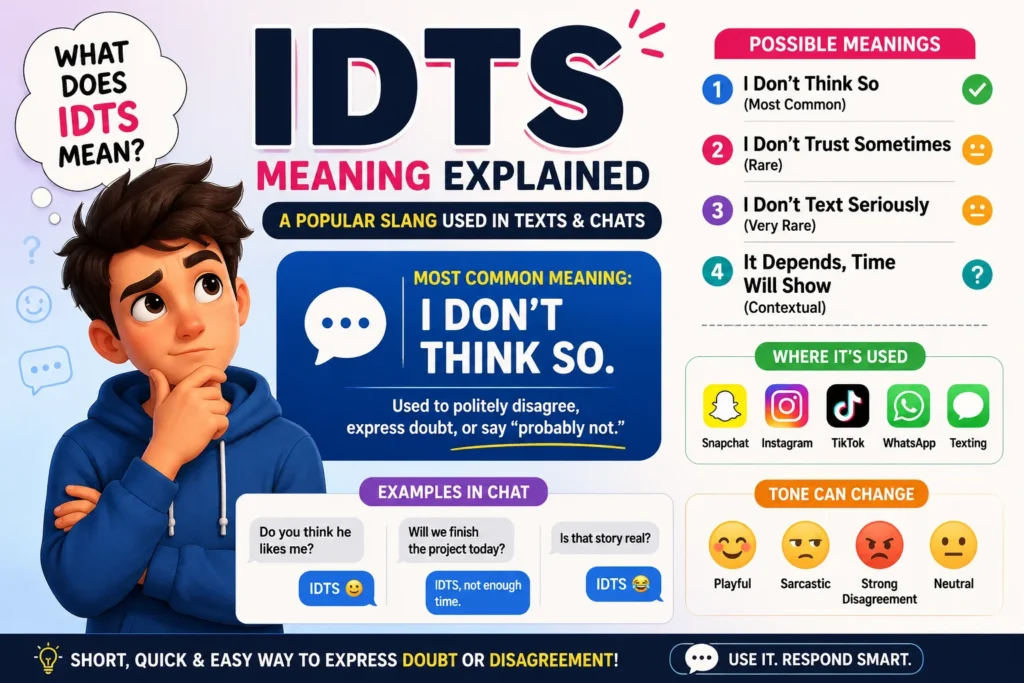

IDTS most commonly means “I Don’t Think So.” It’s a popular texting abbreviation used to politely disagree, express doubt, or say “probably not” in casual online conversations.
If you’ve received IDTS in a text message, Snapchat, TikTok comment, Instagram DM, or WhatsApp chat, you might wonder whether it’s negative, sarcastic, or simply another internet slang term. The good news is that IDTS usually isn’t rude—it’s simply a quick way of expressing disagreement or uncertainty. Understanding how people use it in different situations helps you avoid misunderstandings and reply naturally.
What Does IDTS Mean?
The most widely accepted meaning of IDTS is:
I Don’t Think So
People use this abbreviation when they:
- Disagree with someone
- Express doubt
- Politely reject an idea
- Say “probably not”
- Show uncertainty without sounding too harsh
Instead of typing the full sentence, users simply write IDTS to save time.
For example:
Friend: “Do you think it’ll rain today?”
You: “IDTS. The forecast looks sunny.”
In this conversation, IDTS means “I don’t think so.”
What Does IDTS Mean in Text?
In text messaging, IDTS almost always stands for “I Don’t Think So.”
It helps keep conversations short and fast, which is why it’s common in digital communication.
Examples include:
- “IDTS they’re coming tonight.”
- “IDTS that’s true.”
- “IDTS I’ll finish before dinner.”
- “IDTS he meant it like that.”
Rather than sounding aggressive, the abbreviation usually softens disagreement.
IDTS Meaning in Chat
When used in live chats or messaging apps, IDTS functions as a quick response that communicates doubt or disagreement.
For example:
Alex: “Are we getting a surprise test tomorrow?”
Emma: “IDTS. The teacher said next week.”
Here, Emma isn’t completely certain, but she believes the answer is no.
IDTS Meaning on Snapchat
On Snapchat, IDTS is commonly used in private conversations between friends.
Typical uses include:
- Responding to questions
- Reacting to gossip
- Sharing opinions
- Declining invitations politely
Example:
Friend: “Think Jake likes me?”
You: “IDTS… but maybe you should ask him.”
The tone is casual and conversational.
IDTS Meaning on Instagram
On Instagram, you’ll mostly see IDTS in:
- Direct Messages
- Story replies
- Comment sections
- Group chats
People often use it when discussing:
- Trends
- Celebrities
- Relationships
- Viral videos
Example:
“IDTS that’s the original video.”
IDTS Meaning on TikTok
TikTok users frequently use IDTS in comments to react to videos or opinions.
For example:
Creator:
“This is the best movie ever.”
Comment:
“IDTS 😂”
In this context, the commenter simply disagrees.
Sometimes the abbreviation is paired with laughing emojis to make the disagreement playful rather than serious.
IDTS Meaning on WhatsApp
WhatsApp conversations often resemble normal texting, so the meaning stays the same.
Example:
Mom: “Will you be home before 8?”
Son: “IDTS. Traffic is terrible.”
The abbreviation makes the reply shorter while remaining polite.
Is IDTS an Acronym?
Yes.
IDTS is an acronym.
Each letter represents the first letter of a word:
- I = I
- D = Don’t
- T = Think
- S = So
Unlike internet slang that evolves from misspellings, IDTS is formed from the initials of an entire sentence.
Is IDTS a Short Form?
Yes.
IDTS is both:
- An acronym
- A texting abbreviation
It replaces the complete sentence:
“I don’t think so.”
This makes conversations quicker without changing the meaning.
Is IDTS a Phonetic Spelling?
No.
A phonetic spelling sounds like the word it represents.
Examples include:
- “gonna”
- “wanna”
- “lemme”
IDTS does not imitate pronunciation.
Instead, it is an abbreviation built from initials.
Is IDTS a Typo Turned Slang?
No.
Unlike slang that originated from accidental misspellings or typing errors, IDTS was intentionally created as a texting shortcut.
Its meaning has remained consistent for many years across messaging apps and social media.
How the Tone of IDTS Changes
Although the basic meaning stays the same, the tone depends heavily on the conversation.
The same four letters can sound friendly, playful, sarcastic, or serious depending on context.
Funny Tone
Friends often use IDTS jokingly.
Example:
Mia: “I’m definitely going to become a millionaire this month.”
Sarah: “IDTS 😂… but I hope you prove me wrong!”
The abbreviation creates lighthearted disagreement.
Sarcastic Tone
Sometimes IDTS is intentionally sarcastic.
Example:
Ben: “I’m never late.”
Chris: “IDTS… you’ve been late every day this week.”
The sarcasm comes from the situation rather than the abbreviation itself.
Romantic Tone
Partners may use IDTS in teasing conversations.
Example:
Emma: “You’ll stop stealing my fries someday.”
Ryan: “IDTS 😄”
The disagreement is playful and affectionate.
Angry Tone
When used without explanation, IDTS can sound blunt.
Example:
Person A: “You believe me, right?”
Person B: “IDTS.”
Without additional words or emojis, the reply may feel cold or dismissive.
Playful Tone
Many friends soften IDTS with emojis or laughter.
Example:
Jake: “You’ll beat me at basketball.”
Noah: “IDTS 😂🏀”
Here, the disagreement feels friendly rather than confrontational.
Mini Conversation Examples
Example 1
A: Do you think we’ll finish the project today?
B: IDTS. We still have a lot left.
A: Let’s split the work then.
Example 2
A: Is that the real account?
B: IDTS. It doesn’t have the verification badge.
A: Good catch.
Example 3
A: Think she’ll notice?
B: IDTS… she’s paying attention to something else.
A: Perfect.
Example 4
A: Are they open today?
B: IDTS. It’s a public holiday.
A: I’ll check online first.
Example 5
A: Will this trend still be popular next month?
B: IDTS, but social media changes fast.
A: True. We’ll see.
Grammar and Language Role of IDTS
Although IDTS is an internet slang abbreviation, it follows a consistent role in casual English conversations. It acts as a replacement for the full sentence “I don’t think so.”
Understanding how it functions grammatically helps you use it naturally in texts, chats, and social media.
Part of Speech
IDTS is best described as a sentence abbreviation or texting expression.
Unlike words such as nouns or verbs, it represents an entire statement.
For example:
- “IDTS.”
- “I don’t think so.”
Both express exactly the same idea.
Sentence Position
IDTS most commonly appears:
- At the beginning of a reply
- As a complete response
- Before an explanation
Examples:
Beginning of a sentence
IDTS he’ll be here before noon.
Complete response
A: Are we leaving now?
B: IDTS.
Before additional information
IDTS because the store closes early today.
Does IDTS Replace a Full Sentence?
Yes.
One of the reasons IDTS became popular is because it replaces an entire sentence while keeping the meaning clear.
Instead of writing:
I don’t think so.
People simply type:
IDTS.
This makes texting faster and more convenient.
Tone Impact
The tone of IDTS depends almost entirely on context.
It may sound:
- Polite
- Friendly
- Playful
- Skeptical
- Sarcastic
- Slightly blunt
Adding emojis or extra words usually softens the tone.
Compare these examples:
Blunt
IDTS.
Friendlier
IDTS 😊
More thoughtful
IDTS, but let’s wait and see.
Formal vs. Informal Use
IDTS is considered informal internet slang.
It is appropriate for:
- Text messages
- Snapchat
- TikTok
- Discord
- Messenger
- Online gaming chats
It is not appropriate for:
- Business emails
- Job applications
- Academic papers
- Professional reports
- Official workplace communication
In formal writing, spell out the complete phrase:
I don’t think so.
instead of using:
IDTS.
15 Real Chat Examples Using IDTS
Below are realistic conversations showing how people naturally use IDTS.
Conversation 1
A: Do you think it’ll snow tomorrow?
B: IDTS. The weather app says it’ll be sunny.
A: Hopefully you’re right.
Conversation 2
A: Is that restaurant still open?
B: IDTS. It closed pretty early yesterday.
A: I’ll call just to be sure.
Conversation 3
A: Think he’ll text back tonight?
B: IDTS, but maybe tomorrow.
A: Guess I’ll wait.
Conversation 4
A: Are we late?
B: IDTS. We still have ten minutes.
A: Great!
Conversation 5
A: Did she see my message?
B: IDTS. It still says delivered.
A: I’ll wait a bit longer.
Conversation 6
A: Is this the correct answer?
B: IDTS. Check question five again.
A: Good idea.
Conversation 7
A: Are they serious?
B: IDTS 😂
A: They’re always joking.
Conversation 8
A: Think the movie is worth watching?
B: IDTS. The reviews aren’t great.
A: Maybe we’ll pick another one.
Conversation 9
A: Is Jake coming?
B: IDTS. He said he wasn’t feeling well.
A: That’s too bad.
Conversation 10
A: Can we finish this tonight?
B: IDTS unless everyone helps.
A: I’ll message the group.
Conversation 11
A: Do you think I’ll win?
B: IDTS… but surprise me!
A: Challenge accepted.
Conversation 12
A: Is this the original account?
B: IDTS. The username looks different.
A: You’re probably right.
Conversation 13
A: Think they’ll notice?
B: IDTS 😂
A: Let’s hope not.
Conversation 14
A: Is that rumor true?
B: IDTS. Nobody has confirmed it.
A: Good point.
Conversation 15
A: Are you giving up?
B: IDTS. I’m just taking a break.
A: That’s the spirit.
How to Reply When Someone Says IDTS
When someone replies with IDTS, your response depends on the conversation and relationship.
Here are several natural reply styles.
Funny Replies
Keep the conversation light.
Examples:
- “We’ll see who’s right 😂”
- “Challenge accepted!”
- “Don’t underestimate me!”
- “You might be surprised.”
Serious Replies
Use these when discussing something important.
Examples:
- “That’s fair. Let’s check the facts.”
- “I understand your point.”
- “Why don’t you think so?”
- “Can you explain your reasoning?”
Flirty Replies
If you’re chatting with someone romantically, playful replies work well.
Examples:
- “Maybe I’ll change your mind 😉”
- “You haven’t seen my best side yet.”
- “Give me one chance to prove you wrong.”
- “Let’s make a bet.”
Neutral Replies
These fit almost any conversation.
Examples:
- “Maybe you’re right.”
- “We’ll find out soon.”
- “Let’s wait and see.”
- “Only time will tell.”
Comparison Table
People often confuse IDTS with similar texting abbreviations.
| Term | Meaning | Usage Context | Tone | Popularity | Confusion Risk |
|---|---|---|---|---|---|
| IDTS | I Don’t Think So | Expressing doubt or disagreement | Neutral | High | Low |
| IDK | I Don’t Know | Uncertainty | Neutral | Very High | Medium |
| IMO | In My Opinion | Sharing an opinion | Neutral | High | Low |
| TBH | To Be Honest | Giving an honest opinion | Honest | High | Low |
| NGL | Not Gonna Lie | Introducing an honest statement | Casual | High | Medium |
| YES (contrast) | Agreement | Accepting or confirming | Positive | Very High | Very Low |
Who Uses IDTS?
Age Group
IDTS is most popular among:
- Teenagers
- College students
- Young adults
However, many adults who regularly text also use it.
Gen Z vs. Millennials
Gen Z
- Uses IDTS frequently.
- Often combines it with emojis and memes.
- Common in TikTok comments and Snapchat chats.
Millennials
- Understand the abbreviation well.
- More likely to use it in texting than on TikTok.
Regional Popularity
IDTS is widely recognized in:
- United States
- Canada
- United Kingdom
- Australia
- Other English-speaking countries
Because English internet slang spreads quickly online, many international users also understand its meaning.
Platforms Where IDTS Is Most Common
You’ll most often find IDTS on:
- Snapchat
- TikTok
- Discord
- Facebook Messenger
- X (formerly Twitter)
- iMessage
- SMS text messages
Its popularity comes from the growing use of abbreviations in fast-paced digital communication.
Origin of IDTS and Its Place in Internet Culture
Like many popular internet abbreviations, IDTS became common as texting and instant messaging grew in popularity during the early 2000s.
Before smartphones had predictive text and voice typing, people looked for ways to send messages more quickly. Abbreviations such as LOL, BRB, IDK, and IDTS helped reduce typing while keeping conversations easy to understand.
Unlike newer slang terms that often originate on TikTok, IDTS has existed for years across texting, online forums, chat rooms, and messaging apps. Its popularity has continued because the phrase “I don’t think so” is used frequently in everyday conversations.
Why People Say IDTS on TikTok
Although IDTS did not originate on TikTok, the platform has helped keep the abbreviation relevant among younger users.
TikTok comments move quickly, and users often respond to videos with very short messages.
Instead of writing:
“I don’t think that’s true.”
many users simply comment:
“IDTS.”
This allows them to react instantly while keeping their comments brief.
On TikTok, IDTS commonly appears when users:
- Disagree with a creator’s opinion.
- Question a rumor.
- React to celebrity news.
- Debate viral trends.
- Join humorous comment threads.
Because TikTok conversations are fast-paced, abbreviations like IDTS fit naturally into the platform’s communication style.
Meme Culture and the Popularity of IDTS
Internet memes have also contributed to the continued use of IDTS.
People often pair the abbreviation with:
- Laughing emojis 😂
- Skull emojis 💀
- Side-eye emojis 👀
- GIFs
- Reaction images
For example:
“IDTS 💀”
This combination usually indicates playful disagreement rather than serious criticism.
In meme culture, tone is often communicated through emojis instead of additional words.
Fast Typing Culture
Modern digital communication values speed.
People increasingly shorten common phrases.
Examples include:
| Full Phrase | Short Form |
|---|---|
| I don’t know | IDK |
| I don’t care | IDC |
| I don’t think so | IDTS |
| Be right back | BRB |
| In my opinion | IMO |
IDTS fits perfectly into this pattern because it replaces an entire sentence with only four letters.
Is IDTS Rude?
Generally, no.
IDTS is considered a polite or neutral way to disagree.
For example:
A: “Do you think they’ll cancel school?”
B: “IDTS.”
This reply simply expresses a different opinion.
However, tone matters.
A reply consisting only of “IDTS.” without any explanation may occasionally sound short or dismissive.
If you want to sound friendlier, you can write:
- “IDTS, but we’ll see.”
- “IDTS 😊”
- “IDTS, hopefully I’m wrong.”
Adding a few extra words makes the conversation feel warmer.
Is IDTS a Bad Word?
No.
IDTS does not contain profanity, offensive language, or inappropriate content.
It is considered a safe internet abbreviation and is widely used in everyday conversations.
Unlike some slang expressions, it carries no explicit or adult meaning.
Should You Use IDTS at School or Work?
It depends on the situation.
Appropriate Situations
IDTS is perfectly acceptable in:
- Text messages with classmates
- Group chats
- Casual conversations
- Friendly emails
- Social media comments
Situations to Avoid
Avoid using IDTS in:
- Academic essays
- Research papers
- Business reports
- Job applications
- Professional emails
- Official workplace communication
In formal writing, it’s better to write:
“I don’t think so.”
instead of using the abbreviation.
Experience-Based Insight
From observing how people communicate online, IDTS is most often used as a soft disagreement rather than a harsh rejection. Instead of directly saying “No,” many people choose IDTS because it sounds less confrontational and leaves room for discussion.
On platforms like Snapchat, WhatsApp, and Instagram, users frequently follow IDTS with an explanation, emoji, or joke to make their tone clearer. This is especially common among Gen Z users, who rely heavily on context and emojis to express emotions in digital conversations.
Frequently Asked Questions
What does IDTS mean in text?
IDTS means “I Don’t Think So.” It’s commonly used in text messages to politely express disagreement or doubt.
What does IDTS mean in chat?
In chat conversations, IDTS indicates that someone disagrees with a statement or believes something is unlikely.
What does IDTS mean on Snapchat?
On Snapchat, IDTS has the same meaning: “I Don’t Think So.” Friends often use it in casual conversations, replies, and streak chats.
What does IDTS mean on Instagram?
On Instagram, IDTS is used in direct messages, comments, and story replies to express disagreement or uncertainty.
Is IDTS the same as IDK?
No.
- IDTS means “I Don’t Think So.”
- IDK means “I Don’t Know.”
IDTS expresses an opinion, while IDK expresses uncertainty.
Can adults use IDTS?
Absolutely.
Although it’s especially popular among teenagers and Gen Z, adults who use texting abbreviations also understand and use IDTS.
How do you respond to IDTS?
Natural responses include:
- “Maybe you’re right.”
- “We’ll find out soon.”
- “Let’s wait and see.”
- “Fair enough.”
Is IDTS positive or negative?
Neither.
It is generally considered a neutral expression that simply communicates disagreement or doubt.
What is the full form of IDTS?
The full form of IDTS is “I Don’t Think So.”
Is IDTS slang?
Yes.
It is an internet slang abbreviation commonly used in texting and online conversations.
Is IDTS rude in a text message?
Usually not.
Most people interpret it as a casual, polite disagreement.
When should you use IDTS?
Use it when you want to express doubt, disagreement, or uncertainty in informal conversations.
Where is IDTS most commonly used?
IDTS is commonly seen on:
- Snapchat
- TikTok
- Discord
- Messenger
- SMS text messages
Does IDTS always mean “I Don’t Think So”?
Almost always.
While abbreviations can occasionally have niche meanings, “I Don’t Think So” is by far the most widely recognized definition.
Can IDTS be sarcastic?
Yes.
Depending on the conversation and emojis used, IDTS can sound playful or sarcastic.
Why do people use IDTS instead of typing the full sentence?
People use IDTS because it’s shorter, faster to type, and widely understood in digital communication.
Conclusion
The abbreviation IDTS stands for “I Don’t Think So.” It is one of the most common texting abbreviations used to express doubt, disagreement, or polite skepticism in casual conversations.
Whether you’re chatting on Snapchat, commenting on TikTok, messaging friends on WhatsApp, or replying in an Instagram DM, IDTS helps communicate your opinion quickly without sounding overly harsh. Like many internet slang terms, its tone depends on context, emojis, and the relationship between the people involved.
Understanding abbreviations like IDTS makes online conversations easier to follow and helps you communicate naturally across today’s most popular social media platforms.
Quick Summary
- IDTS = I Don’t Think So
- It is an acronym and texting abbreviation.
- Commonly used in chats, texts, and social media.
- Usually expresses polite disagreement or doubt.
- Most popular among Gen Z and Millennials.
- Appropriate for informal conversations but not formal writing.
Common Mistakes to Avoid
- Assuming IDTS means the same as IDK.
- Using it in professional emails or academic writing.
- Reading it as rude without considering the conversation’s tone.
- Forgetting that emojis often change how the message is interpreted.
When to Use IDTS
Use IDTS when:
- You politely disagree.
- You think something is unlikely.
- You want to keep your reply short.
- You’re chatting casually with friends or family.
Avoid using it in formal or professional communication where complete sentences are more appropriate.