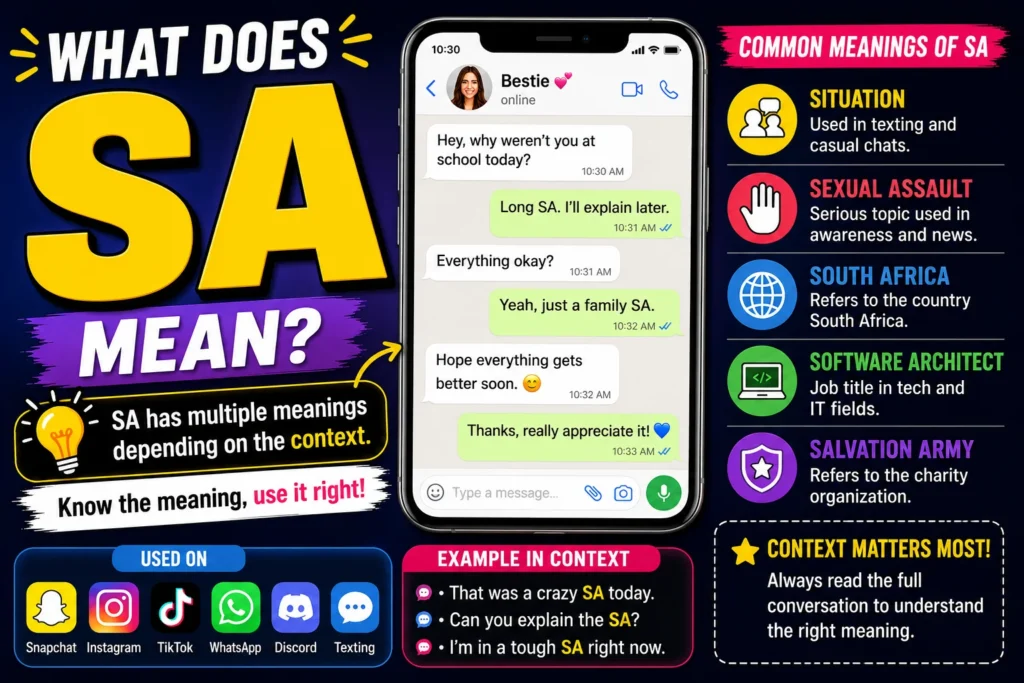

SA usually means different things depending on the conversation. In texting and social media, it can stand for “Situation,” while in other contexts it may refer to “Sexual Assault,” “South Africa,” or several other phrases. Understanding the context is the key to knowing the correct meaning.
If you’ve received “SA” in a text message, seen it in a TikTok comment, or noticed it on Snapchat or Instagram, you’re probably wondering what it actually means. Unlike abbreviations such as LOL or BRB, SA doesn’t have a single universal definition. Its meaning changes depending on who is using it, where it’s used, and the topic of the conversation.
This guide explains what SA means in text, SA slang meaning, what SA means in chat, and how it’s commonly used across Snapchat, Instagram, TikTok, WhatsApp, gaming communities, and online conversations. You’ll also learn how to respond when someone uses SA and how to avoid common misunderstandings.
What Does SA Mean?
SA is a multi-purpose abbreviation that has several meanings across texting, social media, workplaces, and everyday conversations.
The most common meanings include:
| Meaning | Common Context |
|---|---|
| Situation | Text messages and casual chats |
| Sexual Assault | News, awareness campaigns, education, serious discussions |
| South Africa | Geography and travel |
| South America | Geography |
| Software Architect | Technology and IT |
| System Administrator | Computer networking |
| Salvation Army | Charity and nonprofit discussions |
| Subject Area | Education and academics |
Because SA has multiple definitions, the surrounding conversation is far more important than the abbreviation itself.
For example:
- “That’s a tough SA.” → likely means situation.
- “The article discusses SA awareness.” → refers to sexual assault.
- “I’m traveling to SA next month.” → probably means South Africa.
SA Meaning in Text
What Does SA Mean in Text?
In casual texting, SA most commonly stands for “Situation.”
People use it when talking about circumstances, problems, or events without typing the full word.
Examples:
- “That’s a weird SA.”
- “I’m in a bad SA right now.”
- “Can you explain the SA?”
Instead of typing “situation,” many people simply write SA to save time.
Example
A: Why didn’t you come yesterday?
B: Family SA. Everything’s okay now.
A: Glad things worked out.
In this conversation, SA clearly means situation.
SA Slang Meaning
Is SA Slang?
Yes—SA can function as internet slang, especially when it replaces the word “situation” in texting.
Unlike abbreviations such as LOL or IDK, SA isn’t a universal slang term with one fixed definition.
Instead, it’s a context-based abbreviation.
Depending on the platform, users may interpret it differently.
Examples include:
- “Crazy SA 😂”
- “That SA was awkward.”
- “Worst SA ever.”
These uses are informal and appear mainly in conversations between friends.
What Does SA Mean in Chat?
Chat apps encourage fast typing, which explains why abbreviations like SA are common.
When someone writes:
“Explain the SA.”
They’re usually asking:
“Explain the situation.”
However, if the conversation involves legal, educational, or news topics, SA may instead refer to sexual assault.
Always read several messages before deciding which meaning fits.
SA Meaning on Snapchat
On Snapchat, SA usually means “Situation.”
Friends often use it when discussing:
- School
- Relationships
- Weekend plans
- Drama
- Family issues
Example:
Friend 1: What happened after class?
Friend 2: Long SA 😂
Here, SA simply means situation.
Occasionally, users discussing awareness topics may also use SA to refer to sexual assault, but the surrounding conversation makes this clear.
SA Meaning on Instagram
Instagram users often use SA in:
- Story replies
- Direct messages
- Comments
- Awareness campaigns
For casual conversations:
“That’s a funny SA.”
For educational content:
“Supporting SA survivors.”
The intended meaning depends entirely on the subject being discussed.
SA Meaning on TikTok
TikTok is one of the platforms where SA has multiple common meanings.
Creators discussing daily life may write:
“The whole SA was embarrassing.”
Meaning:
The whole situation was embarrassing.
Meanwhile, educational creators often use SA as a shortened reference to sexual assault, especially because some users shorten sensitive terms in captions or comments.
Reading the full video description usually makes the intended meaning obvious.
SA Meaning on WhatsApp
WhatsApp conversations between friends generally use SA to mean:
- Situation
- Specific circumstance
- Current problem
Example:
A: Everything okay?
B: Yeah, just handling a family SA.
Because WhatsApp conversations are private, abbreviations like SA naturally become shorthand between friends and family.
Is SA an Acronym, Short Form, or Something Else?
SA can fit into several language categories depending on how it’s being used.
Acronym
Yes.
When SA represents phrases like:
- Sexual Assault
- Software Architect
- Salvation Army
it functions as an acronym or initialism because each letter represents a separate word.
Short Form
When people use SA instead of typing Situation, it behaves more like a shortened form than a traditional acronym.
Instead of spelling out the entire word, users simply write its initials.
Phonetic Spelling
No.
SA is not a phonetic spelling.
Unlike abbreviations such as “gonna” or “wanna,” SA does not represent pronunciation.
Typo Turned Slang
No.
SA wasn’t created from a typing mistake.
It developed naturally as internet users searched for faster ways to communicate in chats, forums, and messaging apps.
Why Does SA Have So Many Meanings?
Unlike unique abbreviations such as IMHO or BRB, SA uses only two letters.
Short abbreviations often develop multiple meanings because they’re adopted by different communities over time.
For example:
- Gamers may use one meaning.
- Students may use another.
- Office workers may use another.
- Social media users may use another.
This is why context is always the most reliable way to understand what SA means.
Common Meanings of SA at a Glance
| Context | Meaning |
|---|---|
| Texting | Situation |
| Snapchat | Situation |
| Situation or Sexual Assault | |
| TikTok | Situation or Sexual Assault |
| Situation | |
| Geography | South Africa or South America |
| Workplace | Software Architect or System Administrator |
| Charity | Salvation Army |
| Education | Subject Area |
As you can see, there isn’t just one correct definition. Instead, the surrounding conversation determines which meaning is intended.
Tone and Context Variations
The meaning of SA stays the same within a conversation, but the tone changes depending on how it’s used. In casual texting, it often refers to a situation, while in serious discussions it may refer to sexual assault. Understanding the tone helps you interpret the abbreviation correctly.
Funny Tone
Friends often use SA humorously when talking about an awkward or ridiculous situation.
Example
Emma: Did you see Jake trip over the chair?
Liam: That whole SA was hilarious. 😂
Here, SA simply means “situation” and keeps the conversation casual.
Sarcastic Tone
SA can also appear in sarcastic comments.
Example
A: I forgot my homework again.
B: Wow, another amazing SA you’ve created for yourself.
The speaker is joking about the situation rather than praising it.
Romantic Tone
Couples sometimes use SA when talking about relationship situations.
Example
Sophia: Do you think we’re okay?
Ethan: It’s just a temporary SA. We’ll figure it out together.
The abbreviation keeps the conversation informal while referring to a relationship issue.
Angry Tone
When someone is frustrated, SA may describe an annoying circumstance.
Example
A: My flight got canceled again.
B: That’s such a frustrating SA.
Although the speaker is upset, the abbreviation itself isn’t rude.
Playful Tone
Friends frequently use SA while teasing one another.
Example
Alex: I accidentally sent the message to my boss.
Chris: That’s definitely a legendary SA. 😂
The tone is lighthearted and playful.
Real Chat Examples Using SA
The examples below show how people naturally use SA in text messages and online conversations.
Example 1
A: Why are you late?
B: Long SA. I’ll explain later.
A: No worries.
Example 2
A: Everything okay?
B: Yeah, just dealing with a family SA.
A: Hope everything gets better.
Example 3
A: Did your date go well?
B: Not really. The whole SA was awkward.
A: At least it’s over now!
Example 4
A: Why didn’t you answer my call?
B: Work SA. I couldn’t use my phone.
A: Got it.
Example 5
A: You look stressed.
B: It’s been a crazy SA all day.
A: Take some time to relax.
Example 6
A: What happened at school?
B: Teacher SA. I’ll tell you later.
A: Sounds interesting.
Example 7
A: Why are you laughing?
B: You wouldn’t believe the SA that just happened.
A: Tell me everything!
Example 8
A: Did you buy the tickets?
B: Not yet. Payment SA.
A: Hopefully it gets fixed soon.
Example 9
A: Why is everyone talking about SA in this video?
B: They’re referring to the situation in the story.
A: Oh, that makes sense.
Example 10
A: Are you coming tonight?
B: Depends on the family SA.
A: Keep me updated.
Example 11
A: You disappeared yesterday.
B: Internet SA.
A: That explains it.
Example 12
A: Why is the meeting delayed?
B: Scheduling SA.
A: Thanks for letting me know.
Example 13
A: Is everything sorted now?
B: Yep, the SA is finally resolved.
A: Great!
Example 14
A: Should I worry?
B: No, it’s just a small SA.
A: Good to hear.
Example 15
A: What happened after the game?
B: Huge SA with the referee.
A: Wow, tell me later.
Grammar and Language Role
Although SA is an abbreviation, it follows recognizable grammar patterns in casual English.
Part of Speech
When SA means situation, it functions as a noun.
Examples:
- That SA was embarrassing.
- The SA improved quickly.
- We handled the SA well.
It replaces the noun “situation” without changing the sentence structure.
Sentence Position
SA usually appears:
- In the middle of a sentence.
- At the end of a sentence.
- Occasionally at the beginning in informal chats.
Examples:
- That SA was confusing.
- I don’t understand the SA.
- SA like this happens sometimes.
Does SA Replace a Full Sentence?
No.
Unlike abbreviations such as:
- BRB
- TTYL
- AFK
SA doesn’t replace an entire sentence.
Instead, it replaces a single word or phrase.
Compare:
Without abbreviation:
That’s a difficult situation.
With abbreviation:
That’s a difficult SA.
Tone Impact
Using SA makes conversations:
- Faster
- More casual
- More conversational
However, because SA has multiple meanings, readers may misunderstand it if there isn’t enough context.
Formal vs. Informal Use
SA is considered informal when used to mean “situation.”
Appropriate places include:
- Text messages
- Snapchat
- Instagram DMs
- TikTok comments
- Discord
- Gaming chats
Avoid using SA instead of “situation” in:
- Academic papers
- Business reports
- Formal emails
- Legal documents
Writing the complete word is much clearer in professional communication.
How to Reply When Someone Says SA
Your reply depends on which meaning of SA the speaker intends.
Neutral Replies
These work for most everyday conversations.
- “I understand.”
- “Hope everything works out.”
- “Tell me what happened.”
- “That makes sense.”
- “I’m here if you need help.”
Funny Replies
If the conversation is lighthearted, you can respond playfully.
- “Sounds like another adventure!”
- “😂 That must have been interesting.”
- “Only you could end up in that SA!”
- “Now I need the full story.”
Serious Replies
If SA refers to a difficult or sensitive situation, respond respectfully.
- “I’m sorry you’re dealing with that.”
- “Take your time.”
- “Let me know if I can help.”
- “I hope things improve soon.”
If the conversation is about sexual assault, always respond with empathy and avoid jokes.
Flirty Replies
If the conversation is casual or romantic, you can keep things playful.
- “Maybe I can help fix the SA. 😉”
- “Sounds like you need a coffee date.”
- “Let’s solve that situation together.”
Comparison Table
| Term | Meaning | Usage Context | Tone | Popularity | Confusion Risk |
|---|---|---|---|---|---|
| SA | Situation, Sexual Assault, South Africa, etc. | Texting, social media, education, news | Context-dependent | High | Very High |
| IMO | In My Opinion | Sharing opinions | Friendly | Very High | Low |
| IDK | I Don’t Know | Expressing uncertainty | Casual | Extremely High | Very Low |
| TBH | To Be Honest | Honest statements | Casual | Very High | Low |
| SMH | Shaking My Head | Expressing disappointment | Informal | Very High | Low |
| OK | Agreement or acknowledgment | Everyday communication | Neutral | Extremely High | Very Low |
SA vs. IDK
These abbreviations have completely different purposes.
- SA usually refers to a situation or another context-specific meaning.
- IDK means “I don’t know.”
Example:
That’s a difficult SA.
vs.
IDK what happened.
SA vs. SMH
People sometimes see these together in text messages.
- SA describes a situation.
- SMH expresses disappointment or disbelief about that situation.
Example:
That SA yesterday… SMH.
In this example, the speaker is reacting negatively to the situation.
Who Uses the Term SA?
SA is used by a wide range of people, but its meaning often depends on the age group, community, and platform where it appears.
Age Groups
Although almost anyone can use SA, it’s most commonly seen among:
- Teenagers
- Gen Z
- Young Millennials
- College students
- Online gamers
- Social media users
Older adults are more likely to spell out the complete word, especially in formal communication.
Gen Z vs. Millennials
Gen Z
Gen Z uses abbreviations constantly because they communicate through fast-paced messaging apps. They may use SA to mean “situation” or recognize it from awareness campaigns discussing sexual assault.
Millennials
Millennials also understand SA but are generally more likely to use the full word “situation” unless chatting casually with friends.
Regional Usage
SA isn’t limited to one country.
You’ll commonly see it in:
- United States
- Canada
- United Kingdom
- Australia
- New Zealand
- Other English-speaking communities
Some meanings, like South Africa, naturally appear more often in travel or geography discussions.
Platforms Where SA Is Most Common
SA frequently appears on:
- Snapchat
- TikTok
- Discord
- Facebook Messenger
- Gaming chats
- SMS text messages
Each platform has slightly different usage patterns, which is why reading the surrounding conversation is important.
Origin and Internet Culture Insight
Unlike abbreviations such as LOL or BRB, SA didn’t become popular because of one specific website or app.
Instead, it gradually spread as internet users looked for quicker ways to type.
Possible Origin
The abbreviation likely developed naturally because people wanted to shorten frequently used phrases.
For example:
- Situation → SA
- Sexual Assault → SA
- South Africa → SA
Since only two letters are involved, different online communities adopted the abbreviation independently.
TikTok’s Influence
TikTok has increased the visibility of SA.
You’ll often see creators using it in:
- Storytime videos
- Comment sections
- Captions
- Awareness posts
Because TikTok conversations move quickly, abbreviations save space and make comments easier to type.
Meme Culture
Humorous content has also helped spread SA when it means “situation.”
Examples include captions such as:
- “That SA got out of control.”
- “Worst SA ever 😂”
- “Unexpected SA.”
The abbreviation fits naturally into meme culture because it’s short and conversational.
Fast Typing Culture
Modern messaging encourages speed.
Instead of writing:
“What a strange situation.”
Many people simply type:
“What a strange SA.”
This habit is common across nearly every messaging platform today.
Why People Say SA on TikTok
TikTok creators often use SA because:
- Videos have limited caption space.
- Comments are usually brief.
- Abbreviations match the platform’s fast communication style.
Depending on the video, SA could mean:
- Situation
- Sexual Assault
- South Africa
The content itself almost always provides enough context to determine the intended meaning.
If you’re unsure, watch the full video or read additional comments before assuming the definition.
Is SA Rude?
Generally, no.
When SA means “situation,” it isn’t rude or offensive.
For example:
“Crazy SA today.”
This is simply casual internet slang.
However, if SA refers to sexual assault, it represents a serious subject. While the abbreviation itself isn’t offensive, it should always be used respectfully and with sensitivity.
Is SA a Bad Word?
No.
SA is not a swear word or profanity.
It’s simply an abbreviation.
That said, because one common meaning refers to a serious topic, you should be mindful of the context and audience.
Should You Use SA at School or Work?
At School
It’s generally acceptable in:
- Casual texts with classmates
- Student group chats
- Informal discussions
However, in essays, reports, or presentations, it’s better to write the full term instead of relying on abbreviations.
At Work
In professional settings, avoid using SA unless everyone understands the intended meaning.
For example:
Instead of writing:
“We have an SA.”
Write:
“We have a situation.”
Or, if referring to a specific professional term like Software Architect, spell it out on first mention to avoid confusion.
Clear communication is always the better choice in the workplace.
Experience-Based Insight
In everyday online conversations, people rarely stop to explain abbreviations. Instead, they rely on the surrounding messages to make the meaning obvious.
For example, if someone texts, “Long SA today,” most friends immediately understand they mean a long situation. Likewise, if SA appears in a news article or awareness campaign, readers naturally interpret it as sexual assault.
This real-world pattern shows that context is more important than the abbreviation itself. Rather than memorizing a single definition, experienced internet users look at the entire conversation before deciding what SA means.
Frequently Asked Questions
What does SA mean in text?
In texting, SA most commonly means “situation.” However, it can also have other meanings depending on the conversation, such as sexual assault or South Africa.
What does SA mean in chat?
In casual chats, SA usually refers to a situation or circumstance. The exact meaning depends on the topic being discussed.
What does SA mean on Snapchat?
On Snapchat, SA most often means “situation.” Friends use it when talking about school, relationships, work, or everyday events.
What does SA mean on Instagram?
Instagram users may use SA to mean “situation” in direct messages and comments. In educational or awareness posts, it often stands for sexual assault.
What does SA mean on TikTok?
TikTok creators commonly use SA for both situation and sexual assault, depending on the content of the video. Always consider the surrounding context.
Is SA the same as IDK?
No.
SA refers to a situation or another context-specific phrase.
IDK means “I don’t know.”
The two abbreviations serve completely different purposes.
Can adults use SA?
Yes.
Although younger users employ abbreviations more frequently, adults also use SA in casual texting and online conversations.
How do you respond to SA?
Your response depends on the intended meaning.
Examples include:
- “What happened?”
- “Hope everything’s okay.”
- “Tell me more.”
- “I’m here if you need anything.”
Does SA always mean “situation”?
No. While “situation” is common in texting, SA can also mean sexual assault, South Africa, Software Architect, and several other phrases.
Why does SA have multiple meanings?
Because it’s a very short abbreviation, different communities adopted it independently over time. Context determines the correct definition.
Is SA common on social media?
Yes. You’ll frequently see SA on Snapchat, TikTok, Instagram, WhatsApp, Discord, and other messaging platforms.
Should I use SA in formal writing?
Generally, no. Writing the complete word or phrase is clearer and more professional.
Can SA have different meanings in the same app?
Yes. On platforms like TikTok and Instagram, two people may use SA differently depending on the topic of discussion.
How can I tell what SA means?
Read the surrounding messages. Context almost always reveals the intended meaning.
Summary
SA is one of the internet’s most versatile abbreviations. In casual texting, it often means “situation,” while in other contexts it can refer to sexual assault, South Africa, Software Architect, and several other phrases.
Rather than assuming one definition, pay attention to the conversation, platform, and subject matter. That’s the easiest way to interpret SA correctly.
Usage Tips
- Always read the surrounding conversation before deciding what SA means.
- Use the full phrase in professional or academic writing.
- Keep in mind that serious topics require respectful language.
- If you’re unsure, ask the sender for clarification.
Common Mistakes
Avoid these common misunderstandings:
- Assuming SA always means the same thing.
- Using it in formal documents without explanation.
- Ignoring the context of the conversation.
- Confusing “situation” with more serious meanings like “sexual assault.”
When to Use and When to Avoid SA
Use SA When
- Texting friends.
- Chatting on Snapchat or WhatsApp.
- Messaging on Discord.
- Having casual online conversations.
Avoid SA When
- Writing business emails.
- Preparing school assignments.
- Creating legal documents.
- Communicating where clarity is essential.
Spelling out the full phrase is often the better choice in formal situations.