
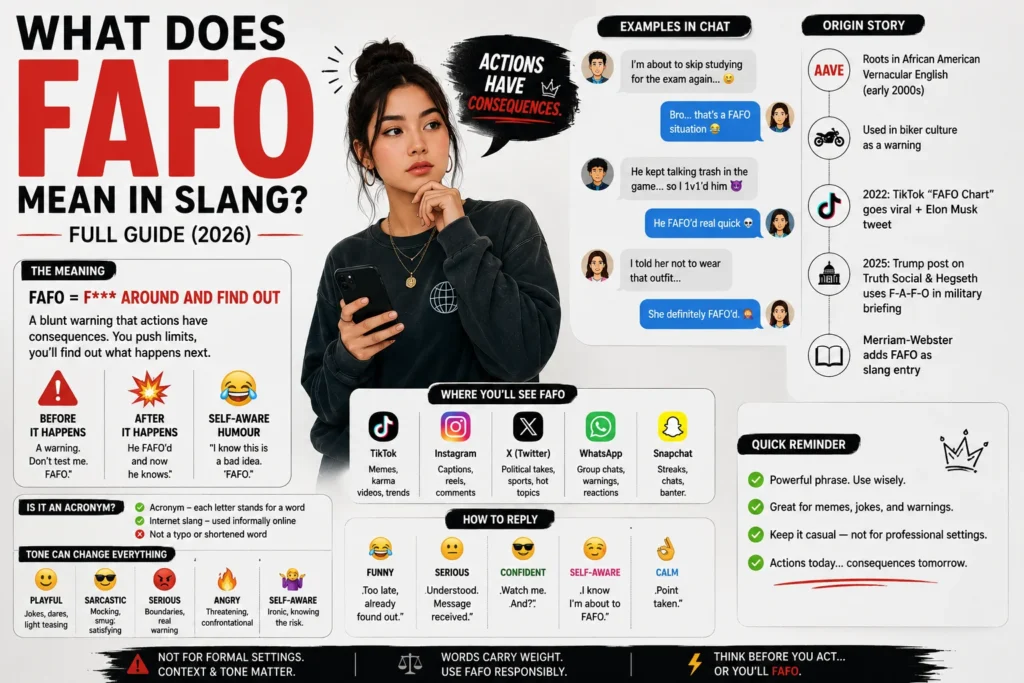

FAFO stands for “F* Around and Find Out.”** It is a blunt, four-word warning that actions have consequences. If someone pushes boundaries, tests limits, or ignores advice — they will “find out” what happens next. That is the entire message, packed into four letters.
People search “FAFO meaning” because they keep seeing it in TikTok captions, comment sections, memes, political posts, and text messages — and the acronym gives nothing away on its own. This guide covers everything: the real meaning, origin, tone variations, real chat examples, who uses it, and when to use it (and when not to).
What Does FAFO Mean?
The Full Meaning
FAFO = F* Around and Find Out**
In cleaner versions: Fool Around and Find Out or Eff Around and Find Out
The phrase is both a warning and a statement of consequence, depending on when it is used:
- Before something happens → a warning: “Don’t test me. FAFO.”
- After something happens → schadenfreude: “He FAFO’d and now he knows.”
- As self-aware humour → “I know this is a bad idea. FAFO.”
Merriam-Webster officially defines FAFO as “an expression of warning or schadenfreude” — meaning it captures both the pre-consequence threat and the post-consequence satisfaction of watching someone learn the hard way.
Is FAFO an Acronym, Abbreviation, or Slang?
- ✅ It is an acronym — each letter represents a specific word
- ✅ It functions as internet slang — used informally in digital communication
- ❌ Not a phonetic spelling or typo
- ❌ Not a shortened word
FAFO is pronounced either as “FAFF-oh” (as one word) or as four individual letters — F-A-F-O. There is no single agreed-upon pronunciation, though “FAFF-oh” is more common in casual speech and TikTok videos.
What Confusion Does Knowing FAFO Solve?
People often see FAFO in a completely different context and wonder if the meaning shifts. It does not — the core warning stays the same whether it appears in a meme, a political tweet, a military press conference, or a group chat. What changes is the tone — playful versus serious — not the definition.
FAFO Meaning in Text, Chat, and on Social Media
FAFO Meaning in Text Messages
In a text, FAFO is almost always used as a punchy warning or a smug “told you so.” The context makes the tone clear:
- “Keep ignoring my boundaries. FAFO.” → a direct personal warning
- “He skipped revision for every exam. FAFO’d on results day.” → post-consequence commentary
- “I’m eating the whole pizza. FAFO.” → self-aware, comedic use
FAFO Meaning on TikTok
TikTok is where FAFO reached its widest audience. The acronym exploded in 2022 after a viral “FAFO chart” was posted by creator Roger Skaer, showing a sliding scale of how much someone has to “f*** around” before they “find out” — the video racked up millions of views and cemented the phrase in Gen Z vocabulary.
On TikTok, FAFO appears in:
- Revenge clips and karma videos (“he cheated, she FAFO’d him”)
- Political commentary and protest content
- Parenting videos (the “FAFO parenting” trend — letting kids experience natural consequences)
- Meme formats where someone takes a dumb risk and immediately regrets it
- Challenge content: dares and stunts captioned with FAFO
Kylie Kelce’s 2025 podcast spinoff — literally titled FAFO — brought the acronym to an even broader, less internet-native audience and connected it firmly to the natural consequences parenting approach.
FAFO Meaning on Instagram
On Instagram, FAFO is most common in:
- Caption text under karma-related content
- Reel comments when someone’s bad decision plays out publicly
- Political commentary posts
- Fitness and sports motivation content (“push past limits — FAFO”)
FAFO Meaning on Snapchat and WhatsApp
On Snapchat and WhatsApp, FAFO appears in friend group chats — usually as a warning when someone is about to do something questionable, or as a reaction after things predictably go wrong. The tone in private chats is usually more playful than threatening.
FAFO Meaning on X (Twitter)
X is where FAFO became politically significant. In 2022, Elon Musk tweeted “FAFO” in response to Kanye West being removed from the platform — sending millions of users scrambling to search what it meant. In January 2025, President Trump posted “FAFO” on Truth Social in the context of a standoff with Colombia over deportation flights. The post went viral within hours.
Where Did FAFO Come From? The Real Origin
Roots in AAVE and Street Culture
The phrase “f*** around and find out” traces back to African American Vernacular English (AAVE), with documented use as early as 2007 according to The Washington Post. It was street wisdom expressed in plain, unambiguous language — a warning about consequences that required no explanation.
From there it spread into biker communities, where Urban Dictionary’s early entries link FAFO to motorcycle gang culture — specifically as a warning about what happens when you underestimate dangerous people.
Software Developers and Tech Culture
A separate and genuinely interesting early use appeared in tech communities, where developers used FAFO to describe “trying something you don’t fully understand just to see what happens” — a common debugging and learning approach. This usage was curious and exploratory rather than threatening.
The 2022 Viral Moment
FAFO broke into mainstream awareness around 2022, driven by two events:
- The “FAFO chart” TikTok went viral, turning the phrase into a meme format
- Elon Musk’s high-profile tweet sent millions of people to search the term for the first time
Several publications named FAFO a “Word of the Year” candidate that year, confirming it had crossed from niche slang into cultural vocabulary.
2025: FAFO Goes Political and Institutional
By 2025, FAFO had moved beyond internet culture entirely:
- January 2025 — President Trump posted “FAFO” on Truth Social during a diplomatic standoff with Colombia
- September 2025 — Pete Hegseth, head of the Department of War, spelled out F-A-F-O in a meeting with top military commanders as a warning to foreign adversaries
- Merriam-Webster officially documented FAFO as a slang entry
- Kylie Kelce named her podcast spinoff FAFO, pulling the term into mainstream parenting culture
The same four letters that started on biker forums and AAVE street talk were now appearing in Pentagon briefings, White House social media posts, and Apple Podcast charts simultaneously.
Tone and Context Variations
FAFO’s meaning stays consistent — but the tone shifts dramatically depending on who says it and why.
Playful / Funny Tone
Between friends, FAFO is usually comedy:
A: I’m going to text my ex at 2am
B: FAFO then honestly
A: I know I know I’m doing it anyway
B: I want a full report tomorrow
No real stakes. The “warning” is gentle and the tone is supportive mockery.
Sarcastic Tone
A: He really thought he could ghost me and come back like nothing happened
B: And?
A: He FAFO’d. Left him on read for three weeks.
B: The correct response. Every time.
Sarcasm here is sharp but satisfying — the schadenfreude version of FAFO.
Serious / Confrontational Tone
A: I’ve told you three times not to share my location without asking.
B: It was just once—
A: Do it again. FAFO.
This version carries real weight. No humour. It is a genuine boundary being drawn.
Self-Aware / Ironic Tone
A: I haven’t studied for this exam at all
B: Bro
A: I know. FAFO I guess. 🙃
B: I cannot help you anymore
The speaker uses FAFO about their own situation — acknowledging they are about to face consequences they could have avoided. This ironic self-application is very common in Gen Z communication.
Angry Tone
A: He actually showed up to the event after I told him not to
B: What did you do
A: Nothing yet. But he’s going to FAFO very quickly.
B: I believe you completely
Anger here is controlled but pointed. FAFO functions as a promise rather than a warning.
Real Chat Conversation Examples
1 — The Classic Warning
A: I’m going to tell my boss exactly what I think of his management style
B: That’s a FAFO situation if I’ve ever heard one
A: Someone has to say it
B: Okay but update me on your employment status after
2 — Post-Consequence Commentary
A: Remember when he said the project didn’t need a timeline?
B: And now the deadline is tomorrow and nothing is done
A: He FAFO’d in real time in front of everyone
B: Beautiful and tragic
3 — Self-Inflicted FAFO
A: I ate street food from a cart that had no line at it
B: That is the definition of FAFO
A: You are correct. I am paying for it now.
B: 😭 I told you about the no-line rule
4 — Parenting Context
A: My daughter refused to wear a coat to school today. I let her go without it.
B: FAFO parenting in action
A: She called me at 10am asking me to bring it
B: And did you?
A: No. Lesson delivered.
5 — Relationship Context
A: He kept flirting with other people right in front of me
B: Please tell me you said something
A: I didn’t have to. He’s going to FAFO on his own.
B: Sometimes the universe handles it
6 — Gaming
A: He really ran into 1v4 with no armour
B: FAFO’d immediately
A: Didn’t even make it three seconds
B: Deserved honestly
7 — Work Situation
A: My colleague keeps taking credit for my work in meetings
B: That is genuinely a FAFO situation
A: He has no idea who he’s dealing with
B: Document everything and let it play out
8 — Ironic Self-Use
A: I booked a 6am flight to save £40
B: …why
A: FAFO I guess. I’ll figure out how to wake up.
B: You will not figure out how to wake up.
9 — Political Reference (Casual)
A: Did you see that FAFO post on Truth Social
B: Yeah it was everywhere
A: Wild that a meme acronym is now in actual diplomacy
B: We live in interesting times
10 — Fitness / Challenge Context
A: Coach told me not to skip leg day for a month and see what happens
B: That’s just called FAFO
A: I thought I could get away with it
B: Nobody gets away with it
11 — Tech / Developer Context
A: I pushed to production without testing because I was sure it was fine
B: The classic developer FAFO
A: It was not fine.
B: It is never fine.
12 — Friendship Roast
A: He thought he could beat me at trivia
B: Does he not know you
A: Apparently not. FAFO’d in front of everyone.
B: Some people need to find out the hard way
Grammar and Language Role of FAFO
Part of Speech
FAFO is extraordinarily flexible. Merriam-Webster notes it is used as a:
- Noun — “That was a FAFO moment”
- Verb — “He FAFO’d hard yesterday”
- Interjection — “FAFO.” as a standalone response
- Adjective — “Full FAFO energy right now”
- Hashtag — #FAFO on social media
This grammatical range is unusual for an internet acronym and explains part of why it spread so effectively — it fits almost anywhere in a sentence.
Does It Replace a Full Sentence?
Yes. “FAFO.” as a one-word response is a complete thought. It replaces: “Go ahead and do that — you will discover the consequences on your own.” That compression is exactly why it works in digital communication.
Formal vs Informal
FAFO is entirely informal in its origin and natural home. However, it has now appeared in:
- White House social media posts
- Pentagon briefings
- Mainstream news reporting
This does not make it appropriate for professional use — it just illustrates how far the phrase has traveled. In a workplace email or formal document, FAFO remains inappropriate.
How to Reply When Someone Says FAFO to You
If It Is a Playful Warning from a Friend
“Noted. Doing it anyway.”
“I appreciate the warning. Still proceeding.”
“Watch me.”
If It Is a Serious Warning
“Understood.”
“Point taken.”
“Fair enough.”
If Someone Says FAFO After You Made a Mistake
“I know. I know.”
“You don’t have to say it.”
“I found out. Trust me.”
Funny Reply
“Too late, already found out. 0/10 experience.”
“I FAFO’d before you even finished typing that.”
Confident / Unbothered Reply
“I’ve FAFO’d before and survived. Try me.”
“Okay. And?”
Comparison Table: FAFO vs Similar Slang Terms
| Term | Meaning | Usage Context | Tone | Popularity | Confusion Risk |
|---|---|---|---|---|---|
| FAFO | F*** Around and Find Out — actions have consequences | Warnings, karma, memes, politics | Warning / Schadenfreude / Humorous | Very High | Low — meaning is clear once known |
| IYKYK | If You Know You Know — insider reference | Exclusive knowledge, inside jokes | Mysterious / Playful | Very High | Medium — feels exclusionary |
| NGL | Not Gonna Lie — honest admission | Casual honesty in texts and posts | Casual / Conversational | Very High | Low |
| IDC | I Don’t Care — expressing indifference | Dismissal, detachment | Blunt / Neutral | High | Low |
| YOLO | You Only Live Once — justifying risk | Reckless decisions, humour | Carefree / Ironic | High (fading) | Low — but dated |
| Karma | What goes around comes around | Consequence commentary | Neutral / Smug | Very High | Low — different format |
| WAGMI | We’re All Gonna Make It — optimism (opposite energy) | Crypto, motivation, community | Hopeful / Positive | Moderate | Medium — very niche |
FAFO and YOLO are thematic opposites in an interesting way — YOLO encourages reckless action with optimism, while FAFO acknowledges that reckless action leads to consequences. They capture different philosophies about risk.
Who Uses FAFO?
Age Groups
- Gen Z (17–28) — the primary online drivers of FAFO in meme and social media culture
- Millennials (29–42) — highly aware and fluent users, particularly in political and workplace contexts
- Gen X and older adults — increasingly exposed through political news, parenting content, and mainstream media coverage
- Children under 16 — increasingly using it, picked up through TikTok, though often without full understanding of the expletive origin
Gen Z vs Millennials
Gen Z uses FAFO naturally in everyday digital communication — memes, group chats, TikTok captions. Millennials tend to use it more deliberately, particularly in political commentary or professional frustration contexts. The ironic self-application (“I know I’m about to FAFO”) is more common among Gen Z.
Regional Usage
- USA — dominant usage, especially post-2022 mainstream moment and 2025 political usage
- UK — widespread awareness through social media, though less culturally embedded than in the US
- Global — spreading internationally through TikTok regardless of local slang traditions
- Australia and Canada — fluent usage in online-native communities
Platforms Where It Is Most Common
- TikTok — meme formats, karma videos, parenting content, political commentary
- X (Twitter) — political debate, sports commentary, celebrity drama
- Reddit — consequence threads, AITA posts, gaming communities
- Instagram — captions and reel comments
- Discord — gaming communities, server moderation warnings
- WhatsApp / iMessage — friend group banter and warnings
Is FAFO Rude? Safety and Appropriateness
Does It Contain Profanity?
Yes. The full phrase — “f*** around and find out” — contains an expletive. The acronym version FAFO is widely used as a polite workaround, but the meaning still carries the weight of the original phrase. Most people who read FAFO know exactly what the F stands for.
Is It a Slur or Hate Speech?
No. FAFO is not a slur and is not inherently hateful. However, it has been associated with certain political groups — including the Proud Boys, who used it as a slogan before the 2024 election. This association does not define the word’s meaning, but it is worth being aware of the history.
Is It Rude?
As noted by Benjamin Morse, a media studies lecturer quoted by TODAY.com: “Whether younger people realize it or not, I do think the statement carries a degree of rudeness and negative connotation.” Even in playful use, it implies a threat — however soft.
Should You Use It at School?
Not recommended. Even the acronym version is widely understood to contain an expletive. In a school setting, using FAFO toward a teacher, administrator, or even classmates carries obvious risk — and not the fun kind.
Should You Use It at Work?
No. FAFO does not belong in professional email, meetings, presentations, or formal communication. The exceptions — Trump’s Truth Social post, Hegseth’s military briefing — were deliberate provocations by public figures, not templates for professional behaviour.
Who Should Be Careful?
Anyone in a position of authority communicating with younger people — teachers, managers, coaches — should avoid FAFO attempts at relatability. It almost always lands awkwardly and can undermine credibility.
Real-World Observation: How People Actually Use FAFO
In practice, FAFO operates on a spectrum from genuinely threatening to completely absurd depending entirely on who uses it. The same four letters can be a serious border-drawing moment in a relationship, a smug caption under a viral clip of someone doing something obviously stupid, or a self-deprecating joke about eating questionable food at midnight.
What makes FAFO culturally durable is that consequences are universal. Everyone has either ignored advice and regretted it, or watched someone else do the same. The phrase captures that shared human experience in four letters — and because it works at every level of seriousness, from Pentagon briefings to cat memes, it has proven almost impossible to exhaust.
Frequently Asked Questions
What does FAFO mean in slang?
FAFO stands for “F*** Around and Find Out.” It is a warning or acknowledgment that reckless or boundary-pushing behaviour will result in consequences. It works as a pre-emptive warning, a post-event comment, or a self-aware joke.
Is FAFO a bad word?
The acronym itself is not profanity, but it stands for a phrase containing an expletive. It is considered informal, edgy, and inappropriate in professional or formal settings. Most people reading FAFO understand what the F stands for.
What does FAFO mean on TikTok?
On TikTok, FAFO appears in karma videos, meme formats, parenting content, and political commentary. It is one of the platform’s most widely used consequence-related phrases, popularised by the viral “FAFO chart” video in 2022.
What does FAFO mean on Snapchat?
On Snapchat, FAFO is used in private and group chats as a casual warning or reaction — usually between friends in a playful tone when someone is about to make a predictably bad decision.
Is FAFO the same as karma?
They share the same idea — actions lead to consequences — but FAFO is more direct, more confrontational, and more personal. Karma implies the universe will handle it eventually. FAFO implies it is going to happen immediately, and the speaker may have something to do with it.
Can adults use FAFO?
Yes. FAFO is used across age groups and has appeared in mainstream political and media contexts. Adults in casual conversation, on social media, or in non-professional settings can use it naturally. It should be avoided in formal or professional communication regardless of age.
How do you respond when someone says FAFO?
If it is playful: “Already ahead of you.” / “Challenge accepted.” / “Too late, already found out.”
If it is serious: “Understood.” / “Message received.”
If it is ironic about yourself: “I know, I know. Watch me anyway.”
What is FAFO parenting?
FAFO parenting is a trend popularised on TikTok and Kylie Kelce’s 2025 podcast where parents allow children to experience the natural consequences of their choices — rather than intervening to prevent every mistake. The idea is that learning through experience is more effective than repeated warnings.
What does FAFO stand for?
FAFO stands for “F*** Around and Find Out” — sometimes written as “Fool Around and Find Out” in family-friendly contexts. It is a warning that reckless or boundary-testing behaviour will result in consequences.
Where did FAFO come from?
FAFO originated in African American Vernacular English (AAVE), with documented use as early as 2007. It spread through biker communities, tech culture, and online forums before going mainstream in 2022 following a viral TikTok and a high-profile tweet from Elon Musk.
Why is FAFO used in politics?
Politicians and public figures use FAFO to signal strength and issue warnings in language that resonates with internet-native audiences. President Trump used it on Truth Social in 2025 during a diplomatic standoff, and Defence Secretary Pete Hegseth spelled it out in a military briefing the same year.
Is FAFO always aggressive?
No. FAFO exists on a wide tonal spectrum — from genuinely confrontational to completely comedic. The self-aware version (“I’m about to FAFO this situation”) is ironic and humorous. Context, relationship, and delivery determine whether it reads as threatening or funny.
Summary, Usage Tips, and When to Avoid It
Summary
FAFO stands for “F*** Around and Find Out.” It is an acronym rooted in AAVE, expanded through biker culture, popularised by tech humour and TikTok memes in 2022, and elevated to political and military language by 2025. It functions as a warning, a schadenfreude expression, and a self-aware joke — sometimes all three at once. Merriam-Webster officially recognises it. It is one of the most versatile and culturally durable internet slang terms of the decade.
Usage Tips
- Use it in casual conversation and social media where the tone is clear
- The playful version works best among friends who share the same energy
- When using it as a genuine warning, keep the tone controlled — it lands harder when calm
- Pair with context so recipients know whether you are joking or serious
- The self-deprecating version (“I FAFO’d, don’t follow my example”) is always safe and relatable
Common Mistakes to Avoid
- Using FAFO in professional emails, presentations, or formal communication
- Using it as an actual threat — in some contexts (labour disputes, online arguments) it has been treated as legal evidence of threatening behaviour
- Assuming it is always playful — it can carry real weight depending on delivery
- Overusing it to the point where it loses meaning in your personal communication
When to Use It
- Casual chat, texts, and social media with friends
- Meme captions and reaction content
- Commenting on someone else’s consequence-worthy decision
- Ironic self-commentary when you know you are about to make a mistake
- Parenting discussions around natural consequences
When to Avoid It
- Professional or workplace communication of any kind
- Formal writing, academic settings, or official documents
- Conversations with people who do not know the acronym — it can read as hostile without context
- Any situation where it could be interpreted as a genuine threat
Meta Title: FAFO Meaning in Slang: What It Stands For (2026)
Meta Description: FAFO means “F*** Around and Find Out” — a warning that actions have consequences. Learn the real origin, how it’s used on TikTok, and when to use it.