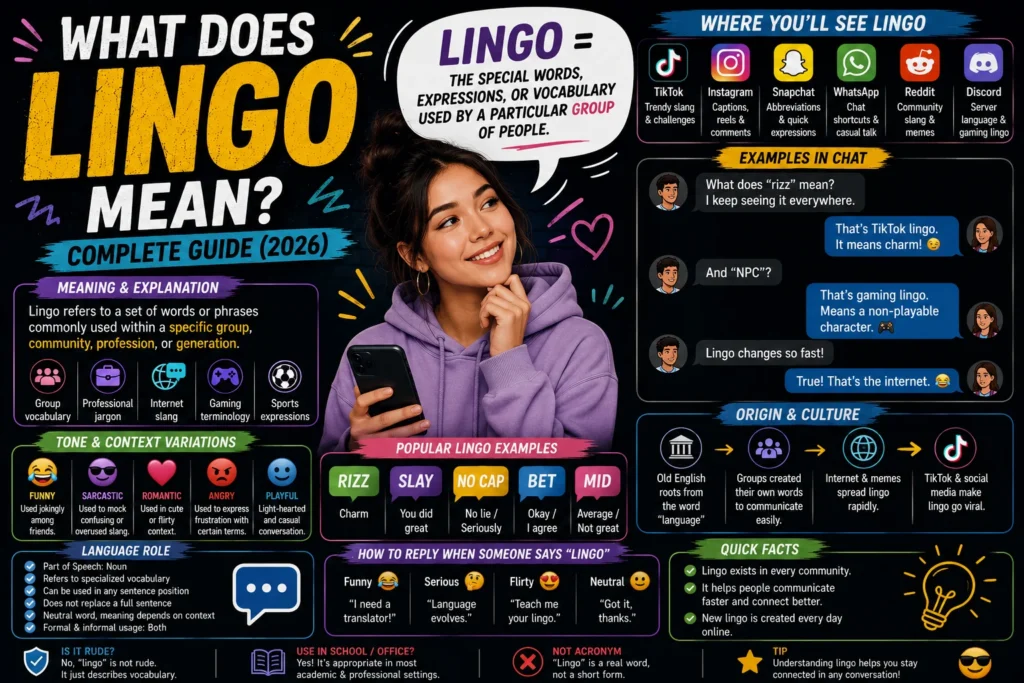

Lingo means the special words, expressions, or vocabulary used by a particular group of people. In texting, social media, and online chats, “lingo” usually refers to internet slang, abbreviations, and trendy phrases that help people communicate quickly.
If you’ve seen someone say, “I don’t understand Gen Z lingo” or “Learn the TikTok lingo,” they’re talking about the unique language or slang used by a specific community. People search for “lingo meaning” because the word can refer to anything from internet slang and texting abbreviations to professional jargon and regional expressions.
What Does Lingo Mean?
Lingo Meaning Explained
The word lingo refers to a specialized way of speaking used by a certain group, profession, community, or generation.
Examples include:
- Gen Z lingo
- Gaming lingo
- Business lingo
- Internet lingo
- Sports lingo
- TikTok lingo
In simple terms, lingo is the collection of words and phrases people use when communicating within a specific group.
For example:
- “No cap”
- “Bet”
- “Slay”
- “NPC”
These are all examples of modern internet lingo.
Is Lingo an Acronym?
No.
Lingo is:
- ❌ Not an acronym
- ❌ Not a texting abbreviation
- ❌ Not a short form
- ❌ Not a typo turned slang
- ✅ A real English word
The term has existed for centuries and simply means a particular style of language or vocabulary.
Lingo Meaning in Text
When people mention “lingo” in text messages, they are usually referring to slang words or texting abbreviations.
Example:
A: What does “IMO” mean?
B: It’s internet lingo for “In My Opinion.”
What Does Lingo Mean in Chat?
In chat conversations, lingo often refers to words commonly understood within a specific online community.
Examples:
- Gaming lingo
- TikTok lingo
- Snapchat lingo
- Discord lingo
Example:
A: I don’t understand half the words my younger cousin uses.
B: That’s just Gen Z lingo.
Lingo Meaning on Snapchat
On Snapchat, lingo includes abbreviations and slang such as:
- SFS
- HMU
- TBH
- WYA
- IDC
- FR
Snapchat users often use short expressions to communicate quickly.
Lingo Meaning on Instagram
Instagram lingo includes:
- Slay
- POV
- DM
- Reel
- Soft launch
- Delulu
These words are commonly used in captions, comments, and stories.
Lingo Meaning on TikTok
TikTok has created countless new slang terms.
Examples:
- Delulu
- Core
- Ate
- Mid
- Rizz
- NPC
Many internet users first encounter new lingo through TikTok videos.
Lingo Meaning on WhatsApp
WhatsApp users often rely on texting abbreviations such as:
- LOL
- BRB
- IMO
- BTW
- IDK
- TBH
These forms of lingo make conversations faster and more casual.
Tone and Context Variations
The word “lingo” itself is neutral, but its tone depends on how it’s used.
Funny Tone
People often use “lingo” humorously when discussing confusing slang.
A: My nephew called my outfit “mid.”
B: Gen Z lingo is getting out of control.
A: I need subtitles for teenagers.
Sarcastic Tone
Sometimes “lingo” is used sarcastically.
A: Apparently I’m supposed to know what “rizz” means.
B: Didn’t you get the 2026 lingo handbook?
A: Must have missed that email.
Romantic Tone
People may use “lingo” while discussing relationship slang.
A: What does “soft launch” mean?
B: Relationship lingo. It means hinting at a partner online.
A: Social media has a term for everything.
Angry Tone
People can become frustrated with constantly changing slang.
A: Every week there’s a new internet word.
B: The lingo changes faster than I can learn it.
A: Same.
Playful Tone
Friends often joke about learning new slang.
A: Teach me TikTok lingo.
B: It’ll take at least three lessons.
A: I’m ready.
Real Chat Examples
Example 1
A: What does “bet” mean?
B: It’s slang for “okay.”
A: Learning new lingo every day.
Example 2
A: Why does everyone say “slay”?
B: It’s internet lingo for doing something really well.
A: Got it.
Example 3
A: My son keeps saying “NPC.”
B: That’s gaming lingo.
A: Makes sense.
Example 4
A: What does “rizz” mean?
B: Charm or flirting ability.
A: New favorite word.
Example 5
A: I don’t understand TikTok comments.
B: You’re not fluent in TikTok lingo yet.
A: Clearly not.
Example 6
A: Is “FR” short for “for real”?
B: Yep.
A: Easy one.
Example 7
A: Why does everyone say “core” now?
B: It’s current social media lingo.
A: Hard to keep up.
Example 8
A: What’s “delulu”?
B: Short for delusional.
A: Internet creativity never ends.
Example 9
A: Why do gamers have their own language?
B: Every community develops its own lingo.
A: True.
Example 10
A: My manager used “synergy” five times today.
B: That’s corporate lingo.
A: Makes sense now.
Example 11
A: What’s “POV”?
B: Point of View.
A: I see it everywhere.
Example 12
A: Is “ate” a compliment?
B: Yes.
A: Modern lingo is interesting.
Example 13
A: What does “W” mean?
B: It means win.
A: That’s simple.
Example 14
A: Why do people say “no cap”?
B: It means no lie.
A: Good to know.
Example 15
A: Can adults use internet slang?
B: Of course.
A: Time to update my vocabulary.
Grammar and Language Role of Lingo
Part of Speech
Lingo is primarily a noun.
Example:
- “Gaming lingo changes quickly.”
- “I don’t understand modern lingo.”
Sentence Position
Lingo can appear:
- At the beginning
- In the middle
- At the end
Examples:
- “Lingo evolves rapidly.”
- “Gen Z lingo dominates TikTok.”
- “I struggle with that lingo.”
Can It Replace a Full Sentence?
No.
Unlike abbreviations such as LOL or IDK, lingo itself cannot replace a complete sentence.
Tone Impact
Using the word lingo often creates:
- Casual tone
- Conversational tone
- Educational tone
Formal vs Informal Use
The word itself is accepted in both formal and informal English.
However, the slang being described may be informal.
How to Reply When Someone Says “Lingo”
Funny Reply
- “I need a translator.”
- “Can I get the dictionary version?”
- “I’m officially old.”
Serious Reply
- “Language changes over time.”
- “Every generation develops new vocabulary.”
Flirty Reply
- “Teach me your lingo sometime 😉”
- “I only speak fluent compliments.”
Neutral Reply
- “Interesting.”
- “That makes sense.”
- “Thanks for explaining.”
Comparison Table
| Term | Meaning | Usage Context | Tone | Popularity | Confusion Risk |
|---|---|---|---|---|---|
| Lingo | Specialized vocabulary | General communication | Neutral | Very High | Low |
| Slang | Informal words | Casual speech | Informal | Very High | Low |
| Jargon | Professional terminology | Work industries | Formal | High | Medium |
| Vernacular | Regional language | Linguistics | Neutral | Medium | Medium |
| Dialect | Regional speech variety | Geography | Neutral | Medium | High |
| Standard English | Formal common language | Education | Formal | Very High | Low |
Who Uses This Term?
Age Groups
Lingo is used by:
- Teenagers
- Young adults
- Millennials
- Gen X
- Professionals
Virtually everyone uses some form of lingo.
Gen Z vs Millennials
Gen Z:
- Creates new internet slang rapidly
- Uses TikTok-driven vocabulary
Millennials:
- Mix traditional internet slang with newer terms
Regional Usage
Popular in:
- United States
- United Kingdom
- Canada
- Australia
- Global English-speaking communities
Common Platforms
- TikTok
- Snapchat
- Discord
- X (Twitter)
Origin and Internet Culture Insight
Where Did the Word Lingo Come From?
The word dates back hundreds of years.
It evolved from older forms of the word “language” and eventually came to mean a specialized vocabulary used by a particular group.
Why People Say Lingo on TikTok
TikTok introduces new slang constantly.
As users encounter unfamiliar terms, they often refer to them collectively as TikTok lingo.
Examples include:
- Rizz
- Delulu
- Mid
- Ate
- Core
Meme Culture’s Influence
Memes accelerate the spread of lingo.
A phrase can go viral overnight and become part of everyday online communication.
Fast Typing Culture
Internet users favor:
- Short words
- Abbreviations
- Efficient communication
This creates new forms of lingo continuously.
Is Lingo Rude?
No.
The word itself is not rude.
It is simply a term describing vocabulary.
Is Lingo a Bad Word?
No.
It is a normal dictionary word with no offensive meaning.
Should You Use It in School or Office?
Yes.
“Lingo” is perfectly appropriate in:
- Schools
- Universities
- Offices
- Professional discussions
Example:
“Technical lingo can confuse new employees.”
Experience-Based Insight
In everyday online communication, people often use “lingo” when they encounter unfamiliar internet slang. Whether it’s Gen Z phrases on TikTok, gaming expressions on Discord, or workplace jargon in meetings, the word helps people describe specialized language quickly and clearly. Most users aren’t asking about the word itself—they’re usually trying to understand the culture and vocabulary behind it.
Frequently Asked Questions
What does lingo mean in text?
Lingo means a specific set of words, slang, or expressions commonly used by a particular group of people.
Is lingo rude?
No. The word itself is completely neutral and not offensive.
What does lingo mean on Snapchat?
On Snapchat, lingo refers to abbreviations, slang terms, and chat expressions frequently used by users.
Is lingo the same as slang?
Not exactly. Slang is a type of lingo, but lingo can also include professional jargon and specialized vocabulary.
Can adults use lingo?
Absolutely. Every age group uses some type of lingo.
How do you respond when someone mentions lingo?
You can ask for clarification, share your understanding, or simply continue the conversation.
Why does internet lingo change so quickly?
Social media trends, memes, and viral content constantly introduce new words and expressions.
Is TikTok responsible for modern lingo?
TikTok is one of the biggest drivers of modern internet slang, but other platforms contribute as well.
What is the simple meaning of lingo?
Lingo means the special words and phrases used by a specific group of people.
Is lingo a real word?
Yes. Lingo is a recognized English dictionary word.
What is Gen Z lingo?
Gen Z lingo refers to slang and expressions commonly used by younger internet users.
Why do different groups develop their own lingo?
Groups create unique vocabulary to communicate efficiently and express shared identities.
Is lingo the same as jargon?
Not always. Jargon is professional language, while lingo is broader and includes slang.
What platforms create the most internet lingo?
TikTok, Instagram, Reddit, Discord, and X are major sources of modern internet vocabulary.
Summary, Usage Tips, and Common Mistakes
Summary
Lingo means the specialized vocabulary, slang, or expressions used by a specific group of people. It is commonly associated with internet slang, Gen Z vocabulary, texting abbreviations, gaming terms, and professional jargon.
Usage Tips
- Use the word when discussing group-specific language.
- Learn platform-specific lingo before joining new online communities.
- Ask questions when unfamiliar terms appear.
Common Mistakes
- Assuming lingo only means slang.
- Confusing lingo with dialect.
- Thinking lingo is always informal.
When to Use It
Use “lingo” when referring to:
- Internet slang
- Industry jargon
- Group-specific vocabulary
- Social media language
When to Avoid It
Avoid using it if a more specific word like “jargon” or “dialect” would be more accurate.