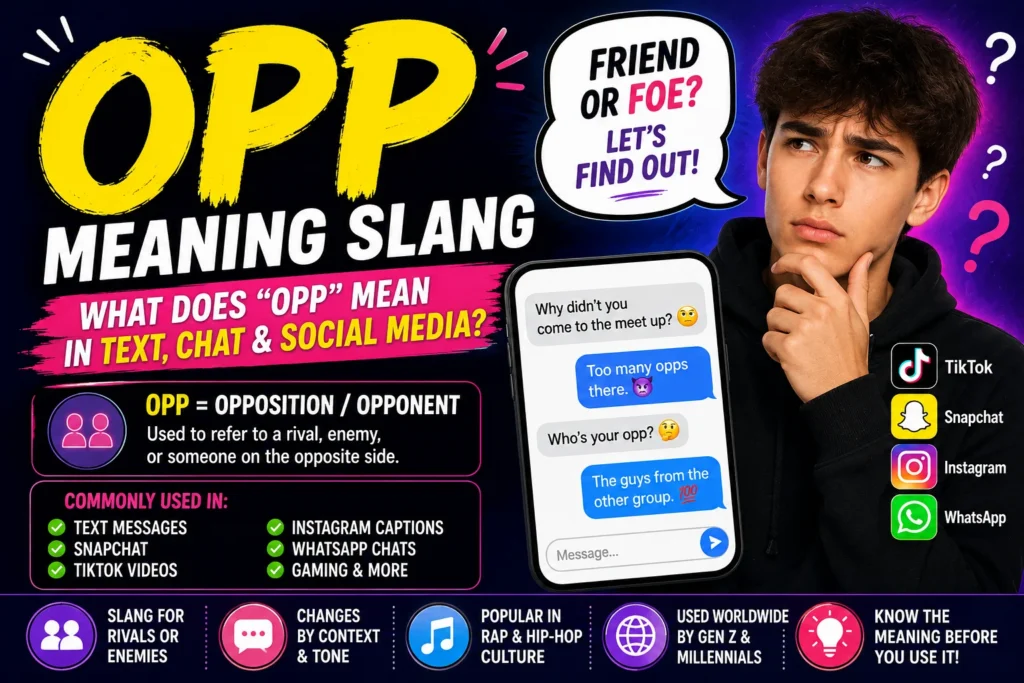

In slang, “OPP” most commonly means “opposition” or “opponent.” It’s widely used in texting, rap culture, TikTok, Snapchat, and online conversations to describe a rival, enemy, or someone on the opposite side.
If you’ve seen OPP in a text message, TikTok comment, Snapchat chat, or Instagram caption, you might wonder what it really means. The term has become one of the most searched internet slang expressions because it can refer to an enemy, a rival, or even someone outside your social group. This guide explains every common meaning of OPP, when people use it, and how to understand it correctly in different online conversations.
What Does “OPP” Mean in Slang?
Today, OPP is most commonly used as slang for opposition, opponent, or enemy.
Originally popularized in hip-hop culture and later adopted by social media users, the word is now widely used by Gen Z in everyday digital communication.
Depending on the conversation, OPP can refer to:
- A rival
- Someone you dislike
- A competing group
- An enemy
- Someone on the opposing side
The meaning depends on context, but it almost always suggests opposition rather than friendship.
OPP Meaning in Text
In text messages, OPP usually refers to someone the sender considers an opponent or rival.
Example:
Alex: Don’t invite him.
Jordan: Why?
Alex: He’s an opp.
In this example, “opp” means someone they don’t trust or someone on the opposing side.
Unlike many texting abbreviations, OPP isn’t used as a reaction. Instead, it acts as a noun describing another person or group.
OPP Slang Meaning
The modern slang meaning comes from urban slang and hip-hop culture.
Today, you’ll often hear people say:
- “He’s an opp.”
- “They’re opps.”
- “Watch out for the opps.”
These phrases usually refer to rivals rather than friends.
However, in casual online conversations, some people also jokingly call someone an opp after a disagreement, even if the situation isn’t serious.
What Does OPP Mean in Chat?
In online chats, OPP generally means someone who’s against you.
For example:
Friend 1: Why did you block him?
Friend 2: He’s an opp now.
This doesn’t necessarily mean they’re enemies forever.
Sometimes people use the word dramatically or humorously after an argument.
OPP Meaning on Snapchat
On Snapchat, OPP often appears in:
- Private conversations
- Story replies
- Group chats
It usually refers to someone outside a friend group or someone with whom there’s conflict.
Example:
A: Did you add him?
B: No, he’s an opp.
Here, the speaker simply means they don’t want contact with that person.
OPP Meaning on Instagram
Instagram users commonly use OPP in:
- Captions
- Comments
- Reels
- Memes
Examples include:
- “No opps allowed.”
- “Stay away from the opps.”
- “Real ones know who the opps are.”
In most cases, it’s used playfully or to emphasize loyalty to friends.
OPP Meaning on TikTok
TikTok has helped make OPP one of the most recognizable slang terms among Gen Z.
You’ll often hear creators say things like:
- “That’s my opp.”
- “Caught my opp lacking.”
- “No love for the opps.”
Many TikTok videos use the word humorously, while others use it more seriously when discussing personal conflicts or competitive situations.
OPP Meaning on WhatsApp
On WhatsApp, OPP is usually used in casual chats between friends.
Example:
Friend: Is he coming tonight?
You: Nah, he’s an opp.
In this conversation, the speaker simply means the person isn’t welcome because of a disagreement or rivalry.
Is “OPP” an Acronym?
Yes.
Unlike many slang words, OPP is commonly treated as a shortened form of opposition or opponent.
Although users rarely spell out the full word, the slang meaning has become so popular that most people simply say opp.
Is “OPP” a Short Form?
Yes.
It functions as a shortened version of words like:
- Opposition
- Opponent
Rather than typing the full word, users simply write:
- Opp
- Opps (plural)
This makes texting faster while keeping the meaning clear.
Is “OPP” a Phonetic Spelling?
No.
Unlike expressions such as “hmm,” “ugh,” or “aww,” OPP isn’t based on how something sounds.
Instead, it’s an abbreviated slang word that developed from existing English vocabulary.
Is “OPP” a Typo Turned Slang?
No.
The word wasn’t created through a typing mistake.
Instead, it evolved naturally from spoken slang and became increasingly popular through rap lyrics, internet culture, and social media.
Other Meanings of OPP
Although opposition is now the primary slang meaning, OPP has had other meanings over the years.
Naughty by Nature’s “O.P.P.”
One of the earliest famous uses came from the 1991 hit song “O.P.P.” by the hip-hop group Naughty by Nature.
In that song, O.P.P. refers to someone else’s romantic partner, often in the context of cheating or infidelity.
While this definition is still recognized by some people familiar with the song, it is far less common than the modern meaning of “opposition.”
Business and Professional Meanings
Outside internet slang, OPP can also stand for different organizations, programs, or business terms.
Examples include:
- Office of Public Prosecutions
- Ontario Provincial Police
- Other official abbreviations
However, these meanings are unrelated to social media slang and depend entirely on the context.
Why Context Matters
One reason people search for OPP meaning slang is that the same three letters can represent very different things.
For example:
Text Message
“He’s an opp.”
Means:
Someone is considered an opponent or rival.
Music Discussion
“That’s what O.P.P. meant.”
May refer to the famous hip-hop song.
Government Document
“Contact the OPP.”
May refer to an official organization instead.
Always read the surrounding conversation before deciding which meaning applies.
Tone and Context Variations
Although OPP usually means opponent or opposition, its tone changes depending on the conversation. Sometimes it’s serious, while other times it’s simply playful slang between friends.
Understanding the speaker’s tone helps you interpret the message correctly.
Funny Tone
Friends often jokingly call each other an opp after a minor disagreement.
Example
Jake: You ate the last slice of pizza.
Chris: My bad.
Jake: You’re officially an opp now. 😂
Here, nobody is genuinely upset. The term is being used humorously.
Sarcastic Tone
People sometimes use opp sarcastically when someone stops supporting them.
Example
Emma: You switched teams?
Liam: Yeah.
Emma: Wow… you’re an opp now.
The speaker doesn’t necessarily mean “enemy.” They’re exaggerating the situation for humor.
Romantic Tone
Although opp isn’t a romantic term, couples sometimes use it playfully during teasing conversations.
Example
Ava: You liked my sister’s photo?
Noah: It was just a picture.
Ava: Sounds like opp behavior. 😏
In this context, the word is lighthearted rather than hostile.
Angry Tone
When used during an argument, opp can indicate a real conflict.
Example
Ryan: Don’t contact me again.
Ethan: Fine.
Ryan: You’re an opp now.
Here, the speaker genuinely views the other person as being against them.
Playful Tone
Many social media users use opp casually without implying serious hostility.
Example
Friend 1: You beat me again.
Friend 2: Skill issue.
Friend 1: You’re my biggest opp.
The conversation is competitive but friendly.
Real Chat Examples
Here are realistic examples of how opp appears in modern text conversations.
Example 1
A: Are you inviting Jake?
B: No.
A: Why not?
B: He’s an opp.
Example 2
A: Why’d you unfollow her?
B: Too much drama.
A: Fair enough.
Example 3
A: Did you see his comment?
B: Yeah.
A: Definitely opp behavior.
Example 4
A: You switched to their team?
B: Yeah.
A: You’re an opp now. 😂
Example 5
A: Are we still friends?
B: Of course.
A: Good. I thought I became an opp.
Example 6
A: Why don’t you talk anymore?
B: We had a falling out.
A: That explains it.
Example 7
A: He keeps copying my ideas.
B: Sounds like an opp.
A: Exactly.
Example 8
A: Are you supporting them now?
B: Nope.
A: Good—I was worried.
Example 9
A: Did your team win?
B: Yes!
A: Guess I’m the opp today.
Example 10
A: Why are people calling him an opp?
B: Because he betrayed the group.
A: Makes sense.
Example 11
A: You beat me three games in a row.
B: Practice more.
A: You’re my gaming opp now.
Example 12
A: He joined another friend group.
B: That’s why everyone jokes he’s an opp.
Example 13
A: We disagree on everything.
B: Doesn’t mean we’re opps.
A: True.
Example 14
A: Is he your enemy?
B: Not really.
A: Then why call him an opp?
B: Just joking.
Example 15
A: Why is “opp” everywhere on TikTok?
B: It’s become part of everyday internet slang.
A: I finally get it.
Grammar and Language Role
Unlike reaction words such as LOL or OOF, opp functions as a noun.
Part of Speech
Opp is generally used as a noun.
Examples:
- He’s an opp.
- They’re opps.
- We don’t trust the opps.
Sentence Position
You’ll usually find opp:
- After the verb.
Example:
He’s an opp.
Or near the end of a sentence.
Example:
I don’t deal with opps.
Can “OPP” Replace a Full Sentence?
No.
Unlike expressions such as:
- LOL
- OMG
- BRB
Opp cannot stand alone as a complete response.
It identifies a person or group rather than expressing an emotion.
Tone Impact
Depending on context, opp may sound:
- Serious
- Funny
- Competitive
- Dramatic
- Playful
Most everyday social media conversations use it casually rather than literally.
Formal vs. Informal Use
Informal
Using opp is common in:
- Text messages
- Snapchat
- TikTok
- Discord
- Gaming chats
Formal
Avoid using opp in:
- Professional emails
- Business meetings
- Academic writing
- Workplace communication
Instead, use words such as:
- Opponent
- Rival
- Competitor
- Opposition
How to Reply When Someone Says “OPP”
The best response depends on the tone of the conversation.
Neutral Replies
If you’re unsure what they mean:
- “Why do you say that?”
- “What happened?”
- “Who’s the opp?”
- “What makes them an opp?”
These replies encourage clarification.
Funny Replies
If everyone’s joking:
- “Guess I’m the villain now. 😂”
- “I’ll try to earn my friend status back.”
- “Not the opp allegations!”
- “I promise I’m innocent.”
Serious Replies
If the conversation involves a real conflict:
- “Let’s talk about it.”
- “I don’t want us to be against each other.”
- “Can we work this out?”
- “I understand why you feel that way.”
These responses help reduce tension.
Flirty Replies
When used playfully between two people:
- “Opp today… favorite person tomorrow?”
- “Does that mean I still get a second chance?”
- “I didn’t know I had to compete for your attention.”
Only use flirty replies when the conversation is clearly lighthearted.
Comparison Table
| Slang Term | Meaning | Usage Context | Tone | Popularity | Confusion Risk |
|---|---|---|---|---|---|
| OPP | Opponent, rival, enemy | Texting, TikTok, chat | Serious or playful | Very High | Medium |
| Hater | Someone who constantly criticizes | Social media | Negative | High | Low |
| Enemy | Someone openly against you | Everyday English | Serious | Very High | Very Low |
| Rival | Competitor | Sports, gaming, work | Neutral | High | Low |
| Ops (Military/Operations) | Short for operations (not slang) | Gaming, military, business | Neutral | Medium | High |
| Bestie (Contrasting Term) | Close friend | Social media | Positive | Very High | Very Low |
OPP vs. Enemy
Both describe someone you’re against.
However:
- Enemy is formal English.
- Opp is informal internet slang.
OPP vs. Rival
A rival competes with you but isn’t necessarily hostile.
An opp usually implies stronger disagreement or conflict.
OPP vs. Hater
A hater constantly criticizes you.
An opp is broader and may simply belong to the opposing side, even without personal dislike.
OPP vs. Bestie
These words represent opposite ideas.
- Bestie = close friend.
- Opp = someone viewed as being against you.
This contrast is common in memes where people joke that a friend became an “opp” after a small disagreement.
Who Uses the Term “OPP”?
The slang term OPP is widely recognized across social media, gaming communities, and hip-hop culture. While it originated in urban slang, it has become part of everyday online conversations among younger internet users.
Age Groups
You’ll most commonly see OPP used by:
- Teenagers (13–19)
- Gen Z
- Young Millennials
- Gamers
- Social media creators
Older adults may recognize the term, especially if they follow modern music or spend time on platforms like TikTok or Instagram.
Gen Z vs. Millennials
Gen Z
Gen Z uses opp frequently in:
- TikTok videos
- Snapchat chats
- Instagram comments
- Discord servers
- Gaming communities
For many Gen Z users, the word isn’t always serious. Calling someone an “opp” after a small disagreement has become a common joke.
Millennials
Millennials are generally familiar with opp through:
- Hip-hop music
- Internet culture
- Sports discussions
- Gaming
They may use it less frequently than Gen Z but usually understand what it means.
Regional Usage
Although opp originated in American slang, it’s now understood in many English-speaking countries.
United States
The U.S. is where the slang is most common. It appears regularly in rap lyrics, sports conversations, and social media.
United Kingdom
British users also understand opp, especially within drill music culture and online gaming communities.
Canada
Canadian social media users, particularly younger audiences, commonly use opp with the same meaning as in the U.S.
Australia and Other English-Speaking Countries
The term is becoming more recognizable thanks to TikTok, YouTube Shorts, and international internet culture.
Platforms Where It’s Most Common
You’ll frequently encounter opp on:
- TikTok
- Snapchat
- Discord
- X (formerly Twitter)
- YouTube comments
- Gaming chats
Because the term has spread globally, context remains important. Someone might use opp seriously, while another person is simply joking with friends.
Origin and Internet Culture Insight
The modern slang meaning of opp comes from the word opposition or opponent.
It became especially popular through American hip-hop culture, where artists used the term to describe rivals or enemies.
Over time, the word expanded beyond music and entered everyday internet slang.
Influence of Hip-Hop Culture
Many rap and drill artists helped popularize the word opp by using it in lyrics about loyalty, rivalry, and conflict.
As these songs gained popularity on streaming platforms and social media, millions of listeners adopted the word in their own conversations.
Today, even people who don’t listen to rap often understand the term because of its widespread online use.
TikTok’s Role in Popularizing “OPP”
TikTok has introduced opp to a much broader audience.
Creators often use the word in:
- Comedy skits
- Relationship jokes
- School stories
- Gaming clips
- Trending memes
It’s common to hear phrases like:
- “He’s my biggest opp.”
- “Don’t become the opp.”
- “The opps are watching.”
In many videos, these phrases are exaggerated for humor rather than describing a real enemy.
Meme Culture
Internet memes have transformed opp into a playful expression.
For example, someone might jokingly call:
- Their sibling an opp for taking the TV remote.
- A friend an opp for beating them in a game.
- Their coworker an opp for drinking the last coffee.
These situations aren’t serious, but the slang makes them more entertaining.
Fast Typing Culture
Like many internet slang terms, opp became popular because it’s short and easy to type.
Instead of writing:
- opponent
- opposition
- rival
Users simply type:
- opp
The shorter form fits perfectly with fast-paced digital communication.
Why People Say “OPP” on TikTok
TikTok has helped make opp one of the most recognizable slang words among Gen Z.
People use it because:
- It’s short and memorable.
- It sounds dramatic.
- It works in funny videos.
- It fits sports, gaming, and relationship content.
- It encourages comments and engagement.
Many creators exaggerate everyday disagreements by calling someone an “opp,” making the content more entertaining.
Is “OPP” Rude?
Not necessarily.
The word itself isn’t considered offensive, but its tone depends on how it’s used.
For example:
Playful
“You’re my opp because you ate my fries.”
This is clearly a joke.
Serious
“He’s an opp.”
This may indicate genuine conflict or dislike.
Always consider the context before using the term.
Is “OPP” a Bad Word?
No.
OPP is not profanity and isn’t classified as a swear word.
However, calling someone an opp may sound confrontational if the relationship is already tense.
Should You Use “OPP” at School or Work?
At School
Among friends, many students casually use opp as a joke.
However, avoid using it to label classmates in a way that could encourage bullying or create unnecessary conflict.
At Work
In professional settings, it’s best to avoid internet slang.
Instead of saying:
- “He’s an opp.”
Use clearer professional language, such as:
- competitor
- opposing team
- rival company
- different department
Professional communication should remain respectful and easy for everyone to understand.
Experience-Based Insight
Based on how people use opp across TikTok, Instagram, Discord, Reddit, and gaming communities, the word has become much less serious than it once was.
While it originally referred to genuine opponents or enemies, many people now use it jokingly for friends who disagree with them, beat them in a game, or simply tease them. Even so, in conversations involving real conflicts, opp still carries a stronger meaning, so understanding the context is essential.
Frequently Asked Questions
What does “opp” mean in text?
In text messages, opp usually means opponent, enemy, or someone on the opposing side.
What does “opp” mean in slang?
The slang meaning refers to a rival or someone you don’t support. Depending on the situation, it can be used seriously or humorously.
What does “opp” mean on Snapchat?
On Snapchat, opp often describes someone outside a friend group or someone with whom there’s conflict or rivalry.
What does “opp” mean on TikTok?
TikTok creators commonly use opp in funny videos, gaming clips, sports content, and relationship jokes. In many cases, it’s used playfully rather than literally.
Is “opp” the same as “IDK”?
No.
IDK means “I don’t know,” while opp refers to an opponent or rival. They have completely different meanings.
Can adults use “opp”?
Yes.
Although it’s especially popular among Gen Z, adults who are familiar with internet slang or hip-hop culture also use and understand the term.
How do you respond when someone calls you an “opp”?
If they’re joking, you can respond with humor.
If they’re serious, ask why they feel that way and clarify the situation instead of making assumptions.
Is “opp” always negative?
No.
Many people use the word playfully with close friends. The tone depends entirely on the relationship and context.
Is “opp” an abbreviation?
Yes. In modern slang, it’s generally treated as a shortened form of opposition or opponent.
Why is “opp” so popular?
Hip-hop music, TikTok, gaming culture, and social media have helped make opp one of today’s most recognizable slang terms.
Does “opp” always mean enemy?
Not always. Sometimes it simply means a rival or someone you’re competing against.
Can “opp” be used as a joke?
Yes. Many friends jokingly call each other “opp” after small disagreements or competitions.
Is “opp” appropriate in professional communication?
No. It’s best to avoid slang in business emails, meetings, and formal writing.
Where did “opp” come from?
The slang evolved from the words opposition and opponent and became popular through hip-hop culture before spreading across social media.
Summary
The slang term OPP most commonly means opponent, opposition, or enemy. Today, it’s widely used in texting, TikTok, Snapchat, Instagram, gaming communities, and online conversations.
Although the word originally carried a more serious meaning, many people now use it humorously to describe friendly rivals or someone who disagrees with them. As with many internet slang terms, context determines whether the word is playful or serious.
Usage Tips
- Read the surrounding conversation before interpreting the meaning.
- Use opp only in casual conversations.
- Remember that the word usually refers to a person, not an action.
- Consider whether the speaker is joking or being serious.
Common Mistakes
Avoid these common misunderstandings:
- Thinking opp is always about violence or crime.
- Assuming every disagreement makes someone an “opp.”
- Using the word in professional settings.
- Confusing opp with unrelated abbreviations.
When to Use and When to Avoid
Use “OPP” When
- Chatting with friends.
- Posting on TikTok or Instagram.
- Gaming online.
- Talking about friendly rivalries.
- Referring to opponents in casual conversations.
Avoid Using “OPP” When
- Writing business emails.
- Speaking in formal presentations.
- Communicating with people unfamiliar with internet slang.
- Discussing sensitive conflicts where the term may escalate tension.