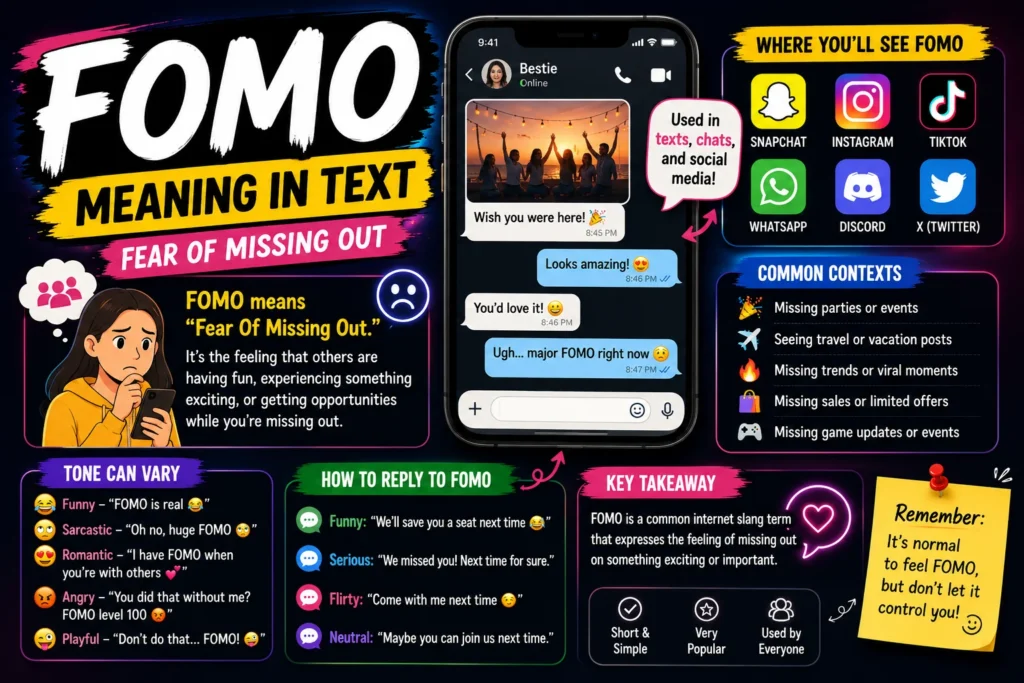

FOMO in text means “Fear of Missing Out.” It describes the feeling that other people are having exciting experiences, opportunities, or fun activities while you are not included or are missing them.
If you’ve seen FOMO in a text message, Snapchat chat, TikTok comment, Instagram caption, or WhatsApp conversation, it usually refers to anxiety or concern about missing something important, exciting, or socially rewarding. While the term originally gained popularity in psychology and social media discussions, it has become one of the most common internet slang expressions used in digital communication today.
People often search for FOMO meaning in text because they see the term in messages, social posts, gaming communities, group chats, or online conversations and want to understand exactly what it means. Unlike many texting abbreviations, FOMO is widely recognized by both younger and older internet users.
In this guide, you’ll learn what FOMO means, how it’s used across social media platforms, how to respond when someone says it, and why it remains one of the most popular expressions in modern online culture.
FOMO Meaning in Text
What Does FOMO Mean?
FOMO stands for Fear of Missing Out.
It describes a feeling that:
- Other people are having more fun than you
- You are missing an event or opportunity
- Something exciting is happening without you
- You wish you were included in an activity
For example:
Friend: “Everyone is going to the concert tonight.”
You: “Now I’ve got serious FOMO.”
In this example, the person feels disappointed about missing the event.
Is FOMO an Acronym or Slang?
FOMO is primarily:
- An acronym
- An internet slang term
- A social media expression
- A texting abbreviation
It is not:
- A typo
- A phonetic spelling
- A shortened word
The letters directly represent the phrase Fear Of Missing Out.
FOMO Meaning in Text Messages
In texting, FOMO is usually used to express:
- Jealousy (in a lighthearted way)
- Regret about missing an event
- Curiosity about what others are doing
- Excitement mixed with disappointment
Example:
A: “We’re all hanging out downtown.”
B: “Stop, you’re giving me FOMO.”
FOMO Meaning in Chat
In chat conversations, FOMO often appears when:
- Friends share photos
- Groups discuss plans
- Someone misses an event
- People talk about trends
Example:
A: “Everyone’s trying the new game.”
B: “I haven’t played yet. Major FOMO.”
FOMO Meaning on Snapchat
On Snapchat, FOMO commonly appears when users:
- See friends at parties
- Watch vacation stories
- Miss social gatherings
- View exclusive events
A Snapchat Story showing friends at a beach party may cause viewers to comment:
“This is giving me FOMO.”
FOMO Meaning on Instagram
Instagram is one of the biggest drivers of FOMO.
Users may experience FOMO when they see:
- Travel photos
- Luxury lifestyles
- Special events
- Social gatherings
Comments often include:
“I have serious FOMO after seeing these pictures.”
FOMO Meaning on TikTok
On TikTok, FOMO is often linked to:
- Viral trends
- Popular challenges
- New products
- Trending events
Users may say:
“TikTok keeps giving me FOMO about traveling.”
FOMO Meaning on WhatsApp
In WhatsApp group chats, FOMO often appears when:
- Plans are discussed
- Photos are shared
- Someone couldn’t attend an event
Example:
Friend: “We’re all at dinner.”
You: “Thanks for the FOMO.”
Different Meanings of FOMO Depending on Context
FOMO always means Fear of Missing Out, but its emotional tone can change depending on the conversation. Sometimes it’s serious, sometimes it’s funny, and other times it’s used playfully or even sarcastically.
Funny Use of FOMO
People often use FOMO as a joke when they feel left out of something small or unimportant.
Example:
Alex: “We ordered pizza during lunch.”
Jake: “Wow, nobody invited me? Extreme FOMO right now.”
Alex: “It was just pepperoni.”
Jake: “That makes it even worse.”
In this case, Jake is joking rather than genuinely upset.
Sarcastic Use of FOMO
Sometimes people use FOMO sarcastically to suggest they are not interested at all.
Example:
Friend: “We’re attending a six-hour meeting on Saturday.”
You: “Yeah, definitely getting FOMO over that.”
The speaker actually means the opposite.
Romantic Use of FOMO
FOMO can appear in dating conversations when someone doesn’t want to miss spending time with another person.
Example:
Taylor: “I’m going away for two weeks.”
Jordan: “Great, now I’m going to have relationship FOMO.”
Taylor: “You’ll survive.”
Jordan: “No promises.”
Here, FOMO expresses affection and interest.
Angry Use of FOMO
Sometimes FOMO reflects genuine frustration about being excluded.
Example:
Chris: “Everyone went out after work.”
Mia: “Nobody told me. Thanks for the FOMO.”
Chris: “I thought you already knew.”
This version carries disappointment.
Playful Use of FOMO
Friends often use FOMO casually in group chats.
Example:
Friend: “Look at all these vacation photos.”
You: “Stop posting. My FOMO can’t handle this.”
The tone is lighthearted and playful.
Real-Life Examples of FOMO in Conversations
Example 1
A: “We’re heading to the beach.”
B: “Now you’ve given me FOMO.”
A: “Come join us.”
Example 2
A: “Did you see the concert videos?”
B: “Yes, and my FOMO is getting worse.”
A: “You should come next time.”
Example 3
A: “Everyone’s playing the new game.”
B: “I haven’t bought it yet.”
A: “That’s some serious FOMO.”
Example 4
A: “We’re trying the new restaurant tonight.”
B: “You’re making me hungry and giving me FOMO.”
A: “We’ll save you a seat next time.”
Example 5
A: “Our whole class went to the event.”
B: “I can’t believe I missed it.”
A: “Classic FOMO moment.”
Example 6
A: “Look at these vacation photos.”
B: “My FOMO just doubled.”
A: “Book a trip.”
Example 7
A: “Everyone stayed up watching the launch.”
B: “I went to bed early.”
A: “Now you’ve got FOMO.”
Example 8
A: “The sale ends tonight.”
B: “Don’t do this to me.”
A: “Retail FOMO is real.”
Example 9
A: “We’re all at the festival.”
B: “Stop sending pictures.”
A: “Too much FOMO?”
Example 10
A: “Did you watch the finale?”
B: “Not yet.”
A: “Avoid social media if you don’t want FOMO.”
Example 11
A: “Everyone is joining the challenge.”
B: “Now I feel left out.”
A: “That’s FOMO talking.”
Example 12
A: “The tickets sold out.”
B: “You’ve got to be kidding.”
A: “I know. Massive FOMO.”
Example 13
A: “We’re having game night.”
B: “Wish I could come.”
A: “FOMO strikes again.”
Example 14
A: “Everyone’s talking about that show.”
B: “Guess I need to watch it.”
A: “Your FOMO is showing.”
Example 15
A: “The whole office went for lunch.”
B: “Nobody invited me.”
A: “Sorry about the FOMO.”
Grammar and Language Role of FOMO
Is FOMO a Noun or an Acronym?
FOMO is both:
- An acronym for Fear Of Missing Out
- A noun used to describe a feeling
Example:
“I have FOMO.”
Here, FOMO acts as a noun.
Where Does FOMO Appear in a Sentence?
It can appear:
- At the beginning
- In the middle
- At the end
Examples:
- “FOMO is hitting me hard.”
- “I have major FOMO today.”
- “Those photos gave me FOMO.”
Can FOMO Replace a Full Sentence?
Yes.
Someone can simply reply:
“FOMO.”
This often means:
“I’m feeling left out.”
Formal vs Informal Use
Informal:
- Text messages
- Social media
- Group chats
- Casual conversations
Formal:
FOMO can occasionally appear in:
- Marketing articles
- Psychology discussions
- Workplace presentations
However, it remains primarily an informal expression.
Tone Impact of FOMO
Depending on context, FOMO can sound:
- Funny
- Playful
- Serious
- Emotional
- Sarcastic
The surrounding conversation determines the tone.
How to Reply When Someone Says FOMO
Funny Replies
- “Good. That means our plan worked.”
- “You’ll survive.”
- “We’ll send more pictures.”
- “Just wait until you see the next post.”
Serious Replies
- “We’ll include you next time.”
- “Sorry you couldn’t make it.”
- “Let’s plan something together soon.”
- “I understand how you feel.”
Flirty Replies
- “Don’t worry, I’ll save a spot for you.”
- “You only need me to avoid FOMO.”
- “Next time you’re coming with me.”
- “I’d miss you too.”
Neutral Replies
- “Maybe next time.”
- “It was fun.”
- “You should join us later.”
- “Hopefully you can make the next one.”
FOMO vs Similar Internet Slang Terms
Comparison Table
| Term | Meaning | Usage Context | Tone | Popularity | Confusion Risk |
|---|---|---|---|---|---|
| FOMO | Fear of Missing Out | Social media, texting | Emotional | Very High | Low |
| YOLO | You Only Live Once | Taking risks | Excited | High | Medium |
| JOMO | Joy of Missing Out | Enjoying staying home | Relaxed | Medium | Medium |
| IDC | I Don’t Care | Indifference | Casual | Very High | Low |
| SMH | Shaking My Head | Disapproval | Casual | Very High | Medium |
| FOMU | Fear of Missing Updates | Online communities | Niche | Low | High |
Who Uses FOMO?
FOMO has become a mainstream internet expression used by people of all ages. While it started as a term often associated with younger social media users, it is now common in texting, workplace conversations, marketing discussions, and everyday speech.
Age Groups That Commonly Use FOMO
FOMO is most popular among:
- Teenagers
- College students
- Young professionals
- Social media users
However, adults in their 30s, 40s, and beyond also use it regularly, especially when discussing social events, travel, or online trends.
Gen Z vs Millennials
Gen Z
Gen Z often uses FOMO in:
- TikTok comments
- Snapchat conversations
- Group chats
- Online gaming communities
For Gen Z, FOMO is frequently connected to viral trends, social events, and online culture.
Millennials
Millennials often use FOMO when discussing:
- Career opportunities
- Travel experiences
- Social gatherings
- Major life events
Their usage tends to be slightly less slang-focused and more related to real-life experiences.
Regional Popularity
FOMO is widely understood in:
- United States
- Canada
- United Kingdom
- Australia
- New Zealand
Because English-speaking internet culture is highly connected, the term is now recognized globally.
Platforms Where FOMO Is Most Common
You’ll frequently see FOMO on:
- TikTok
- Snapchat
- Discord
- X (Twitter)
Anywhere people share experiences, photos, and updates, FOMO tends to appear.
Origin of FOMO and Internet Culture
Where Did FOMO Come From?
The phrase “Fear of Missing Out” existed long before social media became popular.
Psychologists and researchers used the concept to describe anxiety about missing rewarding experiences. As social media grew, the shortened version—FOMO—became widely adopted online.
The rise of smartphones accelerated its popularity because people could constantly see what friends and influencers were doing.
Why People Say FOMO on TikTok
TikTok is one of the biggest drivers of FOMO today.
Users often see:
- Vacation videos
- Concert footage
- Viral experiences
- Luxury lifestyles
- Trendy restaurants
These posts can create the feeling that everyone else is having exciting experiences.
As a result, comments such as:
“This gave me FOMO.”
appear frequently under popular videos.
The Role of Social Media
Social media naturally encourages comparison.
People often share:
- Their best moments
- Achievements
- Travel adventures
- Celebrations
Because viewers usually see highlights rather than everyday reality, FOMO can become more common.
FOMO and Meme Culture
FOMO has also become a meme.
People joke about experiencing FOMO over:
- Food
- Pets
- Television shows
- Video games
- Online trends
This humorous use helps explain why the term remains popular even years after it entered mainstream internet vocabulary.
Fast-Typing Culture and Digital Communication
The internet favors short and efficient communication.
Instead of typing:
“I’m afraid I’m missing out on something fun.”
people simply type:
“FOMO.”
This convenience helped the term spread quickly across social media and messaging platforms.
Is FOMO Rude or Appropriate?
Is FOMO a Bad Word?
No.
FOMO is not profanity, offensive language, or an inappropriate expression.
Most people consider it completely safe for everyday use.
Is FOMO Rude?
Usually not.
However, tone matters.
For example:
Friendly:
“You guys are giving me FOMO.”
Passive-aggressive:
“Nice. Thanks for the FOMO.”
In some situations, it may sound slightly critical if the speaker feels excluded.
Can You Use FOMO at School?
Yes.
Students frequently use FOMO in:
- Conversations
- Group chats
- Social media discussions
The term is generally acceptable in educational settings.
Can You Use FOMO at Work?
Often, yes.
Many professionals understand the term and use it casually.
Examples:
- Marketing discussions
- Team conversations
- Workplace chats
However, in highly formal business documents, writing out the full phrase may be more appropriate.
Real-World Observation: How People Actually Use FOMO
Everyday Usage Trends
In real-world conversations, FOMO is rarely used to describe serious emotional distress.
Most people use it casually when:
- Friends attend events without them
- A trend becomes popular
- Tickets sell out
- They miss a social gathering
- They see exciting photos online
In many cases, the term is used humorously rather than literally.
Someone might say:
“I have FOMO after seeing your vacation pictures.”
Even though they’re not genuinely upset, they are expressing mild envy and interest in a friendly way.
Frequently Asked Questions
What Does FOMO Mean in Text?
FOMO stands for Fear of Missing Out. It describes the feeling that you’re missing an enjoyable, important, or rewarding experience.
What Does FOMO Mean on Snapchat?
On Snapchat, FOMO usually refers to feeling left out after seeing stories, photos, or updates from friends.
What Does FOMO Mean on Instagram?
On Instagram, FOMO often occurs when users see travel photos, events, achievements, or experiences they wish they were part of.
What Does FOMO Mean on TikTok?
On TikTok, FOMO typically refers to missing trends, viral experiences, concerts, products, or activities featured in videos.
Is FOMO Rude?
No. FOMO is generally considered a harmless and widely accepted internet expression.
Is FOMO the Same as IDC?
No.
- FOMO = Fear of Missing Out
- IDC = I Don’t Care
Their meanings are completely different.
Can Adults Use FOMO?
Absolutely.
People of all ages use FOMO, including professionals, parents, and older adults.
How Do You Respond to FOMO?
Common responses include:
- “Come with us next time.”
- “We’ll save you a spot.”
- “You didn’t miss much.”
- “Let’s plan something soon.”
Why Is FOMO So Common on Social Media?
Social media constantly exposes users to other people’s experiences, making comparisons easier and increasing feelings of missing out.
What Causes FOMO?
Common causes include:
- Social comparison
- Fear of exclusion
- Popular trends
- Major events
- Online communities
Is FOMO a Real Psychological Term?
Yes.
Psychologists have studied FOMO as a social and emotional phenomenon linked to technology use and social behavior.
Can FOMO Affect Mental Health?
In some cases, excessive FOMO can contribute to:
- Stress
- Anxiety
- Social pressure
However, casual use of the term is usually harmless.
What Is the Opposite of FOMO?
The opposite is often called JOMO, which stands for Joy of Missing Out.
Why Do Teenagers Use FOMO So Much?
Teenagers spend significant time on social media, where trends, events, and peer interactions are constantly visible.
Final Thoughts on FOMO Meaning in Text
Quick Summary
FOMO means Fear of Missing Out.
It is a popular acronym used in texting, social media, and everyday conversations to describe the feeling of being left out of something exciting or important.
Usage Tips
- Use it casually in conversations.
- Use it when discussing missed events or experiences.
- Understand that it often has a playful tone.
Common Mistakes to Avoid
- Assuming FOMO is always serious.
- Confusing it with other slang terms.
- Using it in highly formal documents without explanation.
When to Use FOMO
Use FOMO when:
- Talking about missed opportunities
- Discussing social events
- Commenting on travel, entertainment, or trends
- Chatting with friends online
When to Avoid FOMO
Avoid it in:
- Formal legal documents
- Academic papers without explanation
- Professional communications where slang is inappropriate
FOMO remains one of the most recognized internet slang terms because it perfectly captures a common modern experience: seeing something exciting happen and wishing you were part of it.