
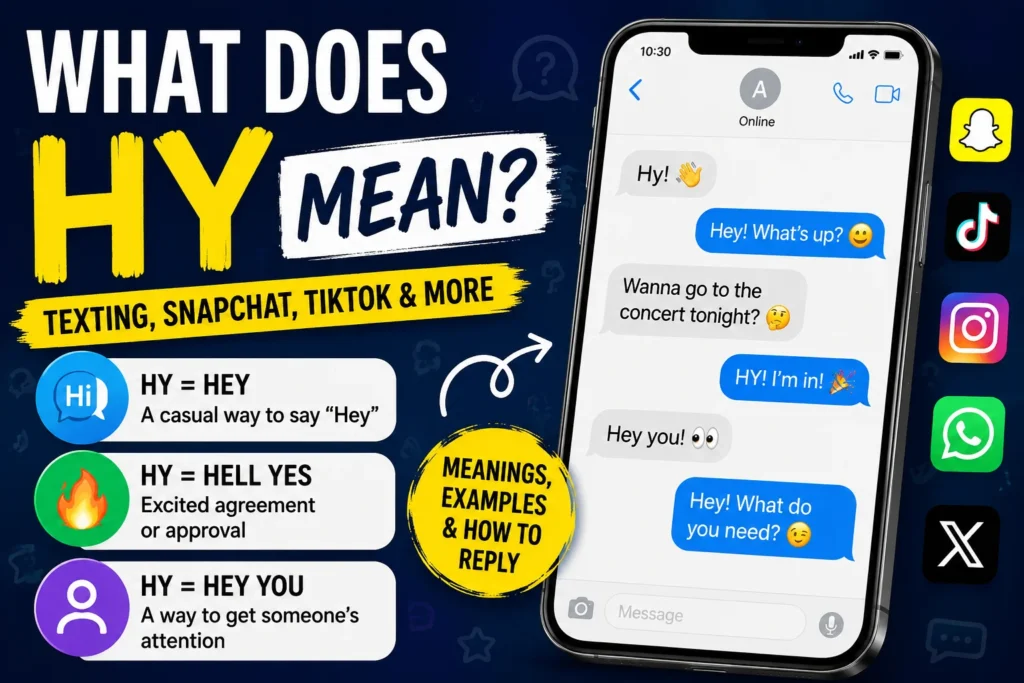

HY most commonly means “Hey” in casual text messages, but it can also mean “Hell Yes,” “Hell Yeah,” or “Hey You,” depending on the conversation. Understanding the context is the key to interpreting its meaning correctly.
If you’ve received a message that simply says “HY” or “Hy,” you’re not alone in wondering what it means. This short expression appears across texting apps and social media, but its meaning changes depending on how it’s used. Some people use it as a greeting, while others use it to express excitement or grab someone’s attention. This guide explains every genuine meaning of HY, where it’s commonly used, and how to understand it correctly.
What Does HY Mean?
HY has multiple legitimate meanings in digital communication. The most common are:
- Hey (a casual greeting)
- Hell Yes / Hell Yeah (enthusiastic agreement)
- Hey You (a friendly way to get someone’s attention)
Although the letters are the same, the intended meaning depends on the conversation, punctuation, and platform.
HY Meaning in Text
In everyday texting, HY most often means “Hey.”
Many people intentionally type Hy instead of Hey because it’s shorter, faster, or simply a personal texting habit. In these situations, it isn’t an abbreviation at all—it’s simply an alternative spelling of the greeting.
Example
A: Hy! What are you doing?
B: Just watching a movie. You?
Here, Hy is simply another way of saying “Hey.”
HY Meaning as “Hell Yes”
Another common meaning of HY is “Hell Yes” or “Hell Yeah.”
This version is used to show excitement, strong agreement, or enthusiasm.
Example
A: Want to grab burgers after work?
B: HY!
This means:
- Absolutely!
- Definitely!
- Count me in!
It’s especially common among younger users who enjoy quick, energetic replies.
HY Meaning as “Hey You”
Sometimes HY stands for “Hey You.”
This usage is less common than “Hey,” but it’s still seen in casual conversations between friends, family members, or romantic partners.
Example
A: HY 😊
B: Hey! What’s up?
Here, the sender is simply trying to get the other person’s attention in a warm, friendly way.
Is HY an Acronym, Abbreviation, or Slang?
The answer depends on which meaning is intended.
HY as “Hey”
When someone writes Hy instead of Hey, it is not an acronym. It’s simply an alternative spelling of a greeting.
HY as “Hell Yes”
When HY means “Hell Yes” or “Hell Yeah,” it functions as an abbreviation because it shortens a longer phrase.
HY as Internet Slang
Regardless of the exact meaning, HY is considered internet slang because it’s primarily used in casual digital communication rather than formal writing.
HY Meaning on Snapchat
On Snapchat, HY is most commonly used in two ways:
As a Greeting
Many Snapchat users simply write:
Hy!
instead of
Hey!
This is especially common when starting a conversation.
As “Hell Yes”
In replies, HY often means enthusiastic agreement.
Example
Friend: Beach tomorrow?
You: HY! 🌴
Because Snapchat conversations are short and informal, abbreviations like HY fit naturally into the platform.
HY Meaning on TikTok
TikTok users occasionally use HY in comments, captions, and replies.
The most common meaning is:
Hell Yes
For example:
HY! This deserves more likes.
or
HY, I completely agree.
Some creators also use Hy as a greeting when replying to followers in the comments.
Unlike other TikTok slang, HY isn’t a trend-specific term. Instead, it’s simply a quick way to communicate.
HY Meaning on Instagram
On Instagram, HY appears mostly in direct messages rather than public captions.
Common meanings include:
- Hey
- Hell Yes
- Hey You
Example:
Friend: Hy! Have you seen my story?
Reply: Not yet, checking now.
Or:
Friend: Coffee after class?
Reply: HY!
The conversation usually makes the intended meaning obvious.
HY Meaning on WhatsApp
WhatsApp conversations are similar to standard texting, so HY usually means either:
- Hey
- Hell Yes
For example:
A: Hy! Are you home?
B: Just arrived.
Or:
A: Want pizza tonight?
B: HY 😄
Because WhatsApp is designed for quick messaging, short expressions like HY save time while keeping conversations natural.
HY Meaning on X (Formerly Twitter)
Although less common than on messaging apps, HY occasionally appears in replies on X.
Most users mean:
- Hell Yes
- Hey
Example:
HY! That’s exactly what I was thinking.
Because posts on X are brief, abbreviations often help users respond quickly without typing full sentences.
Why Does HY Have Multiple Meanings?
Unlike many internet abbreviations that have only one definition, HY developed naturally through texting habits.
Some people shortened Hey into Hy, while others began using the same letters to represent Hell Yes or Hell Yeah.
As social media grew, these meanings spread across different platforms, making context more important than the letters themselves.
For example:
- If someone starts a conversation with “Hy”, they almost certainly mean “Hey.”
- If someone replies “HY!” after an invitation, they almost certainly mean “Hell Yes!”
Reading the surrounding conversation is the easiest way to determine the correct meaning.
Which Meaning Is Most Common?
If you see “Hy” at the beginning of a conversation, the safest interpretation is “Hey.”
If you see “HY!” as a reply to a question or invitation, it usually means “Hell Yes” or “Hell Yeah.”
In most cases, the conversation makes the meaning clear within a few messages, so there’s rarely any confusion once you consider the context.
Tone and Context Variations
The meaning of HY changes depending on the situation, punctuation, and relationship between the people chatting. Sometimes it’s simply a greeting, while other times it’s an enthusiastic response.
Below are the most common tone variations you’ll encounter.
Funny Tone
Friends often use HY in a humorous way when they’re excited about something simple.
Conversation
Emma: Ice cream at 10 p.m.?
Olivia: HY! That’s always a good idea.
Emma: I knew you’d say that.
Olivia: Some decisions are easy.
Meaning: Here, HY means “Hell Yes” and adds excitement to the conversation.
Sarcastic Tone
Occasionally, HY can be used sarcastically, especially when someone isn’t actually excited.
Conversation
Jake: Another three-hour meeting tomorrow.
Ryan: HY… exactly what I wanted.
Jake: I can hear the sarcasm already.
Ryan: You know me too well.
Meaning: The wording sounds positive, but the context makes it clear the speaker means the opposite.
Playful Tone
When used as “Hey,” HY can make a conversation feel relaxed and friendly.
Conversation
Sophia: Hy 😊
Noah: Well, hello there.
Sophia: Just checking if you’re free later.
Noah: I should be.
Meaning: Here, HY is simply a casual greeting.
Serious Tone
Although less common, HY can also be part of a straightforward conversation.
Conversation
Manager: Are you available for tomorrow’s training session?
Employee: HY, I’ll be there.
Manager: Great. See you at 9.
Employee: Looking forward to it.
Meaning: HY means “Hell Yes” or “Yes, definitely,” while still sounding positive and professional enough for an informal workplace chat.
Real Chat Examples
Below are realistic conversations showing how people actually use HY in texting and social media.
Example 1 – Friends Making Plans
A: Hy! Want to grab coffee this afternoon?
B: Sure, what time?
A: Around 3?
B: Sounds good.
Example 2 – Excited Response
A: We got tickets!
B: HY! I thought they were sold out.
A: I managed to get the last two.
B: That’s awesome.
Example 3 – Family Chat
Mom: Hy! Did you make it home safely?
Son: Yes, just got in.
Mom: Great. Have dinner when you’re ready.
Son: Will do.
Example 4 – College Friends
A: Study group tonight?
B: HY. I definitely need the help.
A: Same here.
B: See you at the library.
Example 5 – Coworkers
A: Are you joining us for lunch?
B: HY. Give me five minutes.
A: We’ll save you a seat.
B: Thanks!
Example 6 – Close Friends
A: Hy!
B: Hey! Long time no talk.
A: I know. We should catch up.
B: Definitely.
Example 7 – Gaming Friends
A: New update just dropped.
B: HY! Let’s play tonight.
A: I’ll be online after dinner.
B: Perfect.
Example 8 – Dating Conversation
A: Want to go out this weekend?
B: HY 😊
A: Great! I’ll plan something fun.
B: Looking forward to it.
Example 9 – Group Chat
A: Pizza or burgers?
B: HY to pizza.
A: I was hoping you’d say that.
B: Easy choice.
Example 10 – Social Media DM
A: Hy! Loved your latest post.
B: Thank you so much!
A: The photos were amazing.
B: I appreciate that.
Example 11 – Weekend Plans
A: Beach tomorrow?
B: HY!
A: I’ll bring snacks.
B: I’ll bring the drinks.
Example 12 – Quick Reply
A: Movie tonight?
B: HY.
A: I’ll book the tickets.
B: Sounds perfect.
Grammar and Language Role
Unlike many English words, HY doesn’t have one fixed grammatical role because its function changes depending on the intended meaning.
Part of Speech
When HY means “Hey,” it acts as an interjection or greeting.
Example:
Hy! How are you?
When HY means “Hell Yes,” it functions as an interjection expressing excitement or agreement.
Example:
HY! Let’s do it.
Sentence Position
Most commonly, HY appears:
At the beginning
Hy! What’s up?
or
As a complete reply
HY!
Occasionally, it appears within a sentence for emphasis.
Example:
That’s a HY from me.
Although this is less common.
Can HY Replace a Full Sentence?
Sometimes, yes.
When someone asks a yes-or-no question, replying with HY! is enough.
Example:
A: Want to order dessert?
B: HY!
In greeting form, however, it usually begins a conversation rather than replacing one.
Formal vs. Informal Register
HY is considered informal internet slang.
It is appropriate for:
- Text messages
- Snapchat
- Instagram DMs
- TikTok comments
- Casual online conversations
Avoid using HY in:
- Business emails
- Academic papers
- Job applications
- Professional reports
- Formal presentations
Writing the complete words (“Hello,” “Yes,” or “Absolutely”) is more appropriate in formal communication.
How to Reply When Someone Says “HY”
The best response depends on what the sender means.
If HY Means “Hey”
You can reply with:
- “Hey! How are you?”
- “Hi! What’s up?”
- “Hello! Good to hear from you.”
Funny Reply
If someone says HY enthusiastically:
- “I knew you’d be interested. 😄”
- “That’s the energy I was hoping for!”
- “No hesitation at all!”
Serious Reply
When the conversation is straightforward:
- “Great, I’ll see you then.”
- “Thanks for confirming.”
- “Perfect. I’ll make the arrangements.”
Flirty Reply
If the conversation is with someone you’re interested in:
- “I was hoping you’d say yes.”
- “Now I’m even more excited.”
- “Can’t wait to see you.”
Neutral Reply
If you simply want to continue the conversation:
- “Sounds good.”
- “Okay!”
- “See you soon.”
- “Thanks for letting me know.”
These responses feel natural regardless of whether HY means “Hey” or “Hell Yes.”
Comparison Table
Because HY has more than one legitimate meaning, it’s often confused with other short texting abbreviations. The table below compares HY with similar terms people frequently search together.
| Term | Meaning | Usage Context | Tone | Popularity | Confusion Risk |
|---|---|---|---|---|---|
| HY | Hey, Hell Yes, or Hey You (depends on context) | Texting, Snapchat, WhatsApp, TikTok, Instagram | Friendly, enthusiastic | High | High |
| Hey | Casual greeting | Everyday conversation | Friendly | Very High | Low |
| HBU | How About You? | Texting and chats | Friendly | High | Medium |
| HMU | Hit Me Up | Social media, texting | Casual | High | Medium |
| HYU | Hit You Up | Texting | Casual | Medium | Medium |
| Nah (Opposite) | No, refusal, disagreement | Texting, social media | Casual | Very High | Low |
HY vs. Hey
The biggest source of confusion is that many people type Hy instead of Hey.
Examples:
Hy! How are you?
and
Hey! How are you?
mean exactly the same thing.
HY vs. HBU
Although both are common abbreviations, they have different purposes.
- HY starts a conversation or expresses agreement.
- HBU keeps a conversation going by asking, “How about you?”
Example:
A: I’m doing great. HBU?
HY vs. HMU
These abbreviations are unrelated.
HMU means:
Hit Me Up
or
“Contact me later.”
Example:
HMU when you’re free.
HY vs. HYU
People occasionally confuse HY with HYU.
- HY = Hey or Hell Yes.
- HYU = Hit You Up.
They are not interchangeable.
HY vs. Nah
If HY means “Hell Yes,” then Nah is its opposite.
Example:
A: Want pizza tonight?
B: HY!
or
B: Nah.
Who Uses the Term HY?
Unlike some internet slang that belongs almost exclusively to one generation, HY is used by a wide range of people because one of its meanings is simply a greeting.
However, usage patterns still vary by age and platform.
Age Groups
You’ll commonly see HY used by:
- Teenagers
- College students
- Young professionals
- Adults who text frequently
People who regularly use messaging apps often prefer short greetings and abbreviations.
Gen Z vs. Millennials
Gen Z
Gen Z is more likely to use HY as:
- Hell Yes
- A quick “Hey”
- Fast replies in group chats
They also use it alongside emojis and GIFs.
Example:
HY 😂
Millennials
Millennials typically use Hy as an alternative spelling of Hey rather than as slang.
Many still recognize HY meaning Hell Yes, although they often write the full phrase instead.
Regional Usage
United States
Both meanings—Hey and Hell Yes—are widely understood.
United Kingdom
British users usually interpret Hy as a greeting.
The “Hell Yes” meaning is recognized mainly by people familiar with American internet slang.
Canada
Usage is very similar to the United States because of shared online culture.
Global Usage
Outside English-speaking countries, many users type Hy simply because it resembles Hi or Hey.
For this reason, greeting usage is extremely common worldwide.
Platforms Where HY Is Most Common
Text Messages
Most common meanings:
- Hey
- Hell Yes
Usually:
- Hey
- Hell Yes
Snapchat
Frequently:
- Hey
- Hell Yes
Mostly appears in:
- Direct messages
- Story replies
TikTok
More often:
- Hell Yes
especially in comments showing excitement or agreement.
X (Formerly Twitter)
Occasionally appears as:
- Hell Yes
in replies or quote posts.
Origin and Internet Culture
Unlike many internet abbreviations that were invented for social media, HY developed naturally from everyday texting habits.
There isn’t one single documented origin.
Instead, its meanings emerged independently over time.
How “Hy” Became a Greeting
Many people simply shortened or misspelled Hey as Hy.
Reasons include:
- Faster typing
- Personal habit
- Phone autocorrect
- Preference for shorter messages
Over time, recipients understood that Hy usually meant Hey, so the spelling became accepted in casual conversations.
How HY Became “Hell Yes”
The abbreviation HY also developed as a shortened version of:
- Hell Yes
- Hell Yeah
This follows the same pattern as popular abbreviations like:
- LOL
- OMG
- BRB
- IDK
Because texting encourages speed, shortening two-word expressions became common.
Role in Internet Culture
Unlike highly specialized slang, HY isn’t tied to a particular online community.
Instead, it spread because it’s:
- Short
- Easy to type
- Easy to understand
- Flexible across conversations
That’s one reason it has remained popular despite constantly changing internet slang.
Why People Use HY on TikTok
TikTok users prefer brief comments that quickly express emotion.
Instead of writing:
“Hell yes!”
many simply type:
HY!
This keeps comments short while still showing excitement.
The greeting version (“Hy”) appears less often in public comments but remains common in private messages.
Is HY Rude?
No.
HY is generally considered a friendly, harmless abbreviation.
Neither Hey nor Hell Yes is usually offensive in everyday conversations.
However, because Hell Yes includes the word “hell,” some people may avoid it in religious or very formal settings.
Does HY Contain Profanity?
No.
While “Hell Yes” includes a mild exclamation, it isn’t generally classified as profanity in everyday internet communication.
Most platforms allow it without issue.
Is HY Appropriate at School or Work?
School
Using Hy as a greeting in casual chats with classmates is perfectly acceptable.
However, in assignments or emails to teachers, it’s better to write:
- Hello
- Hi
- Good morning
Workplace
In professional communication, avoid abbreviations like HY.
Instead, write:
- Hello
- Yes
- Absolutely
- Certainly
These sound more professional and create a stronger impression.
Real-World Observation
In real conversations, HY works because it’s simple and flexible. Many people instinctively read “Hy” as “Hey” without thinking twice, while “HY!” in response to a question naturally feels like “Hell Yes!” The surrounding conversation almost always removes any ambiguity. Rather than being a trendy slang word that comes and goes, HY has remained useful because it saves time while still sounding friendly and enthusiastic—a combination that fits perfectly with modern digital communication.
Frequently Asked Questions
What does HY mean in text?
In text messages, HY most commonly means “Hey” as a casual greeting. However, it can also stand for “Hell Yes” or “Hell Yeah” when someone is expressing excitement or enthusiastic agreement. The correct meaning depends on the context of the conversation and how the message is written.
What does HY mean in slang?
As internet slang, HY usually means “Hell Yes” or “Hell Yeah.” It’s used to show excitement, strong approval, or a positive response to a suggestion or invitation. In other conversations, people simply type Hy instead of Hey, making it a casual greeting rather than slang.
What does HY mean on Snapchat?
On Snapchat, HY most often means “Hey” when starting a conversation or “Hell Yes” when replying to someone. Because Snapchat messages are usually brief and informal, abbreviations like HY are common. Reading the surrounding messages will usually make the intended meaning obvious.
What does HY mean on TikTok?
On TikTok, HY is typically used in comments and replies to mean “Hell Yes.” Users type it to show excitement, agreement, or support for a video or comment. Although you may occasionally see Hy used as a greeting in direct messages, the enthusiastic meaning is more common in public comments.
Is HY the same as HBU?
No. These abbreviations have completely different meanings.
- HY means Hey, Hell Yes, or Hey You, depending on context.
- HBU means How About You?
Even though both are popular in texting, they serve different purposes in a conversation.
Can adults use HY?
Yes. HY isn’t limited to teenagers or Gen Z. Adults who regularly text or use messaging apps also use it, especially as a quick greeting. However, many adults prefer writing the full word “Hey” or “Yes” in professional or formal conversations.
How do you respond to HY?
If someone sends Hy as a greeting, simply reply with another greeting such as “Hey!”, “Hi!”, or “Hello!” If they use HY to mean “Hell Yes,” you can continue the conversation naturally by confirming plans or responding with similar enthusiasm.
Does HY always mean “Hell Yes”?
No. This is one of the biggest misunderstandings about the abbreviation. In many conversations, especially at the beginning of a chat, Hy simply means “Hey.” Always read the surrounding conversation before deciding which meaning is intended.
Is HY an official English word?
No. HY is not an official English dictionary word. It is an informal texting abbreviation or an alternative spelling used in digital communication.
Why do people type “Hy” instead of “Hey”?
Many people type Hy because it’s quicker, a personal texting habit, or simply a preferred spelling. In most cases, it isn’t meant to create a new slang term—it functions exactly like “Hey.”
Can HY have different meanings in one conversation?
Yes. Because HY has multiple accepted meanings, context is extremely important. A greeting at the start of a conversation and an enthusiastic reply later in the same chat could both use HY while meaning different things.
Is HY appropriate for professional emails?
Generally, no. While it isn’t offensive, abbreviations like HY are considered too informal for business communication. In professional settings, it’s better to write complete words such as Hello, Hi, or Absolutely.
Is HY popular worldwide?
Yes, but usage varies. The greeting Hy is common in many countries, while HY meaning “Hell Yes” is more frequently seen in English-speaking online communities, particularly in the United States.
What’s the easiest way to understand HY?
Look at the surrounding conversation. If it’s the first message someone sends, Hy almost certainly means “Hey.” If it’s a reply to a question or invitation, HY usually means “Hell Yes.”
Conclusion
HY is a short internet expression with multiple legitimate meanings. In most conversations, it either means “Hey” as a casual greeting or “Hell Yes” as an enthusiastic response. Less commonly, it can also mean “Hey You.”
The good news is that the surrounding conversation almost always reveals which meaning is intended. Once you understand the context, interpreting HY becomes simple.
Whether you’re chatting on WhatsApp, Snapchat, Instagram, TikTok, or through regular text messages, HY is a friendly and informal expression that helps people communicate quickly without losing personality.
Usage Tips
- Use Hy as a casual greeting with friends and family.
- Use HY to express excitement or enthusiastic agreement in informal conversations.
- Read the surrounding messages before assuming the meaning.
- Write complete words instead of abbreviations in formal communication.
Common Mistakes
Avoid these common misunderstandings:
- Assuming HY always means “Hell Yes.”
- Thinking Hy is an official abbreviation in every conversation.
- Using HY in business emails or professional documents.
- Confusing HY with similar abbreviations like HBU, HMU, or HYU.
When to Use HY
Use HY when:
- Texting friends or family.
- Chatting on WhatsApp, Snapchat, or Instagram.
- Replying enthusiastically to invitations.
- Starting an informal conversation with “Hy.”
When to Avoid HY
Avoid using HY when:
- Writing professional emails.
- Communicating with clients or customers.
- Completing school assignments or academic writing.
- Sending formal business messages.