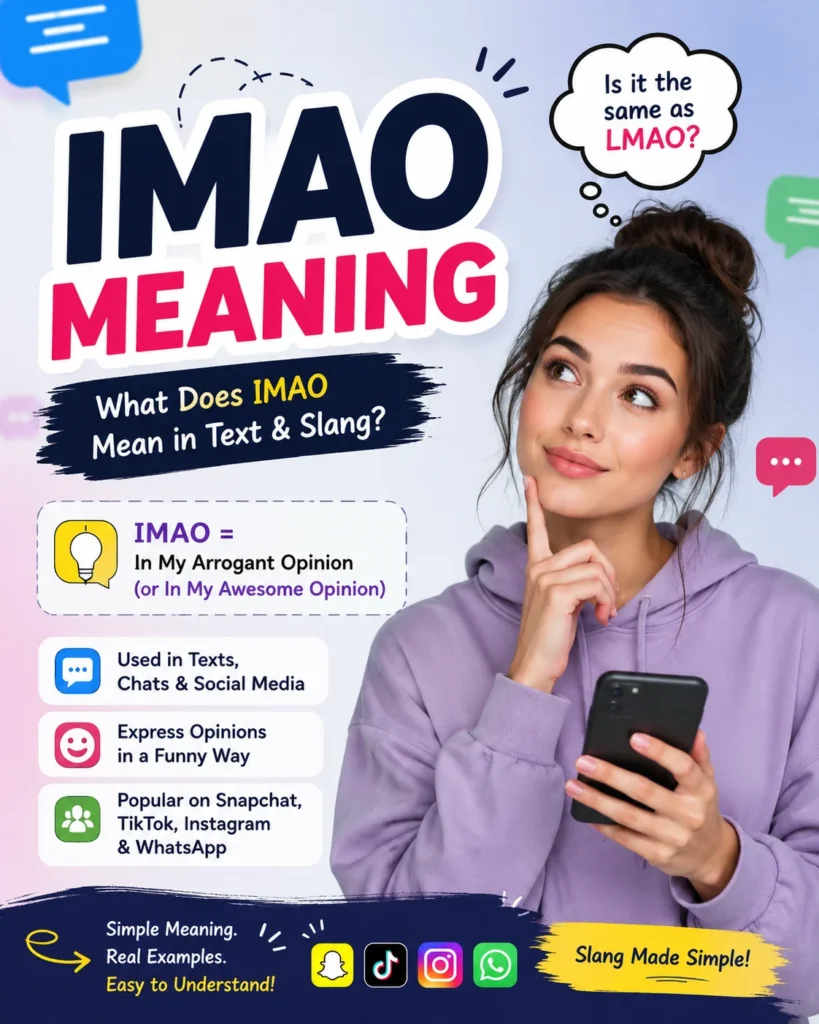

IMAO usually stands for “In My Arrogant Opinion” or, less commonly, “In My Awesome Opinion.” It’s an internet slang term used in texts, chats, and social media to share an opinion in a humorous, sarcastic, or confident way.
Many people search for IMAO meaning because they see it in text messages, TikTok comments, Snapchat conversations, or online discussions and aren’t sure whether it’s a typo of “LMAO” or a completely different slang term. Understanding the meaning helps avoid confusion in modern digital communication.
IMAO means “In My Arrogant Opinion.” It is a texting abbreviation used when someone shares an opinion while jokingly suggesting they think their view is better than others. In some cases, it can also mean “In My Awesome Opinion.”
IMAO Meaning & Explanation
IMAO Meaning in Text
In texting, IMAO is commonly used before or after a personal opinion.
Example:
“IMAO, that was the best movie released this year.”
The sender is expressing a viewpoint while adding a playful or slightly sarcastic tone.
Unlike standard phrases such as “I think” or “in my opinion,” IMAO adds personality and humor.
IMAO Slang Meaning
As an internet slang term, IMAO means:
- In My Arrogant Opinion
- In My Awesome Opinion
The first meaning is more widely recognized online.
People use it to:
- Share strong opinions
- Make jokes
- Sound playful
- Add sarcasm to conversations
What Does IMAO Mean in Chat?
In chat conversations, IMAO often signals that someone is expressing a personal take.
Example:
A: Which phone should I buy?
B: IMAO, the newer model is worth the extra money.
The phrase softens the opinion while making it sound confident.
IMAO Meaning on Snapchat
On Snapchat, IMAO appears in:
- Private chats
- Story replies
- Group conversations
Example:
A: This filter is amazing.
B: IMAO, it’s the best one they’ve released.
The tone is usually casual and friendly.
IMAO Meaning on Instagram, TikTok, and WhatsApp
Users often write IMAO in:
- Comments
- Captions
- Opinion posts
TikTok
TikTok creators use it when:
- Reviewing trends
- Sharing hot takes
- Reacting to viral content
In WhatsApp groups, IMAO is commonly used during:
- Friendly debates
- Sports discussions
- Entertainment conversations
Is IMAO an Acronym, Short Form, Phonetic Spelling, or Typo?
| Type | Does IMAO Fit? |
|---|---|
| Acronym | Yes |
| Short Form | Yes |
| Phonetic Spelling | No |
| Typo Turned Slang | Sometimes Mistaken For One |
Many people confuse IMAO with LMAO because the letters are similar. However, IMAO is its own acronym with a different meaning.
Tone and Context Variations
The meaning of IMAO changes slightly depending on tone.
Funny Tone
People often use IMAO when joking.
A: Pineapple belongs on pizza.
B: IMAO, that’s the greatest food invention ever.
The statement isn’t entirely serious.
Sarcastic Tone
IMAO is frequently used sarcastically.
A: This movie won an award.
B: IMAO, it was the most boring movie I’ve ever seen.
The speaker is expressing criticism with humor.
Romantic Tone
Though less common, IMAO can appear in flirting.
A: Why did you swipe right?
B: IMAO, you’re the most interesting person on this app.
The phrase adds a playful touch.
Angry Tone
During disagreements, IMAO can sound stronger.
A: That was clearly your mistake.
B: IMAO, you’re ignoring what actually happened.
Here it emphasizes the speaker’s viewpoint.
Playful Tone
Friends often use it casually.
A: Which ice cream flavor wins?
B: IMAO, cookies and cream dominates everything.
The conversation remains lighthearted.
Real Chat Examples
Example 1
A: What’s the best streaming service?
B: IMAO, Netflix still wins.
A: Fair point.
Example 2
A: Is that game worth buying?
B: IMAO, absolutely.
A: I’ll check it out.
Example 3
A: Which team wins tonight?
B: IMAO, the home team.
A: We’ll see.
Example 4
A: That song is overrated.
B: IMAO, it’s actually pretty good.
A: Agree to disagree.
Example 5
A: Which phone should I get?
B: IMAO, the newer version.
A: Thanks.
Example 6
A: Why is everyone using IMAO?
B: It’s a slang way to share an opinion.
A: Got it.
Example 7
A: That restaurant was amazing.
B: IMAO, it’s the best in town.
A: Totally agree.
Example 8
A: Is TikTok better than Instagram?
B: IMAO, yes.
A: Interesting.
Example 9
A: That’s a hot take.
B: IMAO, it’s true though.
A: Maybe.
Example 10
A: Which superhero is best?
B: IMAO, Spider-Man.
A: Solid choice.
Example 11
A: Should I watch that show?
B: IMAO, definitely.
A: Adding it to my list.
Example 12
A: Why are comments full of IMAO?
B: People are sharing opinions.
A: Makes sense.
Example 13
A: That’s your opinion.
B: Exactly, IMAO.
A: Fair enough.
Example 14
A: This update is terrible.
B: IMAO, it’s actually better.
A: We disagree then.
Example 15
A: Favorite fast food?
B: IMAO, tacos win.
A: Hard to argue.
Grammar and Language Role
What Part of Speech Is IMAO?
IMAO functions as a:
- Discourse marker
- Opinion indicator
- Conversational abbreviation
It signals that a statement reflects personal opinion.
Sentence Position
IMAO can appear:
- At the beginning
- In the middle
- At the end
Examples:
- “IMAO, this is the best option.”
- “This is, IMAO, the smartest choice.”
- “That’s the best movie, IMAO.”
Does It Replace a Full Sentence?
No.
Unlike abbreviations such as:
- LOL
- OK
- BRB
IMAO usually supports a statement rather than replacing one.
Tone Impact
Using IMAO can make a message sound:
- Funny
- Confident
- Sarcastic
- Casual
- Friendly
Formal vs Informal Use
| Setting | Appropriate? |
| Work Email | No |
| Academic Paper | No |
| Business Meeting | No |
| Text Messages | Yes |
| Social Media | Yes |
| Group Chats | Yes |
How to Reply When Someone Says IMAO
Funny Reply
- “Your arrogant opinion has been noted.”
- “Bold take, but I respect it.”
- “The confidence is impressive.”
Serious Reply
- “I understand your point.”
- “That’s a fair opinion.”
Flirty Reply
- “Your opinions are getting more attractive.”
- “I might agree just because it’s you.”
Neutral Reply
- “Interesting perspective.”
- “Thanks for sharing your view.”
Comparison Table
| Term | Meaning | Usage Context | Tone | Popularity | Confusion Risk |
| IMAO | In My Arrogant Opinion | Opinions | Playful | Medium | High |
| IMO | In My Opinion | Discussions | Neutral | Very High | Medium |
| IMHO | In My Humble Opinion | Forums, chats | Polite | High | Medium |
| LMAO | Laughing My Ass Off | Humor | Funny | Very High | Very High |
| TBH | To Be Honest | Honest opinions | Casual | High | Medium |
| IDK | I Don’t Know | Uncertainty | Neutral | Very High | Low |
Who Uses This Term?
Age Group
Most users are:
- Teens
- Young adults
- Millennials
- Internet-savvy adults
Gen Z vs Millennials
Gen Z
- Uses IMAO in memes
- Uses it sarcastically
- Shares it on TikTok
Millennials
- Uses it in forums
- Uses it in texting
- Understands older internet slang
Region
The term appears in:
- United States
- United Kingdom
- Canada
- Australia
- Global English-speaking communities
Most Common Platforms
- TikTok
- Snapchat
- Discord
- X (Twitter)
Origin and Internet Culture Insight
IMAO emerged from early internet culture and chat rooms where people shortened phrases to type faster.
It developed alongside abbreviations such as:
- IMO
- IMHO
- LOL
- BRB
Because internet users enjoy playful exaggeration, “In My Arrogant Opinion” became a humorous alternative to the more neutral “In My Opinion.”
Why People Say IMAO on TikTok
TikTok thrives on:
- Quick reactions
- Hot takes
- Viral opinions
- Meme humor
IMAO fits perfectly because it allows users to share opinions while sounding playful or self-aware.
You’ll often see it in:
- Comment sections
- Trend reviews
- Ranking videos
- Pop culture discussions
Experience-Based Insight
In real online conversations, IMAO is rarely used to sound genuinely arrogant. Most people use it as a humorous way to soften a strong opinion. The phrase often signals that the speaker is aware their take might be controversial, making discussions feel lighter and more conversational.
Is IMAO Rude?
Generally, no.
Most users understand it as playful internet slang rather than actual arrogance.
However, tone and context matter.
Is IMAO a Bad Word?
No.
IMAO contains no profanity and is generally considered safe for most casual conversations.
Should You Use IMAO in School or the Office?
For formal writing, avoid it.
Instead use:
- In my opinion
- I believe
- From my perspective
IMAO is best reserved for casual digital communication.
Frequently Asked Questions
What does IMAO mean in text?
It usually means “In My Arrogant Opinion.”
What does IMAO slang meaning refer to?
It refers to a humorous or confident way of sharing an opinion.
What does IMAO mean in chat?
It signals that a statement is someone’s personal opinion.
What does IMAO mean on Snapchat?
It has the same meaning and is often used in casual chats.
Is IMAO rude?
Usually not. Most people see it as playful slang.
Is IMAO the same as IDK?
No. IMAO expresses an opinion, while IDK means “I don’t know.”
Can adults use IMAO?
Yes. People of all ages use internet slang abbreviations.
How do you respond to IMAO?
You can reply seriously, humorously, neutrally, or playfully depending on the conversation.
Is IMAO the same as IMO?
Not exactly. IMO means “In My Opinion,” while IMAO adds humor or confidence.
Why do people use IMAO instead of IMO?
To make their opinion sound more playful or sarcastic.
Is IMAO popular on TikTok?
Yes, especially in comments and opinion-based discussions.
Can IMAO be used professionally?
No. Formal communication should avoid internet slang abbreviations.
Is IMAO a texting abbreviation?
Yes. It is commonly used in digital communication.
Does IMAO always mean arrogant?
Not necessarily. Many users mean it jokingly.
Is IMAO part of Gen Z vocabulary?
Yes, although Millennials and older internet users also recognize it.
Why is IMAO often confused with LMAO?
Because the two abbreviations look very similar when typed quickly.
Final Thoughts
The IMAO meaning is most commonly “In My Arrogant Opinion,” though some users interpret it as “In My Awesome Opinion.” It is a popular internet slang term used in texting, social media, chats, and online discussions to share opinions with humor, confidence, or sarcasm.
Usage Tips
- Use it in casual conversations.
- Keep the tone friendly.
- Remember that it’s opinion-based slang.
- Understand your audience.
Common Mistakes
- Confusing IMAO with LMAO.
- Using it in professional writing.
- Assuming everyone knows the abbreviation.
- Interpreting it as genuinely arrogant.
When to Use It
- Text messages
- Snapchat chats
- TikTok comments
- Instagram discussions
- Friendly debates
When to Avoid It
- Business emails
- School assignments
- Professional reports
- Formal communication
Knowing the meaning of IMAO helps you understand modern internet conversations and communicate more naturally in today’s digital world.