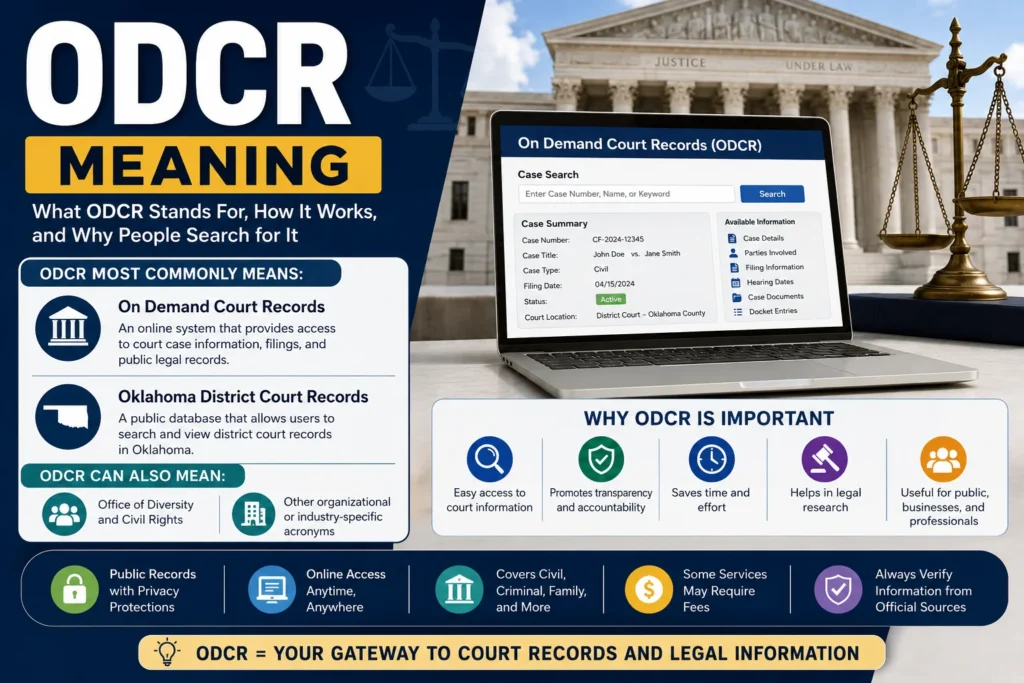

ODCR most commonly stands for “On Demand Court Records” or “Oklahoma District Court Records,” an online system used to access court case information, filings, and public legal records. However, ODCR can also have other meanings depending on the industry or organization.
If you’ve searched for “ODCR,” chances are you’re trying to understand a court case, look up legal records, verify information, or determine what the acronym means. Because ODCR has multiple definitions, many people become confused when they encounter it in legal documents, government websites, or online searches.
This guide explains the real meaning of ODCR, its most common uses, how it relates to court records, alternative definitions, and why it has become a frequently searched term online.
What Does ODCR Mean?
ODCR is an acronym that can represent several different phrases depending on the context.
The most common meanings include:
- On Demand Court Records
- Oklahoma District Court Records
- Office of Diversity and Civil Rights
- Other industry-specific or organizational abbreviations
In most online searches, especially in the United States, ODCR refers to court record systems used to access public legal information.
Why Do People Search for ODCR?
Many users encounter the term ODCR when:
- Looking up court cases
- Searching for public records
- Researching legal proceedings
- Checking lawsuit information
- Verifying criminal or civil court records
- Reviewing case statuses
Others may see the acronym in government communications, official documents, or organizational materials and want to understand its meaning.
The Most Common Meaning of ODCR: On Demand Court Records
When people search for ODCR online, they are often referring to an online court records database.
An On Demand Court Records system allows users to access:
- Court case information
- Filing dates
- Hearing schedules
- Case status updates
- Public legal records
These systems help increase transparency by allowing authorized public access to court information.
Why Court Records Matter
Court records provide important information about legal proceedings.
They may include:
- Civil cases
- Criminal cases
- Family court matters
- Probate cases
- Traffic violations
- Small claims cases
For attorneys, journalists, researchers, and members of the public, these records can be valuable sources of information.
Oklahoma District Court Records (ODCR)
One of the most recognized uses of ODCR is as an abbreviation for Oklahoma District Court Records.
This system is widely associated with public court record searches within Oklahoma.
Users often search ODCR to:
- Check case information
- View court filings
- Monitor legal proceedings
- Verify hearing dates
- Research public court records
Because Oklahoma’s court records system is frequently referenced online, many searches for “ODCR” specifically relate to this meaning.
How ODCR Court Record Systems Work
Court record systems are designed to organize and display legal information efficiently.
Typical information available may include:
Case Number
Each legal matter receives a unique identifier.
Party Names
Records often list plaintiffs, defendants, petitioners, or respondents.
Filing Information
Users may see:
- Filing dates
- Document submissions
- Court actions
Hearing Information
Many systems provide:
- Scheduled court dates
- Hearing updates
- Judicial assignments
Case Status
The system may indicate whether a case is:
- Active
- Pending
- Closed
- Dismissed
- Appealed
Benefits of Online Court Record Systems
Digital access to court information offers several advantages.
Convenience
Users can search records without visiting a courthouse.
Transparency
Public records improve accountability and access to legal information.
Speed
Information can often be found within minutes.
Research Value
Lawyers, journalists, and researchers can access data more efficiently.
Historical Record Keeping
Court systems preserve records for future reference.
What Information Can Be Found Through ODCR?
The exact information available varies depending on jurisdiction and local regulations.
Commonly available information includes:
- Case numbers
- Filing dates
- Court locations
- Judge assignments
- Hearing schedules
- Public case documents
- Status updates
Certain sensitive information may be restricted.
What Information May Not Be Available?
Privacy laws often limit access to specific records.
Examples include:
- Juvenile cases
- Sealed court records
- Protected personal information
- Certain family court matters
- Sensitive criminal investigations
Access rules differ by jurisdiction.
Other Meanings of ODCR
Although court records are the most common search intent, ODCR can also have other meanings.
Office of Diversity and Civil Rights
Some government agencies use ODCR to refer to an Office of Diversity and Civil Rights.
These departments typically focus on:
- Equal opportunity policies
- Workplace inclusion
- Civil rights compliance
- Diversity initiatives
Organizational Abbreviations
Companies, educational institutions, and government agencies sometimes create internal abbreviations using ODCR.
Because acronyms are often reused across industries, context is important.
Is ODCR a Slang Term?
No.
ODCR is generally not considered internet slang.
Unlike abbreviations such as:
- LOL
- IDK
- BRB
- WTW
ODCR is usually a formal acronym connected to legal, governmental, or organizational contexts.
Is ODCR Used in Text Messages?
In most cases, no.
ODCR rarely appears as a texting abbreviation in everyday conversations.
If someone sends “ODCR” in a message, they are likely referring to:
- A court records system
- A legal matter
- An official organization
- A workplace acronym
Context is essential for interpretation.
ODCR vs Other Legal Record Systems
Different jurisdictions maintain different public record systems.
Comparison Table
| Term | Meaning | Main Purpose | Industry | Public Access |
|---|---|---|---|---|
| ODCR | On Demand Court Records | Court case information | Legal | Often available |
| PACER | Federal court records | Federal cases | Legal | Available with registration |
| County Court Records | Local court information | County cases | Legal | Varies |
| Court Clerk Database | Court administration | Case management | Legal | Varies |
| Public Records Search | General government records | Information access | Government | Often available |
Who Uses ODCR?
Attorneys
Lawyers frequently review court records for active cases.
Journalists
Reporters often verify facts using public court documents.
Researchers
Academic researchers may analyze legal trends and court data.
Businesses
Companies sometimes conduct legal background research.
Members of the Public
Individuals often search records for personal or informational purposes.
How ODCR Supports Legal Transparency
Transparency is an important principle within many judicial systems.
ODCR-style systems support transparency by:
- Providing access to public records
- Improving accountability
- Reducing information barriers
- Increasing public awareness of legal proceedings
These systems help citizens better understand court processes.
Common Reasons Someone Searches a Court Record
People search court records for many reasons.
Verifying Case Information
Someone may want to confirm that a case exists.
Checking Court Dates
Parties involved in litigation may verify hearing schedules.
Legal Research
Law students and attorneys often use court records for research.
Background Information
Some individuals search records before making personal or business decisions.
News Verification
Journalists often use court records to verify reporting details.
Is ODCR Free to Use?
This depends on the specific system.
Some court record systems offer:
- Free searches
- Free case summaries
Others may charge fees for:
- Document downloads
- Certified records
- Advanced searches
Availability varies by jurisdiction.
Security and Privacy Considerations
While court records promote transparency, privacy protections remain important.
Users should remember:
- Not all records are public.
- Personal information may be redacted.
- Access restrictions may apply.
- Certain documents require authorization.
Responsible use of public information is important.
ODCR and Digital Transformation
Court systems have changed dramatically over the past two decades.
Before digital databases, accessing records often required:
- Visiting courthouses
- Filing requests
- Waiting for document retrieval
Modern systems provide faster access through online platforms.
Benefits of Digital Court Systems
- Improved efficiency
- Better record management
- Easier public access
- Reduced paperwork
- Faster case tracking
These improvements have transformed legal information access.
Common Misunderstandings About ODCR
Myth 1: ODCR Is Internet Slang
False.
ODCR is generally a formal acronym rather than social media slang.
Myth 2: Every Court Uses ODCR
False.
Different courts use different record systems.
Myth 3: All Court Records Are Public
False.
Some records are protected or restricted.
Myth 4: ODCR Only Refers to Oklahoma
Not always.
While Oklahoma District Court Records is a common meaning, ODCR can represent other phrases as well.
Experience-Based Insight
In real-world searches, most people looking for ODCR are not trying to decode a social media abbreviation. Instead, they are attempting to access court information, understand a legal case, or verify public records. Search behavior consistently suggests that legal and court-related intent dominates ODCR-related queries. This makes accuracy, context, and understanding jurisdiction-specific systems especially important.
Frequently Asked Questions
What does ODCR stand for?
ODCR most commonly stands for On Demand Court Records or Oklahoma District Court Records.
Is ODCR a court records website?
In many contexts, yes. ODCR is often associated with online court record systems.
Can anyone access ODCR records?
Access depends on jurisdiction, record type, and applicable laws.
Is ODCR free?
Some information may be available for free, while certain documents or services may require fees.
Is ODCR an internet slang term?
No. ODCR is generally a legal or organizational acronym rather than internet slang.
What kind of cases appear in ODCR?
Depending on the system, records may include civil, criminal, probate, traffic, and family court cases.
Why do people search for ODCR?
Most users are searching for court records, legal information, case statuses, or public filings.
Does ODCR only exist in Oklahoma?
No. While Oklahoma District Court Records is a common meaning, ODCR may have other definitions in different organizations and industries.
What is ODCR used for?
ODCR is primarily used to access court-related information and public legal records.
What does ODCR mean in legal terms?
In legal contexts, ODCR commonly refers to court record databases and public access systems.
How do I search court records using ODCR?
The process depends on the specific court system and jurisdiction involved.
Are all court records available online?
No. Some records remain restricted or unavailable due to privacy laws.
Is ODCR reliable?
Official court record systems are generally considered reliable sources of legal information.
Why is ODCR important?
ODCR helps improve public access, transparency, and understanding of court proceedings.
Conclusion
ODCR most commonly stands for On Demand Court Records or Oklahoma District Court Records, making it an important term in the legal and public records landscape. While the acronym can have multiple meanings depending on the organization or industry, court-related search intent dominates most ODCR queries.
Key Takeaways
- ODCR is primarily associated with court records.
- It is a formal acronym, not internet slang.
- It helps users access public legal information.
- Different jurisdictions may offer different levels of access.
- Context is essential when interpreting the acronym.
Common Mistakes
- Assuming ODCR is social media slang.
- Believing all court records are public.
- Assuming every court uses the same system.
- Ignoring jurisdiction-specific rules.
When to Use the Term
Use ODCR when discussing:
- Court records
- Legal research
- Public filings
- Judicial information systems
When to Be Careful
- When interpreting the acronym outside legal contexts.
- When handling sensitive or restricted records.
- When relying on information without verification.
Understanding what ODCR means can save time, reduce confusion, and help users navigate legal information more effectively.