
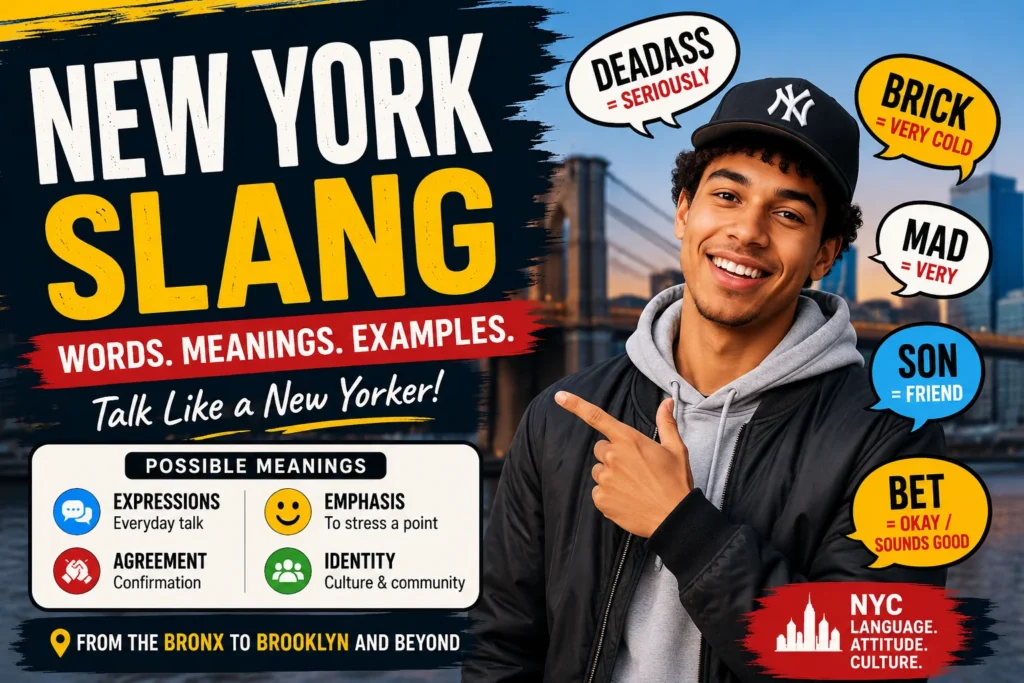

New York slang is a collection of words and expressions commonly used by people across New York City and surrounding areas. Influenced by hip-hop, immigrant communities, and local culture, these phrases have spread far beyond the city through music, movies, and social media.
Whether you’ve heard someone say “deadass,” “brick,” “mad,” or “you buggin’,” you’re already familiar with New York slang—even if you didn’t realize it. Many of these expressions appear every day on TikTok, Instagram, YouTube, podcasts, and in everyday conversations.
The challenge is that many New York slang terms don’t mean what they literally sound like. A visitor might hear “It’s brick outside” and wonder what buildings have to do with the weather. Likewise, hearing “You’re mad funny” doesn’t mean someone is angry—it means they’re very funny.
This guide explains the most popular New York slang words, where they came from, how locals use them, and how you can understand them without sounding forced.
What Is New York Slang?
New York slang refers to the informal words, phrases, and expressions commonly used throughout New York City and nearby communities.
Unlike standard English, these expressions often:
- Have meanings that differ from dictionary definitions.
- Reflect local culture and identity.
- Change quickly as trends evolve.
- Spread through music, sports, and social media.
Many people think there’s one “New York accent” or one “New York vocabulary,” but that’s not entirely true. Language varies from neighborhood to neighborhood and is shaped by the city’s incredible cultural diversity.
Today, many expressions that started in New York have become part of everyday internet language.
Why New York Slang Is Unique
New York City is home to people from hundreds of cultural and linguistic backgrounds. Over generations, communities borrowed words, shortened phrases, and created expressions that reflected daily life in the city.
Several factors helped shape modern New York slang:
- African American Vernacular English (AAVE)
- Hip-hop culture
- Caribbean communities
- Puerto Rican and Dominican communities
- Jewish, Italian, Irish, and other immigrant influences
- Fast-paced city life
Because New York is also a global center for entertainment, many local expressions eventually spread across the United States—and later around the world.
50 Common New York Slang Words and Phrases
1. Deadass
Meaning: Seriously; honestly; without joking.
Example:
“I’m deadass tired after that game.”
Tone: Serious or emphatic.
Where you’ll hear it: Everyday conversations, TikTok, Instagram, X, YouTube.
2. Brick
Meaning: Extremely cold weather.
Example:
“It’s brick outside—grab your coat.”
Tone: Casual.
Where you’ll hear it: Winter conversations throughout NYC.
3. Mad
Meaning: Very; extremely.
Example:
“That pizza is mad good.”
Notice that “mad” here doesn’t mean angry.
4. Son
Meaning: Friend, buddy, or someone you’re addressing casually.
Example:
“Son, where you been?”
Often used between close friends.
5. Buggin’
Meaning: Acting irrationally or overreacting.
Example:
“You think that’s expensive? You buggin’.”
6. OD
Meaning: Excessively; too much.
Example:
“You’re OD loud today.”
The phrase usually means someone is being excessive—not the medical meaning of “overdose.”
7. Word
Meaning: I agree; that’s true; understood.
Example:
“We’re meeting at six.”
“Word.”
8. Bet
Meaning: Okay; sounds good; deal.
Example:
“I’ll text you later.”
“Bet.”
9. Facts
Meaning: That’s completely true.
Example:
“This place has the best bagels.”
“Facts.”
10. Wildin’
Meaning: Acting crazy or behaving unreasonably.
Example:
“You skipped work to play video games? You wildin’.”
11. Tight
Meaning: Upset or annoyed.
Example:
“He’s still tight about losing.”
12. Valid
Meaning: Approved, respectable, or acceptable.
Example:
“That outfit is valid.”
13. Dub
Meaning: To reject or ignore someone.
Example:
“She dubbed my invitation.”
14. Shook
Meaning: Surprised, frightened, or emotionally affected.
Example:
“I was shook after watching that ending.”
15. Smacked
Meaning: Very good tasting (usually food).
Example:
“These tacos are smacked.”
In some contexts, “smacked” may have other meanings, but when discussing food, it simply means delicious.
16. Chopped
Meaning: Unattractive or poorly done.
Example:
“That haircut is chopped.”
Used jokingly among friends, though it can sound insulting depending on the context.
17. Fiending
Meaning: Really wanting something.
Example:
“I’m fiending for a bacon, egg, and cheese.”
18. Gucci
Meaning: Everything is okay.
Example:
“Don’t worry, we’re Gucci.”
Although associated with the fashion brand, the slang simply means everything is fine.
19. Frontin’
Meaning: Pretending or showing off.
Example:
“Stop frontin’. I know you liked the movie.”
20. Low-key
Meaning: Somewhat; secretly; quietly.
Example:
“I low-key want another slice.”
21. No Cap
Meaning: I’m telling the truth; no exaggeration.
Example:
“No cap, that’s the best slice of pizza I’ve ever had.”
Tone: Honest, confident.
Where you’ll hear it: TikTok, Instagram Reels, YouTube, everyday conversations.
22. High-Key
Meaning: Openly or obviously.
Example:
“I’m high-key excited for the concert.”
Unlike low-key, this means someone isn’t hiding their feelings.
23. Cappin’
Meaning: Lying or exaggerating.
Example:
“You met the actor? Stop cappin’.”
24. Bread
Meaning: Money.
Example:
“I’m saving my bread for vacation.”
25. Cake
Meaning: Money or earnings.
Example:
“She’s making serious cake with her business.”
26. Pressed
Meaning: Upset, bothered, or overly concerned.
Example:
“Why are you so pressed about a game?”
27. Link Up
Meaning: Meet someone in person.
Example:
“Let’s link up after work.”
28. Gassed
Meaning: Overly excited, overconfident, or excessively praised.
Example:
“They complimented him once and now he’s totally gassed.”
29. Bugged Out
Meaning: Extremely surprised or behaving strangely.
Example:
“I bugged out when I saw the final score.”
30. Say Less
Meaning: I understand; no further explanation needed.
Example:
“We’re grabbing burgers tonight.”
“Say less.”
31. Tighten Up
Meaning: Get yourself together or improve your behavior.
Example:
“You’ve been late all week. Tighten up.”
32. Whip
Meaning: Car.
Example:
“I finally bought a new whip.”
33. Drip
Meaning: Stylish clothing or fashionable appearance.
Example:
“Your drip is clean today.”
34. Flex
Meaning: Show off something you own or have achieved.
Example:
“He loves to flex his new sneakers.”
35. Lit
Meaning: Exciting, fun, or energetic.
Example:
“The block party was lit.”
36. Vibe
Meaning: Atmosphere, feeling, or mood.
Example:
“This café has a great vibe.”
37. Fire
Meaning: Excellent or impressive.
Example:
“That new album is fire.”
38. Dope
Meaning: Really good or impressive.
Example:
“Your artwork is dope.”
39. Wack
Meaning: Bad, boring, or disappointing.
Example:
“That movie was wack.”
40. Extra
Meaning: Overly dramatic or excessive.
Example:
“You’re being extra over a tiny mistake.”
41. Ghost
Meaning: Stop replying or disappear from communication.
Example:
“He ghosted everyone after graduation.”
42. Salty
Meaning: Bitter or annoyed.
Example:
“He’s still salty about losing.”
43. Hype
Meaning: Excitement or publicity.
Example:
“That restaurant deserves the hype.”
44. Bounce
Meaning: Leave.
Example:
“It’s getting late. Let’s bounce.”
45. Chill
Meaning: Relax or calm down.
Example:
“Just chill—we’ll figure it out.”
46. Clowning
Meaning: Making fun of someone.
Example:
“They were clowning him for wearing sandals in winter.”
47. Respectfully
Meaning: A polite way to disagree or soften a statement.
Example:
“Respectfully, I don’t think that’s true.”
Online, it’s sometimes used humorously before a bold opinion.
48. That’s Crazy
Meaning: A common reaction showing surprise without necessarily expressing strong emotion.
Example:
“I waited three hours for pizza.”
“That’s crazy.”
49. Facts Only
Meaning: Complete agreement.
Example:
“New York bagels are unmatched.”
“Facts only.”
50. Good Looks
Meaning: Thank you; I appreciate it.
Example:
“You saved me a seat?”
“Yeah.”
“Good looks.”
This expression is especially common in New York and is often used instead of saying “thanks.”
New York Slang by Borough
Although many expressions are understood across the city, each borough has its own history, communities, and speaking style.
Brooklyn
Brooklyn slang is perhaps the most internationally recognized thanks to hip-hop, film, and television.
You’ll frequently hear:
- Deadass
- Mad
- Son
- Good looks
- Word
- Bet
Brooklyn speech is often direct, confident, and conversational rather than overly formal.
The Bronx
The Bronx has had a profound influence on modern slang because it is widely recognized as the birthplace of hip-hop culture.
Common expressions include:
- Facts
- OD
- Wildin’
- Pressed
- Buggin’
Many phrases that later became mainstream first gained popularity through Bronx neighborhoods and music.
Queens
Queens is one of the most linguistically diverse places in the world, and that diversity influences everyday speech.
People often mix traditional New York slang with expressions influenced by Caribbean, South Asian, East Asian, Middle Eastern, and Latino communities.
The result is a vocabulary that feels uniquely multicultural while still unmistakably New York.
Manhattan
Manhattan’s population is highly mixed, including lifelong residents, commuters, students, and professionals.
Because of this, you’ll hear both classic New York expressions and more standard American English depending on the neighborhood.
Locals may use slang casually with friends while switching to more formal language at work.
Staten Island
Staten Island has its own local identity and speech patterns.
Many residents use the same citywide slang, but pronunciation, humor, and neighborhood expressions can differ from the other boroughs.
Some phrases are shared across the entire city, while others remain more local.
One important thing to remember is that there is no single “New York dialect.” A teenager from the Bronx, a business professional in Manhattan, and a lifelong resident of Queens may all use different vocabulary, even though they live in the same city.
The Cultural Roots of New York Slang
New York slang didn’t appear overnight. It developed over decades as people from different cultures, neighborhoods, and generations influenced one another. Today, many expressions that originated in New York are recognized around the world thanks to music, movies, television, and social media.
Understanding these influences helps explain why New York slang is constantly evolving and why some expressions spread far beyond the city.
The Influence of African American Vernacular English (AAVE)
Many well-known New York slang terms either originated in or were shaped by African American Vernacular English (AAVE), a recognized variety of English with its own grammatical patterns, pronunciation, and vocabulary.
Expressions such as:
- Deadass
- Mad (meaning “very”)
- Buggin’
- Wildin’
- Pressed
- Facts
- Bet
became widely recognized through everyday speech in New York communities before reaching broader audiences through music and social media.
It’s important to recognize that while many of these words are now used by people worldwide, some have cultural roots that deserve respect. Using them naturally is different from imitating someone’s identity or accent.
Hip-Hop’s Role in Popularizing New York Slang
Few cultural movements have influenced language as much as hip-hop.
Since hip-hop began in the Bronx during the 1970s, artists have introduced local expressions to national and international audiences.
Lyrics, interviews, freestyle battles, and music videos helped popularize words like:
- Son
- Word
- Bet
- Deadass
- Mad
- Fire
As hip-hop grew into a global genre, many listeners adopted these expressions even if they had never visited New York City.
Today, it’s common to hear New York slang in songs by artists from entirely different regions.
The Influence of Immigrant Communities
New York is one of the world’s most culturally diverse cities.
Generations of immigration have influenced local speech through:
- Caribbean English
- Puerto Rican Spanish
- Dominican Spanish
- Italian-American communities
- Jewish communities
- Irish communities
- South Asian communities
- Chinese communities
- Middle Eastern communities
Rather than borrowing entire languages, New Yorkers often blend pronunciation, rhythm, and vocabulary into everyday conversations.
This constant exchange helps explain why New York slang feels dynamic and continues to evolve.
New York Slang on Social Media
Many people first encounter New York slang online rather than in New York itself.
Different platforms tend to popularize different expressions.
New York Slang on TikTok
TikTok has introduced millions of people to New York vocabulary.
Creators frequently use words like:
- Deadass
- Brick
- Valid
- Wildin’
- Buggin’
- Bet
These words appear naturally in:
- Storytimes
- Comedy skits
- Street interviews
- Lifestyle videos
- Sports commentary
Because TikTok videos spread quickly, local expressions often become global trends within days.
New York Slang on Instagram
Instagram captions, Reels, and comments frequently feature New York slang.
Examples include:
“Deadass the best coffee.”
“That fit is valid.”
“You wildin 😂”
Most usage is casual and conversational.
New York Slang on Snapchat
Snapchat conversations are usually between friends, making slang feel especially natural.
You’ll often see:
- Bet
- Word
- Good looks
- Link up
- Mad
- Deadass
Since messages disappear, people tend to write the same way they speak.
New York Slang on X
X (formerly Twitter) has long been known for short, fast-moving conversations.
New Yorkers frequently use slang while discussing:
- Sports
- Politics
- Entertainment
- Local news
- Memes
The platform helped popularize expressions such as deadass years before short-form video became dominant.
New York Slang on Reddit
Reddit communities often explain the meanings and origins of New York slang.
Unlike TikTok or Instagram, Reddit discussions tend to focus more on:
- Definitions
- Regional differences
- History
- Cultural context
Many visitors searching for slang explanations eventually end up reading these discussions.
Words Visitors Often Misunderstand
Some New York expressions confuse first-time visitors because the literal meaning is completely different from the local meaning.
| Word | Literal Meaning | What New Yorkers Actually Mean |
|---|---|---|
| Brick | A building block | Extremely cold weather |
| Mad | Angry | Very or extremely |
| Son | Male child | Friend or buddy |
| Word | Vocabulary | I agree or that’s true |
| Bet | A gamble | Okay, sounds good |
| Deadass | Sounds serious | Completely serious; honestly |
| OD | Medical overdose | Excessively or too much |
| Valid | Legally acceptable | Good, approved, respectable |
Learning these differences helps visitors understand conversations without confusion.
How to Use New York Slang Naturally
Using slang effectively isn’t about memorizing dozens of words—it’s about understanding context.
Listen Before You Use It
If you’re unfamiliar with an expression, pay attention to how locals use it first.
Notice:
- The situation
- The tone
- Who is speaking
- Who they’re speaking to
Context matters more than memorization.
Don’t Force Slang Into Every Sentence
One common mistake is trying to sound “authentic” by using several slang words at once.
Instead of saying:
“Deadass, son, that’s mad fire, no cap, facts.”
A local conversation is usually much more natural:
“That pizza was deadass good.”
Simple feels more authentic.
Match the Situation
Some expressions work well among friends but feel awkward in professional settings.
For example:
Appropriate:
- Hanging out
- Texting friends
- Social media comments
- Sports conversations
Less appropriate:
- Job interviews
- Business emails
- Academic papers
- Formal presentations
Knowing when not to use slang is just as important as knowing what it means.
Respect Cultural Origins
Many New York slang expressions have deep cultural histories.
It’s perfectly fine to learn and understand them, but it’s best to avoid exaggerating accents or using expressions simply because they’re trendy.
Respecting the communities that shaped these words helps preserve their meaning.
Common Mistakes People Make
Even native English speakers misunderstand New York slang.
Some of the most common mistakes include:
- Assuming every New Yorker speaks the same way.
- Believing every slang word originated in New York.
- Taking expressions literally instead of understanding their local meaning.
- Overusing slang to sound “cool.”
- Confusing internet slang with everyday spoken language.
- Forgetting that meanings change depending on context and tone.
The best approach is to use slang naturally, sparingly, and only when it fits the conversation.
New York Slang Compared with Other U.S. Cities
Although every major American city has its own vocabulary, New York slang stands out for its directness, speed, and cultural influence. Thanks to music, movies, and social media, many New York expressions have become recognizable across the country.
| City | Example Slang | Typical Style | Major Influences |
|---|---|---|---|
| New York City | Deadass, Brick, Mad, Buggin’, Bet | Direct, fast-paced | Hip-hop, AAVE, multicultural communities |
| Chicago | Joe, Merch | Casual, neighborhood-focused | Midwest culture, local communities |
| Los Angeles | Dope, Tight, Chill | Relaxed, laid-back | West Coast culture, entertainment industry |
| Atlanta | Twin, Finna*, Plug | Conversational, expressive | Southern culture, hip-hop |
| Philadelphia | Jawn | Flexible, context-based | Local urban culture |
*Some expressions, such as finna, are not exclusive to one city and have broader roots in AAVE.
The comparison shows that while many slang terms spread nationwide, each city still maintains expressions that locals instantly recognize.
Who Uses New York Slang Today?
New York slang isn’t limited to one age group or neighborhood. Different generations use different expressions, and some terms have become mainstream across the English-speaking world.
Teenagers
Teenagers are often the fastest to adopt new expressions. They combine classic New York slang with newer internet language from TikTok, gaming, and memes.
Common examples include:
- Deadass
- Bet
- Valid
- Wildin’
- No cap
Gen Z
Gen Z has helped spread New York slang globally through short-form video platforms.
Many creators use local expressions naturally in:
- Comedy videos
- Street interviews
- Fashion content
- Sports discussions
- Lifestyle vlogs
As a result, people outside New York often recognize these words even if they’ve never visited the city.
Millennials
Millennials are more likely to use long-established expressions such as:
- Son
- Word
- Mad
- Good looks
- Brick
Many first encountered these terms through music, television, or growing up in or around New York.
Long-Time Residents
People who have lived in New York for decades often mix traditional expressions with newer slang.
Their vocabulary tends to reflect:
- Neighborhood
- Family background
- Cultural influences
- Age
- Occupation
There is no single “correct” version of New York slang.
Visitors and Social Media Users
Millions of people now use New York slang simply because they’ve encountered it online.
Some expressions—especially deadass, bet, and valid—have become common even outside the United States.
Is New York Slang Appropriate Everywhere?
Most New York slang is informal rather than offensive. However, whether it’s appropriate depends on the setting.
Appropriate in:
- Text messages
- Casual conversations
- Social media
- Group chats
- Friendly discussions
Better avoided in:
- Job interviews
- Business emails
- Academic writing
- Legal documents
- Professional presentations
Some slang terms may also have strong cultural associations. If you’re unfamiliar with a word’s background, it’s better to understand it before trying to use it yourself.
Real-World Observation
One of the most interesting things about New York slang is how quickly it moves from neighborhood conversations to global internet culture. A phrase that starts among friends in one borough can appear in a viral TikTok video weeks later and become part of everyday online language. At the same time, local speakers continue to create new expressions, meaning New York slang is constantly evolving rather than remaining fixed. This ability to adapt while keeping its cultural identity is one reason it continues to influence English around the world.
Frequently Asked Questions
What is the most common New York slang word?
There isn’t a single “most common” word, but deadass, bet, mad, brick, and word are among the most recognizable. Which one you hear most often depends on the neighborhood, age group, and social circle. Some expressions have also become popular nationwide through social media.
What does “deadass” mean?
Deadass means seriously, honestly, or I’m not joking. People use it to emphasize that they’re telling the truth or expressing a genuine opinion. For example, “I’m deadass tired after work” simply means “I’m genuinely exhausted.”
Why do New Yorkers say “mad”?
In New York slang, mad often means very or extremely, rather than angry. Someone might say, “That restaurant is mad good,” meaning it’s extremely good. This usage has been common in New York for many years.
Is New York slang the same as AAVE?
No. While many New York slang expressions were influenced by or originated in African American Vernacular English (AAVE), New York slang as a whole is shaped by many communities, including Caribbean, Latino, Jewish, Italian, Irish, and other immigrant groups. The two overlap but are not identical.
Can tourists use New York slang?
Yes, but it’s best to use it naturally and in the right context. Understanding the meaning is more important than trying to imitate a local accent or speech style. Listening first usually helps you use expressions more confidently.
Why is New York slang so popular on TikTok?
TikTok has introduced New York slang to a worldwide audience through comedy videos, street interviews, podcasts, and lifestyle content. Creators often use authentic local language, making viewers curious about unfamiliar expressions. Viral videos have accelerated the spread of words like deadass, brick, and valid.
Do all New Yorkers use the same slang?
No. Language varies by borough, neighborhood, age, culture, and personal experience. While many expressions are understood citywide, not everyone uses the same vocabulary or pronunciation.
How can I learn New York slang naturally?
The best approach is to pay attention to real conversations, podcasts, interviews, and videos created by New Yorkers. Learning expressions in context helps you understand not just what they mean, but when they feel natural to use.
Is New York slang difficult to learn?
Not usually. Once you understand the meanings behind common expressions, most are easy to recognize in conversation.
What’s the difference between New York slang and internet slang?
Some New York expressions became internet slang after spreading through music and social media. Others remain primarily local.
Why do New Yorkers say “good looks”?
Good looks is a casual way of saying thank you or I appreciate it.
Is “brick” only used in New York?
It’s most strongly associated with New York and nearby areas, although people in other regions may use it after hearing it online.
Which New York slang words became famous worldwide?
Examples include deadass, bet, word, mad, valid, and brick.
Conclusion
New York slang reflects the city’s diversity, creativity, and fast-paced culture. While some expressions remain deeply local, many have become part of everyday internet language through hip-hop, movies, and social media. Learning the meanings behind these words makes conversations easier to understand and gives you a better appreciation of New York’s cultural influence.
Usage Tips
- Learn expressions in context before using them.
- Keep slang natural rather than forcing it into every sentence.
- Consider your audience—casual slang isn’t appropriate everywhere.
- Respect the cultural communities that shaped many of these expressions.
Common Mistakes
- Thinking every New Yorker speaks the same way.
- Taking slang literally instead of understanding the intended meaning.
- Overusing trendy expressions to sound authentic.
- Assuming every internet slang word originated in New York.
When to Use and When to Avoid
Use New York slang when:
- Chatting with friends.
- Commenting on social media.
- Discussing pop culture or sports.
- Having informal conversations.
Avoid using it when:
- Writing professional emails.
- Giving formal presentations.
- Completing academic assignments.
- Speaking in situations where clarity and professionalism are expected.