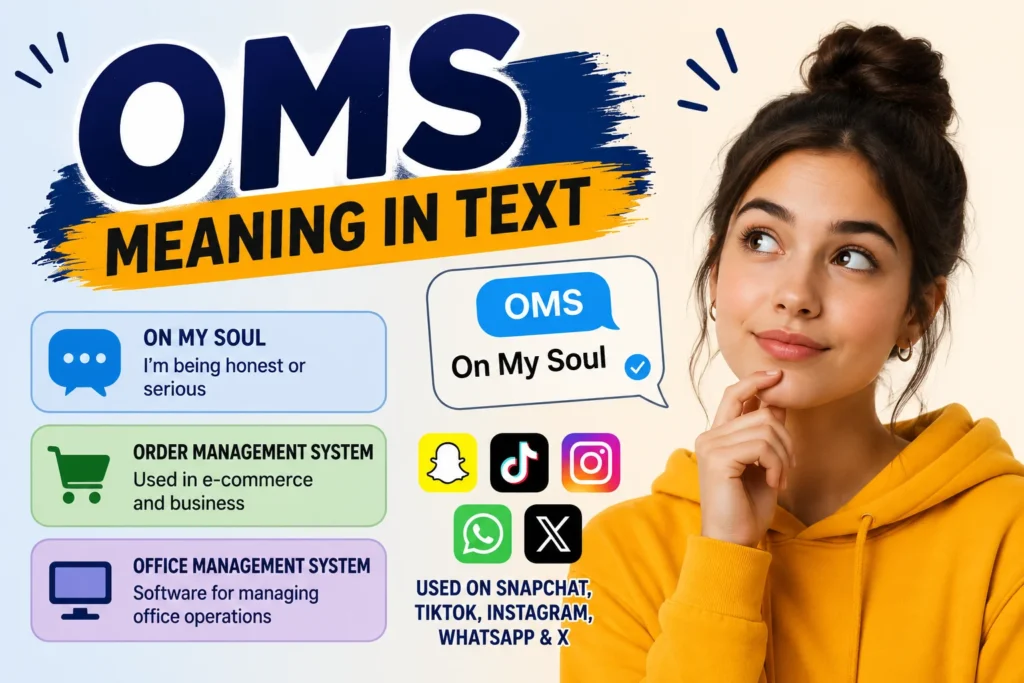

OMS in text most commonly stands for “On My Soul,” a slang expression used to emphasize honesty or sincerity. Depending on the context, it can also have other meanings, so understanding where and how it’s used is important.
If you’ve seen OMS in a text message, on TikTok, Snapchat, Instagram, or X (formerly Twitter), you may have wondered what it actually means. Like many internet abbreviations, OMS has more than one definition. While “On My Soul” is the most common meaning in modern texting slang, it can also represent other phrases in different industries and online communities. This guide explains every genuine meaning so you can understand it with confidence.
What Does OMS Mean?
The abbreviation OMS has several legitimate meanings, but only one dominates casual online conversations.
1. OMS = On My Soul (Most Common Text Meaning)
In texting and internet slang, OMS most often stands for “On My Soul.”
People use it to emphasize that they are telling the truth or making a sincere promise. It functions similarly to expressions such as:
- I swear
- Honestly
- For real
- I promise
Example:
“OMS I didn’t see your message.”
Here, the sender is emphasizing that they’re being truthful.
Although the phrase is common in texting, it isn’t a legally binding promise. Instead, it’s simply a way of adding emotional emphasis to a statement.
2. OMS = Office Management System
Outside of texting, OMS commonly stands for Office Management System.
Businesses use this abbreviation when discussing:
- Administrative software
- Office workflow
- Employee management
- Digital record systems
Example:
“Our company upgraded its OMS last month.”
This meaning has nothing to do with internet slang.
3. OMS = Order Management System
In e-commerce, retail, and logistics, OMS frequently means Order Management System.
This refers to software that helps businesses:
- Process customer orders
- Track shipments
- Manage inventory
- Handle returns
If you’re reading technology or business articles, this is likely the intended definition.
4. OMS in Medical Contexts
Healthcare organizations sometimes use OMS as an abbreviation for specialized medical terms, such as Oral and Maxillofacial Surgery or department names.
However, this meaning almost never appears in casual messaging.
Is OMS an Acronym, Abbreviation, or Slang?
That depends on the context.
In texting:
- OMS is an acronym representing “On My Soul.”
- It is also considered internet slang because it’s mainly used in informal digital conversations.
In business:
- OMS is simply a professional abbreviation.
So, the same three letters can have entirely different meanings depending on where you encounter them.
OMS Meaning in Text
When someone sends OMS in a text message, they are almost always saying:
“On My Soul.”
The purpose is to show sincerity or convince the other person that they’re being honest.
Example:
A: Did you really forget?
B: OMS, I completely forgot.
The abbreviation adds emphasis rather than changing the meaning of the sentence.
What Does OMS Mean in Chat?
In online chats, OMS usually appears during casual conversations between friends.
People often use it when:
- Defending themselves
- Promising something
- Reacting honestly
- Trying to sound convincing
Example:
A: You didn’t actually finish the whole movie.
B: OMS I watched every minute.
OMS Meaning on Different Platforms
The meaning stays fairly consistent across social media, but some platforms use it more frequently than others.
OMS Meaning on Snapchat
On Snapchat, OMS almost always means “On My Soul.”
Because Snapchat conversations are informal and fast-paced, users frequently rely on abbreviations instead of typing complete phrases.
Example:
OMS I wasn’t ignoring you.
OMS Meaning on TikTok
TikTok comments and captions sometimes include OMS, especially in videos involving:
- Friends
- Relationships
- Storytimes
- Challenges
- Reaction videos
Creators use it to stress honesty or surprise.
Example:
OMS that actually happened.
Although TikTok has many slang expressions, OMS isn’t as widespread as terms like Rizz, Delulu, or NPC, but it’s still recognized among younger users.
OMS Meaning on Instagram
Instagram users commonly write OMS in:
- Story replies
- DMs
- Comment sections
- Group chats
Its meaning remains “On My Soul.”
OMS Meaning on WhatsApp
WhatsApp users, particularly younger speakers, may use OMS while chatting with close friends or family.
Example:
OMS I’ll call you later.
OMS Meaning on X (Formerly Twitter)
On X, OMS appears in tweets, replies, and discussions where users want to strongly emphasize a point.
Example:
OMS that was the funniest video today.
Unlike business or technical discussions, social conversations on X almost always use the slang meaning.
Why Do People Say OMS?
People use OMS because it’s:
- Short
- Easy to type
- More expressive than simply saying “I’m serious”
It helps communicate sincerity without writing an entire sentence like:
“I swear I’m telling the truth.”
Instead, users simply type:
OMS.
This makes conversations faster while still conveying emotion.
Tone & Context Variations
The meaning of OMS (“On My Soul”) stays the same, but the tone changes depending on the conversation. It can sound playful, serious, humorous, or even slightly dramatic.
Understanding the tone helps you interpret what the sender really means.
Funny Tone
Friends often use OMS jokingly to exaggerate a small situation.
Conversation Example
A: You seriously ate the last slice of pizza?
B: OMS, I thought nobody wanted it.
A: That’s the excuse you’re going with?
B: Absolutely.
Serious Tone
When discussing something important, OMS adds sincerity.
Conversation Example
A: Did you really tell the teacher everything?
B: OMS, I told the whole truth.
A: I appreciate your honesty.
B: I didn’t want to lie.
Playful Tone
Close friends frequently use OMS while teasing each other.
Conversation Example
A: You’re always late.
B: OMS, today wasn’t my fault.
A: That’s what you said last week.
B: Okay… maybe you’re right.
Sarcastic Tone
Sometimes people use OMS sarcastically to mock exaggerated excuses.
Conversation Example
A: He says he forgot because his phone disappeared.
B: OMS, sure it did.
A: You don’t believe him?
B: Not even a little.
Real Chat Examples
Below are realistic conversations showing how OMS naturally appears in text messages and online chats.
Example 1 – Forgetting a Reply
A: Why didn’t you answer me?
B: OMS I fell asleep.
A: That’s actually believable.
B: I was exhausted.
Example 2 – School
A: Did you finish the assignment?
B: OMS I submitted it this morning.
A: Nice.
B: I didn’t want another late grade.
Example 3 – Friends
A: Did Jake really say that?
B: OMS he actually did.
A: No way.
B: Everyone heard it.
Example 4 – Gaming
A: You carried the whole team.
B: OMS everyone else played great too.
A: You’re being modest.
B: We all contributed.
Example 5 – Family Chat
A: Are you coming for dinner?
B: OMS I’ll be there in ten minutes.
A: We’ll wait.
B: Thanks.
Example 6 – Relationship
A: Did you forget our anniversary?
B: OMS I already bought your gift.
A: You scared me.
B: I planned ahead.
Example 7 – Group Chat
A: Who finished the snacks?
B: OMS it wasn’t me.
A: Really?
B: Ask everyone else.
Example 8 – Sports
A: That goal was incredible.
B: OMS I didn’t expect him to score.
A: Neither did I.
B: It changed the whole match.
Example 9 – Shopping
A: Those shoes sold out already?
B: OMS they disappeared in minutes.
A: That’s crazy.
B: I should’ve ordered sooner.
Example 10 – Movie Night
A: Did you actually cry during the ending?
B: OMS yes.
A: Same here.
B: It was emotional.
Example 11 – Vacation
A: Did you miss your flight?
B: OMS I got to the airport five minutes late.
A: That’s rough.
B: Lesson learned.
Grammar & Language Role
Unlike ordinary words, OMS functions as a conversational abbreviation rather than a traditional part of speech.
Part of Speech
OMS is generally treated as an interjection or discourse marker.
It emphasizes sincerity rather than acting as a noun or verb.
Examples:
- OMS I’m serious.
- OMS I forgot.
Sentence Position
Most people place OMS:
- At the beginning of a sentence
- Occasionally at the end for emphasis
Examples:
- OMS I didn’t know.
- I didn’t know, OMS.
Beginning the sentence is far more common.
Can OMS Replace a Full Sentence?
No.
Unlike LOL, which can sometimes stand alone as a reaction, OMS usually introduces or supports another statement.
Correct:
- OMS I wasn’t lying.
Less natural:
- OMS.
By itself, it lacks enough information unless both people already understand the context.
Formal vs. Informal Register
OMS is highly informal.
It’s appropriate for:
- Text messages
- Snapchat
- TikTok
- Instagram DMs
- Casual online chats
Avoid using it in:
- Business emails
- Academic writing
- Professional reports
- Formal presentations
Instead, write complete phrases like:
- I assure you…
- Honestly…
- I sincerely believe…
How to Reply When Someone Says OMS
Your response depends on whether you believe them and the tone of the conversation.
Funny Reply
- “I’ll believe you… this time.”
- “That’s a pretty serious promise!”
- “You better be telling the truth.”
Serious Reply
- “I trust you.”
- “Thanks for being honest.”
- “I appreciate you explaining.”
Flirty Reply
If you’re chatting with someone you like:
- “I’ll take your word for it 😊”
- “You sound pretty convincing.”
- “Guess I’ll have to trust you.”
Neutral Reply
- “Got it.”
- “Okay, thanks.”
- “That makes sense.”
- “No worries.”
Comparison Table
People often confuse OMS with other texting abbreviations because they all appear in casual digital communication. Here’s how OMS compares to similar terms.
| Term | Meaning | Usage Context | Tone | Popularity | Confusion Risk |
|---|---|---|---|---|---|
| OMS | On My Soul | Texting, social media, casual chat | Serious, emphatic | Medium | High |
| ONG | On God | Texting, TikTok, Snapchat | Serious, emphatic | Very High | High |
| FR | For Real | Casual texting and online chat | Casual | Very High | Low |
| NGL | Not Gonna Lie | Honest opinions or confessions | Honest | Very High | Low |
| ISTG | I Swear to God | Expressing frustration or sincerity | Emotional | High | Medium |
| IDC (Opposite) | I Don’t Care | Showing indifference | Dismissive | Very High | Low |
OMS vs. ONG
These abbreviations are extremely similar.
- OMS (On My Soul) emphasizes honesty by referencing one’s soul.
- ONG (On God) emphasizes honesty by invoking God.
Both are commonly used to strengthen a statement, although ONG is more widespread across social media.
OMS vs. FR
FR simply means “For Real.”
Example:
FR, that movie was amazing.
Meanwhile:
OMS, that really happened.
OMS carries stronger emotional emphasis than FR.
OMS vs. ISTG
ISTG means “I Swear to God.”
Both expressions communicate sincerity.
However:
- OMS sounds more conversational among younger users.
- ISTG is often used during frustration, disbelief, or urgency.
Who Uses OMS?
Although anyone can type OMS, it’s primarily used by younger internet users who frequently communicate through messaging apps and social media.
Age Groups
OMS is most common among:
- Teenagers
- High school students
- College students
- Young adults (roughly ages 15–30)
Older adults generally recognize abbreviations like LOL or OMG, but OMS is much less familiar outside younger online communities.
Gen Z vs. Millennials
Gen Z
Gen Z uses OMS naturally in:
- Snapchat
- TikTok comments
- Instagram DMs
- Group chats
- Discord
- Text messages
For many Gen Z users, abbreviations help conversations feel quicker and more expressive.
Millennials
Millennials are less likely to use OMS regularly.
Many Millennials instead prefer:
- OMG
- LOL
- TBH
- FR
- NGL
While some Millennials understand OMS, it isn’t nearly as common as it is among Gen Z.
Regional Usage
United States
The slang meaning “On My Soul” is most widely recognized in the United States.
It appears frequently in:
- Social media
- Group chats
- Podcasts
- Youth conversations
United Kingdom
OMS is less common in the UK.
British users are generally more likely to encounter it through American content creators.
Canada
Canadian Gen Z users familiar with American social media generally recognize OMS.
Global Usage
Outside English-speaking countries, OMS is much more likely to be interpreted as a business abbreviation such as Order Management System than as texting slang.
Platforms Where OMS Is Most Common
Frequently used:
- Snapchat
- TikTok
- X (formerly Twitter)
- Discord
Sometimes used:
- Facebook Messenger
Rarely used:
- Professional emails
- Workplace messaging platforms
Unlike abbreviations such as FYI or ASAP, OMS belongs almost exclusively to casual digital communication.
Origin & Internet Culture
Where Did OMS Come From?
OMS developed naturally as a shortened version of the phrase “On My Soul.”
The expression itself existed in spoken English before social media became popular. As texting culture grew, users shortened longer expressions into easy-to-type abbreviations, eventually producing OMS.
Cultural Background
The phrase “On My Soul” has appeared in various English-speaking communities, particularly in informal speech, where it functions as a strong statement of sincerity.
Like several modern texting abbreviations, its popularity increased as messaging apps encouraged shorter, faster communication.
Today, many users recognize the abbreviation without ever typing the complete phrase.
Why People Say OMS on TikTok
TikTok has helped spread abbreviations like OMS because comments have limited space and conversations move quickly.
Users commonly type OMS when:
- Reacting to unbelievable stories
- Defending themselves
- Promising something
- Sharing genuine experiences
Example:
OMS that really happened.
The abbreviation helps communicate emotion without writing a longer sentence.
Evolution from Speech to Text
The evolution followed a familiar pattern:
- People regularly said “On My Soul.”
- Text messaging encouraged shorter phrases.
- Users abbreviated it to OMS.
- Social media increased its visibility among younger audiences.
Today, many people know OMS only as a texting abbreviation rather than its spoken phrase.
Is OMS Offensive?
No.
OMS is not considered offensive or rude.
It is simply an expression used to emphasize honesty or sincerity.
However, because it references a personal oath (“On My Soul”), some people prefer not to use it casually.
Does OMS Contain Profanity?
No.
OMS contains:
- No profanity
- No explicit language
- No offensive wording
It is generally considered safe for most online conversations.
Is OMS Appropriate at School or Work?
School
Among friends, OMS is usually acceptable in casual conversations or text messages.
For formal assignments or emails to teachers, it’s better to write complete sentences instead of using abbreviations.
Workplace
OMS should generally be avoided in professional communication.
Instead of writing:
OMS I’ll finish today.
Write:
I assure you I’ll finish today.
Professional writing should avoid slang abbreviations whenever possible.
Real-World Observation
In everyday digital communication, OMS works as a quick way to strengthen a statement without writing an entire sentence. Most people use it naturally when talking with close friends rather than strangers or coworkers. Its popularity reflects a broader trend in texting culture: users increasingly shorten emotional expressions into compact abbreviations that communicate sincerity, speed, and personality all at once. As a result, OMS has become part of the evolving vocabulary of modern online conversations, particularly among Gen Z and younger social media users.
Frequently Asked Questions
What does OMS mean in text?
In texting, OMS most commonly stands for “On My Soul.” People use it to emphasize that they are telling the truth or making a sincere promise. It’s similar to saying “I swear,” “Honestly,” or “For real.” The abbreviation is especially popular in casual conversations among younger users.
What does OMS mean on Snapchat?
On Snapchat, OMS almost always means “On My Soul.” Users include it in chats and story replies to stress that they’re being honest or serious. Since Snapchat conversations are fast and informal, abbreviations like OMS help people communicate more quickly without losing emotional emphasis.
What does OMS mean on TikTok?
On TikTok, OMS appears mainly in comments, captions, and replies where users want to reinforce a statement. For example, someone might write, “OMS that really happened,” to convince others they’re telling the truth. While it isn’t as common as slang like Rizz or NPC, it’s still recognized among many Gen Z users.
Is OMS the same as ONG?
Not exactly. OMS means “On My Soul,” while ONG stands for “On God.” Both abbreviations are used to express sincerity or honesty, but they reference different phrases. In everyday texting, they often serve the same purpose, although ONG is generally more popular across social media.
Is OMS rude or offensive?
No, OMS is not considered rude or offensive. It doesn’t contain profanity or explicit language and is generally safe to use in casual conversations. However, because it refers to making a personal oath, some people may choose not to use it frequently, especially in formal situations.
Can adults use OMS?
Yes. Adults can certainly use OMS, although it’s much more common among teenagers and young adults. Older users may prefer writing out complete phrases like “I promise” or “Honestly” instead of using texting abbreviations. The meaning remains the same regardless of age.
How do you reply when someone says OMS?
Your reply depends on the context of the conversation. If you trust the person, you might respond with “I believe you” or “Got it.” If the conversation is playful, a humorous response like “I’ll hold you to that!” works well. The key is to match the tone of the discussion.
Does OMS have other meanings besides texting?
Yes. Outside of internet slang, OMS has several professional meanings, including Order Management System, Office Management System, and various medical abbreviations. In business or healthcare, these definitions are much more common than the slang meaning. Always use the surrounding context to determine which definition is intended.
What does OMS stand for in social media?
On social media platforms like TikTok, Snapchat, Instagram, and X, OMS usually stands for “On My Soul.” It’s used to emphasize honesty, sincerity, or a serious statement. Most users interpret it this way unless the conversation involves business or technology.
Is OMS a real slang word?
Yes. OMS is a genuine internet slang abbreviation that has become popular through texting and social media. Although it isn’t as universally recognized as LOL or OMG, it’s widely understood among younger users who frequently communicate online.
Should I use OMS in professional emails?
No. OMS is best reserved for casual conversations with friends or family. In professional emails, workplace chats, or academic writing, it’s better to write complete phrases like “I assure you,” “Honestly,” or “I sincerely believe.”
Why do people say OMS instead of “I swear”?
Many people prefer OMS because it’s shorter and faster to type. Texting culture encourages abbreviations that save time while still expressing emotion. As a result, OMS has become a convenient alternative to longer phrases like “I swear” or “I promise.”
Conclusion
The OMS meaning in text is most commonly “On My Soul,” a popular internet slang expression used to emphasize honesty, sincerity, or a serious promise. Although the abbreviation also has professional meanings such as Order Management System and Office Management System, those definitions rarely appear in everyday texting or social media conversations.
By understanding the context, you’ll know whether someone is making a heartfelt statement in a chat or referring to business software in a professional discussion.
Usage Tips
- Use OMS only in casual text messages or social media conversations.
- Remember that it usually means “On My Soul” in online chats.
- Read the surrounding conversation before assuming its meaning.
- Use complete phrases instead of OMS in formal communication.
Common Mistakes
- Assuming OMS always means Order Management System.
- Using OMS in professional emails or academic writing.
- Confusing OMS with ONG or ISTG.
- Forgetting that context determines the correct meaning.
When to Use OMS
Use OMS when:
- Texting friends or family.
- Chatting on Snapchat, TikTok, Instagram, or WhatsApp.
- Emphasizing honesty or sincerity.
- Participating in informal online conversations.
When to Avoid OMS
Avoid using OMS when:
- Writing business emails.
- Communicating in professional settings.
- Completing school assignments.
- Talking with people unfamiliar with internet slang.