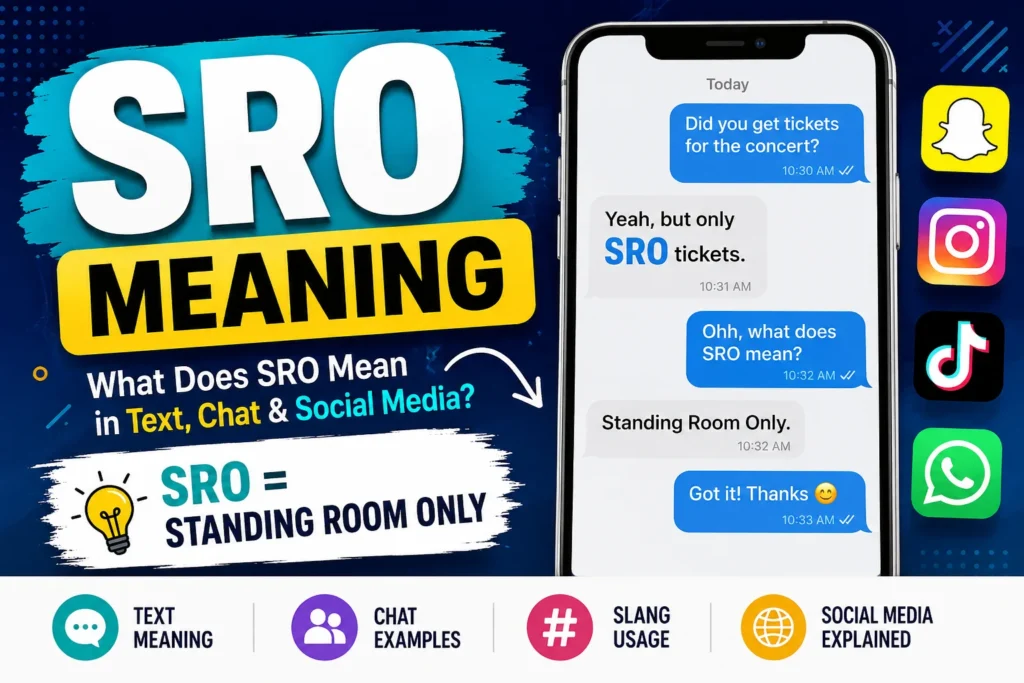

SRO most commonly means “Standing Room Only.” It is often used to describe an event, venue, or gathering where all seats are taken and only standing space remains. However, depending on the context, SRO can also have other meanings in texting, social media, education, government documents, and online conversations.
If you’re wondering about the SRO meaning in text, it usually refers to “Standing Room Only.” People search for this term because they see it in messages, event posts, social media captions, tickets, or chats and aren’t sure whether it means a slang phrase, an acronym, or a texting abbreviation. Understanding the context helps avoid confusion because SRO can have multiple meanings across different platforms.
SRO Meaning Explained
SRO is an acronym made from the first letters of a phrase.
Most Common Meaning
SRO = Standing Room Only
This means:
- No seats are available
- People must stand
- The event is fully booked or crowded
- Tickets may allow entry but not reserved seating
Examples:
- “The concert is SRO tonight.”
- “We got SRO tickets for the game.”
- “The event became SRO within an hour.”
Other Possible Meanings
Depending on context, SRO may also stand for:
| SRO Meaning | Context |
|---|---|
| Standing Room Only | Events and entertainment |
| School Resource Officer | Education |
| Senior Responsible Owner | Business and project management |
| Single Room Occupancy | Housing and real estate |
| Self-Regulatory Organization | Finance and regulation |
When discussing texting and social media, Standing Room Only is usually the meaning people are looking for.
SRO Meaning in Text
In texting, SRO typically means Standing Room Only.
People use it when talking about:
- Concerts
- Sports games
- Festivals
- School events
- Popular gatherings
Example
A: Did you get tickets?
B: Yeah, but only SRO.
A: That’s okay. At least we’re getting in.
Here, SRO means there are no seats available.
SRO Slang Meaning
Technically, SRO is not traditional slang like “rizz,” “cap,” or “sus.”
Instead, it is:
- An acronym
- A shorthand phrase
- A texting abbreviation
- A common event-related expression
Many people mistakenly think it is Gen Z slang because they see it frequently online.
Is SRO a Slang Term?
Not exactly.
It functions more as a practical abbreviation than an internet slang term.
What Does SRO Mean in Chat?
When used in chat, SRO usually indicates that something is extremely popular or crowded.
Example
A: How packed was the comedy show?
B: Total SRO by the time we arrived.
A: Wow, must have been good.
The term communicates that every seat was occupied.
SRO Meaning on Snapchat
On Snapchat, SRO generally keeps its standard meaning.
Users may post:
- Event stories
- Concert updates
- Festival clips
- Sports content
Example Snapchat caption:
“SRO tonight 🔥”
This tells viewers that the venue is packed and only standing space remains.
SRO Meaning on Instagram
Instagram users commonly use SRO in:
- Story captions
- Event promotions
- Concert photos
- Sports content
Example:
“Another SRO crowd tonight. Thanks everyone!”
The caption highlights a sold-out or highly attended event.
SRO Meaning on TikTok
TikTok creators often use SRO when posting:
- Concert videos
- Festival clips
- Comedy shows
- Live performances
Example:
“Didn’t expect this place to be SRO 😳”
The creator is emphasizing how crowded the event became.
SRO Meaning on WhatsApp
On WhatsApp, SRO often appears in group conversations discussing events.
Example:
A: Should we arrive early?
B: Definitely. It’s expected to be SRO.
A: Good call.
The abbreviation quickly communicates that seating may be unavailable.
Is SRO an Acronym, Short Form, or Slang?
SRO Is an Acronym
It is formed using the first letters of:
Standing Room Only
It Is Also a Short Form
People use it because it saves time while typing.
Is It a Phonetic Spelling?
No.
It is not a phonetic spelling.
Is It a Typo Turned Slang?
No.
Unlike some internet expressions that started as typing mistakes, SRO has been used for decades in event and ticketing industries.
Tone and Context Variations
The meaning of SRO stays relatively consistent, but the tone can change.
Funny Tone
A: Did everyone show up?
B: Everyone plus half the neighborhood. It was SRO.
A: Sounds chaotic.
The term is used humorously to exaggerate attendance.
Sarcastic Tone
A: Was the meeting important?
B: Apparently. It was practically SRO.
A: That’s surprising.
The speaker is using sarcasm to comment on attendance.
Romantic Tone
A: How was your performance?
B: SRO crowd, and you were there.
A: That’s sweet.
The focus shifts from attendance to emotional significance.
Angry Tone
A: Why couldn’t you get seats?
B: Because they oversold everything and it became SRO.
A: That’s frustrating.
The term communicates annoyance.
Playful Tone
A: How busy was your birthday party?
B: My living room turned SRO.
A: That’s a good problem to have.
The abbreviation is used playfully.
Real Chat Examples Using SRO
Example 1
A: Are there still tickets available?
B: Only SRO tickets.
A: I’ll take them.
Example 2
A: Was the concert packed?
B: Completely SRO.
A: Sounds amazing.
Example 3
A: Should we get there early?
B: Yes, it’s expected to be SRO.
A: Got it.
Example 4
A: Did you find seats?
B: Nope, SRO all night.
A: Hopefully it was worth it.
Example 5
A: How was the festival?
B: Huge turnout. SRO everywhere.
A: Nice.
Example 6
A: What ticket type did you buy?
B: SRO.
A: Better than missing the event.
Example 7
A: Was attendance good?
B: It became SRO within minutes.
A: Impressive.
Example 8
A: Why are you arriving so early?
B: It’s an SRO event.
A: Makes sense.
Example 9
A: Any seats left?
B: Not a chance. SRO only.
A: Wow.
Example 10
A: How crowded was it?
B: SRO from front to back.
A: That’s wild.
Example 11
A: Is the show sold out?
B: Pretty much. Just SRO tickets.
A: I’ll still go.
Example 12
A: Was the speaker popular?
B: The room was SRO.
A: That’s impressive.
Example 13
A: Did people enjoy the event?
B: Definitely. It was SRO.
A: Great sign.
Example 14
A: How was opening night?
B: SRO crowd.
A: Congratulations.
Example 15
A: Should I reserve a seat?
B: Yes. Otherwise you’ll end up SRO.
A: Good advice.
Grammar and Language Role
What Kind of Word Is SRO?
SRO is an acronym functioning as an adjective or descriptive label.
Part of Speech
Usually:
- Adjective
- Modifier
- Event descriptor
Sentence Position
Common placements:
- Before a noun
- After a linking verb
Examples:
- SRO event
- The venue was SRO
Can It Replace a Full Sentence?
Sometimes.
Example:
A: Any seats left?
B: SRO.
The single acronym communicates a complete idea.
Tone Impact
SRO often conveys:
- Popularity
- Excitement
- High demand
- Crowd energy
Formal vs Informal Use
| Usage | Appropriate? |
| Texting | Yes |
| Social Media | Yes |
| Event Advertising | Yes |
| Business Communication | Sometimes |
| Academic Writing | Usually not |
How to Reply When Someone Says SRO
Many users search this because they want response ideas.
Funny Reply
- “Guess I’ll be standing all night.”
- “Leg day it is.”
- “Hope my feet are ready.”
Serious Reply
- “Thanks for the heads-up.”
- “I’ll arrive early.”
- “Good to know.”
Flirty Reply
- “As long as I’m standing next to you.”
- “No seat needed if you’re there.”
- “Worth it for the company.”
Neutral Reply
- “Okay, understood.”
- “Got it.”
- “Thanks for letting me know.”
SRO Meaning Comparison Table
| Term | Meaning | Usage Context | Tone | Popularity | Confusion Risk |
| SRO | Standing Room Only | Events, concerts | Neutral | Medium | High |
| IDK | I Don’t Know | Texting | Casual | Very High | Low |
| IMO | In My Opinion | Discussions | Casual | High | Low |
| RSVP | Please Respond | Invitations | Neutral | High | Medium |
| OMW | On My Way | Messaging | Casual | Very High | Low |
| SOLD OUT | No tickets available | Events | Neutral | High | Medium |
Who Uses SRO?
Age Groups
Most common among:
- Teens
- College students
- Young adults
- Event attendees
Gen Z
Gen Z frequently encounters SRO through:
- TikTok
- Snapchat
Millennials
Millennials often recognize it from:
- Concert tickets
- Sporting events
- Online event listings
Regional Usage
SRO is commonly used in:
- United States
- Canada
- United Kingdom
- Australia
It is also understood globally because of international entertainment culture.
Platforms Where SRO Appears Most
- TikTok
- Snapchat
- Facebook Events
- Ticketing websites
Origin and Internet Culture Insight
Where Did SRO Come From?
SRO existed long before social media.
The phrase originated in event and theater industries to indicate that all seats were occupied.
Over time, the abbreviation moved into digital communication.
TikTok Influence
TikTok helped spread many event-related terms.
Creators frequently use SRO in:
- Concert clips
- Festival videos
- Live performance content
As audiences became familiar with the abbreviation, searches increased.
Meme Culture Role
While SRO itself is not a meme, people sometimes use it humorously.
Examples include:
- “My kitchen was SRO during dinner.”
- “The group chat went SRO after the announcement.”
These exaggerations create comedic effect.
Fast Typing Culture
Modern users prefer quick communication.
Instead of typing:
Standing Room Only
they simply type:
SRO
This aligns with broader texting abbreviation trends.
Why People Say SRO on TikTok
People use SRO on TikTok because it:
- Saves space
- Looks professional
- Signals popularity
- Creates excitement
- Quickly describes crowd size
Is SRO Rude or Inappropriate?
Is SRO Rude?
No.
SRO is generally neutral.
Is It a Bad Word?
No.
It contains no offensive language.
Can You Use It at School?
Yes.
It is appropriate in educational settings.
Can You Use It at Work?
Usually yes.
Especially when discussing:
- Conferences
- Presentations
- Corporate events
Experience-Based Insight
In real-world conversations, people rarely use SRO as internet slang. Most often, it appears when discussing concerts, sporting events, festivals, conferences, or sold-out gatherings. When someone says an event was “SRO,” they are usually emphasizing that attendance exceeded expectations and that demand was extremely high. The phrase often carries a positive sense of excitement and popularity.
Frequently Asked Questions
What does SRO mean in text?
SRO usually means Standing Room Only, indicating that no seats are available.
What does SRO mean in chat?
In chat, SRO typically describes a crowded or fully attended event.
What does SRO mean on Snapchat?
On Snapchat, SRO generally refers to a packed venue or event with standing space only.
What does SRO mean on Instagram?
Instagram users often use SRO in captions related to concerts, festivals, and sold-out events.
Is SRO rude?
No. SRO is a neutral and widely accepted abbreviation.
Is SRO the same as IDK?
No.
- SRO = Standing Room Only
- IDK = I Don’t Know
They have completely different meanings.
Can adults use SRO?
Absolutely.
The abbreviation is commonly used by people of all ages.
How do you respond to SRO?
You can reply with:
- “Good to know.”
- “I’ll get there early.”
- “Hope I can still get in.”
- “Guess I’ll be standing.”
Does SRO mean sold out?
Not necessarily. Some venues still sell SRO tickets after all seats are gone.
What are SRO tickets?
SRO tickets allow entry but do not guarantee a seat.
Is SRO a slang word?
No. It is primarily an acronym and event abbreviation.
Why do concerts have SRO sections?
Venues sometimes offer standing areas to accommodate more attendees.
Can SRO tickets be cheaper?
Sometimes. Pricing varies by venue and event.
Is SRO common on social media?
Yes. It often appears in posts about concerts, sports, and live events.
Final Thoughts
Understanding the SRO meaning is simple once you know the context. In most texting, chat, Snapchat, Instagram, TikTok, and WhatsApp conversations, SRO stands for “Standing Room Only.” It is an acronym used to describe events where seats are unavailable and attendees must stand.
Usage Tips
- Use SRO when discussing crowded events.
- Understand the context before assuming another meaning.
- Recognize it as an acronym rather than traditional slang.
Common Mistakes
- Assuming it is Gen Z slang.
- Confusing it with unrelated abbreviations.
- Thinking it always means “sold out.”
When to Use It
Use SRO when talking about:
- Concerts
- Sports games
- Festivals
- Conferences
- Public events
When to Avoid It
Avoid using SRO when your audience may not understand event-related abbreviations or when formal writing requires the full phrase.