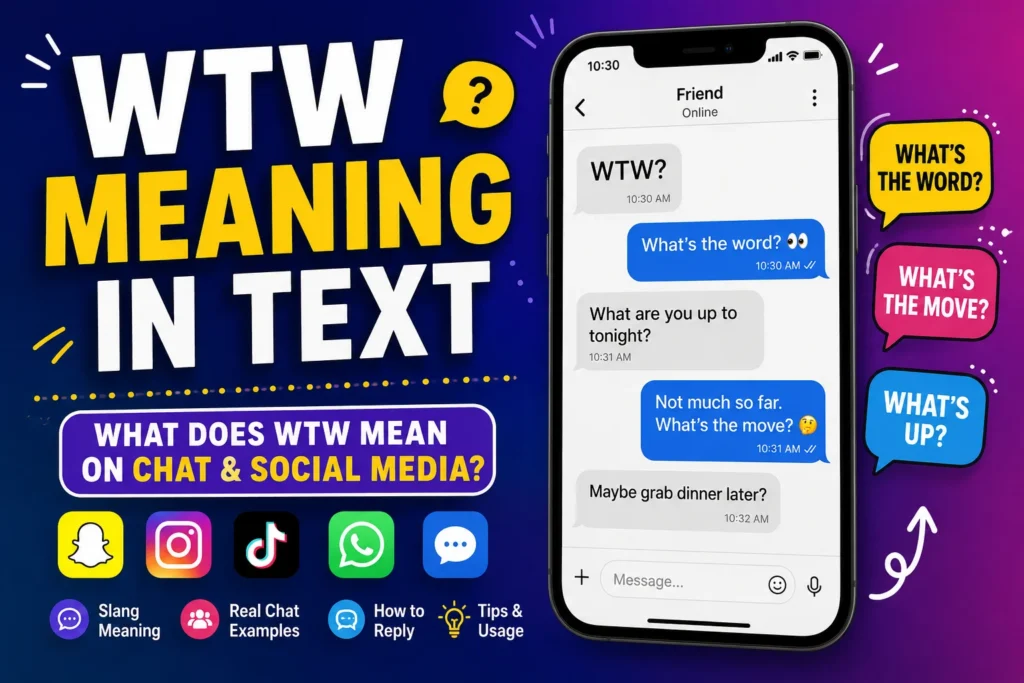

WTW means “What’s the Word?” or “What’s the Move?” in text messages and online chats. People use it to ask what’s happening, what someone is doing, what the plan is, or simply to start a conversation casually.
If you’ve received “WTW?” in a text, Snapchat message, TikTok comment, or Instagram DM and weren’t sure what it meant, you’re not alone. This popular internet slang term has become common in digital communication, especially among Gen Z and younger Millennials. Depending on the conversation, it can mean anything from “What’s up?” to “What are we doing later?” Understanding the context helps you interpret it correctly and reply naturally.
WTW Meaning in Text
The most common WTW meaning in text is:
- What’s the Word?
- What’s the Move?
Both meanings are used as casual conversation starters.
When someone sends “WTW,” they’re usually asking:
- What’s going on?
- What’s up?
- What’s the plan?
- What are you doing?
- Anything happening today?
- How have you been?
In most situations, WTW is simply a friendly way to check in or start a conversation.
WTW Meaning in Text Slang Meaning
As a slang term, WTW is widely used in texting culture because it’s quick, simple, and versatile.
Examples:
- “WTW tonight?”
- “WTW this weekend?”
- “WTW bro?”
- “WTW after school?”
The phrase sounds casual and relaxed, making it popular among younger internet users.
What Does WTW Mean in Chat?
In chat conversations, WTW usually means:
- What’s happening?
- What’s the plan?
- What’s going on with you?
For example:
A: Hey, WTW?
B: Not much. Just watching Netflix.
Here, WTW functions similarly to asking “What’s up?”
WTW Meaning on Snapchat
On Snapchat, WTW often means:
- What’s the move?
- What are we doing?
- Any plans?
Example:
Friend: WTW tonight?
You: Thinking about going out around 8.
Because Snapchat is commonly used for quick social conversations, “What’s the Move?” is especially popular there.
WTW Meaning on Instagram, TikTok, and WhatsApp
The meaning remains mostly the same across platforms.
| Platform | Common Meaning |
|---|---|
| What’s up? | |
| TikTok | What’s happening? |
| Snapchat | What’s the move? |
| What’s going on? | |
| Messenger | What are the plans? |
While wording may vary, the core idea is asking about current activities, plans, or updates.
Is WTW an Acronym, Short Form, or Slang?
WTW is primarily an acronym.
Each letter represents a word:
- W = What’s
- T = The
- W = Word/Move
It is also considered:
- A texting abbreviation
- An internet slang term
- A casual chat phrase
It is not:
- A phonetic spelling
- A typo turned slang
Instead, it developed naturally through fast digital communication.
Tone and Context Variations
The meaning of WTW can change depending on tone and context.
Funny Tone
Friends often use WTW jokingly.
Alex: WTW? You finally finished that game?
Jake: Finished? I just started another one.
Alex: That’s exactly what I expected.
Sarcastic Tone
Sometimes it expresses disbelief.
Emma: WTW? You missed another meeting?
Ryan: My alarm betrayed me.
Emma: Sure it did.
Romantic Tone
WTW can be a subtle way to start flirting.
Sophia: Hey 😊 WTW tonight?
Liam: Nothing planned. Why?
Sophia: Thought maybe we could talk.
Angry Tone
Context can make it sound confrontational.
Chris: WTW? Why aren’t you answering?
Jordan: I’ve been busy.
Chris: You’ve been busy all day?
Playful Tone
Friends use it casually.
Mia: WTW this weekend?
Noah: Hopefully something fun.
Mia: Let’s make it happen.
15 Real Chat Examples of WTW
Example 1
A: WTW?
B: Just got home.
A: Nice.
Example 2
A: WTW tonight?
B: Movie night.
A: Count me in.
Example 3
A: WTW this weekend?
B: No plans yet.
A: Let’s go somewhere.
Example 4
A: WTW after class?
B: Going to the gym.
A: I’ll join.
Example 5
A: WTW bro?
B: Just chilling.
A: Same.
Example 6
A: WTW later?
B: Working till 7.
A: Got it.
Example 7
A: WTW today?
B: Busy with homework.
A: Good luck.
Example 8
A: WTW tomorrow?
B: Beach trip maybe.
A: Sounds fun.
Example 9
A: WTW this evening?
B: Dinner with family.
A: Enjoy.
Example 10
A: WTW?
B: Nothing much.
A: Same here.
Example 11
A: WTW after work?
B: Coffee?
A: Perfect.
Example 12
A: WTW this Friday?
B: Concert.
A: Nice.
Example 13
A: WTW this afternoon?
B: Running errands.
A: Good luck.
Example 14
A: WTW on Snapchat?
B: Just posting stories.
A: Cool.
Example 15
A: WTW this summer?
B: Traveling.
A: That’s exciting.
Grammar and Language Role
Understanding the WTW meaning in text also involves understanding its grammatical function.
Part of Speech
WTW acts as an abbreviated question.
Sentence Position
Usually appears:
- At the beginning
- As a complete message
- As a standalone question
Examples:
- WTW?
- WTW tonight?
- WTW this weekend?
Does It Replace a Full Sentence?
Yes.
Instead of saying:
“What are your plans for tonight?”
People simply write:
“WTW tonight?”
Tone Impact
WTW makes messages feel:
- Casual
- Friendly
- Relaxed
- Conversational
Formal vs Informal Use
| Type | Appropriate? |
| Texting friends | Yes |
| Social media chats | Yes |
| Family messages | Usually |
| School essays | No |
| Work emails | No |
| Professional reports | No |
How to Reply When Someone Says WTW
Many users search how to respond naturally.
Funny Reply
- “Trying to become a millionaire.”
- “Surviving one snack at a time.”
- “Waiting for my superhero moment.”
Serious Reply
- “Just finishing some work.”
- “I’m studying right now.”
- “Nothing much, how about you?”
Flirty Reply
- “Depends. Are you part of the plan?”
- “Just waiting for your message.”
- “Thinking about you.”
Neutral Reply
- “Not much.”
- “Just relaxing.”
- “What’s up with you?”
Comparison Table
Many people confuse WTW with other internet abbreviations.
| Term | Meaning | Usage Context | Tone | Popularity | Confusion Risk |
| WTW | What’s the Word? / What’s the Move? | Asking plans or updates | Casual | High | Medium |
| WYD | What You Doing? | Asking current activity | Casual | Very High | High |
| WSG | What’s Good? | Greeting | Friendly | High | Medium |
| WSP | What’s Up? | Conversation starter | Casual | High | Medium |
| HMU | Hit Me Up | Contact me later | Friendly | High | Low |
| IDK | I Don’t Know | Expressing uncertainty | Neutral | Very High | Low |
| BRB | Be Right Back | Leaving temporarily | Functional | High | Low |
Who Uses WTW?
Age Groups
Most common among:
- Teens
- High school students
- College students
- Young adults
Gen Z vs Millennials
Gen Z
- Uses WTW frequently
- Common in daily texting
Millennials
- Understand it
- Use it less often
Regional Usage
WTW is especially common in:
- United States
- Canada
- United Kingdom
- Australia
Due to social media, it is now recognized globally.
Platforms Where WTW Is Common
- Snapchat
- TikTok
- Discord
- Messenger
- iMessage
Origin and Internet Culture Insight
The exact origin of WTW is difficult to pinpoint.
However, it likely developed through texting culture where users shortened common questions to save time.
Why People Say WTW on TikTok
TikTok helped popularize many slang expressions.
Creators frequently use WTW in:
- Comments
- DMs
- Livestream chats
- Captions
Because videos encourage quick interaction, short phrases like WTW spread rapidly.
Meme Culture Influence
Internet memes reward speed and relatability.
WTW fits perfectly because it:
- Is short
- Feels conversational
- Works in many situations
Fast Typing Culture
Modern users prefer abbreviations because they:
- Save time
- Reduce typing effort
- Feel trendy
- Match casual communication styles
WTW became popular for all of these reasons.
Is WTW Rude or Inappropriate?
Is WTW Rude?
No.
WTW is generally considered friendly and harmless.
Is WTW a Bad Word?
No.
It contains no offensive language.
Can You Use It in School?
Yes, in casual conversations with friends.
However, avoid using it in:
- Academic assignments
- Formal presentations
- Official communications
Can You Use It at Work?
Only in informal workplace chats where abbreviations are accepted.
Avoid it in:
- Client emails
- Professional reports
- Formal business communication
Experience-Based Insight
In everyday online conversations, WTW is most often used as a quick conversation opener rather than a literal question. People commonly send it when they want to chat, make plans, check availability, or casually reconnect with someone. On platforms like Snapchat and Instagram, it often serves the same purpose as “What’s up?” but feels slightly more modern and social-media-oriented.
Frequently Asked Questions
What does WTW mean in text?
WTW usually means “What’s the Word?” or “What’s the Move?” It is used to ask what’s happening or what someone’s plans are.
Is WTW rude?
No. WTW is generally friendly and informal.
What does WTW mean on Snapchat?
On Snapchat, WTW often means “What’s the Move?” and is commonly used when discussing plans.
Is WTW the same as IDK?
No.
WTW asks a question.
IDK means “I Don’t Know.”
Can adults use WTW?
Yes. Although younger users use it more frequently, adults can also use it in casual conversations.
How do you respond to WTW?
You can reply with:
- Your plans
- What you’re doing
- A question back
- A funny response
Does WTW mean flirting?
Not necessarily. However, some people use it to start romantic or flirty conversations.
Is WTW popular on TikTok and Instagram?
Yes. WTW is widely used across TikTok, Instagram, Snapchat, and other social platforms.
What does WTW stand for in texting?
WTW stands for “What’s the Word?” or “What’s the Move?”
Why do people say WTW?
People use it to start conversations, ask about plans, or check what someone is doing.
Is WTW a Gen Z slang term?
Yes. It is especially popular among Gen Z users.
Can WTW have different meanings?
Yes. The exact meaning depends on the context of the conversation.
Is WTW used worldwide?
While most common in North America, it is increasingly recognized worldwide through social media.
What is the difference between WTW and WYD?
WTW asks about plans or what’s happening generally, while WYD specifically asks what someone is doing right now.
Conclusion
WTW meaning in text typically stands for “What’s the Word?” or “What’s the Move?” It is a popular texting abbreviation and internet slang term used to ask what’s happening, what someone’s plans are, or simply to start a conversation.
Quick Usage Tips
- Use it with friends and family.
- Great for casual chats.
- Common on Snapchat, TikTok, Instagram, and WhatsApp.
- Reply naturally by sharing what you’re doing or asking a question back.
Common Mistakes
- Assuming it always means one thing.
- Using it in formal emails.
- Misreading it as a negative phrase.
When to Use It
✅ Casual texting
✅ Social media messages
✅ Making plans
✅ Starting conversations
When to Avoid It
❌ Business emails
❌ School assignments
❌ Professional communication
As digital communication continues evolving, WTW remains one of the easiest and most popular ways to ask, “What’s going on?” in modern online conversations.