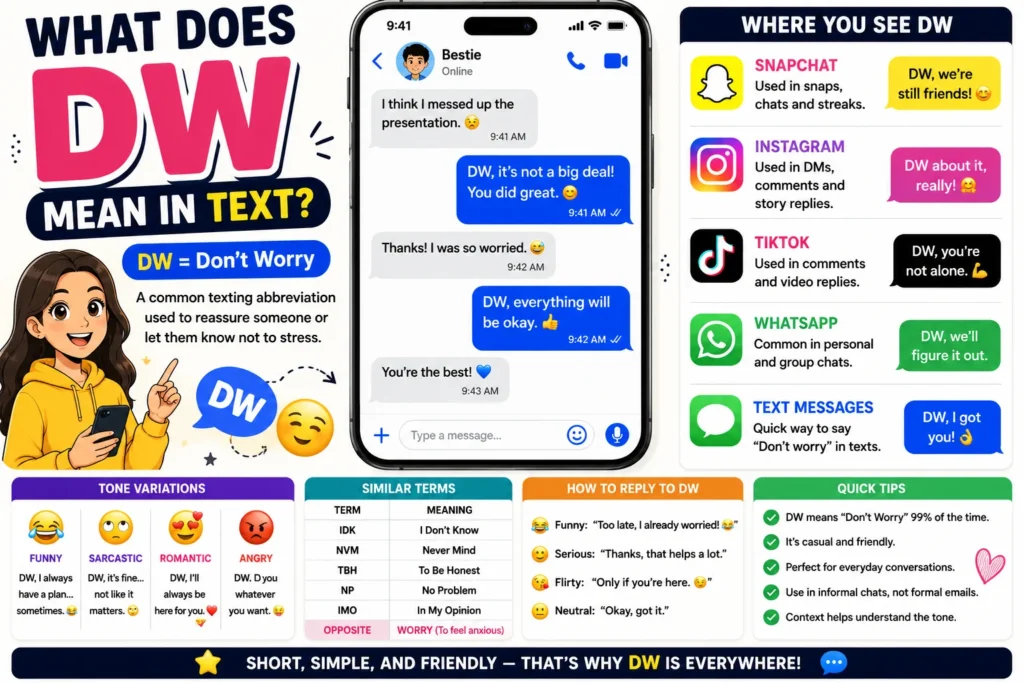

DW means “Don’t Worry” in text messages, chats, Snapchat, TikTok, Instagram, and WhatsApp. It’s a popular texting abbreviation used to reassure someone, reduce concern, or show that everything is okay.
If you’ve received a message containing “DW” and weren’t sure what it meant, you’re not alone. This common internet slang term appears everywhere in digital communication, from casual chats to social media comments. Most people use it as a quick way of saying “Don’t worry,” but the tone can vary depending on the conversation and platform.
What Does DW Mean in Text?
When people search what does DW mean in text, they’re usually trying to understand a message they received from a friend, family member, coworker, or online contact.
In texting, DW stands for “Don’t Worry.”
It’s a short and friendly way to reassure someone that a situation is under control or that they don’t need to stress about something.
Example
A: Sorry I’m running late.
B: DW, I’m still getting ready too.
In this conversation, DW simply means “Don’t worry.”
Why People Use DW in Text Messages
People use DW because it is:
- Faster than typing “Don’t worry”
- Friendly and reassuring
- Easy to understand
- Common across many platforms
This makes it one of the most popular texting abbreviations in modern online communication.
DW Slang Meaning
The DW slang meaning is almost always connected to reassurance.
Unlike some slang terms that have multiple interpretations, DW is relatively straightforward.
Common meanings include:
- Don’t worry
- No problem
- It’s okay
- Everything is fine
Example of DW as Slang
A: I forgot to send the picture.
B: DW, send it whenever you can.
Here, DW means:
“It’s okay, don’t stress about it.”
What Does DW Mean in Chat?
If you’re wondering what does DW mean in chat, the answer is usually the same as in texting: “Don’t Worry.”
People use DW in online chats to reassure others quickly without typing a longer response.
Example Chat
A: I think I sent the wrong file.
B: DW, I figured out which one you meant.
Another Example
A: Sorry for replying late.
B: DW, I was busy too.
In both situations, DW helps keep the conversation relaxed and friendly.
What Does DW Mean on Snapchat?
The DW meaning on Snapchat is almost always “Don’t Worry.”
Snapchat conversations are usually fast-paced, so abbreviations are extremely common.
People use DW when:
- Reassuring friends
- Responding to apologies
- Keeping streak conversations casual
- Avoiding long explanations
Snapchat Example
A: Sorry I almost lost our streak.
B: DW, we saved it.
Snapchat Story Reply Example
A: Sorry for spamming your story replies.
B: DW 😂 I don’t mind.
What Does DW Mean on Instagram?
On Instagram, DW commonly appears in:
- Direct Messages (DMs)
- Story replies
- Comments
- Group chats
Instagram Example
A: Sorry for commenting so much.
B: DW, I like hearing your thoughts.
The phrase helps conversations feel friendly and low-pressure.
What Does DW Mean on TikTok?
TikTok users often use DW in comments and replies.
TikTok Example
Comment: I think I misunderstood the video.
Reply: DW, lots of people did 😂
Why TikTok Users Like DW
- It’s short
- Easy to type
- Fits comment limits
- Matches fast internet culture
What Does DW Mean on WhatsApp?
The DW meaning on WhatsApp remains the same.
Examples include:
A: Sorry, I missed your call.
B: DW, call me later.
A: I forgot to bring the documents.
B: DW, we can print them again.
Is DW an Acronym, Short Form, or Slang?
Many users wonder exactly what category DW belongs to.
DW Is an Acronym
DW stands for:
D = Don’t
W = Worry
Because each letter represents a word, it is technically an acronym.
DW Is Also a Texting Abbreviation
Most people simply view it as a texting shortcut used in digital communication.
Is DW a Typo Turned Slang?
No.
Unlike some internet terms that evolved from typing mistakes, DW was intentionally created as a shortened form of “Don’t Worry.”
Tone & Context Variations of DW
Although DW always means roughly the same thing, its tone can change dramatically depending on context.
DW in a Funny Tone
Friends often use DW jokingly.
A: I accidentally ate half your fries.
B: DW, I wasn’t hungry anyway 😂
The meaning stays the same, but the tone is playful.
DW in a Sarcastic Tone
Sometimes people use DW sarcastically.
A: I forgot to tell you the meeting was canceled.
B: Oh, DW. It’s not like I drove 40 minutes for nothing.
Here, the speaker clearly isn’t relaxed.
DW in a Romantic Tone
DW can sound caring and affectionate.
A: I’m nervous about tomorrow.
B: DW, you’ve got this. I’m proud of you ❤️
The phrase becomes supportive and loving.
DW in an Angry Tone
Occasionally, DW can sound dismissive.
A: Do you want me to explain?
B: DW. I already figured it out.
Depending on wording, it may signal frustration.
DW in a Playful Tone
Many friends use DW casually.
A: I lost our game again.
B: DW, you’re improving 😆
This creates a relaxed atmosphere.
Real Chat Examples Using DW
Example 1
A: Sorry I’m late.
B: DW, I just got here too.
A: Perfect.
Example 2
A: I forgot your birthday.
B: DW, it happens.
A: I still feel bad though.
Example 3
A: Did I annoy you?
B: DW, not at all.
A: Good 😂
Example 4
A: I spilled coffee everywhere.
B: DW, we’ve all done that.
A: True.
Example 5
A: I think I failed the quiz.
B: DW, it was hard for everyone.
A: That helps.
Example 6
A: Sorry for texting so much.
B: DW, I enjoy talking to you.
A: Aww.
Example 7
A: I lost the screenshot.
B: DW, I’ll send it again.
A: Thanks.
Example 8
A: I can’t find parking.
B: DW, we’re not starting yet.
A: Great.
Example 9
A: My internet crashed.
B: DW, we’ll catch you up later.
A: Appreciate it.
Example 10
A: I forgot the snacks.
B: DW, I brought extra.
A: You’re the best.
Example 11
A: I made a typo in the email.
B: DW, nobody noticed.
A: Good.
Example 12
A: I lost our game save.
B: DW, we can start again.
A: That’s kind of you.
Example 13
A: Sorry I missed your call.
B: DW, call me when free.
A: Will do.
Example 14
A: I think I embarrassed myself.
B: DW, nobody remembers.
A: Hopefully.
Example 15
A: I can’t make it tonight.
B: DW, we’ll hang out another time.
A: Sounds good.
Grammar & Language Role of DW
What Part of Speech Is DW?
DW functions as a phrase replacement.
Instead of typing:
“Don’t worry.”
People simply type:
“DW.”
Sentence Position
DW can appear:
- At the beginning
- In the middle
- At the end
Examples:
- DW, it’s fine.
- It’s fine, DW.
- You can DW about it.
Can DW Replace a Full Sentence?
Yes.
Many people reply with only:
DW
And the message is fully understood.
Formal vs Informal Usage
| Context | Appropriate? |
|---|---|
| Friends | Yes |
| Family | Yes |
| Snapchat | Yes |
| TikTok | Yes |
| Workplace Chat | Sometimes |
| Formal Emails | No |
How to Reply When Someone Says DW
If someone sends you DW (Don’t Worry), your response depends on the situation and your relationship with the sender.
Funny Replies to DW
Use these when chatting with friends:
- “Too late, I already worried for three hours 😂”
- “That’s not how my anxiety works 😅”
- “I’ll try, but no promises.”
- “Challenge accepted.”
Example
A: DW, it’s all good.
B: Too late, I already imagined 20 worst-case scenarios 😂
Serious Replies to DW
When the conversation is genuine:
- “Thanks, I appreciate that.”
- “That makes me feel better.”
- “I’m glad to hear that.”
- “Thank you for reassuring me.”
Example
A: DW, we’ll figure it out together.
B: Thanks, that means a lot.
Flirty Replies to DW
When talking to a crush or partner:
- “I only stop worrying when you’re around 😉”
- “Easy for you to say 😏”
- “Fine, but only because you said so ❤️”
- “You’re good at calming me down.”
Example
A: DW, everything will be okay.
B: It always is when you’re here ❤️
Neutral Replies to DW
Simple and safe responses:
- “Okay.”
- “Got it.”
- “Sounds good.”
- “Thanks.”
- “Will do.”
DW vs Similar Texting Slang Terms
Many people confuse DW with other common internet slang terms.
| Slang Term | Meaning | Usage Context | Tone | Popularity | Confusion Risk |
|---|---|---|---|---|---|
| DW | Don’t Worry | Reassurance | Friendly | Very High | Low |
| IDK | I Don’t Know | Uncertainty | Neutral | Very High | Medium |
| NVM | Never Mind | Canceling a topic | Casual | High | Medium |
| TBH | To Be Honest | Sharing opinions | Honest | High | Low |
| NP | No Problem | Responding to thanks | Friendly | High | Low |
| Worry | Actual concern | Opposite meaning | Serious | Universal | Low |
DW vs IDK
- DW = Reassurance
- IDK = Uncertainty
Example:
DW, it’ll be fine.
vs
IDK what happened.
Who Uses DW?
Age Groups That Use DW
DW is widely used by:
- Teenagers
- College students
- Young professionals
- Adults who text frequently
Unlike some Gen Z-only slang, DW is understood by multiple generations.
Gen Z vs Millennials
Gen Z
Uses DW frequently in:
- TikTok comments
- Snapchat messages
- Instagram DMs
- Group chats
Millennials
Often use DW in:
- Text messages
- Facebook Messenger
- Workplace chats
Regions Where DW Is Popular
DW is common in:
- United States
- Canada
- United Kingdom
- Australia
- New Zealand
Because English-speaking internet culture is global, DW is recognized almost everywhere.
Platforms Where DW Is Most Common
- Snapchat
- TikTok
- Discord
- Messenger
- SMS texting
Origin of DW and Internet Culture Insight
Where Did DW Come From?
DW emerged during the early years of internet messaging and SMS texting.
When mobile phones had limited character counts, people shortened common phrases to save time.
Instead of typing:
“Don’t worry about it.”
People simply typed:
“DW.”
How DW Became Popular
DW spread through:
- Text messaging culture
- Online forums
- Instant messengers
- Social media platforms
As smartphones became common, the abbreviation remained popular because it was fast and easy to understand.
Why People Say DW on TikTok
TikTok encourages short, quick interactions.
Users often write:
- DW 😂
- DW about it
- DW bro
- DW queen
Because comments move fast, abbreviations fit naturally into TikTok culture.
DW and Fast-Typing Culture
DW is a perfect example of modern digital communication.
People value:
- Speed
- Simplicity
- Efficiency
Instead of typing two full words, they type two letters.
Is DW Rude or Offensive?
Is DW a Bad Word?
No.
DW is not offensive, vulgar, or inappropriate.
It is generally considered polite and friendly.
Can DW Sound Rude?
Sometimes.
Tone matters.
For example:
A: Can you explain?
B: DW.
This can feel dismissive if no additional context is provided.
However:
A: Can you explain?
B: DW, I’ll handle it.
Sounds much friendlier.
Can You Use DW at School?
Yes.
DW is generally acceptable in:
- Student chats
- Group projects
- Classroom messaging apps
Can You Use DW at Work?
Sometimes.
It’s fine in:
- Casual workplace chats
- Team messaging apps
Less suitable in:
- Formal emails
- Professional reports
- Client communications
Real-Life Experience With DW Usage
In everyday online conversations, DW is usually used to reduce tension.
People often send it after:
- Receiving an apology
- Hearing someone express concern
- Seeing someone feel nervous
- Fixing a minor mistake
In practice, DW functions as a digital version of saying:
“It’s okay.”
“No problem.”
“Don’t stress about it.”
That’s why it remains one of the most common texting abbreviations across social media and messaging apps.
Frequently Asked Questions About DW
What Does DW Mean in Text?
DW means “Don’t Worry.” It’s a texting abbreviation used to reassure someone.
What Does DW Mean on Snapchat?
On Snapchat, DW almost always means “Don’t Worry.”
Is DW Rude?
No.
DW is generally friendly, although context can occasionally make it sound dismissive.
Is DW the Same as IDK?
No.
- DW = Don’t Worry
- IDK = I Don’t Know
They have completely different meanings.
Can Adults Use DW?
Absolutely.
DW is understood and used by teenagers, millennials, and adults.
How Do You Respond to DW?
Common responses include:
- Thanks!
- Got it.
- Appreciate it.
- Okay 😊
What Does DW Mean on TikTok?
On TikTok, DW usually means “Don’t Worry.”
Users often write it in comments and replies.
Can DW Be Used in a Relationship?
Yes.
Partners often use DW as a caring way to reassure each other.
What Does DW Stand for in Texting?
DW stands for “Don’t Worry.”
Why Do People Say DW Instead of Don’t Worry?
Because it’s faster and easier to type.
Is DW Internet Slang?
Yes.
It’s considered both internet slang and a texting abbreviation.
Does DW Have Multiple Meanings?
Most of the time it means “Don’t Worry.” Other meanings are extremely uncommon.
Can DW Replace a Full Sentence?
Yes.
Many people simply reply:
“DW.”
And the entire message is understood.
Is DW Formal English?
No.
It’s informal internet language best suited for casual communication.
Final Thoughts
DW is one of the most widely used texting abbreviations online. In almost every situation, it means “Don’t Worry” and serves as a quick way to reassure someone.
Usage Tips
- Use DW in casual conversations.
- Use it with friends, family, and social media contacts.
- Pair it with additional context when needed.
Common Mistakes
- Assuming DW means the same as IDK.
- Using DW in highly formal emails.
- Misreading tone without context.
When to Use DW
✅ Text messages
✅ Snapchat
✅ TikTok comments
✅ Instagram DMs
✅ WhatsApp chats
When to Avoid DW
❌ Formal business emails
❌ Academic papers
❌ Professional documents
DW is simple, friendly, and effective—which is exactly why it remains one of the most popular abbreviations in digital communication.