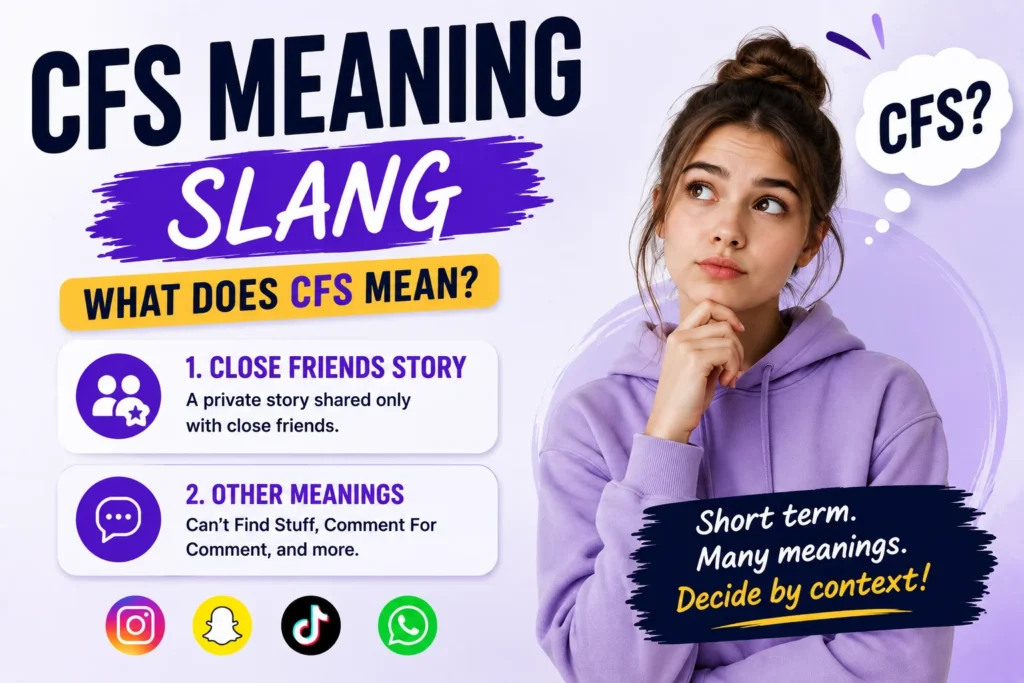

CFS in slang usually means “Close Friends Story” on Instagram or Snapchat. People use it when talking about private stories, selective posts, or exclusive social media content shared only with trusted friends.
If you searched for “cfs meaning slang massage,” you were probably confused because CFS has multiple meanings online. In texting and social apps, it most commonly refers to a private story feature. However, in some conversations, people may also use CFS casually for “Can’t Find Stuff,” “Comment For Comment,” or other niche internet abbreviations depending on the platform.
This guide explains exactly what CFS means in text slang, how Gen Z uses it on Snapchat, TikTok, Instagram, and WhatsApp, plus how to reply naturally when someone sends “CFS” in chat.
CFS Meaning & Explanation
CFS Meaning Slang Meaning in Text
In texting slang, CFS most often stands for:
- Close Friends Story
- Comment For Comment
- Sometimes other niche meanings depending on context
The most popular meaning today is Close Friends Story, especially on Instagram.
Example:
- “I posted it on my CFS only.”
- Meaning: They shared something privately with selected friends.
What Does CFS Meaning Slang Mean in Chat?
When someone says “CFS” in chat, they are usually talking about:
- Private social media stories
- Exclusive content
- Trusted friend circles
- Casual online interactions
For example:
A: “Why didn’t I see your post?”
B: “It was on my CFS only.”
That means the content was visible only to selected followers.
CFS Meaning Slang Meaning on Snapchat
On Snapchat, CFS can refer to:
- A private story
- A smaller friend group
- Exclusive snaps shared with select people
Although Snapchat officially calls them “Private Stories,” many users still say “CFS” because of Instagram influence.
CFS Meaning Slang Meaning on Instagram, TikTok & WhatsApp
Instagram is where CFS became extremely popular because of the Close Friends Story feature.
People use CFS to share:
- Personal updates
- Funny memes
- Relationship posts
- Rants
- Embarrassing moments
TikTok
On TikTok, users mention CFS while discussing:
- Private stories
- Drama circles
- Friend-only content
- Viral confession trends
Example:
- “That belongs on the CFS, not main.”
On WhatsApp, CFS is less common but may appear in casual chats discussing Instagram stories.
Example:
- “Add me to your CFS.”
Is CFS an Acronym, Short Form, or Typo?
CFS is mainly:
- An acronym
- A texting abbreviation
- A social media slang term
It is not usually a typo or phonetic spelling.
Tone & Context Variations
The meaning of CFS changes slightly depending on tone and context.
Funny Tone
People use CFS humorously when sharing embarrassing content.
Example:
A: “I accidentally sent my singing video.”
B: “That belongs on the CFS only 😂”
Sarcastic Tone
Sometimes users mock overly dramatic private stories.
Example:
A: “She posted another sad quote.”
B: “Classic CFS behavior.”
Romantic Tone
CFS can feel intimate because only trusted people are included.
Example:
A: “You’re finally on my CFS.”
B: “Wow, promoted to inner circle?”
Angry Tone
People sometimes complain about being excluded.
Example:
A: “You posted everyone except me.”
B: “It was just for my CFS.”
Playful Tone
Friends joke about exclusive access.
Example:
A: “CFS content goes crazy at 2 AM.”
B: “That’s where the real personality appears.”
Real Chat Examples (Natural & Relatable)
Example 1
A: “Did you see my story?”
B: “No?”
A: “Oh wait, it was CFS only.”
Example 2
A: “Why is your CFS so funny?”
B: “Because the public can’t handle it.”
Example 3
A: “You removed me from CFS?”
B: “Temporary suspension 😂”
Example 4
A: “That selfie was cute.”
B: “Only the CFS squad gets those.”
Example 5
A: “Bro your private stories are wild.”
B: “CFS is where chaos happens.”
Example 6
A: “Can I be added to your CFS?”
B: “Applications are closed.”
Example 7
A: “Why not post it publicly?”
B: “Too embarrassing. CFS only.”
Example 8
A: “That meme was hilarious.”
B: “Straight from the CFS archives.”
Example 9
A: “You trust me now?”
B: “Yeah, you made the CFS.”
Example 10
A: “Who saw the drama?”
B: “Only the CFS people.”
Example 11
A: “Why do Gen Z people love CFS?”
B: “Because privacy matters now.”
Example 12
A: “I rant only on CFS.”
B: “Same. Public stories are scary.”
Example 13
A: “I accidentally posted to everyone.”
B: “That was supposed to stay on CFS 😭”
Example 14
A: “What does CFS mean?”
B: “Close Friends Story.”
Example 15
A: “Your CFS feels like VIP access.”
B: “Exactly the point.”
Grammar & Language Role
Part of Speech
CFS acts as:
- A noun
- A digital communication abbreviation
Example:
- “That’s on my CFS.”
Sentence Position
CFS usually appears:
- Mid-sentence
- At the end of messages
- In captions
Examples:
- “Posted it on CFS.”
- “CFS only.”
Does It Replace a Full Sentence?
Sometimes yes.
Example:
A: “Public or private?”
B: “CFS.”
Tone Impact
CFS creates a tone that feels:
- Exclusive
- Personal
- Casual
- Friendly
Formal vs Informal Use
CFS is completely informal.
Avoid using it in:
- Academic writing
- Workplace communication
- Professional emails
How to Reply When Someone Says CFS Meaning Slang
Funny Reply
- “VIP access only?”
- “Can I buy a membership?”
- “Your CFS deserves Netflix rights.”
Serious Reply
- “Makes sense.”
- “I understand why you kept it private.”
- “That’s probably safer online.”
Flirty Reply
- “So I’m important enough for the CFS?”
- “I feel honored now 😏”
- “Guess I made the trusted list.”
Neutral Reply
- “Oh okay.”
- “Got it.”
- “That explains it.”
Comparison Table
| Slang Term | Meaning | Usage Context | Tone | Popularity | Confusion Risk |
|---|---|---|---|---|---|
| CFS | Close Friends Story | Instagram/Snapchat private stories | Casual | High | Medium |
| Finsta | Fake/private Instagram | Private content sharing | Funny | High | Medium |
| Priv Story | Private Story | Snapchat slang | Casual | High | Low |
| CF | Close Friends | Instagram circles | Friendly | High | High |
| GC | Group Chat | Messaging apps | Casual | Very High | Low |
| Public Story | Visible to everyone | Open posting | Opposite tone | High | Low |
Who Uses This Term?
Age Group
CFS is mostly used by:
- Teenagers
- Gen Z users
- Young adults
Gen Z vs Millennials
Gen Z uses CFS far more frequently than Millennials because private online sharing became more important with newer social media culture.
Region
CFS is common in:
- United States
- UK
- Canada
- Australia
- Global English-speaking internet culture
Platforms Where It Is Most Common
- Snapchat
- TikTok
- Discord
Origin & Internet Culture Insight
Possible Origin
CFS became popular after Instagram introduced the Close Friends feature.
Users quickly shortened it to “CFS” in text conversations.
TikTok Influence
TikTok boosted the phrase through:
- Storytime videos
- Meme culture
- “Main vs CFS” jokes
- Relationship drama content
Meme Culture Role
People often joke that:
- Public stories are fake
- CFS shows the “real personality”
This idea became a common meme online.
Fast Typing Culture
Like most internet slang terms, CFS became popular because:
- It saves typing time
- It feels modern
- It matches Gen Z communication habits
Why People Say CFS Meaning Slang on TikTok
TikTok users mention CFS because private stories are connected to:
- Social drama
- Friend groups
- Dating culture
- Secret opinions
- Relatable humor
Safety & Appropriateness
Is CFS Rude?
No. CFS is not considered rude.
Is It a Bad Word?
No. It is a harmless social media abbreviation.
Should You Use It in School or Office?
You can use it casually with friends, but avoid it in:
- Professional communication
- Business emails
- Academic papers
It works best in informal digital conversations.
Experience-Based Insight
In real-world online conversations, people usually use CFS to separate their “real” personality from public social media content. Many users feel more comfortable posting jokes, opinions, or emotional updates privately instead of sharing them with everyone.
That’s why CFS became such a huge Gen Z vocabulary term across Instagram and Snapchat culture.
FAQ
What Does CFS Meaning Slang Mean in Text?
CFS usually means “Close Friends Story,” referring to private Instagram or Snapchat stories visible only to selected friends.
Is CFS Rude?
No. CFS is a neutral internet slang term.
What Does CFS Meaning Slang Mean on Snapchat?
On Snapchat, CFS usually refers to private stories shared with a limited friend group.
Is CFS the Same as IDK?
No. IDK means “I don’t know,” while CFS refers to “Close Friends Story.”
Can Adults Use CFS Meaning Slang?
Yes. Anyone who uses social media can use the term CFS.
How Do You Respond to CFS Meaning Slang?
You can respond casually, humorously, or neutrally depending on the conversation.
Why Do People Post on CFS Instead of Public Stories?
People use CFS for privacy, trusted audiences, and more personal content.
Is CFS Popular on TikTok?
Yes. TikTok users often reference CFS in memes, storytimes, and relatable content.
What does CFS stand for in slang?
CFS usually stands for “Close Friends Story.”
What does CFS mean on Instagram?
It refers to Instagram’s private story feature for selected followers.
What does CFS mean from a girl?
Usually the same meaning — a private or trusted story group.
Is CFS used on Snapchat too?
Yes. Many users casually use CFS for private Snapchat stories.
Why do people say “main vs CFS”?
“Main” means public profile content, while “CFS” refers to private sharing.
Can someone remove you from their CFS?
Yes. Users can add or remove people anytime.
Is CFS only for close friends?
Mostly yes, though some people use it for selective audiences or exclusive content.
Final Thoughts
CFS is one of the most popular modern texting abbreviations in Gen Z internet culture. Most commonly, it means “Close Friends Story,” especially on Instagram and Snapchat.
The slang term became popular because people increasingly prefer private digital communication over public posting. Whether used humorously, romantically, or casually, CFS helps create a sense of exclusivity and trusted interaction online.
Usage Tips
- Use CFS casually with friends
- Understand the platform context
- Don’t confuse it with unrelated abbreviations
Common Mistakes
- Assuming it always means one thing
- Using it in formal writing
- Misunderstanding platform-specific meanings
When to Use and When to Avoid
Use it:
- In casual chats
- On social media
- With friends
Avoid it:
- In professional settings
- In formal communication
- With people unfamiliar with slang