
S/U most commonly means “Swipe Up” on social media, especially Snapchat and Instagram. However, depending on context, it can also mean “Shut Up” in casual texting, which is why many people search for its exact meaning.
Have you seen “S/U” in a text message, Snapchat story, Instagram DM, or TikTok comment and wondered what it means? You’re not alone. Because S/U has multiple meanings in digital communication, it can be confusing to interpret correctly. This guide explains the S/U meaning in text, social media usage, slang definitions, and how context changes its interpretation.
Whether you’re trying to decode Gen Z vocabulary or simply understand a casual chat phrase, this article covers everything you need to know about S/U in modern online conversations.
What Does S/U Mean?
The meaning of S/U depends on where and how it is used.
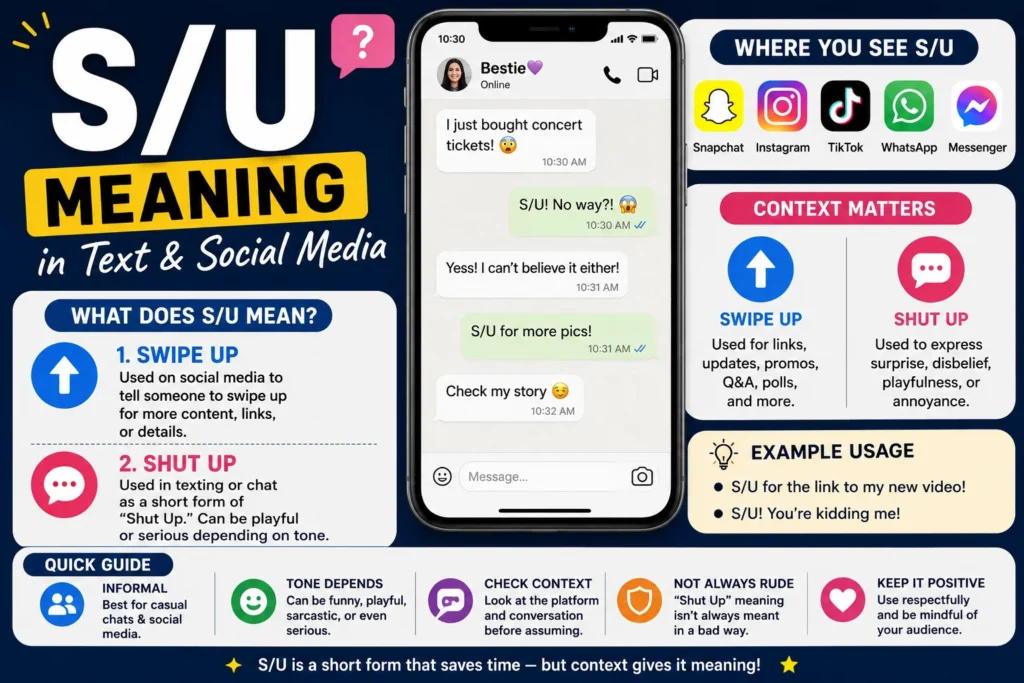
The two most common meanings are:
- Swipe Up – Used on social media platforms.
- Shut Up – Used in texting and casual conversations.
Context is everything. The same abbreviation can have completely different meanings depending on the platform and conversation.
S/U Meaning in Text
The S/U meaning in text most commonly refers to:
1. Shut Up
In texting, S/U may stand for “Shut Up.”
This doesn’t always mean someone is being rude.
For example:
Friend 1: I just won concert tickets!
Friend 2: S/U! No way!
Here, S/U expresses surprise rather than anger.
However, tone matters. In some situations, “shut up” can sound playful, sarcastic, or even offensive.
S/U Slang Meaning
As an internet slang term, S/U functions as:
- A texting abbreviation
- A social media shorthand
- A casual chat phrase
Unlike some acronyms, S/U can represent different expressions depending on digital communication contexts.
What Does S/U Mean in Chat?
In chat conversations, S/U usually means:
- Shut Up (surprise or disbelief)
- Swipe Up (social media action)
Examples:
A: I met my favorite celebrity.
B: S/U! You’re so lucky!
Or:
Influencer: New vlog is live! S/U for details.
S/U Meaning on Snapchat
On Snapchat, S/U most often means:
Swipe Up
Users write:
- “S/U for more”
- “S/U to vote”
- “S/U to ask questions”
Historically, Snapchat stories encouraged users to swipe up to access links or additional content.
Although platform features evolve, the phrase remains common in social media culture.
S/U Meaning on Instagram, TikTok, and WhatsApp
On Instagram, S/U frequently means:
- Swipe Up
- Check the link
- View additional content
TikTok
TikTok users may use S/U in comments or captions, although it is less common than on Instagram.
On WhatsApp, S/U more often means:
- Shut Up
- An expression of surprise
| Platform | Common Meaning |
|---|---|
| Snapchat | Swipe Up |
| Swipe Up | |
| TikTok | Swipe Up or text slang |
| Shut Up | |
| Messenger | Shut Up |
Is S/U an Acronym, Short Form, or Slang?
S/U is primarily:
- A short form
- A texting abbreviation
- An internet slang term
It is not:
- A phonetic spelling
- A typo turned slang
The abbreviation developed naturally as users looked for faster ways to communicate online.
Tone and Context Variations
The meaning of S/U changes based on tone.
Funny Tone
Emma: I accidentally waved back at someone who wasn’t waving at me.
Sarah: S/U 😂 That’s happened to me too!
The tone here is playful and humorous.
Sarcastic Tone
Jake: I forgot my wallet again.
Mike: S/U. You’re always forgetting something.
The phrase adds sarcasm to the conversation.
Romantic Tone
Alex: I got us reservations at your favorite restaurant.
Taylor: S/U 🥹 That’s so sweet.
In this case, S/U expresses happy disbelief.
Angry Tone
Person A: Stop interrupting me.
Person B: S/U.
In this context, the phrase may come across as rude.
Playful Tone
Friend 1: I just beat your high score.
Friend 2: S/U! Impossible.
The tone is lighthearted and competitive.
15 Real Chat Examples
Example 1
A: I got promoted today.
B: S/U! Congratulations!
A: Thank you!
Example 2
A: S/U for my latest post.
B: Just did.
A: Appreciate it!
Example 3
A: I met a famous actor.
B: S/U. Seriously?
A: Yep!
Example 4
A: New story up. S/U!
B: Watching now.
A: Let me know what you think.
Example 5
A: I won the competition.
B: S/U! That’s amazing.
A: I’m still shocked.
Example 6
A: S/U for details.
B: Done.
A: Thanks!
Example 7
A: Guess who’s engaged?
B: S/U! Who?
A: My cousin.
Example 8
A: New product launch today.
B: S/U for the link?
A: Check my story.
Example 9
A: I aced the exam.
B: S/U! That’s awesome.
A: Hard work paid off.
Example 10
A: S/U to ask me anything.
B: What’s your favorite movie?
A: Interstellar.
Example 11
A: I finally bought my dream car.
B: S/U. That’s incredible.
A: Feels unreal.
Example 12
A: New photos uploaded.
B: S/U now.
A: Thanks!
Example 13
A: I got front-row tickets.
B: S/U! No way.
A: I couldn’t believe it either.
Example 14
A: S/U for today’s deal.
B: Looking now.
A: Great.
Example 15
A: I ran into my teacher at the mall.
B: S/U 😂
A: It was awkward.
Grammar and Language Role
Part of Speech
S/U acts as an abbreviation or interjection.
Sentence Position
It appears:
- At the beginning
- At the end
- As a standalone message
Examples:
- “S/U!”
- “S/U for more.”
- “No way, S/U!”
Does It Replace a Full Sentence?
Yes.
Instead of saying:
- “Swipe up for more information.”
- “Shut up, I can’t believe it.”
People simply write:
- “S/U”
Tone Impact
S/U can make conversations feel:
- Casual
- Excited
- Playful
- Promotional
Formal vs Informal Use
| Context | Appropriate? |
| Texting friends | Yes |
| Social media | Yes |
| Work emails | No |
| Academic writing | No |
| Business reports | No |
How to Reply When Someone Says S/U
Funny Reply
- “Only if you tell me the secret!”
- “I can’t stop talking now.”
Serious Reply
- “Really? Tell me more.”
- “I appreciate that.”
Flirty Reply
- “Only because you’re saying it 😉”
- “You’re making me blush.”
Neutral Reply
- “What happened?”
- “No way!”
- “Got it.”
Comparison Table
| Term | Meaning | Usage Context | Tone | Popularity | Confusion Risk |
| S/U | Swipe Up or Shut Up | Social media, texting | Casual | Medium | High |
| SW | Swipe | Social media | Neutral | Medium | Medium |
| IDK | I Don’t Know | Texting | Neutral | Very High | Low |
| BRB | Be Right Back | Chat | Neutral | High | Low |
| LOL | Laugh Out Loud | Texting | Friendly | Very High | Low |
| IRL | In Real Life | Social media | Neutral | High | Low |
Who Uses This Term?
Age Group
Most common among:
- Teenagers
- Young adults
- Social media users
- Content creators
Gen Z vs Millennials
Gen Z
- Uses S/U more frequently
- Familiar with social media abbreviations
Millennials
- Recognize it but may use it less often
Region
S/U is common in:
- United States
- Canada
- United Kingdom
- Australia
Platforms
Most common on:
- Snapchat
- TikTok
- Messenger
Origin and Internet Culture Insight
S/U likely originated from social media culture.
As platforms encouraged users to interact with stories and links, “Swipe Up” became a widely recognized phrase.
Texting culture also shortened “Shut Up” to S/U for faster communication.
Why People Say S/U on TikTok
TikTok users prefer quick captions and abbreviations.
S/U saves space and feels natural in fast-moving online conversations.
Meme Culture Role
Internet culture thrives on speed.
Abbreviations like S/U spread quickly because they’re easy to type and understand.
Fast Typing Culture
Digital communication rewards brevity.
S/U became popular because it reduces typing effort while maintaining meaning.
Is S/U Rude?
Not always.
If S/U means “Swipe Up,” it’s completely neutral.
If it means “Shut Up,” tone determines whether it sounds playful or rude.
Is S/U a Bad Word?
No.
S/U is not profanity.
However, context matters.
Should You Use S/U in School or Office?
Casual conversations may be fine.
However, avoid it in:
- Formal writing
- Professional emails
- Official reports
Experience-Based Insight
In real-world conversations, S/U is most often used either as a social media instruction (“Swipe Up”) or an expression of disbelief (“Shut Up!”). Younger users usually understand the intended meaning immediately, while older users may rely more heavily on context clues to interpret it correctly.
FAQ
What does S/U mean in text?
S/U usually means “Shut Up” or “Swipe Up,” depending on context.
Is S/U rude?
Not necessarily. Tone determines whether it sounds playful or offensive.
What does S/U mean on Snapchat?
On Snapchat, S/U most commonly means “Swipe Up.”
Is S/U the same as IDK?
No. IDK means “I Don’t Know,” while S/U has entirely different meanings.
Can adults use S/U?
Yes. Anyone familiar with internet slang can use it casually.
How do you respond to S/U?
Respond based on context—whether it’s surprise, humor, or a social media action.
Is S/U popular on Instagram?
Yes. It is especially common in stories and promotional posts.
Does S/U always mean Swipe Up?
No. In texting, it may also mean “Shut Up.”
What is S/U on social media?
It usually means “Swipe Up.”
Why do people say S/U in texts?
Often to express surprise or disbelief.
Is S/U Gen Z slang?
It is commonly used among Gen Z and social media users.
Can S/U have multiple meanings?
Yes. Context determines the intended meaning.
Is S/U formal?
No. It is an informal abbreviation.
Conclusion
The answer to “what does S/U mean?” depends on context. On social media, it usually means “Swipe Up,” while in texting, it often means “Shut Up” as an expression of surprise or disbelief.
Usage Tips
- Look at the platform.
- Consider the conversation tone.
- Use it casually.
Common Mistakes
- Assuming it has only one meaning.
- Using it in formal settings.
- Ignoring context clues.
When to Use It
✅ Casual chats
✅ Social media posts
✅ Friendly conversations
When to Avoid It
❌ Business emails
❌ Academic writing
❌ Professional documents
Understanding abbreviations like S/U helps you communicate confidently in today’s digital world.