
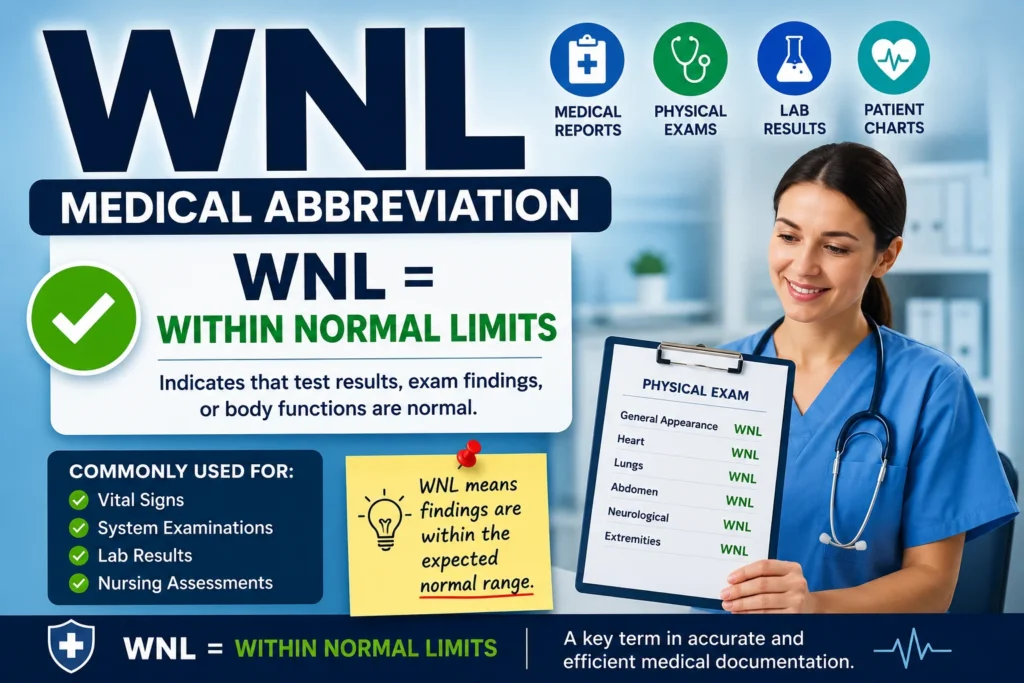

WNL stands for “Within Normal Limits,” a common medical abbreviation used by healthcare professionals to indicate that a patient’s examination findings, test results, or body functions appear normal and show no significant abnormalities.
If you’ve seen WNL in a medical report, nursing note, hospital chart, or lab documentation, you may wonder whether it means you’re completely healthy. That’s one of the biggest reasons people search for the term. While WNL generally indicates normal findings, its exact meaning depends on the context of the examination, test, or assessment being documented.
This guide explains what WNL means, how healthcare providers use it, examples from real medical documentation, common misconceptions, related abbreviations, and when you should ask your healthcare provider for clarification.
What Does WNL Mean?
WNL Meaning in Healthcare
WNL stands for:
Within Normal Limits
Healthcare professionals use this abbreviation to indicate that a specific body system, examination finding, or test result falls within the expected range considered normal.
For example:
- Blood pressure may be documented as WNL.
- Heart sounds may be WNL.
- Neurological findings may be WNL.
- Laboratory values may be WNL.
In simple terms, WNL means nothing unusual was found during that particular assessment.
Why Is WNL Used?
Medical professionals often document large amounts of information during patient evaluations.
Using abbreviations such as WNL helps:
- Save time
- Standardize documentation
- Improve chart efficiency
- Reduce repetitive wording
Instead of writing:
“Heart sounds are normal with no significant abnormalities detected.”
A clinician may simply write:
Heart: WNL
What Does WNL Mean in Medical Charts?
Medical charts contain records of a patient’s health history, examinations, medications, diagnoses, and treatments.
When you see WNL in a chart, it usually means the healthcare provider observed findings that are considered normal for that specific assessment.
Example
Cardiovascular System: WNL
This generally means:
- Normal heart rate
- Normal rhythm
- No obvious abnormalities detected
Example
Respiratory: WNL
This may indicate:
- Normal breathing pattern
- Clear lung sounds
- No respiratory distress
It’s important to remember that WNL applies only to the specific area being evaluated.
WNL in Nursing Documentation
Nurses frequently use WNL during patient assessments.
A nursing assessment often reviews:
- Neurological status
- Respiratory system
- Cardiovascular system
- Gastrointestinal function
- Musculoskeletal function
- Skin condition
Example nursing note:
Neurological: WNL
Respiratory: WNL
Cardiovascular: WNL
This allows nurses to document findings quickly while maintaining accurate records.
WNL in Physical Examinations
Physical exams commonly include WNL notation.
Head and Neck
A physician may document:
HEENT: WNL
HEENT refers to:
- Head
- Eyes
- Ears
- Nose
- Throat
This means no unusual findings were identified during examination.
Abdomen
A provider may write:
Abdomen: WNL
This could indicate:
- Normal bowel sounds
- No tenderness
- No swelling
- No abnormal masses
Musculoskeletal System
Documentation may include:
MSK: WNL
Meaning:
- Normal movement
- Normal strength
- No obvious deformities
Does WNL Mean Everything Is Perfectly Healthy?
One of the most common misconceptions is that WNL means a person is completely healthy.
That’s not always true.
WNL only refers to the specific examination or measurement being documented.
For example:
A patient may have diabetes but still have:
- Heart exam WNL
- Lung exam WNL
- Neurological exam WNL
The patient still has a medical condition, but those particular findings were normal.
WNL vs Normal: Is There a Difference?
Many people wonder whether WNL and “normal” mean exactly the same thing.
In most healthcare settings, they are very similar.
However, clinicians often prefer WNL because it recognizes that individuals vary slightly while still falling within acceptable medical ranges.
Normal
Suggests a finding exactly matches expected standards.
Within Normal Limits
Suggests a finding falls within an acceptable range.
This distinction is subtle but important in clinical practice.
Common Areas Where WNL Appears
Vital Signs
Healthcare providers may document:
- Blood pressure WNL
- Heart rate WNL
- Temperature WNL
- Respiratory rate WNL
Laboratory Results
Lab reports may show findings that are within established reference ranges.
Examples:
- Blood glucose WNL
- Sodium WNL
- Potassium WNL
Neurological Assessment
A neurological assessment documented as WNL may indicate:
- Alertness
- Appropriate responses
- Normal reflexes
- Intact sensation
Cardiovascular Assessment
Cardiovascular findings documented as WNL often include:
- Regular rhythm
- Normal pulse
- No abnormal heart sounds
Examples of WNL in Medical Notes
Example 1
Heart: WNL
Interpretation:
No significant abnormalities detected during cardiovascular examination.
Example 2
Lungs: WNL
Interpretation:
Breathing sounds clear and normal.
Example 3
Skin: WNL
Interpretation:
No rashes, wounds, discoloration, or concerning findings observed.
Example 4
Neuro: WNL
Interpretation:
Neurological function appears normal.
Example 5
GI: WNL
Interpretation:
Digestive system findings are within expected limits.
Why Patients Often Misunderstand WNL
Several factors contribute to confusion.
Medical Terminology
Many patients are unfamiliar with clinical abbreviations.
Different Contexts
WNL can apply to:
- Physical exams
- Nursing notes
- Laboratory reports
- Diagnostic testing
Incomplete Understanding
Patients sometimes assume WNL guarantees perfect health.
In reality, it only applies to the specific area being evaluated.
Related Medical Abbreviations
Healthcare documentation contains many abbreviations similar to WNL.
| Abbreviation | Meaning |
|---|---|
| WNL | Within Normal Limits |
| NAD | No Acute Distress |
| NKA | No Known Allergies |
| WDL | Within Defined Limits |
| ROM | Range of Motion |
| VS | Vital Signs |
| BP | Blood Pressure |
| HR | Heart Rate |
These abbreviations help streamline clinical documentation.
WNL vs WDL
People often confuse WNL and WDL.
WNL
Within Normal Limits
WDL
Within Defined Limits
WDL is often used in nursing and facility-specific documentation where standards are defined by organizational guidelines.
In many situations, the two terms are used similarly.
Is WNL Still Used in Modern Healthcare?
Yes, WNL remains one of the most widely used abbreviations in healthcare documentation.
Despite the growth of electronic health records (EHRs), clinicians still use WNL because it communicates information quickly and efficiently.
You’ll commonly find it in:
- Hospital charts
- Nursing assessments
- Emergency department records
- Physical therapy notes
- Outpatient clinic documentation
- Long-term care facilities
However, some healthcare organizations encourage more detailed documentation when necessary to reduce ambiguity and improve patient safety.
When WNL May Not Be Enough
Although WNL is useful, healthcare providers cannot rely on it in every situation.
For example, writing:
“Neurological: WNL”
may not provide enough information for a patient experiencing neurological symptoms.
In such cases, clinicians often include specific details such as:
- Alert and oriented ×4
- Cranial nerves intact
- Normal gait
- Equal strength bilaterally
Detailed documentation helps other providers understand exactly what was assessed.
Understanding WNL in Lab Results
Many patients encounter WNL after reviewing laboratory reports.
Example
A complete blood count (CBC) may show:
- White blood cells: WNL
- Hemoglobin: WNL
- Platelets: WNL
This means the values fall within the laboratory’s reference ranges.
However, normal ranges can vary slightly between laboratories due to:
- Testing equipment
- Population differences
- Reference standards
This is why healthcare providers interpret results within the broader clinical context.
Can Test Results Be WNL Even If Symptoms Exist?
Yes.
This situation is actually quite common.
A patient may experience symptoms while certain tests remain WNL.
For example:
A person may have:
- Fatigue
- Headaches
- Dizziness
Yet their:
- Blood count
- Blood pressure
- Heart examination
may all be documented as WNL.
Healthcare providers use multiple assessments, symptoms, and tests before reaching a diagnosis.
WNL does not automatically rule out every medical condition.
WNL in Different Medical Specialties
Primary Care
Family physicians frequently use WNL during annual physical examinations.
Example:
Cardiovascular: WNL
Respiratory: WNL
Emergency Medicine
Emergency departments often document WNL findings while identifying areas requiring immediate attention.
Physical Therapy
Therapists may record:
Range of Motion: WNL
Meaning movement appears normal.
Pediatrics
Pediatric providers use WNL to document developmental and physical findings that fall within expected age-based ranges.
Mental Health
Mental health professionals occasionally document findings such as:
Speech: WNL
Thought Process: WNL
to indicate expected functioning.
Real-World Examples of WNL Documentation
Example 1: Annual Physical
Provider Note:
- Heart: WNL
- Lungs: WNL
- Abdomen: WNL
Interpretation:
No significant abnormalities detected during routine examination.
Example 2: Emergency Department Visit
Provider Note:
- Neuro: WNL
- Respiratory: WNL
Interpretation:
Neurological and respiratory systems appear stable.
Example 3: Physical Therapy Assessment
Provider Note:
- Upper Extremity Strength: WNL
- Balance: WNL
Interpretation:
Strength and balance fall within expected limits.
Example 4: Pediatric Visit
Provider Note:
- Growth Parameters: WNL
Interpretation:
Height, weight, and development are progressing normally.
Example 5: Postoperative Follow-Up
Provider Note:
- Surgical Site: WNL
Interpretation:
Healing appears normal with no obvious complications.
What Should Patients Do If They See WNL?
If you encounter WNL in your records:
Understand the Context
Determine:
- Which body system was assessed?
- Which test result was evaluated?
Review the Full Report
Never rely on a single abbreviation.
Read:
- Clinical notes
- Diagnoses
- Recommendations
- Follow-up plans
Ask Questions
If something is unclear, ask your healthcare provider:
- What was assessed?
- What does WNL mean in this situation?
- Are any follow-up tests needed?
Avoid Self-Diagnosis
Medical records contain professional terminology that may not tell the full story without clinical interpretation.
Common Misconceptions About WNL
Myth 1: WNL Means Perfect Health
Reality:
It only applies to the specific finding being documented.
Myth 2: WNL Means No Medical Problems Exist
Reality:
A person can have chronic conditions while certain assessments remain WNL.
Myth 3: WNL Means No Further Testing Is Needed
Reality:
Additional testing may still be recommended based on symptoms or risk factors.
Myth 4: WNL Is a Diagnosis
Reality:
WNL is an observation, not a diagnosis.
Myth 5: WNL Always Means the Same Thing
Reality:
The meaning depends on the system or test being evaluated.
Why Healthcare Providers Prefer WNL
Several factors explain its continued popularity.
Efficiency
Medical professionals document hundreds of findings daily.
Standardization
The abbreviation is widely recognized throughout healthcare.
Clarity
Experienced clinicians immediately understand its meaning.
Consistency
It helps maintain uniform documentation across departments.
Experience-Based Insight
In real healthcare settings, WNL is often one of the first abbreviations students learn because it appears throughout patient records. While patients sometimes worry when they don’t understand medical shorthand, healthcare providers generally use WNL to indicate reassurance rather than concern. The key is remembering that it refers only to the specific area assessed—not necessarily the patient’s entire health picture.
Frequently Asked Questions
What does WNL stand for in medical terms?
WNL stands for Within Normal Limits.
Is WNL good or bad on a medical report?
Generally, WNL is considered a positive finding because it indicates normal results or observations.
Does WNL mean healthy?
Not necessarily. It means the specific assessment was within expected limits.
Is WNL the same as normal?
In most situations, yes. However, WNL emphasizes that findings fall within an acceptable range rather than being exactly identical for every individual.
What does WNL mean in nursing notes?
In nursing documentation, WNL means the nurse found no significant abnormalities during assessment.
What does WNL mean on lab results?
It means the test value falls within the laboratory’s reference range.
Can a person be sick if results are WNL?
Yes. Symptoms and medical conditions can exist even when certain tests or examinations are WNL.
Why do doctors use WNL instead of normal?
WNL is a standardized medical abbreviation that allows concise and efficient documentation.
What is WNL in a physical examination?
It means the findings from that part of the physical exam were within normal limits.
Is WNL a diagnosis?
No. WNL is a documentation term, not a medical diagnosis.
What is the difference between WNL and WDL?
WNL means Within Normal Limits, while WDL means Within Defined Limits.
Can patients see WNL in their medical records?
Yes. Many electronic health portals allow patients to view notes containing WNL.
Should I worry if my report says WNL?
Generally, no. WNL usually indicates normal findings, but you should review the entire report and discuss questions with your healthcare provider.
Conclusion
If you’ve been wondering about the WNL medical abbreviation, the answer is straightforward: WNL stands for “Within Normal Limits.” It is a common healthcare term used to indicate that a test result, examination finding, or body system appears normal and shows no significant abnormalities.
While WNL is generally reassuring, it’s important to understand that it applies only to the specific area being assessed. It does not automatically mean every aspect of a person’s health is perfect.
Usage Tips
✅ Read WNL in the context of the full report.
✅ Ask healthcare providers for clarification when needed.
✅ Understand that WNL usually indicates normal findings.
Common Mistakes
❌ Assuming WNL means perfect health.
❌ Ignoring the rest of the medical report.
❌ Treating WNL as a diagnosis.
When WNL Is Helpful
- Reading medical charts
- Understanding nursing notes
- Reviewing lab results
- Interpreting physical examinations
When to Seek Clarification
- Symptoms continue despite WNL findings.
- Medical terminology is unclear.
- Additional testing is recommended.