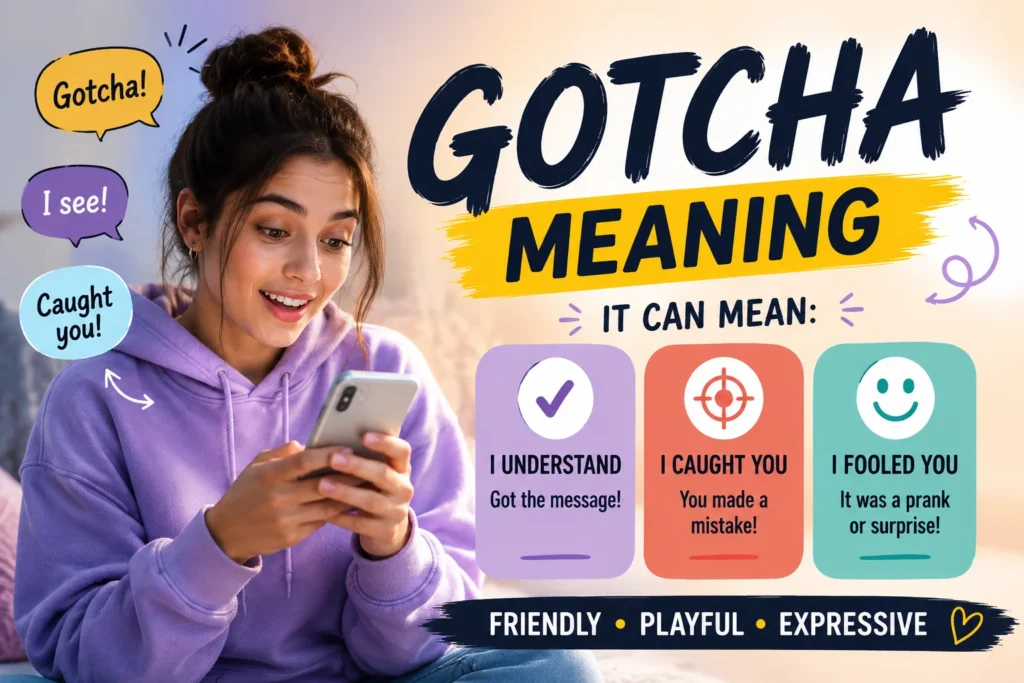

**”Gotcha” is an informal English expression that most commonly means “I understand,” “I caught you,” or “I tricked you.” The exact meaning depends on the conversation and the speaker’s tone.
If you’ve received a text saying “Gotcha!”, heard someone say it in a movie, or seen it in a TikTok comment, you may wonder exactly what it means. The good news is that “gotcha” isn’t complicated—but it does have several common uses. Depending on the context, it can show understanding, signal that someone has been caught making a mistake, or refer to a playful prank or surprise. This guide explains every major meaning, how people use it online and offline, and when it’s appropriate to say it.
What Does “Gotcha” Mean?
The meaning of “gotcha” depends on the situation, but it usually falls into one of three categories:
- “I understand.”
- “I caught you.”
- “I fooled or surprised you.”
Because tone plays a major role, the same word can sound friendly, playful, or slightly confrontational.
For example:
Friend: “Meet me at the coffee shop instead.”
You: “Gotcha!”
Here, gotcha simply means “I understand” or “Okay, I got the message.”
In another situation:
Sibling: “I wasn’t eating the cookies.”
You: “Gotcha! There are crumbs all over your shirt.”
Now, gotcha means “I caught you telling a lie.”
Why Do People Search for “Gotcha Meaning”?
People search for “gotcha meaning” for several reasons:
- They received it in a text message.
- They heard it in a TV show or movie.
- They saw it in a TikTok or Instagram comment.
- Someone replied “Gotcha” during a conversation.
- They want to know whether it sounds rude, sarcastic, or friendly.
Since gotcha has multiple meanings, understanding the surrounding conversation is the key to interpreting it correctly.
Is “Gotcha” Slang, an Interjection, or an Abbreviation?
One common misconception is that gotcha is a texting acronym like LOL or BRB.
It isn’t.
Is It an Acronym?
No.
Unlike abbreviations such as OMW (On My Way) or IDK (I Don’t Know), gotcha is not formed from the first letters of other words.
Is It an Abbreviation?
Not exactly.
Instead, gotcha is an informal contraction of the phrase:
“Got you.”
Over time, native English speakers began pronouncing “got you” quickly in conversation, causing it to naturally become “gotcha.”
This process is common in spoken English.
Similar examples include:
- “Want to” → “Wanna”
- “Going to” → “Gonna”
- “Let me” → “Lemme”
Is It Slang?
Partly.
While gotcha originated as a spoken contraction, today it’s also considered an informal slang expression because it’s widely used in casual conversation, texting, and online communication.
You’ll hear it between:
- Friends
- Family members
- Coworkers
- Classmates
- Gamers
- Social media users
However, it’s less common in formal writing or professional documents.
The Three Main Meanings of “Gotcha”
Although gotcha can appear in different contexts, nearly every use falls into one of these three meanings.
Meaning 1: “I Understand”
This is the most common meaning in everyday conversation.
Here, gotcha simply means:
- I understand.
- I see.
- Okay.
- Message received.
Example
A: The meeting starts at 2 PM instead of 3 PM.
B: Gotcha.
A: Thanks for letting me know.
In this conversation, nobody has been caught or tricked. The speaker is simply acknowledging the information.
Because of this meaning, many people use gotcha as a quicker, friendlier alternative to:
- Understood.
- Okay.
- Noted.
- I see.
Meaning 2: “I Caught You”
Another common meaning is discovering that someone made a mistake, lied, or accidentally revealed something.
Example
A: I definitely didn’t look at your birthday present.
B: Gotcha! I saw you peeking.
A: Fine… you caught me.
Here, gotcha expresses victory or recognition after catching someone.
You’ll often hear this use during:
- Friendly teasing
- Games
- Sports
- Practical jokes
- Detective stories
- Police dramas
Meaning 3: “I Fooled or Surprised You”
Sometimes gotcha refers to successfully tricking someone.
This meaning appears in expressions like:
- Gotcha prank
- Gotcha moment
- Gotcha question
Example
A: I seriously thought today was Friday.
B: Gotcha! It’s only Thursday.
A: You almost fooled me.
In these situations, gotcha celebrates a harmless surprise rather than expressing understanding.
What Does “Gotcha” Mean in Text Messages?
In text conversations, gotcha almost always means:
“I understand.”
It’s often used as a casual acknowledgment after receiving instructions or information.
Examples:
- “Gotcha, I’ll be there at six.”
- “Gotcha. Thanks!”
- “Gotcha 👍”
Compared with simply saying “Okay,” gotcha often sounds warmer and more conversational.
What Does “Gotcha” Mean on WhatsApp?
On WhatsApp, gotcha is commonly used among friends, family, and coworkers to confirm that a message has been understood.
For example:
Friend: “We’re meeting at the north entrance.”
You: “Gotcha.”
The conversation doesn’t necessarily continue because gotcha already confirms that you’ve understood the plan.
In group chats, it’s also used to acknowledge instructions without writing a long response.
What Does “Gotcha” Mean on Snapchat?
On Snapchat, gotcha usually keeps its everyday meaning of “I understand” or “I caught you.”
For example:
- “Gotcha 😂”
- “Gotcha! I knew that was you.”
- “Gotcha, sending a Snap now.”
When paired with laughing emojis, it often signals playful teasing rather than criticism.
What Does “Gotcha” Mean on Instagram?
Instagram users commonly write gotcha in comments, direct messages, and Story replies.
Examples include:
- “Gotcha, thanks for explaining.”
- “Haha, gotcha!”
- “Gotcha now.”
Because Instagram conversations are generally casual, the expression feels friendly and natural.
What Does “Gotcha” Mean on TikTok?
On TikTok, gotcha appears in several ways.
Creators use it when:
- Responding to comments.
- Reacting to misunderstandings.
- Revealing a joke or surprise.
- Explaining that they finally understood something.
Example caption:
“Ohhh… gotcha 😂”
Unlike some modern slang, gotcha wasn’t created on TikTok. Instead, TikTok has simply introduced it to a newer generation of users who continue using it in videos, captions, and comments.
What Does “Gotcha” Mean on X (Formerly Twitter)?
On X, gotcha often appears in fast-moving conversations where people respond quickly to news, opinions, or explanations.
Examples:
- “Gotcha. That makes sense now.”
- “Gotcha—I misunderstood your point.”
- “Ah, gotcha.”
Because posts on X are brief, gotcha serves as a concise way to acknowledge understanding without writing a longer reply.
Tone & Context Variations
Friendly Tone
This is the most common way people use “gotcha.” It simply means “I understand,” “Okay,” or “I follow what you’re saying.” The tone is warm, casual, and reassuring.
Example:
A: The restaurant moved to the next street.
B: Gotcha! I’ll head there instead.
A: Great, see you soon.
B: Looking forward to it.
Funny Tone
In a humorous context, “gotcha!” is often said after a harmless prank, joke, or playful surprise. The goal is to make someone laugh rather than embarrass them.
Example:
A: Did you really buy a pet dinosaur?
B: Of course I did.
A: Wait… seriously?
B: Gotcha! April Fools!
Playful Tone
Friends and family frequently use “gotcha” while teasing each other. The expression feels lighthearted and usually isn’t meant to criticize anyone.
Example:
A: I totally wasn’t hiding your phone.
B: Really? Then why is it in your pocket?
A: Oops…
B: Gotcha!
Sarcastic Tone
Sometimes “gotcha” carries a sarcastic edge. Instead of showing understanding, it implies that someone has made an obvious mistake or contradicted themselves.
Example:
A: I only watched one episode.
B: Then why did you finish the entire season overnight?
A: …
B: Gotcha.
Serious Tone
Although less common, “gotcha” can also be used sincerely in professional or everyday conversations to confirm instructions.
Example:
A: Please submit the report before 5 PM.
B: Gotcha. I’ll send it before the deadline.
A: Thank you.
B: No problem.
Real Chat Examples
Example 1
A: Don’t forget the meeting starts at 9.
B: Gotcha. I’ll join five minutes early.
A: Perfect.
B: See you then.
Example 2
A: The concert venue changed.
B: Really? Where is it now?
A: Downtown Arena instead.
B: Gotcha, thanks for letting me know.
Example 3
A: You said you weren’t hungry.
B: I wasn’t… until I smelled pizza.
A: Gotcha. I knew you’d change your mind.
B: Guilty.
Example 4
A: Don’t tell anyone about the surprise party.
B: Gotcha. My lips are sealed.
A: I knew I could trust you.
B: It’ll stay a secret.
Example 5
A: I accidentally wore mismatched shoes today.
B: Seriously?
A: Nope. Gotcha!
B: I almost believed you.
Example 6
A: Can you send me the presentation tonight?
B: Gotcha. I’ll email it after dinner.
A: Thanks a lot.
B: You’re welcome.
Example 7
A: I found your missing wallet.
B: Really? Where?
A: Under the couch.
B: Gotcha. I must’ve dropped it there.
Example 8
A: I beat your high score.
B: No way.
A: Check the leaderboard.
B: Gotcha… I’ll have to beat it tomorrow.
Example 9
A: I thought today was Saturday.
B: It’s only Friday.
A: Seriously?
B: Gotcha! One more workday left.
Example 10
A: Don’t park in that lot—it closes early.
B: Gotcha. I’ll park across the street instead.
A: Good idea.
B: Thanks for the warning.
Example 11
A: I finally watched the movie you recommended.
B: So what did you think?
A: Now I understand the ending. Gotcha!
B: I knew you’d like it.
Example 12
A: Can we move our lunch to 1 PM?
B: Gotcha. I’ll adjust my schedule.
A: Appreciate it.
B: See you then.
Grammar & Language Role
Part of Speech
Gotcha most commonly functions as an interjection—a word or short expression used to react quickly during conversation.
Depending on context, it can also behave like a conversational response that replaces longer phrases such as:
- I understand.
- I caught you.
- I see what you mean.
- I tricked you.
Unlike internet abbreviations such as LOL or BRB, gotcha is an actual English expression rather than an acronym.
Sentence Position
Gotcha is very flexible and can appear in several positions within a sentence.
As a complete response:
- Gotcha.
- Gotcha!
At the beginning:
- Gotcha, I’ll take care of it.
- Gotcha, thanks for explaining.
At the end:
- Oh, gotcha.
- I understand now, gotcha.
The standalone reply is by far the most common in texting and casual conversations.
Can “Gotcha” Replace a Full Sentence?
Yes.
One reason gotcha remains so popular is that it can replace an entire sentence without losing meaning.
For example:
A: The meeting has been moved to tomorrow.
B: Gotcha.
Instead of writing:
“I understand. Thanks for letting me know.”
the single word gotcha communicates the same idea naturally and efficiently.
Formal vs Informal Register
| Context | Appropriate? |
|---|---|
| Text Messages | ✅ Yes |
| ✅ Yes | |
| Snapchat | ✅ Yes |
| ✅ Yes | |
| TikTok Comments | ✅ Yes |
| Casual Workplace Chat | ✅ Usually |
| Business Emails | ❌ No |
| Academic Writing | ❌ No |
| Official Reports | ❌ No |
Although many coworkers casually say gotcha in spoken conversations or internal chats, using the full phrase “I understand” or “Understood” is generally more professional in formal communication.
How to Reply When Someone Says “Gotcha”
The best response depends on how the word is being used. If someone says “gotcha” to show they understand, you can simply continue the conversation. If they’re teasing you or joking around, a playful reply often works best.
Funny Reply
These responses keep the conversation light and humorous.
- “Glad we’re on the same page!”
- “You finally figured it out. 😄”
- “That took you long enough!”
- “Mission accomplished!”
- “See? I wasn’t making it up.”
Serious Reply
Use these when discussing work, school, or anything important.
- “Thanks for understanding.”
- “I appreciate you confirming.”
- “Perfect. Let me know if you have any questions.”
- “Sounds good.”
- “Great, we’re all set.”
Flirty Reply
If you’re chatting with someone you’re interested in, gotcha can lead into playful flirting.
- “So you’ve been paying attention to me?”
- “Glad you got me. 😉”
- “Now you’ve got my attention too.”
- “Guess we’ll have to keep talking.”
- “I was hoping you’d understand.”
Neutral Reply
These work in almost any casual conversation.
- “Okay!”
- “Sounds good.”
- “Perfect.”
- “Thanks.”
- “Exactly.”
- “That’s what I meant.”
Comparison Table
| Term | Meaning | Usage Context | Tone | Popularity | Confusion Risk |
|---|---|---|---|---|---|
| Gotcha | I understand / I caught you / I fooled you | Texting, conversation, social media | Friendly, playful | Very High | Medium |
| I See | I understand | Everyday conversation | Neutral | High | Low |
| Understood | Message received | Workplace, formal settings | Professional | High | Low |
| Roger | Message received | Military, aviation, radio communication | Formal | Medium | Low |
| Copy That | I received your message | Emergency services, workplace, gaming | Professional | Medium | Low |
| Oops | Acknowledging a mistake | Casual conversation | Lighthearted | High | Low |
Who Uses This Term?
Age Group Breakdown
Gotcha is one of the few informal expressions that crosses multiple generations.
You’ll commonly hear it from:
- Teenagers
- College students
- Young professionals
- Parents
- Older adults
Unlike newer internet slang that changes every few years, gotcha has remained part of spoken English for decades.
Gen Z vs Millennials
Gen Z
Gen Z often uses gotcha in:
- Text messages
- TikTok comments
- Instagram DMs
- Snapchat chats
- Gaming conversations
For many younger users, it simply means “I understand.”
Millennials
Millennials frequently use gotcha in both spoken conversations and digital communication.
They may also use it when:
- Confirming plans
- Replying to work messages
- Making jokes
- Teasing friends
Because many Millennials grew up with instant messaging, gotcha feels natural in both online and offline conversations.
Regional Usage
Gotcha is widely understood across English-speaking countries.
It’s especially common in:
- United States
- Canada
- United Kingdom
- Australia
- New Zealand
Thanks to movies, television, and social media, the expression is also familiar to many English learners around the world.
Although pronunciation may vary slightly by region, the meaning remains largely the same.
Platforms Where It Appears Most
You’ll regularly encounter gotcha on:
- Text messages
- Snapchat
- TikTok
- X (formerly Twitter)
- Facebook Messenger
- Discord
Unlike many slang terms that belong to one platform, gotcha has become universal across digital communication.
Origin & Internet Culture
Where Did “Gotcha” Come From?
Gotcha is much older than the internet.
It developed naturally in spoken English as a contracted pronunciation of:
“Got you.”
When native speakers say “got you” quickly, the sounds blend together until they resemble “gotcha.”
This type of pronunciation change is common in conversational English.
For example:
- “Did you” → “Didja”
- “Would you” → “Wouldja”
- “Don’t you” → “Don’tcha”
Over time, gotcha stopped being just a pronunciation and became a recognized word in its own right.
How the Meaning Expanded
Originally, gotcha literally meant:
“I’ve got you.”
or
“I’ve caught you.”
As everyday conversations evolved, people began using it more broadly to mean:
- I understand.
- I see what you mean.
- I caught your mistake.
- I fooled you.
- I figured it out.
Today, context—not the dictionary—is what determines which meaning is intended.
“Gotcha” in Internet and Meme Culture
Although gotcha predates social media by many decades, the internet helped spread it even further.
On platforms like TikTok, Instagram, and X, people use it to:
- React to explanations.
- Reply to comments.
- Reveal jokes.
- Celebrate catching a mistake.
- End conversations quickly.
Memes also popularized expressions such as:
- “Gotcha!”
- “Haha, gotcha.”
- “You almost had me—gotcha!”
Unlike trendy slang that appears and disappears within months, gotcha has stayed relevant because it’s useful in everyday communication.
The “Gotcha Question”
Another well-known use is the phrase “gotcha question.”
A gotcha question is designed to catch someone off guard or expose a contradiction.
For example, during political debates or interviews, journalists sometimes ask what are described as gotcha questions—questions intended to challenge the speaker rather than simply gather information.
This meaning is different from the friendly conversational use but comes from the same idea of “catching” someone.
Safety & Appropriateness
Is “Gotcha” Rude?
Generally, no.
Most people interpret gotcha as friendly or conversational.
However, if someone says “Gotcha!” after exposing another person’s mistake, it can sound slightly smug or teasing depending on the tone.
Is “Gotcha” Offensive?
No.
Unlike expressions that contain profanity, gotcha is not considered offensive.
It’s appropriate for general audiences and does not contain explicit language.
Is It Appropriate for School?
Yes.
Teachers and students often use gotcha during informal classroom discussions.
For example:
Student: So the assignment is due Friday?
Teacher: Gotcha—that’s correct.
Is It Appropriate for Work?
Usually yes.
In casual workplace conversations or team chats, gotcha is perfectly acceptable.
For example:
“Gotcha, I’ll update the spreadsheet.”
However, in formal business emails, phrases like “Understood” or “Thank you for the clarification” create a more professional tone.
Cultural Sensitivity Notes
Unlike some internet slang terms, gotcha is not strongly associated with a particular online community, dialect, or culture. It is a widely used informal English expression that has been part of everyday speech for many years.
Its meaning is generally understood across English-speaking regions, making it one of the more universally recognized conversational expressions.
Real-World Observation
One reason gotcha has remained popular for decades is its versatility. In real conversations, people rarely stop to think about whether they’re using it as “I understand” or “I caught you”—the surrounding context makes the meaning obvious. Unlike many internet slang terms that fade as trends change, gotcha has become part of everyday spoken English because it’s short, natural, and instantly recognizable. Whether someone is confirming instructions in a text, joking with a friend, or acknowledging new information, gotcha continues to feel conversational without sounding outdated.
Frequently Asked Questions
What Does “Gotcha” Mean in Text?
In text messages, gotcha usually means “I understand” or “I got your message.” It’s a casual, friendly way to acknowledge what someone has said without typing a longer response. Most people use it interchangeably with phrases like “Okay,” “Understood,” or “I see.”
What Does “Gotcha” Mean on TikTok?
On TikTok, gotcha appears in comments, captions, and replies. It often means “I understand now” after someone explains a trend or joke. You’ll also see creators use it playfully after surprising viewers with an unexpected ending or revealing a prank.
Is “Gotcha” the Same as “Got You”?
Almost. Gotcha originated as a spoken contraction of “got you.” Over time, it became a standalone expression with broader meanings, including “I understand,” “I caught you,” and “I fooled you.” While they’re closely related, gotcha is now considered its own informal word in English.
Is “Gotcha” a Slang Word?
Yes, but only partly. Gotcha is an informal English expression that functions as conversational slang in everyday speech and online communication. Unlike internet abbreviations such as LOL or BRB, it isn’t an acronym—it evolved naturally from spoken English.
Is “Gotcha” Rude?
Usually not. In most conversations, gotcha sounds friendly, casual, and cooperative. However, if someone says “Gotcha!” after exposing another person’s mistake or embarrassing them, it may come across as teasing or slightly smug, depending on the tone.
Can Adults Use “Gotcha”?
Absolutely. Gotcha is widely used by teenagers, Millennials, Gen X, and older adults. Because it has been part of spoken English for many decades, it’s one of the few informal expressions that comfortably spans multiple generations.
How Do You Reply to “Gotcha”?
If someone says “gotcha” after you’ve explained something, you can simply continue the conversation.
Natural replies include:
- “Perfect, thanks!”
- “Great!”
- “Glad that helped.”
- “See you then.”
- “Exactly.”
If they’re using it jokingly, responding with humor usually keeps the conversation fun.
Is “Gotcha” Appropriate in Professional Communication?
It depends on the situation. In casual workplace chats, team messaging apps, or spoken conversations, gotcha is generally acceptable and sounds natural. However, for formal emails, reports, or client communication, phrases such as “Understood,” “Thank you for the clarification,” or “I understand” are more professional.
Why Do People Say “Gotcha” Instead of “Okay”?
Many people feel gotcha sounds warmer and more conversational than simply saying “okay.” It reassures the other person that the message was understood rather than merely acknowledged.
Does “Gotcha” Always Mean “I Understand”?
No. Although “I understand” is the most common meaning today, gotcha can also mean “I caught you” or “I tricked you.” The intended meaning depends entirely on the conversation and the speaker’s tone.
Is “Gotcha” Common in Everyday English?
Yes. Gotcha is one of the most widely recognized informal expressions in English. It’s used in face-to-face conversations, text messages, phone calls, social media, movies, and television.
Can “Gotcha” Be Used as a Joke?
Definitely. Many people say “Gotcha!” after playing a harmless prank or surprising someone with unexpected news. In these situations, the expression is meant to create laughter rather than criticize or offend.
Conclusion
Gotcha is a versatile informal English expression that can mean “I understand,” “I caught you,” or “I fooled you,” depending on the situation. Originally evolving from the spoken phrase “got you,” it has become a natural part of everyday English and remains widely used in conversations, text messages, and social media.
Unlike many internet slang terms that come and go, gotcha has stood the test of time because it’s simple, expressive, and easy to understand. Whether you’re confirming instructions, acknowledging information, teasing a friend, or celebrating a playful prank, the surrounding context makes its meaning clear.
Usage Tips
- Use gotcha to show that you understand someone’s message.
- Use it naturally in casual conversations, texts, and social media.
- Pay attention to tone, as it can sound playful or teasing.
- Choose more formal alternatives like “Understood” in professional emails.
Common Mistakes
- Assuming gotcha always means “I caught you.”
- Using it in highly formal business writing.
- Mistaking it for an internet acronym.
- Ignoring the role of tone and context in determining its meaning.
When to Use “Gotcha”
- Casual text messages
- WhatsApp conversations
- Snapchat and Instagram chats
- TikTok comments
- Friendly workplace conversations
- Everyday spoken English
When to Avoid “Gotcha”
- Formal business emails
- Academic papers
- Legal or official documents
- Professional presentations
- Situations where a more formal tone is expected