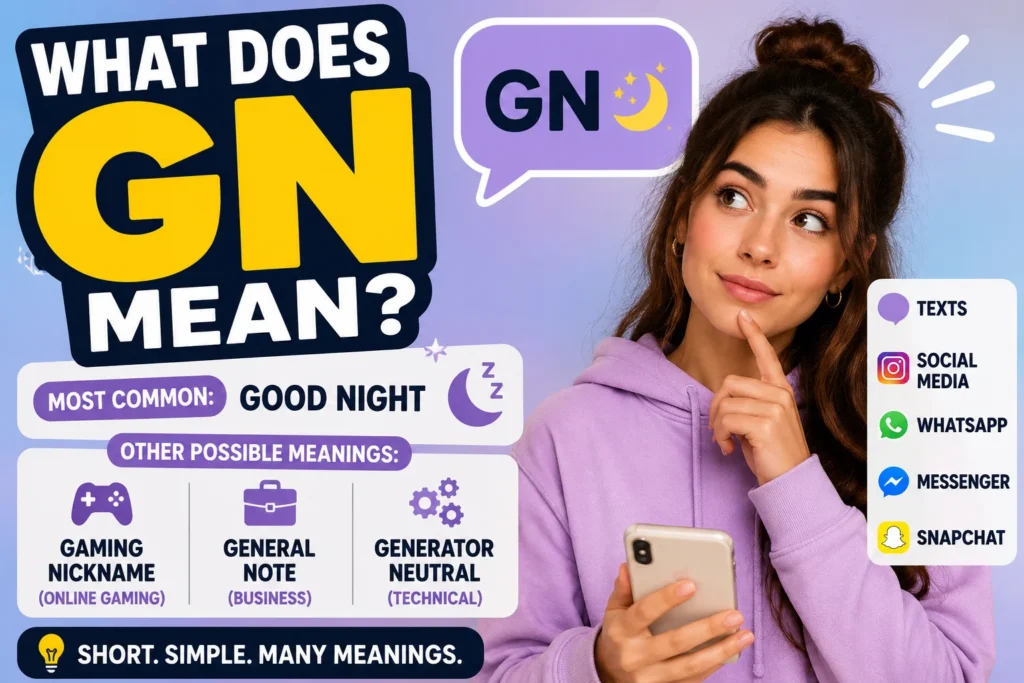

GN most commonly means “Good Night.” It’s a widely used texting abbreviation that people send before going to sleep. Depending on the context, it can also appear in gaming, business, or technical discussions, but in everyday messaging, “Good Night” is by far the most common meaning.
If you’ve received “GN” in a text, Snapchat, Instagram DM, or WhatsApp message, you’re probably wondering whether it’s simply a bedtime greeting or something more. This guide explains every genuine meaning of GN, how it’s used across different platforms, when it’s appropriate, and how to reply naturally.
What Does GN Mean?
The abbreviation GN is primarily used in digital communication to mean:
- Good Night ✅ (most common)
- Less commonly, it can refer to technical or professional abbreviations depending on the industry or context.
For everyday texting and social media, however, GN almost always means “Good Night.”
Is GN an Acronym or an Abbreviation?
GN is an abbreviation (or initialism), not a traditional acronym.
Here’s why:
- G = Good
- N = Night
People pronounce it by saying the full words (“good night”) rather than saying “gen” as a word, making it an initialism commonly grouped with internet abbreviations.
Why Do People Use GN Instead of “Good Night”?
People use GN because it’s:
- Faster to type
- Easy to recognize
- Friendly
- Common in texting
- Convenient before ending a conversation
Instead of writing:
Good night! Sleep well.
Many people simply type:
GN 😊
The meaning is immediately understood.
What Does GN Mean in Text?
In text messages, GN almost always means “Good Night.”
It’s used to politely end a conversation before someone goes to sleep.
Example
A: I’m heading to bed.
B: GN! Sleep well.
A: Thanks! You too.
The abbreviation helps keep conversations short while still sounding thoughtful.
Why It’s Popular in Texting
Texting encourages quick communication.
Just like:
- LOL
- BRB
- IDK
- TTYL
GN saves time without changing the meaning.
What Does GN Mean on Snapchat?
On Snapchat, GN keeps its standard meaning:
Good Night
Users often send it:
- before ending a streak conversation
- after a late-night chat
- before logging off
- with selfies or Bitmojis
Example
A: I’m exhausted.
B: Same 😂 GN.
A: Sleep well!
Many Snapchat users also pair it with:
- 🌙
- 😴
- ❤️
- 💙
- ✨
making the message feel warmer.
What Does GN Mean on Instagram?
On Instagram, GN usually appears in:
- Direct Messages
- Story replies
- Close Friends chats
Its meaning remains:
Good Night
Example:
A: Thanks for talking tonight.
B: Anytime 😊 GN.
A: Sweet dreams.
Because Instagram conversations often feel personal, GN can sound friendly or affectionate depending on the relationship.
What Does GN Mean on WhatsApp?
WhatsApp is one of the most common places to see GN.
Friends and family often send:
GN
instead of
Good night everyone.
Many family groups also include:
- 🌙
- ⭐
- 😴
- 🙏
alongside GN.
Example:
Mom: GN everyone ❤️
Dad: GN.
Son: Night!
What Does GN Mean on X (Formerly Twitter)?
GN appears differently on X.
Instead of ending one-on-one conversations, people often tweet it publicly.
Examples:
GN everyone.
GN Twitter.
GN, tomorrow is another day.
Followers usually understand the tweet as the creator signing off for the night.
Other Genuine Meanings of GN
Although Good Night is overwhelmingly the most common meaning, GN can represent different terms in specialized fields.
Geological Note
In geology or engineering documents, GN may be used as an abbreviation depending on company standards.
This usage is uncommon outside professional environments.
Government Notice
Some organizations shorten internal documents as GN.
Again, this isn’t related to texting slang.
Gaming Communities
In online gaming, players still use GN primarily to mean:
Good Night
especially after finishing a long gaming session.
Example:
Player 1: Great games tonight.
Player 2: GG! GN everyone.
Which Meaning Is Most Common?
For over 99% of internet users, GN means:
Good Night.
If someone sends:
GN 😊
there’s almost no ambiguity.
Unless you’re reading a technical report or workplace document, you should assume they’re simply wishing you a good night’s sleep.
Why GN Became So Popular
GN became popular for the same reason many internet abbreviations did:
- texting on older phones required more typing
- SMS had character limits
- instant messaging encouraged speed
- internet culture embraced shortcuts
Even though modern smartphones make typing easier, abbreviations like GN remain popular because they’re familiar and efficient.
Tone & Context Variations
Although GN almost always means “Good Night,” its emotional tone changes depending on the relationship between the people chatting. A simple two-letter message can sound caring, playful, romantic, or even slightly sarcastic.
Funny Tone
Friends often use GN while joking around before ending a conversation.
Conversation
A: I stayed up way too late watching videos again.
B: 😂 Same here. Go to sleep already.
A: Fine, fine… GN.
B: Don’t let the memes follow you into your dreams.
Playful Tone
Among close friends, GN can feel cheerful and lighthearted.
Conversation
A: Tomorrow we’re finally going hiking!
B: I know! I’m excited.
A: Better get some sleep then.
B: GN! Don’t oversleep this time.
Serious Tone
Sometimes GN is simply a polite and sincere way to end a conversation.
Conversation
A: Thanks for listening today.
B: Anytime. I hope tomorrow is better.
A: I appreciate it. GN.
B: Good night. Take care.
Sarcastic Tone
Occasionally, GN is used jokingly when someone disappears from the chat unexpectedly.
Conversation
A: You’ve ignored my messages for three hours.
B: I accidentally fell asleep.
A: Yeah, sure… GN then. 😂
B: I deserved that.
Romantic Tone
When sent between partners or someone you’re interested in, GN often carries affection.
Conversation
A: I wish we could talk longer.
B: Me too.
A: GN ❤️ Sweet dreams.
B: Sleep well. I’ll text you tomorrow.
Real Chat Examples
Below are realistic examples showing how people naturally use GN in everyday conversations.
Example 1 – Friends
A: I’m heading to bed.
B: Alright, GN!
A: Night!
B: Sleep well.
Example 2 – Couple
A: I miss you already.
B: Me too.
A: GN ❤️
B: Sweet dreams.
Example 3 – Family Group
Mom: I’m going to sleep.
Dad: GN.
Son: Night everyone!
Mom: Love you all.
Example 4 – Study Group
A: We finally finished the assignment.
B: Thank goodness.
A: GN everyone.
B: See you tomorrow.
Example 5 – Gaming Friends
A: Great games tonight.
B: GG!
A: GN everyone.
B: Catch you tomorrow.
Example 6 – Snapchat
A: Thanks for the streak.
B: Anytime 😊
A: GN!
B: Night!
Example 7 – Instagram DM
A: I loved your vacation photos.
B: Thank you!
A: GN.
B: Sleep well.
Example 8 – Late-Night Chat
A: I can’t believe it’s already 1 AM.
B: We should really sleep.
A: GN 😴
B: Definitely.
Example 9 – Long-Distance Friends
A: It was nice catching up.
B: We should do this more often.
A: Absolutely. GN!
B: Talk tomorrow.
Example 10 – Busy Workday
A: Big meeting tomorrow.
B: Better rest.
A: GN.
B: Good luck!
Example 11 – Best Friends
A: Tomorrow’s going to be fun.
B: Can’t wait!
A: GN.
B: Don’t forget your alarm.
Example 12 – Casual Chat
A: I’m exhausted.
B: Same.
A: GN.
B: Sleep tight!
Grammar & Language Role
Although GN is only two letters long, it plays an important role in digital communication.
Part of Speech
GN functions as a fixed abbreviation (initialism) representing the phrase:
Good Night
Unlike ordinary nouns or verbs, it serves as a complete expression.
Sentence Position
GN usually appears at the end of a conversation.
Examples:
- GN!
- Okay, GN.
- Talk tomorrow. GN.
It can also appear in the middle of a sentence, although this is less common.
Example:
I’ll text you tomorrow. GN ❤️
Can GN Replace a Full Sentence?
Yes.
In many conversations, GN completely replaces:
- Good night.
- Have a good night’s sleep.
- Sleep well.
Instead of writing:
Good night! I’ll talk to you tomorrow.
People often simply write:
GN 😊
The meaning is immediately understood.
Formal vs. Informal Register
GN is considered informal internet shorthand.
It’s appropriate for:
- Friends
- Family
- Romantic partners
- Casual online conversations
- Social media messaging
It’s generally not appropriate for:
- Business emails
- Professional communication
- Academic writing
- Official correspondence
While everyone understands “Good Night,” spelling it out is usually more suitable in formal situations.
How to Reply When Someone Says “GN”
When someone sends “GN” (Good Night), your reply depends on your relationship with them and the tone of the conversation. While a simple “GN” is perfectly acceptable, adding a thoughtful response can make the conversation feel warmer and more personal.
Funny Reply
If you’re chatting with friends, a humorous response keeps the conversation light.
Someone says:
GN!
You could reply:
- Good night! Don’t let your alarm betray you tomorrow. 😄
- Sleep well… and don’t dream about work!
- GN! Hopefully your dreams are less chaotic than today.
- Night! Try not to stay up scrolling TikTok.
Serious Reply
For family members, coworkers you know well, or close friends, a sincere response works best.
Replies include:
- Good night! Sleep well.
- GN! Hope you have a restful night.
- Take care and get some good rest.
- Good night. Talk to you tomorrow.
Flirty Reply
If you’re talking to someone you’re dating or interested in, GN can become more affectionate.
Replies:
- Good night ❤️ Dream about me.
- Sleep well. I’ll be thinking about you.
- GN 😊 Can’t wait to talk tomorrow.
- Sweet dreams. Text me when you wake up.
Neutral Reply
Sometimes a short response is all you need.
Examples:
- GN!
- Night!
- Sweet dreams.
- Sleep well.
- See you tomorrow.
These replies work in almost every casual conversation.
Comparison Table
Although GN almost always means Good Night, it’s often searched alongside other common texting abbreviations. Here’s how they compare.
| Term | Meaning | Usage Context | Tone | Popularity | Confusion Risk |
|---|---|---|---|---|---|
| GN | Good Night | Ending conversations before bed | Friendly | Very High | Low |
| GM | Good Morning | Morning greeting | Friendly | Very High | Low |
| GN8 | Good Night | Texting variation using “8” for “night” | Casual | Medium | Medium |
| TTYL | Talk To You Later | Ending a conversation | Casual | High | Low |
| ILY | I Love You | Expressing affection | Romantic | Very High | Low |
| HY | Hi / Hey (depending on context) | Starting a conversation | Casual | Medium | Medium |
GN vs. GM
These abbreviations are opposites.
GN
- Good Night
- Used before sleeping
GM
- Good Morning
- Used after waking up
GN vs. TTYL
Both can end conversations, but they aren’t identical.
GN
Ends the conversation because someone is going to sleep.
TTYL
Simply means:
“Talk to you later.”
The person may continue chatting elsewhere afterward.
GN vs. GN8
Both mean exactly the same thing.
The only difference:
- GN = traditional abbreviation
- GN8 = creative texting variation using the number 8 to represent “night.”
GN is much more common today.
Who Uses GN?
GN is one of the most universally recognized internet abbreviations. Unlike many slang terms that belong to a specific generation, GN is understood by almost everyone who uses digital messaging.
Gen Z
Gen Z uses GN daily.
You’ll often see:
- GN ❤️
- GN 😴
- GN bestie
- GN everyone
It’s commonly paired with emojis, GIFs, or Bitmojis.
Millennials
Millennials also use GN frequently, especially in:
- Messenger
- SMS
- Instagram DMs
Many prefer the simple:
GN
without additional emojis.
Older Adults
Parents and grandparents increasingly use GN in family chats.
It’s especially common in:
- WhatsApp family groups
- Facebook Messenger
- SMS
Some still prefer writing:
Good Night
instead of the abbreviation.
Regional Usage
GN is understood almost everywhere English texting is common.
You’ll regularly see it used in:
- United States
- Canada
- United Kingdom
- Australia
- New Zealand
- India
- Pakistan
- Philippines
- Singapore
- Many other English-speaking online communities
Because it’s based on English, GN is recognized globally among internet users.
Where GN Is Most Common
You’ll frequently find GN on:
- Snapchat
- TikTok comments
- Facebook Messenger
- Discord
- SMS
- Telegram
- X (formerly Twitter)
Regardless of platform, its meaning remains almost identical.
Origin & Internet Culture
The abbreviation GN emerged during the early days of online chatting and SMS messaging, when typing full sentences on mobile phones was slower and text messages often had character limits. Shortened expressions like BRB, LOL, TTYL, and GN became popular because they made conversations quicker and more convenient.
Early Internet Messaging
During the late 1990s and early 2000s, internet users relied on:
- AOL Instant Messenger (AIM)
- MSN Messenger
- Yahoo! Messenger
- IRC chat rooms
- SMS text messaging
Typing GN instead of Good Night saved both time and characters, making it a practical abbreviation that quickly became part of online culture.
Influence of Social Media
As messaging apps evolved, GN remained popular because it’s simple, friendly, and universally understood. Today it’s commonly used on WhatsApp, Snapchat, Instagram, Discord, and even in TikTok comment sections when people end conversations or livestreams.
Why GN Has Lasted
Unlike trendy slang that comes and goes, GN has remained popular because it serves a clear purpose. It’s short, polite, and works across generations. Whether someone is texting a friend, family member, or partner, the meaning stays consistent, making it one of the most enduring abbreviations in digital communication.
Safety & Appropriateness
The abbreviation GN is one of the safest and most widely accepted internet abbreviations. Since it simply stands for “Good Night,” it isn’t considered offensive, rude, or inappropriate in normal conversations.
Is GN Rude?
No.
On its own, GN is a polite way to end a conversation before going to bed.
However, tone still matters.
For example:
Friendly
GN! Sleep well 😊
Cold
GN.
The first feels warm and caring, while the second may sound brief or distant depending on the conversation.
Is GN a Bad Word?
No.
GN contains:
- No profanity
- No offensive language
- No inappropriate meaning
It’s suitable for almost every age group.
Can You Use GN at School?
Yes.
Students frequently use GN when chatting with classmates after homework or group projects.
Example:
GN everyone. See you in class tomorrow!
It’s perfectly acceptable in casual student conversations.
Can You Use GN at Work?
Yes—but only in informal workplace chats.
Examples include:
- Team messaging apps
- Friendly coworker conversations
- Casual group chats
For professional emails, it’s usually better to write:
Good night.
or
Have a good evening.
instead of using abbreviations.
Cultural Considerations
GN has no cultural or offensive background.
Unlike some slang terms that vary by country or community, GN is understood almost universally among English speakers as a simple bedtime greeting.
Real-World Observation
One reason GN has remained popular for decades is its simplicity. People rarely stop to think about what it means because it has become a natural part of digital communication. Whether it’s sent between friends, family members, classmates, or romantic partners, GN serves as a quick and thoughtful way to end the day. Many people even pair it with emojis, GIFs, or heart symbols to add warmth without writing a longer message.
Frequently Asked Questions
What does GN mean in text?
In texting, GN almost always means “Good Night.” It’s a quick abbreviation people send before going to sleep or ending a late-night conversation. Because it’s short and universally recognized, it’s one of the most common texting abbreviations used today.
What does GN mean on Snapchat?
On Snapchat, GN still means “Good Night.” Users often send it after maintaining a Snap Streak, finishing a conversation, or before logging off for the night. It’s frequently paired with emojis like 🌙, 😴, or ❤️.
What does GN mean on Instagram?
On Instagram, GN is commonly used in direct messages and private chats. It simply wishes someone a good night’s sleep and politely ends the conversation. Some users also include heart emojis or “sweet dreams” to make the message more personal.
Is GN the same as Good Night?
Yes.
GN is simply the abbreviated form of Good Night. Both expressions carry exactly the same meaning, but GN is faster to type and more common in casual online conversations.
Can adults use GN?
Absolutely.
GN isn’t limited to teenagers or Gen Z. Adults of all ages use it in text messages, family group chats, and social media. Because it’s easy to understand, it has become a standard part of digital communication.
How do you respond to GN?
A natural response depends on the relationship and tone of the conversation. You can simply reply with “GN!”, “Good night!”, “Sweet dreams,” or “Sleep well.” If you’re talking to someone close, adding an emoji or a friendly message can make your reply feel warmer.
Does GN always mean Good Night?
Almost always.
In everyday texting and social media, GN nearly always means Good Night. Although the abbreviation can represent other technical or professional terms in specialized fields, those meanings are uncommon and usually obvious from the context.
Is GN formal or informal?
GN is considered an informal abbreviation. It’s perfect for texting, social media, and casual conversations but isn’t recommended for formal business emails or official documents, where writing “Good Night” in full is more appropriate.
Why do people say GN instead of Good Night?
People use GN because it’s quicker to type and instantly recognizable. The abbreviation became popular during the early days of texting when character limits and mobile phone keyboards encouraged shorter messages. Today, it’s simply a convenient habit.
Is GN used on TikTok?
Yes.
While TikTok comments don’t use GN as frequently as messaging apps, creators and viewers often use it during livestreams or in comment sections when ending conversations for the night. Its meaning remains exactly the same.
What’s the difference between GN and GN8?
Both mean Good Night.
The only difference is that GN8 creatively replaces the word “night” with the number 8 because they sound similar. GN is much more common in modern texting.
Is GN considered internet slang?
GN is better described as an internet abbreviation or texting shorthand rather than slang. Unlike slang words, its meaning doesn’t change over time or depend on cultural trends. It simply shortens the phrase “Good Night.”
Conclusion
GN is one of the simplest yet most widely used abbreviations in digital communication. In almost every texting, social media, or messaging context, it means “Good Night.” Its popularity comes from being short, friendly, and universally understood. Whether you’re chatting with friends, family, classmates, or someone special, GN is an easy way to end the conversation politely before bedtime.
Usage Tips
- Use GN when ending a conversation before going to sleep.
- Add emojis like 🌙, 😴, or ❤️ if you want the message to feel warmer.
- Spell out “Good Night” in formal emails or professional communication.
- Match your tone to your relationship with the other person.
Common Mistakes
- Assuming GN has hidden meanings in casual chats.
- Using GN in formal business correspondence.
- Confusing GN with GM (Good Morning).
- Overthinking a simple abbreviation that usually means exactly what it says.
When to Use GN
Use it when:
- Texting friends or family.
- Ending a late-night conversation.
- Chatting on Snapchat, WhatsApp, Instagram, or Messenger.
- Saying goodbye before bed.
When to Avoid GN
Avoid it when:
- Writing professional emails.
- Creating formal reports or documents.
- Communicating in official workplace settings where full phrases are expected.