
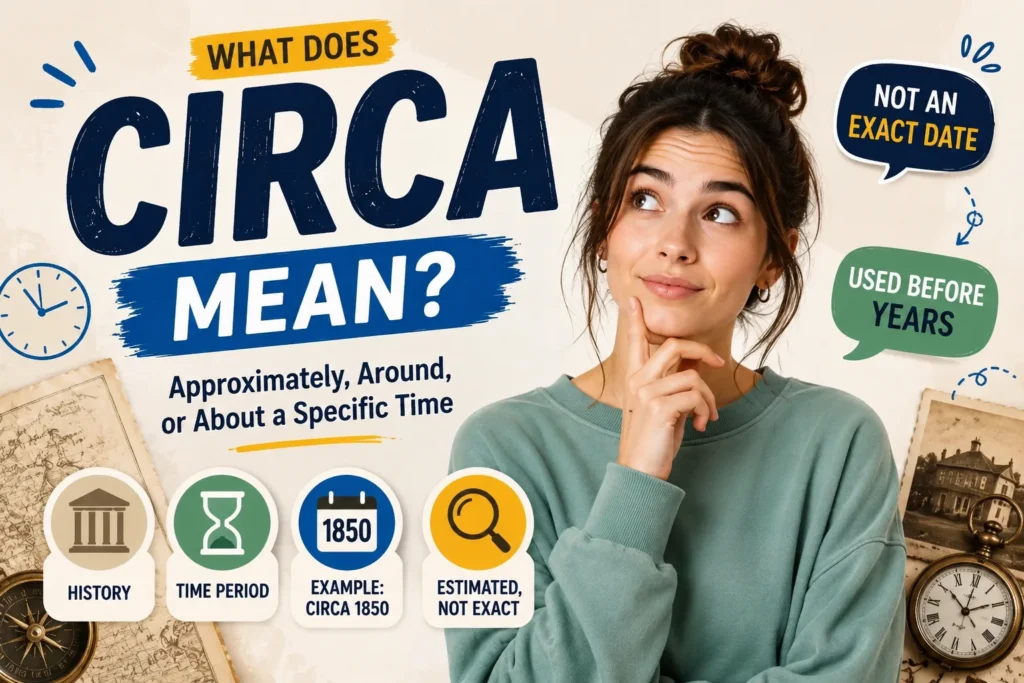

Circa means “approximately,” “around,” or “about” a specific date or time period. It is most commonly used before years when the exact date is unknown, such as circa 1850 or c. 1850. Many people search for its meaning because they see it in history books, antiques, genealogy records, social media posts, or vintage product descriptions and want to know whether it indicates an exact or estimated date.
Unlike internet slang abbreviations, circa is not an acronym or texting abbreviation. It is a traditional word derived from Latin and is widely used in historical, academic, and professional contexts.
What Does Circa Mean?
The word circa comes from Latin and literally means “around” or “approximately.”
When someone uses circa before a year, they are saying the date is estimated rather than exact.
Common Definition
Examples:
- The house was built circa 1920.
- This photograph dates to circa 1945.
- The manuscript was written circa the late 1700s.
In each case, the exact year is uncertain, but the time period is known approximately.
Is Circa an Acronym, Abbreviation, or Slang?
| Term Type | Does Circa Fit? |
|---|---|
| Acronym | No |
| Abbreviation | Sometimes shortened to “c.” |
| Internet Slang | No |
| Formal Word | Yes |
| Historical Term | Yes |
Many people mistake circa for an abbreviation because it is often written as c.
Example:
- c. 1880
- circa 1880
Both mean the same thing.
Why People Search “What Does Circa Mean”
People often encounter the term in:
- History books
- Antique listings
- Museum descriptions
- Family trees
- Property records
- Vintage clothing listings
- Social media captions discussing old items
The confusion usually comes from not knowing whether the date is exact or estimated.
The answer: circa always suggests approximation.
Circa Meaning Across Different Platforms
Circa on TikTok
On TikTok, users often use circa humorously when referencing old photos or earlier life phases.
Example:
“Me circa 2014 thinking skinny jeans would never go out of style.”
In this context, it still means “around that time.”
Circa on Instagram
Instagram users commonly use it in:
- Vintage photography posts
- Throwback content
- Historical accounts
- Fashion pages
Example:
“Family photo, circa 1987.”
Circa on Snapchat
Circa is relatively uncommon on Snapchat because the platform favors shorter slang.
When used, it usually appears in nostalgic captions.
Example:
“Me circa freshman year 😭”
Circa on WhatsApp
WhatsApp users may use it in casual conversations about old events.
Example:
“I think we met circa 2018.”
Circa on X (Twitter)
On X, writers and commentators often use it when referencing:
- Historical events
- Previous internet trends
- Political discussions
- Pop culture moments
Example:
“Twitter circa 2012 was a completely different place.”
Tone & Context Variations
Although the meaning remains consistent, the tone changes depending on how it is used.
Funny Tone
A:
Remember when I thought I’d become a famous singer?
B:
Yeah, circa 2015.
A:
Please don’t remind me.
B:
The videos still exist.
Here, circa playfully references an earlier phase.
Sarcastic Tone
A:
I’ve been waiting forever.
B:
What do you mean?
A:
You said five minutes.
B:
Yeah, circa an hour ago.
The word adds sarcasm to the response.
Playful Tone
A:
When was your gaming obsession?
B:
Circa middle school.
A:
Still looks active.
B:
Some habits never die.
The term creates a lighthearted nostalgic effect.
Serious Tone
A:
Do historians know exactly when this building was constructed?
B:
Not exactly.
A:
What’s the estimate?
B:
Circa 1825.
In formal discussion, the word retains its traditional meaning.
Real Chat Examples
Example 1
A:
How old is that painting?
B:
Experts think it’s circa 1880.
A:
So the exact year isn’t known?
B:
Right.
Example 2
A:
When did your grandparents move here?
B:
Circa the early 1960s.
A:
That’s amazing.
B:
The neighborhood looked completely different then.
Example 3
A:
When was this picture taken?
B:
Circa 2007.
A:
That hairstyle definitely confirms it.
B:
Unfortunately, yes.
Example 4
A:
When did this trend start?
B:
Circa 2020.
A:
Feels longer somehow.
B:
Internet years move fast.
Example 5
A:
How long have you had that guitar?
B:
Circa 2016.
A:
Still looks new.
B:
I take good care of it.
Example 6
A:
When did we first meet?
B:
Circa freshman year.
A:
That long ago?
B:
Time flies.
Example 7
A:
When was your first social media account?
B:
Circa 2011.
A:
You’re a veteran.
B:
Apparently.
Example 8
A:
How old is this restaurant?
B:
Circa 1955.
A:
No wonder it’s famous.
B:
It’s been around forever.
Example 9
A:
When did that rumor start?
B:
Circa last summer.
A:
Makes sense.
B:
That’s when everyone started talking about it.
Example 10
A:
How old is this family heirloom?
B:
Circa the late 1800s.
A:
That’s incredible.
B:
It’s been passed down for generations.
Example 11
A:
When did you become obsessed with coffee?
B:
Circa college.
A:
That explains everything.
B:
Guilty.
Grammar & Language Role
Part of Speech
Circa is generally considered:
- A preposition
- An adverb in some usages
Its main function is to indicate approximation.
Sentence Position
It usually appears:
- Before dates
- Before years
- Before time periods
Examples:
- Circa 1900
- Circa the 1950s
- Circa last decade
Can It Replace a Full Sentence?
No.
Unlike texting slang such as:
- IDK
- LOL
- BRB
Circa cannot stand alone as a complete response.
Formal vs Informal Use
| Usage | Appropriate? |
|---|---|
| Academic papers | Yes |
| Museums | Yes |
| History books | Yes |
| Antique sales | Yes |
| Casual conversation | Yes |
| Business reports | Sometimes |
It is more formal than most internet expressions.
How to Reply When Someone Says Circa
Funny Reply
“That sounds suspiciously specific for an estimate.”
Serious Reply
“Got it, so the exact date isn’t confirmed.”
Flirty Reply
“If we’re talking memories, my favorite era is whenever I’m with you.”
Neutral Reply
“Thanks for clarifying the timeline.”
Comparison Table
| Term | Meaning | Usage Context | Tone | Popularity | Confusion Risk |
|---|---|---|---|---|---|
| Circa | Approximately | Historical dates | Neutral | High | Medium |
| Around | Rough estimate | Everyday speech | Casual | Very High | Low |
| Approximately | Nearly exact estimate | Formal writing | Formal | High | Low |
| Roughly | General estimate | Conversation | Casual | High | Low |
| About | Approximate amount or time | Daily speech | Casual | Very High | Low |
| Exactly | Precise and confirmed | Opposite meaning | Neutral | High | Medium |
Who Uses This Term?
Age Groups
Circa is used by:
- Students
- Historians
- Researchers
- Collectors
- Antique dealers
- Genealogists
Gen Z vs Millennials
Gen Z
- Often uses it humorously online
- Uses it in memes and nostalgic posts
Millennials
- More likely to use it in reference to real dates and events
Regional Usage
Circa is recognized globally because of its Latin origin.
It is commonly used in:
- United States
- United Kingdom
- Canada
- Australia
- Europe
Most Common Platforms
- X
- History forums
- Genealogy websites
- Museum websites
Origin & Internet Culture
Historical Origin
The word comes from Latin circa, meaning:
- Around
- Approximately
- About
Its use dates back centuries and became common in historical scholarship.
How It Entered Internet Culture
Social media revived interest in the term because users began applying it humorously to:
- Old photos
- Childhood memories
- Past fashion trends
- Internet nostalgia
Example:
“Me circa 2010 discovering Facebook.”
Why People Say Circa on TikTok
TikTok creators frequently use the term to frame:
- Before-and-after content
- Throwback photos
- Cringe memories
- Old trends
The word sounds slightly formal, which often makes the joke funnier.
Is Circa Rude or Offensive?
No.
Circa is:
- Not profanity
- Not offensive
- Not rude
- Not controversial
It is considered a standard English borrowing from Latin.
Can You Use It at School?
Yes.
Teachers, professors, and textbooks regularly use it.
Can You Use It at Work?
Yes.
Especially in:
- Research
- Documentation
- Historical reports
- Archives
Real-World Observation
In modern conversation, circa has developed a second life beyond academic writing. While historians use it to indicate uncertainty around dates, social media users often use it humorously to reference old versions of themselves. This combination of serious and playful usage has helped the term remain relevant even centuries after its introduction into English.
FAQ
What does circa mean in text?
In text, circa means approximately or around a particular time. It usually appears before years or date ranges. It signals that the date is estimated rather than exact.
What does c. mean before a year?
The abbreviation “c.” stands for circa. It carries exactly the same meaning. Historians and museums often use it to save space.
Is circa the same as approximately?
Yes, in most cases. Both indicate that something is not exact. Circa is simply more common when discussing dates and historical periods.
Can you use circa in casual conversation?
Yes. Many people use it when estimating dates, especially when discussing memories, old photos, or life events. It sounds slightly more formal than saying “around.”
Is circa a slang word?
No. Circa is not internet slang. It is a traditional Latin-derived term that has been used for centuries.
Why do museums use circa?
Museums often don’t know the exact year an object was created. Using circa allows them to provide the best estimated date based on available evidence.
Does circa mean exactly?
No. Circa specifically indicates uncertainty or approximation. If the exact date is known, there is no need to use circa.
Can adults and students use circa?
Absolutely. The term is appropriate for people of all ages and is commonly used in education, research, and everyday conversation.
What language does circa come from?
It comes from Latin and originally meant “around” or “about.”
Is circa still used today?
Yes. It remains common in academic, historical, and social media contexts.
How do you pronounce circa?
Most English speakers pronounce it as SUR-kuh.
What is the symbol for circa?
The most common abbreviation is c.
Can circa be used with decades?
Yes. For example:
- Circa the 1980s
- Circa the early 1900s
Conclusion
Circa means approximately, around, or about a particular date or time period. It is most often used before years when the exact date is unknown.
Usage Tips
- Use it before estimated dates.
- Use “c.” as a shorter form.
- Use it in historical or timeline discussions.
- Use it for old photos, artifacts, and memories.
Common Mistakes
- Using it when the exact date is known.
- Assuming it is internet slang.
- Treating it as an acronym.
- Using it without a date or time reference.
When to Use It
- Historical discussions
- Antique descriptions
- Genealogy research
- Nostalgic social media posts
When to Avoid It
- Exact dates
- Formal records requiring precision
- Situations where certainty is known