
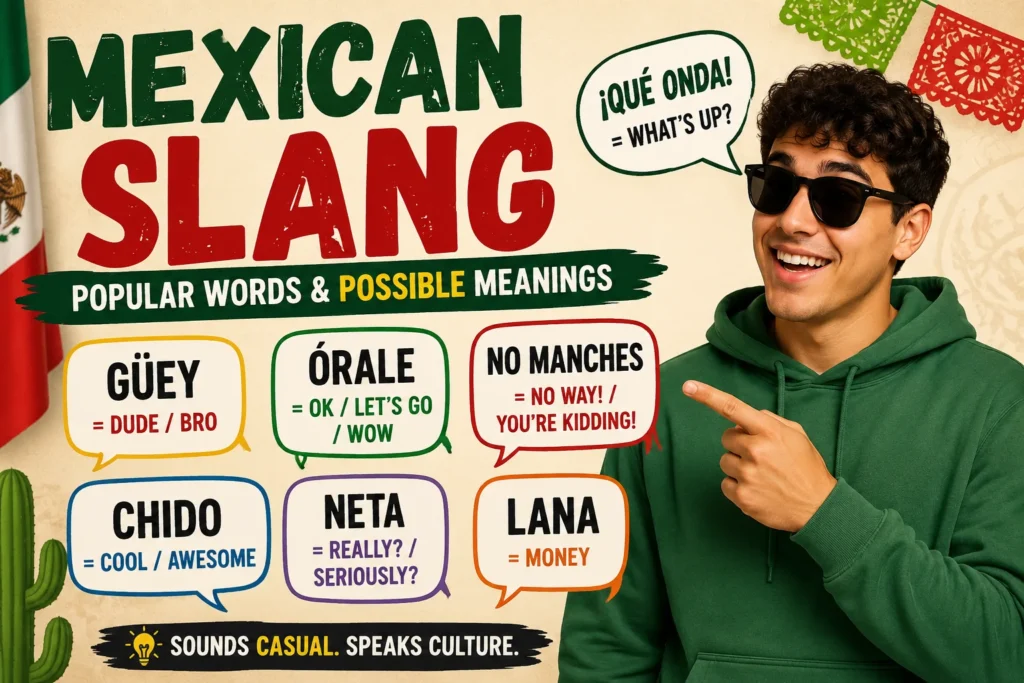

Mexican slang refers to the informal words and expressions used in everyday Mexican Spanish. From famous phrases like güey and no manches to newer internet expressions, these terms help you understand conversations, memes, social media, and authentic Mexican culture.
If you’re learning Spanish, planning a trip to Mexico, or simply curious about words you’ve seen on TikTok, WhatsApp, or Netflix, understanding Mexican slang is essential. Many of these expressions don’t translate literally, which often leaves learners confused. This guide explains the most popular Mexican slang words, how native speakers use them, and when they’re appropriate.
What Is Mexican Slang?
Mexican slang is the collection of informal words, phrases, and expressions commonly used throughout Mexico. Unlike textbook Spanish, slang reflects everyday life, humor, regional traditions, and modern internet culture.
Many expressions have existed for decades, while others continue to evolve through music, television, memes, and social media.
Why Mexican Slang Is Different from Standard Spanish
Spanish is spoken in more than 20 countries, but every country has developed its own unique vocabulary.
For example:
| Standard Spanish | Mexican Slang | English |
|---|---|---|
| Amigo | Güey | Dude / Bro |
| Muy bueno | Chido | Really cool |
| Dinero | Lana | Money |
| Trabajo | Chamba | Work |
Although every Mexican understands standard Spanish, slang makes conversations feel more natural and authentic.
Is Mexican Slang a Dialect?
No.
Mexican slang is not a separate language or dialect.
Instead, it’s the informal vocabulary used within Mexican Spanish.
Think of it like the difference between:
- Formal English
- Everyday American slang
- British slang
- Australian slang
The grammar remains Spanish—the vocabulary simply becomes more casual.
Most Popular Mexican Slang Words
Below are some of the most common expressions you’ll hear throughout Mexico.
Güey (or Wey)
Probably the most famous Mexican slang word.
It usually means:
- Dude
- Bro
- Mate
- Guy
Examples:
¿Qué haces, güey?
“What are you doing, dude?”
Among close friends, it’s friendly.
Used toward strangers, however, it may sound disrespectful.
No Manches
One of Mexico’s most recognizable expressions.
Possible meanings include:
- No way!
- You’re kidding!
- Seriously?
- Come on!
Example:
¡No manches!
“No way!”
Depending on tone, it can express surprise, frustration, or disbelief.
Chido
Means:
- Cool
- Awesome
- Great
- Nice
Example:
Está bien chido.
“That’s really cool.”
Young people use it constantly in casual conversation.
Órale
Perhaps the most flexible word in Mexican Spanish.
Depending on context, it may mean:
- Let’s go.
- Hurry up.
- Wow.
- Okay.
- Really?
Examples:
¡Órale!
“Let’s go!”
or
“Wow!”
Native speakers understand the intended meaning through tone.
Qué Onda
Literally:
“What wave?”
Actual meaning:
- What’s up?
- How’s it going?
- Hey!
Example:
¡Qué onda!
“Hey! What’s up?”
It’s one of Mexico’s most common greetings.
Neta
Neta usually means:
- Really?
- Honestly
- Seriously
- Truth
Examples:
¿Neta?
“Really?”
or
La neta…
“Honestly…”
Chela
Instead of saying cerveza, many Mexicans simply say:
Chela
Meaning:
Beer
Example:
Vamos por unas chelas.
“Let’s go grab some beers.”
Chamba
Meaning:
- Job
- Work
Example:
Tengo mucha chamba.
“I’ve got a lot of work.”
Lana
Literally:
“Wool”
Slang meaning:
Money
Example:
No tengo lana.
“I don’t have any money.”
Fresa
Literally:
Strawberry
Slang meaning:
Someone who is:
- Preppy
- Wealthy
- Fashionable
- Spoiled
Example:
Es muy fresa.
“She’s really preppy.”
Carnal
Means:
- Brother
- Close friend
Example:
Gracias, carnal.
“Thanks, brother.”
Compa
Short for:
Compañero
Meaning:
- Buddy
- Friend
- Mate
Very common throughout northern Mexico.
Jefa / Jefe
Literally:
Boss
Informally, many people use them for:
- Mom
- Dad
Example:
Mi jefa me llamó.
“My mom called me.”
Chamaco
Means:
Kid
Child
Young person
Example:
Ese chamaco tiene mucha energía.
Morra / Morro
Common informal words meaning:
Girl
Boy
Young woman
Young man
Very popular among younger speakers.
Aguas
Literally:
Waters
Actual meaning:
- Watch out!
- Be careful!
Example:
¡Aguas con el carro!
“Watch out for the car!”
Padre
Although it literally means “father,” Mexicans also use it to mean:
- Awesome
- Great
- Excellent
Example:
Está padre.
“That’s awesome.”
Cañón
Depending on context:
- Extremely
- Very difficult
- Really hard
Example:
El examen estuvo cañón.
“The exam was really difficult.”
Gacho
Means:
- Mean
- Bad
- Unfair
Example:
Qué gacho.
“That’s unfair.”
Sale
A common way to say:
- Okay
- Deal
- Sounds good
Example:
Nos vemos mañana.
Sale.
Simón
A casual alternative to:
Sí
Meaning:
Yes.
Example:
¿Vienes?
Simón.
Arre
Increasingly popular among younger generations.
Means:
- Let’s do it.
- Sounds good.
- I’m in.
Example:
¿Vamos por tacos?
¡Arre!
Chale
Expresses disappointment.
Similar to:
- Oh no.
- That’s unfortunate.
Example:
Chale… perdimos.
“Oh no… we lost.”
¡Qué Padre!
Means:
- That’s awesome!
- That’s great!
Frequently heard in family conversations.
Me Late
Means:
- I like that idea.
- Sounds good.
Example:
¿Vamos al cine?
Me late.
Pisto
In some regions of Mexico:
Means:
Alcohol
Drinks
Liquor
Cruda
Means:
Hangover
Example:
Tengo cruda.
“I have a hangover.”
Paro
Means:
Favor
Help
Example:
Hazme un paro.
“Do me a favor.”
Bronca
Means:
Problem
Trouble
Example:
No hay bronca.
“No problem.”
Chismoso
Means:
Someone who gossips.
Example:
No seas chismoso.
“Don’t be so nosy.”
Mexican Slang Continues to Evolve
These are only some of the most widely recognized expressions. New slang appears every year through music, memes, online creators, and younger generations, while classic words like güey, órale, and no manches remain part of everyday Mexican speech across the country.
Mexican Slang on Social Media
Mexican slang has expanded far beyond face-to-face conversations. Thanks to social media, millions of people now encounter expressions like güey, neta, and no manches every day, even if they don’t live in Mexico.
Each platform has its own style, but authentic Mexican slang appears naturally across them all.
Mexican Slang on TikTok
TikTok has become one of the biggest drivers of modern Mexican slang.
Creators use informal expressions to sound genuine and relatable, especially in:
- Comedy skits
- Food reviews
- Lifestyle videos
- Family humor
- Street interviews
- Travel content
You’ll frequently hear words like:
- Güey
- No manches
- Chido
- Neta
- Órale
- Qué onda
Example Caption
No manches, este lugar está bien chido.
Translation:
No way, this place is really awesome.
Mexican Slang on Instagram
Instagram captions often mix Mexican slang with emojis and casual storytelling.
Example:
Qué padre estuvo el viaje 🇲🇽❤️
Translation:
The trip was awesome.
Popular expressions include:
- Chido
- Padre
- Güey
- Neta
- Arre
Mexican Slang on WhatsApp
WhatsApp conversations between family members and friends are full of slang.
Typical messages include:
¿Qué onda?
¿Ya vienes?
Sale.
Arre.
Because WhatsApp feels personal, people rarely use formal Spanish unless speaking to someone older or in a professional group.
Mexican Slang on Snapchat
Snapchat messages are short and informal, making slang feel completely natural.
Common greetings include:
- Qué onda
- Güey
- Simón
- Sale
Voice notes often contain even more regional vocabulary because people speak naturally rather than typing.
Mexican Slang on X (Formerly Twitter)
On X, slang appears throughout:
- Sports commentary
- Memes
- Entertainment
- Politics
- Viral discussions
Because tweets are short, slang helps people express emotion quickly.
Example:
No manches, qué partidazo.
Translation:
No way, what an amazing game.
Tone & Context Variations
One reason Mexican slang is difficult for learners is that the same word can have different meanings depending on tone, facial expressions, and context.
A phrase that sounds friendly among close friends may sound sarcastic or even rude in another situation.
Funny Tone
Friends constantly joke using slang.
Conversation
A: I accidentally ordered ten tacos.
B: ¡No manches!
A: I thought it said two.
B: Looks like you’re eating tacos all week.
Playful Tone
Slang creates warmth and familiarity.
Conversation
A: ¿Qué onda?
B: Todo chido.
A: ¿Listo para salir?
B: ¡Arre!
Serious Tone
Some expressions remain sincere.
Conversation
A: ¿Neta estás bien?
B: Sí, solo estoy cansado.
A: Descansa un poco.
B: Lo haré.
Sarcastic Tone
Tone completely changes the meaning.
Conversation
A: Llegué solo una hora tarde.
B: Órale… qué puntual.
A: Ya sé.
B: Mejor la próxima vez.
Real Mexican Slang Conversations
Here are realistic conversations that sound like everyday Mexican Spanish.
Example 1 – Meeting a Friend
A: ¿Qué onda, güey?
B: Todo bien.
A: ¿Vamos por tacos?
B: Sale.
Example 2 – Watching Soccer
A: ¿Viste el gol?
B: ¡No manches!
A: Estuvo increíble.
B: Fue un golazo.
Example 3 – Shopping
A: Compré unos tenis nuevos.
B: Están bien chidos.
A: Gracias.
B: Buena compra.
Example 4 – Family Chat
A: Ya llegué.
B: Qué bueno.
A: Había muchísimo tráfico.
B: Chale.
Example 5 – Weekend Plans
A: ¿Qué hacemos mañana?
B: Vamos a la playa.
A: Me late.
B: Perfecto.
Example 6 – Restaurant
A: ¿Qué tal la comida?
B: Estuvo padrísima.
A: Hay que volver.
B: Claro.
Example 7 – School
A: El examen estuvo cañón.
B: Sí.
A: Casi no termino.
B: Yo tampoco.
Example 8 – Money
A: ¿Traes lana?
B: Solo un poco.
A: Alcanza para un café.
B: Vámonos.
Example 9 – Work
A: Tengo mucha chamba.
B: Igual yo.
A: Qué semana.
B: Ya casi es viernes.
Example 10 – Instagram DM
A: Tus fotos quedaron bien chidas.
B: Gracias.
A: ¿Dónde fue?
B: En Oaxaca.
Example 11 – Movie Night
A: La película estuvo padre.
B: Sí.
A: Me sorprendió bastante.
B: A mí también.
Example 12 – Everyday Conversation
A: ¿Vienes hoy?
B: Simón.
A: Nos vemos en media hora.
B: Arre.
Grammar & Language Role
Mexican slang isn’t limited to one part of speech. Depending on the word, it can function as a noun, adjective, interjection, greeting, or even a complete response. That’s one reason it feels so natural in everyday conversations.
Parts of Speech
Many Mexican slang words fit into different grammatical categories.
| Slang Word | Part of Speech | Example |
|---|---|---|
| Güey | Noun | Ese güey es mi amigo. |
| Chido | Adjective | Está bien chido. |
| Órale | Interjection | ¡Órale! Vamos. |
| Neta | Interjection / Noun | ¿Neta? |
| Chela | Noun | Vamos por una chela. |
| Lana | Noun | No tengo lana. |
| Chamba | Noun | Tengo mucha chamba. |
| Sale | Interjection | Sale, nos vemos. |
Where Mexican Slang Usually Appears
Most slang appears naturally:
At the Beginning
Examples:
- ¡Órale!
- ¡Qué onda!
- ¡No manches!
These expressions immediately set a casual tone.
In the Middle
Examples:
Ese restaurante está bien chido.
Mi compa llegó temprano.
At the End
Examples:
Nos vemos luego, güey.
Todo bien, sale.
Adding slang at the end often makes a sentence sound friendlier.
Can Mexican Slang Replace an Entire Sentence?
Yes.
Many expressions communicate a complete idea without needing additional words.
Examples:
Neta?
Meaning:
“Really?”
Órale.
Meaning:
“Okay.”
“Let’s go.”
“I understand.”
Sale.
Meaning:
“Sounds good.”
“Deal.”
Arre.
Meaning:
“I’m in.”
“Let’s do it.”
These short replies are extremely common in texting and casual conversations.
Formal vs. Informal Register
Mexican slang belongs almost entirely to informal communication.
Use it when talking with:
- Friends
- Cousins
- Siblings
- Classmates
- Coworkers you know well
- Online gaming friends
Avoid it in:
- Job interviews
- Business emails
- Academic writing
- Official documents
- Customer service interactions
Although some expressions like qué onda are fairly mild, standard Spanish is usually the safer choice in professional settings.
How to Reply Naturally to Mexican Slang
If someone uses Mexican slang with you, you don’t have to know every expression. Understanding the context is usually enough to respond naturally.
Below are several response styles.
Funny Reply
Someone says:
¡No manches!
Possible replies:
- “You haven’t heard the best part yet.”
- “It gets even crazier.”
- “I know—I couldn’t believe it either.”
Someone says:
Qué chido.
Reply:
- “Right? I got lucky.”
- “Glad you liked it.”
- “I thought so too.”
Serious Reply
Someone asks:
¿Neta?
You can answer:
- “Sí, es verdad.”
- “I’m serious.”
- “That’s exactly what happened.”
Someone says:
Tengo mucha chamba.
Reply:
- “Espero que termines pronto.”
- “Good luck with everything.”
- “You’ve got this.”
Friendly Reply
Someone greets you:
¿Qué onda?
Natural responses:
- Todo bien.
- Aquí ando.
- Todo tranquilo.
- ¿Y tú?
Someone says:
Sale.
You can respond:
- Perfecto.
- Nos vemos.
- Ahí estaré.
- Claro.
Neutral Reply
Sometimes simple answers work best.
Examples:
- Sí.
- No.
- Entiendo.
- Gracias.
- Está bien.
- Claro.
These replies fit nearly every conversation.
Comparison Table
Many learners confuse common Mexican slang expressions because several have similar meanings. This table highlights the differences.
| Term | Meaning | Usage Context | Tone | Popularity | Confusion Risk |
|---|---|---|---|---|---|
| Mexican Slang | Informal vocabulary used in Mexico | Everyday conversations | Casual | Very High | High |
| Güey | Dude, bro | Friends | Friendly | Very High | Medium |
| Órale | Okay, wow, let’s go | Casual conversations | Flexible | Very High | High |
| No manches | No way!, You’re kidding! | Surprise | Emotional | Very High | Low |
| Chido | Cool, awesome | Compliments | Positive | High | Low |
| Formal Spanish | Standard Spanish | Professional situations | Formal | Very High | Low |
Güey vs. Amigo
Both refer to another person, but they aren’t identical.
Amigo
- Friend
- Standard Spanish
- Works almost everywhere
Güey
- Dude
- Bro
- Extremely informal
Among close friends it’s normal.
With strangers, it may sound disrespectful.
Chido vs. Padre
Both often mean:
- Cool
- Awesome
However:
Chido is especially common among younger speakers.
Padre is understood across several generations.
Órale vs. Sale
Both can mean “okay.”
Difference:
Órale
Can also express surprise or encouragement.
Sale
Usually means:
- Deal.
- Sounds good.
- Agreed.
No Manches vs. En Serio
Both express surprise.
No manches
Very informal.
Highly emotional.
En serio
More neutral.
Suitable in a wider variety of situations.
Who Uses Mexican Slang?
Mexican slang is used by people of all ages, but the expressions someone chooses often depend on their generation, region, and social circle. While younger speakers tend to adopt newer slang from social media, many classic expressions have remained popular for decades.
Gen Z
Gen Z frequently blends traditional Mexican slang with internet culture and English words.
Popular expressions include:
- Güey
- Arre
- Chido
- Neta
- No manches
- Qué onda
They’re commonly heard on:
- TikTok
- Instagram Reels
- YouTube
- Discord
Many younger speakers also mix Spanish and English naturally, especially in bilingual communities.
Millennials
Millennials generally use long-established slang that’s been common since the early internet and before.
Examples include:
- Órale
- Chela
- Chamba
- Lana
- Sale
- Padre
These expressions remain part of everyday conversations throughout Mexico.
Regional Differences
Although most of the words in this guide are understood nationwide, regional preferences do exist.
Northern Mexico
- More English influence due to proximity to the United States.
- Words like compa are especially common.
Central Mexico
- Mexico City has helped popularize expressions such as güey, neta, and no manches through television, music, and online creators.
Southern Mexico
- Speakers often combine national slang with local vocabulary and indigenous language influences.
If you’re traveling across Mexico, you’ll hear familiar slang almost everywhere, but you’ll also discover regional expressions unique to each area.
Origin & Internet Culture
Mexican slang has developed over centuries through a blend of indigenous languages, Spanish, regional traditions, migration, and modern media. Unlike internet abbreviations, it wasn’t invented overnight—it has evolved alongside Mexican culture itself.
Indigenous Influences
Many everyday Mexican Spanish words trace their roots to Nahuatl, the language of the Aztec civilization, as well as other indigenous languages spoken throughout Mexico.
While not every slang term comes directly from these languages, they have significantly influenced pronunciation, vocabulary, and cultural expressions.
Urban Culture
Large cities—especially Mexico City—have played a major role in spreading slang nationwide.
Television, radio, movies, stand-up comedy, and popular music helped local expressions become part of everyday speech across the country.
Mexican Slang on TikTok
TikTok has introduced Mexican slang to millions of international viewers.
Popular content includes:
- Comedy sketches
- Street interviews
- Family humor
- Food reviews
- Travel vlogs
- Lifestyle videos
Creators often use slang because it sounds authentic and reflects how people naturally speak.
Meme Culture
Many Mexican memes rely on slang for their humor.
Expressions such as:
- No manches
- Güey
- Órale
- Qué onda
- Neta
appear frequently because they’re instantly recognizable to native speakers.
Global Popularity
Streaming platforms, music artists, YouTubers, and TikTok creators have made Mexican slang more recognizable worldwide.
Today, learners often encounter these expressions through:
- Netflix series
- Mexican films
- Podcasts
- Soccer content
- Gaming streams
- Social media creators
Is Mexican Slang Offensive?
Generally, no.
Most Mexican slang is simply informal rather than offensive. However, context matters.
For example:
- Güey is friendly among close friends but may sound disrespectful if directed at a stranger.
- No manches is considered mild and widely accepted in casual conversations, though it’s still informal.
Understanding your audience is the key to using slang appropriately.
Is It Appropriate at School?
Some mild expressions like qué onda or sale are common among classmates, but formal Spanish is usually expected in presentations, essays, and classroom discussions.
Is It Appropriate at Work?
In professional environments, it’s best to avoid slang in emails, meetings, and official communication.
While coworkers who know each other well may casually say órale or sale, standard Spanish is generally more appropriate in the workplace.
Cultural Etiquette
If you’re learning Spanish, using a few common slang words can make conversations feel warmer and more natural. However:
- Don’t overuse slang.
- Avoid copying expressions you don’t fully understand.
- Remember that meanings can vary by region.
Native speakers usually appreciate respectful attempts to learn their language and culture.
Real-World Observation
One of the most fascinating things about Mexican slang is how naturally it creates a sense of closeness. Friends rarely think about whether they’re using slang—they simply speak the way they always have. Expressions like güey, qué onda, and sale help conversations feel relaxed, humorous, and authentic. For language learners, understanding these words isn’t just about vocabulary; it’s about recognizing the cultural tone and emotional connection behind everyday communication.
Frequently Asked Questions
What is the most common Mexican slang word?
The most recognizable Mexican slang word is güey (also spelled wey). It usually means “dude,” “bro,” or “mate” and is used constantly among friends. Although it’s very common, it’s best reserved for casual conversations rather than formal settings.
What does “no manches” mean?
No manches is an informal expression that usually means “No way!”, “You’re kidding!”, or “Seriously?” It’s commonly used to express surprise, disbelief, or frustration. The exact meaning depends on the speaker’s tone and the situation.
Is Mexican slang different from Spanish slang?
Yes. Every Spanish-speaking country has its own slang. While some expressions are understood across Latin America, many Mexican slang words—such as órale, güey, and chido—are unique to Mexico and may not be commonly used in Spain or South America.
Can tourists use Mexican slang?
Yes, but moderation is important. Using simple expressions like qué onda, sale, or gracias, güey with close friends can sound friendly. However, avoid overusing slang or imitating expressions whose meaning you’re unsure about.
Is “güey” considered rude?
Not usually. Among friends, güey is often affectionate and casual. However, calling someone you don’t know güey may sound disrespectful or overly familiar.
What does “chido” mean?
Chido means “cool,” “awesome,” or “great.” It’s one of the most positive and widely used slang adjectives in Mexican Spanish.
Why is Mexican slang popular on TikTok?
TikTok creators use slang because it reflects how people naturally speak. Comedy videos, travel content, family humor, and food reviews often include expressions like neta, no manches, and qué onda, helping viewers learn authentic conversational Spanish.
Is Mexican slang appropriate for business?
Generally, no. Business emails, meetings, presentations, and professional documents should use standard Spanish. Slang is best reserved for casual conversations with friends or people you know well.
Is Mexican slang easy to learn?
Yes. Many common expressions are short and used repeatedly in everyday conversations. Watching Mexican TV shows, YouTube videos, and TikTok creators can help learners become familiar with them quickly.
Why do Mexicans say “órale”?
Órale is one of the most versatile words in Mexican Spanish. Depending on the situation, it can mean “okay,” “wow,” “let’s go,” or “hurry up.” Native speakers understand the intended meaning through tone and context.
Do all Spanish speakers understand Mexican slang?
Not always. While some popular expressions are recognized throughout Latin America, many slang words are specific to Mexico. Spanish speakers from Spain, Argentina, or Colombia may not use the same expressions in daily conversation.
What’s the difference between Mexican slang and Spanglish?
Mexican slang consists of informal Spanish expressions used in Mexico, while Spanglish refers to mixing English and Spanish within the same conversation. Although bilingual speakers may combine both, they are not the same thing.
Conclusion
Mexican slang adds personality, humor, and warmth to everyday conversations. Expressions like güey, chido, qué onda, órale, and no manches are deeply rooted in Mexican culture and help conversations feel natural and authentic. Whether you’re learning Spanish, traveling to Mexico, or simply trying to understand social media, becoming familiar with these expressions will make communication much easier.
Usage Tips
- Learn the most common expressions before exploring regional slang.
- Pay attention to tone and context, as many words have multiple meanings.
- Use slang naturally rather than forcing it into every sentence.
- Listen to native speakers through movies, podcasts, and social media to improve your understanding.
Common Mistakes
- Assuming Mexican slang is used in every Spanish-speaking country.
- Using informal words in professional or academic situations.
- Translating slang literally instead of understanding its cultural meaning.
- Calling strangers güey, which may sound too familiar.
When to Use Mexican Slang
Use it when:
- Chatting with friends.
- Messaging on social media.
- Watching or discussing Mexican entertainment.
- Traveling in casual settings.
When to Avoid Mexican Slang
Avoid it when:
- Writing business emails.
- Giving formal presentations.
- Speaking with people who may not understand informal vocabulary.
- You’re unsure of the expression’s regional meaning.