
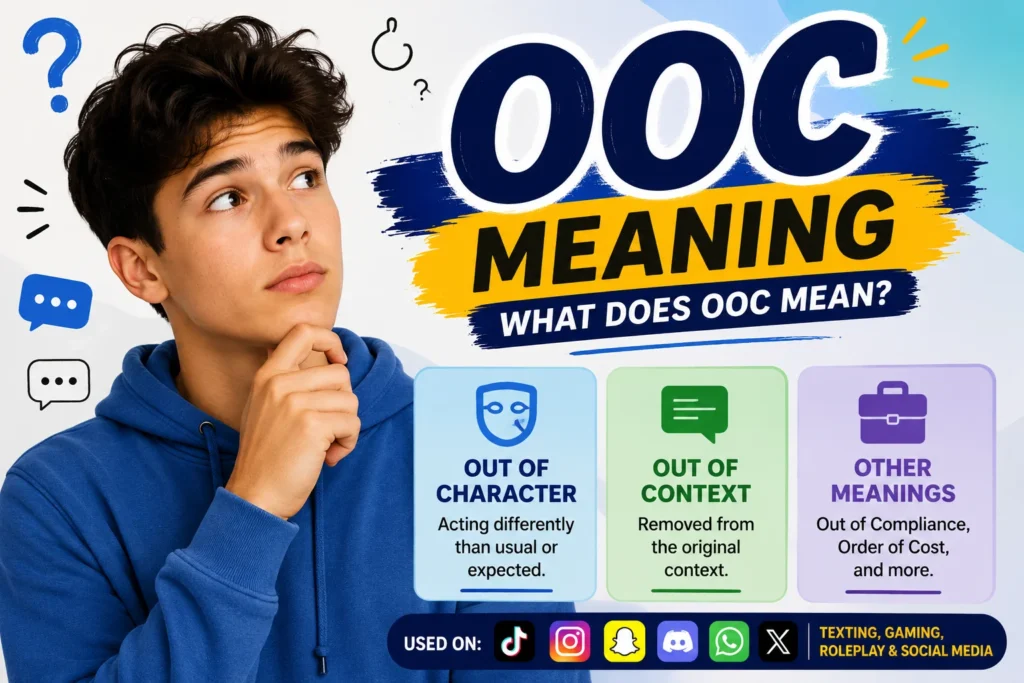

OOC most commonly means “Out of Character,” referring to someone acting differently than usual or stepping outside a role. Depending on the context, it can also mean “Out of Context” or have specialized business meanings, which often causes confusion.
If you’ve seen OOC in a text message, TikTok comment, gaming chat, roleplay community, or social media conversation, you may have wondered what it actually means. Unlike abbreviations with a single definition, OOC has several legitimate meanings. The most common is “Out of Character,” especially in texting, roleplay, and online communities, but it can also stand for “Out of Context” in certain discussions. This guide explains every genuine meaning so you know exactly what someone means based on the situation.
What Does OOC Mean?
The abbreviation OOC has multiple recognized definitions, but one meaning dominates online communication.
1. OOC = Out of Character (Most Common Meaning)
The most common meaning of OOC is “Out of Character.”
It describes someone behaving in a way that doesn’t match their normal personality, habits, or expected behavior.
People commonly use it when discussing:
- Friends acting unusually
- Fictional characters
- Movies and TV shows
- Online roleplay
- Gaming communities
Example:
“That comment was really OOC for him.”
This means the person’s behavior was unusual or unexpected.
2. OOC = Out of Context
Another genuine meaning is “Out of Context.”
People use this when:
- A quote is missing important information.
- A screenshot doesn’t tell the full story.
- A clip has been edited.
Example:
“That video is completely OOC.”
Here, the speaker means the content has been removed from its original context.
Although legitimate, this meaning is less common than Out of Character in casual texting.
3. OOC in Roleplay Communities
In roleplaying communities (Discord servers, online games, fan fiction, and forums), OOC has a very specific meaning.
Players write OOC whenever they’re speaking as themselves instead of as the fictional character they’re playing.
Example:
OOC: I’ll be offline for dinner.
This tells everyone the player—not the character—is speaking.
4. Other Professional Meanings
Outside internet slang, OOC may also represent:
- Out Of Compliance
- Order of Cost
- Other industry-specific abbreviations
These meanings appear in business or technical fields but are rarely encountered in everyday social media conversations.
Is OOC an Acronym, Abbreviation, or Slang?
OOC is an acronym.
Each letter represents the first letter of a phrase:
- Out
- Of
- Character
or
- Out
- Of
- Context
Because it’s frequently used in online conversations, it’s also considered internet slang.
OOC Meaning in Text
When someone sends OOC in a text message, they almost always mean:
Out of Character
They’re saying someone’s actions don’t match their normal personality.
Example:
A: Sarah ignored everyone today.
B: That’s really OOC for her.
This suggests Sarah normally behaves very differently.
What Does OOC Mean in Chat?
In chat conversations, OOC depends on the type of community.
Casual Chat
People usually mean:
Out of Character
Example:
A: He never gets angry.
B: Yeah, that reaction felt OOC.
Gaming or Roleplay Chat
Players use OOC to separate real-life communication from roleplay.
Example:
OOC: I need five minutes.
Everyone immediately understands the player—not the character—is speaking.
OOC Meaning on Different Platforms
The meaning changes slightly depending on where it’s appears.
OOC Meaning on TikTok
TikTok users commonly write OOC when discussing celebrities, influencers, TV characters, or fictional stories.
Example:
That ending felt so OOC.
They’re saying the character behaved differently than expected.
OOC Meaning on Instagram
Instagram users frequently use OOC in comments about:
- TV shows
- Movies
- Celebrities
- Anime
- Fan edits
Example:
That scene was completely OOC.
OOC Meaning on Snapchat
On Snapchat, OOC is less common than abbreviations like FR, TBH, or NGL.
When it does appear, it almost always means:
Out of Character
Example:
You’re acting OOC today.
OOC Meaning on WhatsApp
In WhatsApp chats, friends may use OOC when someone’s behavior seems unusual.
Example:
That message sounded OOC.
OOC Meaning on X (Formerly Twitter)
X users frequently discuss fictional characters, television shows, and public figures.
OOC often appears in fandom discussions.
Example:
The writers made him completely OOC.
This is especially common among fans reviewing new episodes or movies.
Why Do People Say OOC?
People use OOC because it’s much shorter than typing:
- Out of Character
- That’s unlike you
- That’s unusual behavior
It quickly communicates that someone’s actions don’t match what’s normally expected.
Tone & Context Variations
The meaning of OOC stays the same, but the tone changes depending on the conversation. It can sound playful, critical, surprised, or completely neutral.
Understanding the tone helps you decide whether the speaker is joking, concerned, or simply making an observation.
Funny Tone
Friends often use OOC humorously when someone behaves in an unexpected way.
Conversation Example
A: You cleaned your room without being asked?
B: I know. I’m feeling productive today.
A: That’s extremely OOC.
B: Don’t get used to it.
Playful Tone
Close friends may tease each other with the term.
Conversation Example
A: You actually arrived early.
B: Traffic was somehow perfect.
A: This is very OOC for you.
B: I deserve credit for that.
Serious Tone
Sometimes OOC expresses genuine concern.
Conversation Example
A: Jake hasn’t answered anyone all day.
B: That’s really OOC for him.
A: Maybe we should check on him.
B: I think that’s a good idea.
Sarcastic Tone
People occasionally use OOC sarcastically when someone is pretending to be different.
Conversation Example
A: He suddenly claims he loves studying.
B: Wow, completely OOC.
A: You don’t believe him?
B: Not for a second.
Real Chat Examples
Below are realistic conversations showing how OOC naturally appears in texting, fandom discussions, and online chats.
Example 1 – Text Message
Casual
A: Why was Emma so quiet today?
B: Honestly, that felt OOC for her.
A: I noticed it too.
B: She usually talks nonstop.
Example 2 – TV Show Discussion
Fandom
A: What did you think of the finale?
B: The main character felt completely OOC.
A: That’s exactly why I didn’t like it.
B: It didn’t match his personality at all.
Example 3 – Gaming Chat
Gaming
A: OOC: I’ll be back in five minutes.
B: No problem.
A: Thanks for waiting.
B: We’ll continue when you’re back.
Example 4 – Group Chat
Friends
A: Who made breakfast this morning?
B: Mark did.
A: That’s very OOC.
B: We were all shocked.
Example 5 – Relationship
Personal
A: He forgot our date.
B: That’s really OOC for him.
A: That’s why I was surprised.
B: Maybe something happened.
Example 6 – School
School
A: Did the teacher cancel the quiz?
B: Yes.
A: That’s completely OOC for her.
B: I know, she never cancels quizzes.
Example 7 – Instagram Comments
Social
A: Why is everyone saying OOC?
B: They think the celebrity’s reaction was unusual.
A: Oh, that makes sense.
B: It’s a common fandom term.
Example 8 – WhatsApp
Chat
A: Your message sounded angry.
B: Sorry, that was OOC for me.
A: I figured something was wrong.
B: Long day at work.
Example 9 – Roleplay Forum
Roleplay
A: OOC: I need to log off for dinner.
B: Sure, we’ll continue later.
A: Thanks.
B: Have a good meal.
Example 10 – X (Twitter) Discussion
Public
A: Did you see the new episode?
B: Yes, but that decision was OOC.
A: The writers changed him too much.
B: Exactly.
Example 11 – Casual Conversation
Everyday
A: You skipped coffee today?
B: I know. Very OOC.
A: Are you feeling okay?
B: Just trying something new.
Grammar & Language Role
Unlike ordinary words, OOC functions as a conversational acronym.
Part of Speech
OOC is usually treated as an adjective or descriptive phrase.
Examples:
- That reaction was OOC.
- His behavior seemed OOC.
Sentence Position
Most commonly, OOC appears after a linking verb.
Examples:
- That was OOC.
- Her response felt OOC.
It can also appear before a noun in some online communities:
- an OOC moment
- an OOC decision
Can OOC Replace a Full Sentence?
Sometimes.
In fandom or roleplay chats, a single message like “OOC: Need a break” is perfectly normal.
In regular texting, people usually include additional words.
More natural:
- That’s OOC for him.
Less natural:
- OOC.
Formal vs. Informal Register
Informal
Appropriate for:
- Text messages
- Discord
- Gaming chats
- Fandom discussions
- Social media comments
Formal
Avoid in:
- Business emails
- Academic papers
- Professional reports
- Formal presentations
How to Reply When Someone Says OOC
Your response depends on whether the conversation is serious, playful, or analytical.
Funny Reply
- “Who are you and what have you done with the real him?”
- “That’s character development.”
- “I’ll need evidence that this is the same person.”
Serious Reply
- “I noticed that too.”
- “Hopefully everything is okay.”
- “That does seem unusual.”
Flirty Reply
If the conversation is lighthearted:
- “Maybe you’re just trying to impress me.”
- “I’m not complaining about this OOC behavior.”
- “Should I expect more surprises?”
Neutral Reply
- “Good point.”
- “I can see that.”
- “That makes sense.”
- “True.”
Comparison Table
Because OOC has multiple meanings, people often confuse it with other internet abbreviations. The table below compares OOC with similar terms you may encounter in texting, fandoms, and social media.
| Term | Meaning | Usage Context | Tone | Popularity | Confusion Risk |
|---|---|---|---|---|---|
| OOC | Out of Character | Texting, fandoms, gaming, social media | Neutral, descriptive | High | High |
| IC | In Character | Roleplay, gaming, fan fiction | Neutral | Medium | High |
| OOT | Out of Topic | Forums, online discussions | Neutral | Medium | Medium |
| TBH | To Be Honest | Casual texting | Honest | Very High | Low |
| NGL | Not Gonna Lie | Social media, texting | Honest | Very High | Low |
| IC (Opposite) | In Character | Roleplay and storytelling | Neutral | Medium | Low |
OOC vs. IC
These two abbreviations are direct opposites.
- OOC = Out of Character
- IC = In Character
Example:
IC
The knight refuses to leave the castle.
OOC
I’ll be offline for ten minutes.
Roleplayers switch between these two constantly.
OOC vs. OOT
Although similar-looking, they mean completely different things.
- OOC discusses someone’s behavior.
- OOT means Out of Topic, referring to conversations that drift away from the original subject.
OOC vs. TBH
TBH means “To Be Honest.”
Example:
TBH I didn’t enjoy the movie.
Meanwhile:
That reaction was OOC.
One expresses honesty.
The other describes unusual behavior.
OOC vs. NGL
NGL stands for “Not Gonna Lie.”
Like TBH, it’s used to introduce an honest opinion.
OOC, however, evaluates someone’s actions rather than expressing personal honesty.
Who Uses OOC?
OOC has become common across several online communities, but its popularity varies depending on the platform.
Age Groups
OOC is most frequently used by:
- Teenagers
- College students
- Young adults
- Adults involved in fandoms, gaming, or roleplay
Unlike newer slang terms, OOC has been around for years, so its users span multiple generations.
Gen Z vs. Millennials
Gen Z
Gen Z commonly uses OOC while discussing:
- TikTok videos
- TV shows
- Anime
- Gaming
- Internet personalities
Many Gen Z users first encounter the abbreviation through fandom communities.
Millennials
Millennials often recognize OOC because of:
- Online forums
- MMORPGs
- Fan fiction
- Early internet communities
- Roleplaying games
For many Millennials, OOC has been familiar long before TikTok became popular.
Regional Usage
United States
The abbreviation is widely recognized among:
- Gamers
- Anime fans
- Comic communities
- Social media users
United Kingdom
OOC is also understood in the UK, especially among people involved in gaming and online fandoms.
Canada
Canadian internet users generally interpret OOC the same way as American users.
Global Usage
English-speaking online communities around the world use OOC with essentially the same meaning.
Because the abbreviation comes from internet culture rather than regional slang, its meaning stays remarkably consistent internationally.
Platforms Where OOC Is Most Common
Very Common
- Discord
- Tumblr
- X (Twitter)
- Roleplay forums
- Gaming chats
Moderately Common
- TikTok
- Snapchat
Rarely Used
- Professional email
- Workplace messaging
Unlike abbreviations such as LOL, OOC appears much more often within fandoms and gaming communities than in everyday workplace communication.
Origin & Internet Culture
Where Did OOC Come From?
Unlike many modern slang terms, OOC didn’t originate on TikTok.
It became popular during the early internet through:
- Online roleplaying forums
- Multiplayer games
- Fan fiction communities
- IRC chat rooms
- Discussion boards
Roleplayers needed a quick way to distinguish between:
- Character dialogue
- Real-life conversation
“OOC” became the universal shorthand.
Roleplay Roots
The earliest widespread use of OOC appeared in online roleplaying communities.
Example:
IC
My wizard casts a fire spell.
OOC
Sorry, my internet disconnected.
This simple distinction helped players avoid confusion.
Over time, the abbreviation expanded beyond gaming into general internet language.
Fandom Culture
As online fandoms grew, OOC developed another meaning.
Fans began describing fictional characters whose behavior didn’t match their established personalities.
Examples include discussions about:
- TV series
- Movies
- Anime
- Comic books
- Novels
Comments such as:
That ending felt completely OOC.
became extremely common.
Why People Say OOC on TikTok
TikTok users frequently analyze:
- Characters
- Celebrities
- Influencers
- Reality TV personalities
When someone behaves unexpectedly, viewers often comment:
That’s so OOC.
This usage mirrors the fandom meaning rather than the roleplay definition.
Evolution into Everyday Internet Language
The progression looked something like this:
- Online roleplaying communities created widespread usage.
- Gaming communities adopted the abbreviation.
- Fan fiction writers popularized it.
- Social media introduced it to mainstream internet users.
Today, millions of users recognize OOC even if they’ve never participated in roleplay.
Is OOC Offensive?
No.
OOC is not offensive, vulgar, or inappropriate.
It simply describes behavior that differs from what is normally expected.
Does OOC Contain Profanity?
No.
It includes:
- No profanity
- No offensive wording
- No explicit language
It is considered a safe abbreviation for general online discussion.
Is OOC Appropriate at School or Work?
School
Yes.
Students discussing books, literature, or fictional characters often use OOC appropriately.
Teachers in literature or media studies may even recognize the abbreviation.
Workplace
Generally avoid using OOC in professional emails unless everyone understands the term.
Instead of writing:
That response was OOC.
A professional alternative would be:
That response was unusual.
Cultural Sensitivity
Unlike some internet slang rooted in specific communities, OOC is largely neutral.
It doesn’t carry offensive historical or cultural implications.
However, labeling someone’s behavior as “out of character” shouldn’t be used to dismiss genuine emotions or difficult personal situations. Sometimes people behave differently because they’re stressed, tired, or dealing with challenges others can’t see.
Real-World Observation
In real online conversations, OOC has become one of the internet’s most practical shorthand expressions because it instantly communicates that someone’s words or actions feel unusual compared to their normal behavior. Whether fans are debating a television character, gamers are stepping out of roleplay, or friends are noticing someone’s unexpected mood, the abbreviation saves time while conveying a very specific idea. Its longevity comes from its versatility—unlike many trendy slang terms that disappear after a few months, OOC has remained relevant for decades because it fills a genuine communication need across gaming, fandom, and everyday digital conversations.
Frequently Asked Questions
What does OOC mean in text?
In text messages, OOC most commonly stands for “Out of Character.” It’s used when someone behaves differently than they normally do or says something unexpected. For example, if a usually calm friend suddenly gets angry, you might say, “That was really OOC for you.” The abbreviation is common in casual texting and online conversations.
What does OOC mean on Snapchat?
On Snapchat, OOC almost always means “Out of Character.” Friends use it to comment on unusual behavior, surprising reactions, or unexpected messages. Although it isn’t as common as abbreviations like TBH or NGL, many younger users recognize its meaning.
What does OOC mean on TikTok?
On TikTok, OOC frequently appears in comments discussing fictional characters, celebrities, influencers, or viral videos. Users write “That’s OOC” when someone behaves differently from what viewers expect. It’s especially common in fandom communities that analyze TV shows, anime, movies, and online personalities.
Is OOC the same as IC?
No. OOC and IC are opposites. OOC means “Out of Character,” while IC means “In Character.” In roleplaying communities, players switch between these two terms to distinguish between speaking as themselves and speaking as their fictional character.
Is OOC rude or offensive?
No. OOC is a neutral abbreviation that simply describes unusual behavior. It doesn’t contain profanity or insulting language. However, telling someone they’re “acting OOC” during a serious situation may come across as insensitive if they’re experiencing stress or personal difficulties.
Can adults use OOC?
Yes. Adults use OOC frequently, particularly in gaming, fan fiction, online forums, and entertainment discussions. Because the abbreviation has existed since the early internet, it’s actually familiar to many Millennials and long-time internet users, not just Gen Z.
How do you reply when someone says OOC?
Your reply depends on the conversation. If someone points out that your behavior seems unusual, you could explain what happened by saying, “I’ve just had a stressful day,” or “Yeah, I’m not feeling like myself today.” If the conversation is playful, you can respond humorously with something like, “Character development!”
Does OOC have meanings outside texting?
Yes. Outside texting and internet culture, OOC can stand for several professional phrases, including Out of Compliance and other industry-specific abbreviations. However, in social media, gaming, and casual conversations, “Out of Character” is by far the most common meaning.
Does OOC always mean Out of Character?
Most of the time, yes. In texting, gaming, fan fiction, and social media, Out of Character is the standard definition. However, in business, legal, or technical settings, OOC may represent different professional abbreviations. Always consider the context before deciding which meaning applies.
Why do gamers use OOC?
Gamers, especially those involved in roleplaying games, use OOC to indicate they’re speaking as themselves rather than as their character. This helps separate gameplay from real-life communication and avoids confusion during roleplay sessions.
Is OOC popular on social media?
Yes, although it’s more common within fandoms than in general social media conversations. TikTok, X (formerly Twitter), Reddit, Discord, and Tumblr users frequently use OOC when discussing fictional characters or unexpected behavior from public figures.
Can OOC describe real people?
Absolutely. While the term originated in roleplaying communities, it’s now commonly used to describe anyone whose behavior seems unusual. For example, if a normally cheerful coworker appears unusually quiet, someone might say their behavior is OOC.
Conclusion
The OOC meaning depends on the conversation, but in most online settings it stands for “Out of Character.” It’s used to describe someone acting differently than expected, whether that’s a friend, a fictional character, or even a public figure. In roleplaying communities, it also signals that a player is speaking as themselves rather than as their character.
Because OOC has remained relevant across gaming, fandoms, texting, and social media for many years, it’s one of the internet’s most enduring abbreviations. Understanding its context ensures you interpret messages correctly and use the term naturally in your own conversations.
Usage Tips
- Use OOC to describe behavior that feels unusual or unexpected.
- Remember that it commonly means “Out of Character” in texting and fandoms.
- In roleplay communities, use OOC to indicate you’re speaking as yourself.
- Always consider the surrounding conversation before interpreting the abbreviation.
Common Mistakes
- Assuming OOC always means Out of Context.
- Using it in professional emails where readers may not understand the abbreviation.
- Confusing OOC with IC, its opposite in roleplaying.
- Calling someone OOC without considering that real-life stress or circumstances may explain their behavior.
When to Use OOC
Use OOC when:
- Discussing fictional characters.
- Talking about unusual behavior.
- Participating in roleplaying games.
- Chatting casually with friends online.
When to Avoid OOC
Avoid using OOC when:
- Writing formal or professional documents.
- Speaking with people unfamiliar with internet slang.
- Discussing sensitive personal situations where the phrase may sound dismissive.
- Clear, straightforward language would be more appropriate.