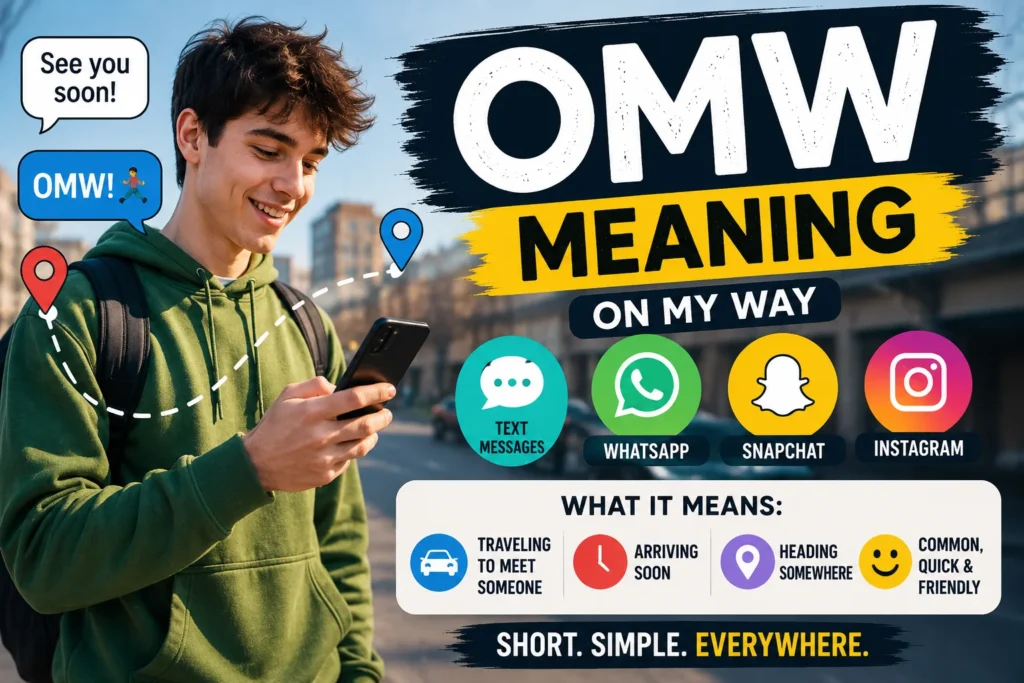

OMW means “On My Way.” It’s a widely used texting abbreviation that tells someone you’re traveling to meet them or will arrive soon. You’ll commonly see OMW in text messages, WhatsApp, Snapchat, Instagram, TikTok, and other online conversations.
Whether you’re waiting for a friend, coordinating plans with family, or replying to a coworker, chances are you’ve seen someone type “OMW.” It’s one of the most common internet abbreviations because it’s short, easy to type, and instantly communicates your status.
Many people search “OMW meaning” after receiving a message like “OMW!” or seeing it in a social media comment. While its primary meaning is simple, the tone and context can change depending on who says it, where it’s used, and whether they’re actually on the way—or just joking.
In this guide, you’ll learn exactly what OMW means, where it came from, how people use it on different platforms, and how to reply naturally.
What Does OMW Mean?
The abbreviation OMW stands for “On My Way.”
People use it to let someone know they have already left, are about to leave, or are currently traveling toward a destination.
For example:
Friend: “Are you almost here?”
You: “OMW!”
That short reply tells the other person you’re heading there without typing a full sentence.
Although OMW usually refers to physically traveling somewhere, it can also be used more casually to mean you’re about to start something.
For example:
“OMW to finish this assignment.”
In this sentence, the speaker isn’t literally traveling—they’re simply saying they’re about to begin working.
Is OMW an Acronym, Abbreviation, or Slang?
OMW is best described as a texting abbreviation or internet acronym.
Here’s why:
- Acronym: It is formed from the first letters of the phrase On My Way.
- Text abbreviation: It saves time when typing messages.
- Internet slang: While not slang in the traditional sense, OMW has become part of everyday digital communication because of its frequent use in chats and social media.
Unlike many slang terms, OMW has only one widely accepted meaning, making it easy to understand across different age groups and platforms.
OMW Meaning in Text Messages
In text messaging, OMW almost always means “On My Way.”
People use it when they want to reassure someone that they’re heading toward a meeting place.
Examples include:
- “OMW, see you in ten.”
- “Running a little late but OMW.”
- “Just left the house. OMW.”
Because texting is designed to be quick and conversational, abbreviations like OMW help people communicate efficiently without typing long explanations.
OMW Meaning in Chat
In online chats, OMW serves the same purpose but can sometimes be used more loosely.
For example:
A: “Can you help me with this project?”
B: “OMW.”
Depending on the situation, this could mean:
- They’re physically coming over.
- They’re opening their laptop.
- They’re joining a voice call.
- They’re about to assist online.
The exact meaning depends on the conversation rather than the abbreviation itself.
OMW Meaning on WhatsApp
On WhatsApp, OMW is one of the most frequently used abbreviations for coordinating plans.
Friends and family often send messages like:
- “OMW 🚗”
- “OMW now.”
- “Traffic is bad but OMW.”
Adding emojis such as 🚗, 🚶, 🚕, or 🚌 makes the message even clearer.
Since WhatsApp is commonly used for real-life coordination, OMW usually refers to actually traveling somewhere.
OMW Meaning on Snapchat
On Snapchat, OMW often appears alongside:
- Snap Map updates
- Selfies
- Photos from the car
- Quick captions
Examples:
- “OMW 😂”
- “Finally OMW!”
- “Coffee first… OMW.”
Because Snapchat focuses on real-time sharing, OMW usually reflects what someone is doing at that moment.
OMW Meaning on Instagram
On Instagram, OMW appears less often in comments but frequently in:
- Stories
- Reels
- Captions
Examples include:
- “OMW to vacation ✈️”
- “OMW to the gym.”
- “OMW to brunch.”
Creators often pair OMW with travel photos or videos to let followers know they’re heading to an event or destination.
OMW Meaning on TikTok
On TikTok, OMW is commonly used in captions and short videos.
Popular examples include:
- “OMW to make another bad financial decision.”
- “OMW to buy something I definitely don’t need.”
- “POV: OMW to meet my online bestie.”
In many TikTok videos, OMW is used humorously rather than literally. The creator may not actually be traveling—they’re simply introducing a funny scenario.
This playful use has helped keep the abbreviation popular among younger users.
OMW Meaning on X (Formerly Twitter)
On X, OMW appears in fast-paced conversations where people share updates in real time.
Examples include:
- “OMW to the game.”
- “OMW home after work.”
- “Coffee first. OMW.”
Because posts on X are often short, abbreviations like OMW fit naturally into the platform’s style.
Why Is OMW So Popular?
OMW has remained one of the most popular texting abbreviations for years because it is:
- Short and easy to type.
- Instantly understood by most English speakers.
- Useful in everyday conversations.
- Appropriate for friends, family, classmates, and coworkers.
- Flexible enough to be used both literally and humorously.
Unlike many internet slang terms that disappear after a trend fades, OMW continues to be useful because people constantly need a quick way to say they’re on their way.
Tone and Context Variations of OMW
Although OMW always means “On My Way,” its tone can change depending on the situation, the relationship between the people chatting, and even the punctuation or emojis that accompany it.
A simple “OMW” may sound calm and straightforward, while “OMW 😂” or “OMW!!!” can completely change the mood of the conversation.
Here are the most common ways people use OMW in everyday digital communication.
OMW in a Serious Tone
In serious conversations, OMW simply provides a status update. The speaker wants the other person to know they’re already heading to the agreed location.
Example Conversation
A: Are you at the hospital yet?
B: Not yet. OMW now.
A: Okay, drive safely. I’ll meet you at the entrance.
This is one of the most common and straightforward uses of OMW.
OMW in a Funny Tone
People often use OMW humorously by exaggerating what they’re “on the way” to do.
Example Conversation
A: There’s free pizza in the office kitchen.
B: OMW! Don’t let anyone take the last slice.
A: Better hurry—it’s disappearing fast.
Here, OMW adds excitement and playful urgency rather than simply describing travel.
OMW in a Playful Tone
Friends frequently use OMW in lighthearted conversations, especially when making casual plans.
Example Conversation
A: I found a café that sells giant milkshakes.
B: OMW already.
A: I knew you’d say that!
The tone suggests enthusiasm and eagerness rather than literal urgency.
OMW in a Sarcastic Tone
Sometimes people use OMW sarcastically when they clearly have no intention of leaving immediately.
Example Conversation
A: You’ve been saying “five more minutes” for half an hour.
B: Fine… OMW 😂
A: I’ll believe it when I see you.
The laughing emoji signals that the speaker is joking about being late.
Real Chat Examples Using OMW
Below are realistic examples showing how OMW appears in everyday conversations across different situations. Each conversation reflects how people naturally text in 2026.
Example 1 – Meeting a Friend
A: Are you still coming?
B: Yep, OMW.
A: Great! I’ll save you a seat.
B: Thanks!
Example 2 – Family Dinner
Mom: Dinner’s almost ready.
You: OMW now.
Mom: Drive carefully.
You: Will do.
Example 3 – Coffee Date
A: I’m already at the café.
B: Sorry, traffic was bad. OMW.
A: No worries. I’ll order your drink.
B: Appreciate it.
Example 4 – Group Project
A: Everyone else is already here.
B: OMW. I’ll be there in five.
A: Perfect.
B: Save me a chair.
Example 5 – Picking Someone Up
A: Ready whenever you are.
B: OMW.
A: I’ll wait outside.
B: Sounds good.
Example 6 – Gym Plans
A: Are we still working out?
B: Definitely. OMW.
A: See you soon.
B: Let’s do it.
Example 7 – Funny Conversation
A: Fresh cookies just came out of the oven.
B: OMW! Don’t eat them all.
A: No promises.
B: Save me at least two.
Example 8 – Online Gaming
A: We’re waiting in the lobby.
B: OMW. Just turning on my PC.
A: Hurry before the match starts.
B: Joining now.
In online gaming, OMW often means someone is about to join rather than physically travel.
Example 9 – Shopping Trip
A: The store closes in twenty minutes.
B: OMW.
A: You should make it.
B: Fingers crossed.
Example 10 – Office Meeting
Coworker: The meeting starts in five.
You: OMW now.
Coworker: Thanks for the update.
You: Almost there.
Example 11 – Airport Pickup
A: I’ve collected my luggage.
B: Perfect. OMW to Terminal 3.
A: I’ll wait outside.
B: See you in a few minutes.
Example 12 – Lighthearted Chat
A: I found your favorite dessert.
B: OMW 😂
A: I knew that would get your attention.
B: Absolutely!
Grammar and Language Role of OMW
Unlike traditional vocabulary words, OMW functions as an abbreviation rather than a standard dictionary word.
Part of Speech
OMW is generally considered a texting abbreviation or internet acronym.
It stands in place of the complete phrase:
“I’m on my way.”
Sentence Position
People usually place OMW:
- As a complete reply
- At the beginning of a sentence
- At the end of a sentence
Examples:
- OMW!
- OMW now.
- I’ll be there soon, OMW.
Can OMW Replace a Full Sentence?
Yes.
This is one reason it became so popular.
Instead of typing:
“I’m on my way now and should arrive shortly.”
People simply type:
OMW
The abbreviation communicates the same idea much more quickly.
Formal vs Informal Use
Informal:
- Friends
- Family
- Group chats
- Social media
- Gaming
Generally acceptable:
- Casual workplace messaging apps like Slack or Microsoft Teams (depending on company culture)
Avoid in formal writing:
- Business emails
- Academic assignments
- Official documents
- Professional reports
In formal situations, writing “I’m on my way” is usually more appropriate than using OMW.
How to Reply When Someone Says “OMW”
The best response depends on the situation and your relationship with the sender.
Funny Reply
- “I’ll start the countdown. 😂”
- “Don’t get distracted on the way!”
- “I’ll believe it when you arrive.”
- “No speeding—we still want you here!”
Serious Reply
- “Drive safely.”
- “See you soon.”
- “Thanks for letting me know.”
- “I’ll be waiting.”
Flirty Reply
If the conversation is already friendly or romantic, you might reply with:
- “Can’t wait to see you ❤️”
- “I’ll save the best seat for you.”
- “Hurry—I miss you already.”
- “Looking forward to seeing you.”
Neutral Reply
- “Okay.”
- “Sounds good.”
- “See you soon.”
- “Thanks.”
These responses work well in both personal and professional conversations.
OMW Compared with Similar Texting Abbreviations
Although OMW is one of the most recognizable texting abbreviations, it’s often confused with several other internet terms. Understanding the differences helps you use each one naturally and avoid misunderstandings.
| Term | Meaning | Usage Context | Tone | Popularity | Confusion Risk |
|---|---|---|---|---|---|
| OMW | On My Way | Traveling to meet someone or starting something | Neutral, friendly | Very High | Low |
| OTW | On The Way | Describes a person or object that is coming | Neutral | High | Medium |
| ETA | Estimated Time of Arrival | Giving an expected arrival time | Practical, informative | High | Low |
| BRB | Be Right Back | Leaving a conversation briefly | Casual | Very High | Low |
| AFK | Away From Keyboard | Temporarily unavailable online | Gaming, work chats | Medium | Low |
| IDC | I Don’t Care | Expressing indifference | Casual, sometimes blunt | High | Low |
HOMW vs OTW
People often think these abbreviations mean exactly the same thing, but there’s a small difference.
OMW (On My Way) usually refers to your own movement.
Example:
“OMW. I’ll be there in ten minutes.”
OTW (On The Way) can describe people, deliveries, or objects.
Example:
“Your package is OTW.”
In everyday texting, many people use them interchangeably, but OMW is more personal.
OMW vs ETA
These abbreviations often appear together.
Example:
A: OMW.
B: Great! What’s your ETA?
Here:
- OMW tells someone you’ve started traveling.
- ETA tells them when you’ll arrive.
OMW vs BRB
These phrases describe completely different actions.
BRB
“I’m stepping away for a minute.”
OMW
“I’m traveling to meet you.”
One refers to leaving a conversation; the other refers to going somewhere.
OMW vs AFK
AFK is mainly used online.
Example:
“AFK for five minutes.”
OMW is generally used for physical movement.
Example:
“OMW to your house.”
OMW vs IDC
These abbreviations express entirely different ideas.
OMW
Shows action.
IDC
Shows attitude.
Example:
“OMW now.”
vs.
“IDC where we eat.”
Who Uses OMW?
OMW is one of the few internet abbreviations understood across nearly every generation.
Unlike newer slang that changes rapidly, OMW has remained popular for decades because it’s useful in everyday life.
Teenagers
Teenagers use OMW constantly while making plans.
Examples include:
- Meeting friends
- Going to school events
- Joining gaming sessions
- Hanging out after class
Because texting is their primary form of communication, abbreviations like OMW save time.
Gen Z
Gen Z continues to use OMW in:
- Text messages
- Snapchat
- Instagram DMs
- TikTok captions
- Discord chats
While Gen Z also creates new slang regularly, OMW remains one of the most practical abbreviations in daily conversations.
Millennials
Millennials helped popularize OMW during the early years of smartphones and instant messaging.
Many still use it regularly because it has become second nature.
You’ll commonly see it in:
- Family chats
- Workplace messaging
- Friend groups
- Travel planning
Adults and Professionals
OMW isn’t limited to younger users.
Adults frequently use it in:
- Microsoft Teams
- Slack
- SMS
- iMessage
Example:
“OMW to the meeting.”
It’s short, professional enough for informal workplace chats, and universally understood.
Regional Usage
One reason OMW has lasted so long is that it isn’t tied to a specific region.
United States
OMW is extremely common throughout the United States.
People of all ages understand it.
United Kingdom
British English speakers also use OMW, particularly in texting and messaging apps.
Although some abbreviations differ between American and British English, OMW is widely recognized.
Canada
Canadian users frequently use OMW in casual conversations.
Its meaning is identical to American usage.
Australia and New Zealand
OMW appears regularly in:
- SMS
- Messenger
- Snapchat
The abbreviation requires little explanation because it’s become part of global internet English.
Global Usage
Because English dominates many online platforms, OMW is now understood by millions of non-native English speakers.
Even people learning English often encounter OMW before they learn other internet abbreviations.
The Origin of OMW
Unlike trendy slang terms with uncertain histories, the origin of OMW is relatively straightforward.
The abbreviation developed naturally as people looked for faster ways to type common phrases during the early years of:
- SMS texting
- Instant messaging
- Online chat rooms
Since mobile phones had small keyboards and character limits, shortening “On My Way” to OMW became an obvious convenience.
As smartphones became widespread, the abbreviation remained popular because it was already familiar.
OMW Before Smartphones
Long before messaging apps existed, people often had strict character limits on text messages.
Typing:
“I’m on my way.”
required far more keystrokes than:
“OMW”
That efficiency helped the abbreviation spread quickly.
OMW in Internet Culture
Unlike many internet slang terms, OMW didn’t become popular because of a meme or viral challenge.
Instead, it grew because it solved a practical communication problem.
Today it’s used millions of times each day simply because it’s convenient.
Why OMW Is Still Popular
Many internet expressions disappear after a few years.
OMW hasn’t.
That’s because people always need a quick way to tell someone they’re coming.
Its popularity comes from usefulness rather than trendiness.
Whether someone is:
- Meeting friends
- Going to work
- Picking up family
- Joining an online game
OMW remains one of the fastest ways to communicate that status.
Is OMW Safe and Appropriate to Use?
Yes.
OMW is considered one of the safest and most universally accepted internet abbreviations.
Is OMW Rude?
No.
The abbreviation itself is completely polite.
However, context still matters.
For example:
If someone has been waiting an hour and you simply reply:
“OMW.”
they may feel frustrated—not because of the abbreviation, but because you’re late.
Does OMW Contain Offensive Language?
No.
OMW contains:
- No profanity
- No explicit language
- No offensive wording
It’s suitable for nearly all audiences.
Can You Use OMW at School?
Yes.
Students commonly use OMW in conversations with classmates and friends.
Teachers may also understand it, although writing the full phrase is usually better in formal assignments.
Can You Use OMW at Work?
Yes—in informal workplace communication.
It’s appropriate in messaging apps like:
- Slack
- Microsoft Teams
- Google Chat
Example:
“OMW to Conference Room B.”
For formal emails, writing “I’m on my way” is generally the better choice.
Real-World Observation
One reason OMW has survived while countless internet abbreviations have faded is its simplicity. Unlike slang that depends on trends or specific online communities, OMW communicates a real-life action people perform every day. Whether someone is heading to a restaurant, joining a video call, or picking up a friend, the abbreviation remains clear, practical, and immediately understood. Its usefulness—not hype—is what has kept it relevant across multiple generations of internet users.
Frequently Asked Questions
What does OMW mean in text messages?
In text messages, OMW stands for “On My Way.” It’s a quick way to tell someone that you’ve already left or are heading to meet them. Instead of typing a full sentence like “I’m on my way,” people often use the abbreviation to save time. It’s one of the most common texting abbreviations used worldwide.
What does OMW mean on Snapchat?
On Snapchat, OMW usually has the same meaning: “On My Way.” You’ll often see it in chats, Story captions, or alongside a Snap Map location. Many users also pair it with emojis like 🚗, 🚌, ✈️, or 🏃 to show they’re traveling somewhere.
What does OMW mean on WhatsApp?
On WhatsApp, OMW is commonly used while making plans with friends, family, or coworkers. It lets the recipient know that the sender has started traveling and should arrive soon. Because WhatsApp is often used for coordinating real-life activities, OMW almost always refers to physically going somewhere.
Is OMW internet slang?
Not exactly. OMW is better described as a texting abbreviation or internet acronym rather than traditional slang. Unlike slang words whose meanings can change over time, OMW has kept the same meaning—“On My Way”—for many years.
Can OMW mean something else?
In everyday texting and social media, “On My Way” is by far the most common meaning. While OMW may represent different phrases in highly specialized industries or organizations, those meanings are uncommon and rarely appear in casual conversations. If someone texts you “OMW,” they’re almost certainly saying they’re on their way.
Can adults use OMW?
Absolutely. OMW isn’t limited to teenagers or Gen Z. Adults frequently use it in text messages, family group chats, workplace messaging apps, and everyday conversations because it’s quick, clear, and widely understood.
H3: How do you respond when someone says OMW?
A natural reply depends on the situation. If you’re waiting for them, you might say “Drive safely,” “See you soon,” or “Thanks for the update.” If you’re joking with a friend, replies like “I’ll believe it when you get here!” or “Don’t keep me waiting!” also fit naturally.
Is OMW appropriate for work?
Yes, in informal workplace chats. OMW is commonly used in Slack, Microsoft Teams, Google Chat, and SMS when letting coworkers know you’re heading to a meeting or office. However, in formal emails or business documents, writing the full phrase “I’m on my way” is generally more professional.
Is OMW the same as OTW?
Not quite. OMW means “On My Way,” while OTW means “On The Way.” OMW is usually used when talking about yourself, whereas OTW can refer to people, packages, food deliveries, or anything else that’s coming.
Does OMW mean you’re already driving?
Not necessarily. It simply means you’re heading toward a destination. You could be driving, walking, taking public transportation, cycling, or even joining an online meeting. The exact meaning depends on the conversation.
Is OMW still popular in 2026?
Yes. Despite the constant evolution of internet slang, OMW remains one of the most widely used texting abbreviations. Its practical meaning and universal recognition have helped it stay relevant across generations.
Should I use OMW in professional emails?
Generally, no. While OMW is perfectly acceptable in casual workplace chats, it’s better to write “I’m on my way” in formal emails or professional correspondence. Using the full phrase creates a more polished and professional impression.
Conclusion
OMW is one of the simplest and most useful internet abbreviations you’ll encounter. It stands for “On My Way” and lets someone know that you’re traveling toward them or about to arrive. Whether you’re texting a friend, replying in a WhatsApp group, sending a Snapchat message, or updating coworkers in Slack, OMW is a quick and universally recognized way to communicate your status.
Unlike many internet slang terms that rise and fall with online trends, OMW has remained popular because it solves a real communication need. Its meaning is clear, it’s easy to type, and people of all ages understand it.
Usage Tips
- Use OMW when you’ve started heading to a location or are about to leave.
- Pair it with an estimated arrival time if someone is waiting for you.
- It’s appropriate for texts, messaging apps, and most casual workplace chats.
- If the situation is formal, write “I’m on my way” instead of using the abbreviation.
Common Mistakes to Avoid
- Don’t use OMW if you haven’t actually left yet, as it may confuse or frustrate the other person.
- Don’t confuse OMW with OTW. OMW usually refers to yourself, while OTW can refer to people, objects, or deliveries.
- Avoid using OMW in formal business emails, where the full phrase is more professional.
- Don’t assume everyone knows internet abbreviations—when communicating with someone unfamiliar with texting shorthand, spelling it out may be clearer.
When to Use and When to Avoid OMW
Use OMW when:
- You’re heading to meet someone.
- You’re updating friends or family about your arrival.
- You’re coordinating plans in text messages or chat apps.
- You’re sending a quick status update in an informal workplace conversation.
Avoid OMW when:
- Writing formal emails or reports.
- Communicating with people who may not understand texting abbreviations.
- You haven’t actually started traveling yet.
- A detailed explanation is needed instead of a brief update.