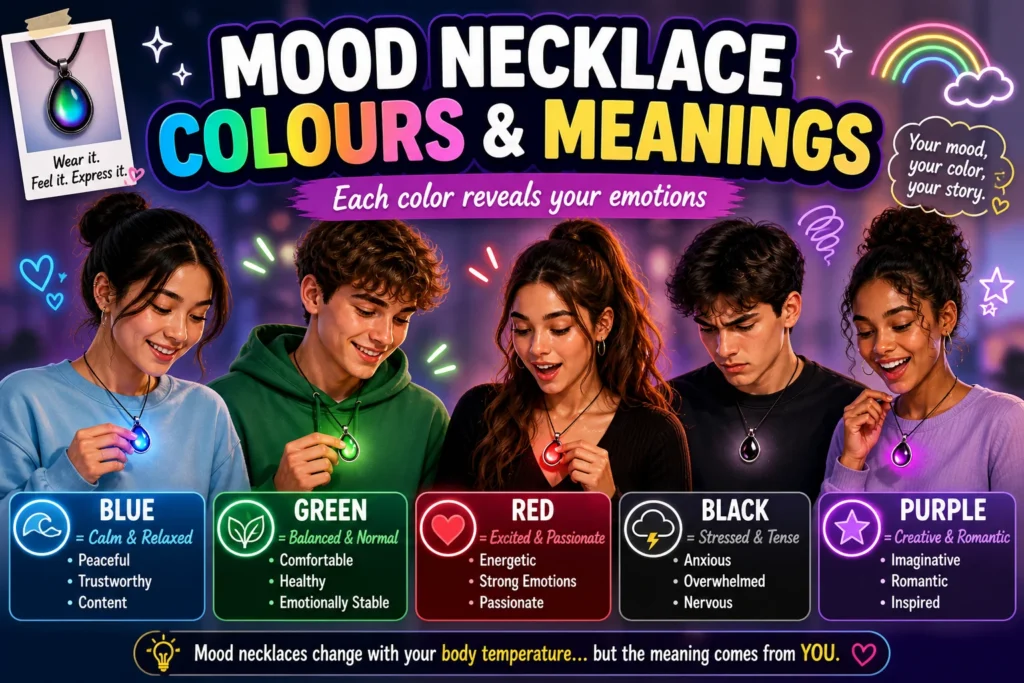

Mood necklace colours and meanings refer to the idea that different colors on a mood necklace represent your emotional state—like blue for calm, red for passion, and black for stress—based on temperature-sensitive materials.
If you’ve ever watched your necklace shift colors and wondered what it actually means, you’re not alone. From TikTok trends to nostalgic fashion, mood necklaces are making a comeback—and people want clear, modern explanations.
Mood Necklace Colours and Meanings – Quick Explanation
A mood necklace is a piece of jewelry that changes color based on body temperature, which is then interpreted as emotional states.
Common meanings include:
- Blue → Calm, relaxed
- Green → Balanced, normal
- Red → Excited, passionate
- Black → Stressed or tense
- Purple → Creative, romantic
Quick examples:
- “My necklace turned blue during the exam—I guess I was calmer than I thought.”
- “It went black when I got nervous talking to him 😭”
- “It’s green today… just a chill mood.”
💎 What Is a Mood Necklace?
A mood necklace is a piece of jewelry that changes colour using thermochromic liquid crystals. These crystals react to temperature changes in your skin. ()
👉 When your body temperature changes (due to emotions or environment), the necklace shifts colour.
🌡️ How Do Mood Necklace Colours Work?
Mood necklaces don’t actually read your mind—they detect temperature changes.
- Warm body = brighter colours (red, pink, orange)
- Cool body = darker colours (black, gray)
- Normal state = green or blue
👉 Emotions can affect body temperature, which is why colours seem connected to feelings. ()
🎨 Mood Necklace Colours and Meanings (Full Chart)
🖤 Black Mood Necklace Meaning
- Cold temperature
- Stress or tension
- Sometimes means the necklace isn’t warmed up
🤎 Brown / Gray Meaning
- Nervous or uneasy
- Mixed emotions
- Low energy
💛 Yellow Mood Necklace Meaning
- Happiness
- Curiosity
- Positive energy
🟢 Green Mood Necklace Meaning
- Balanced emotions
- Calm and stable mood
- Most common “normal” state
🔵 Blue Mood Necklace Meaning
- Relaxed
- Peaceful
- Comfortable
🟣 Purple Mood Necklace Meaning
- Creative
- Emotional
- Imaginative
🟠 Orange Mood Necklace Meaning
- Energetic
- Confident
- Adventurous
❤️ Red / Pink Mood Necklace Meaning
- Love or passion
- Excitement
- High energy
📊 What Each Colour Really Means (Truth Explained)
Most websites miss this:
👉 Mood necklaces measure temperature—not emotions directly
- Stress → lowers skin temperature → darker colours
- Relaxation → increases circulation → blue/green
- Excitement → raises temperature → red/pink
👉 That’s why external factors (weather, AC, exercise) can affect colours.
❗ Why Your Mood Necklace Stays Black
If your necklace is always black:
- You might be in a cold environment
- Your skin isn’t warming it enough
- The necklace may be damaged
👉 Try holding it in your hand to warm it up.
😂 Are Mood Necklace Meanings Accurate?
Not 100%.
Mood necklaces are:
- ✔️ Fun and interactive
- ❌ Not scientifically precise
👉 They reflect temperature changes, which sometimes match emotions.
📱 Why Mood Necklaces Are Trending Again
Mood necklaces are popular because:
- They’re interactive
- They feel personal
- They’re nostalgic (70s & early 2000s trend)
👉 People love checking their “mood” throughout the day.
🔁 Mood Necklace vs Mood Ring
- Necklace = worn on chest (more stable readings)
- Ring = reacts faster (hands change temperature quickly)
👉 Both work the same way.
Meaning & Explanation in Text and Chat
Mood necklace colours and meanings meaning in text
In texting or casual digital communication, people use mood necklace colors metaphorically:
- “I’m in my blue era today” → feeling calm
- “Full black mood necklace vibes” → stressed or overwhelmed
Slang meaning
While not an acronym or short form, it works as a symbolic slang expression. It’s more of a visual metaphor than a typed abbreviation.
What does mood necklace colours and meanings mean in chat?
In chat, it often means:
- Describing emotions indirectly
- Using colors instead of long explanations
- Adding personality to messages
Platform usage (Snapchat, TikTok, Instagram, WhatsApp)
- TikTok: Used in aesthetic videos (“my mood today based on my necklace”)
- Instagram: Caption style (“feeling green today 🌿”)
- Snapchat: Quick emotional hints in stories
- WhatsApp: Casual chat expression between friends
Type of slang
- ❌ Not an acronym
- ❌ Not a short form
- ❌ Not a typo
- ✅ A symbolic internet slang concept
Tone & Context Variations
The meaning shifts depending on tone and situation.
Funny Tone
A: My necklace turned black during math class
B: Same, mine turned invisible 💀
A: Emotional damage level: max
Sarcastic Tone
A: Wow my necklace is blue… guess I’m sooo calm
B: Yeah sure, you were literally yelling 5 mins ago
Romantic Tone
A: It turned purple when I saw you
B: That’s kinda cute not gonna lie
Angry Tone
A: It’s red right now
B: Uh oh… who annoyed you this time?
Playful Tone
A: Mine is green
B: NPC mood 😂
Real Chat Examples (Natural & Relatable)
A: My mood necklace turned black 😭
B: Same, Monday vibes
A: It’s blue today
B: Peaceful queen
A: Why is mine always green?
B: You’re emotionally stable… weird flex
A: It turned red when I saw him
B: OHHH 👀
A: Mine is purple today
B: Creative era unlocked
A: It’s yellow now
B: Happy energy ✨
A: It went black during the interview
B: Anxiety said hello
A: Mine changes every 2 mins
B: Emotional rollercoaster
A: Blue again
B: Calm or pretending?
A: It’s green… boring
B: Or peaceful, depends
A: It turned red after coffee
B: That’s caffeine, not emotion 😂
A: Purple again
B: You’re in love fr
A: Black mode activated
B: Who stressed you out?
A: Mine is yellow
B: Good vibes only
A: It’s stuck on blue
B: Inner peace unlocked
Grammar & Language Role
Part of speech
- Functions as a noun phrase (“mood necklace meaning”)
- Also works as a descriptive expression
Sentence position
- Beginning: “Blue mood necklace today”
- Middle: “I’m feeling like a green mood necklace”
- End: “Yeah… total black mood necklace vibe”
Does it replace a full sentence?
Sometimes yes:
- “Black.” = I’m stressed
Tone impact
- Makes communication more visual
- Adds personality and relatability
Formal vs informal
- ❌ Not formal
- ✅ Highly informal and social
How to Reply When Someone Uses It
Funny Reply
- “Mine turned black just reading your message 😂”
- “Plot twist: it’s broken, not your mood”
Serious Reply
- “Sounds like you’re stressed, take a break.”
- “That color actually means you need rest.”
Flirty Reply
- “Did it turn red when you saw me? 😏”
- “Purple means you’re thinking about me right?”
Neutral Reply
- “Oh nice, what does that color mean?”
- “Interesting, mine is green today.”
Comparison Table
| Term | Meaning | Usage Context | Tone | Popularity | Confusion Risk |
|---|---|---|---|---|---|
| Mood necklace colours | Emotional state via color | Social media, chat | Playful | High | Medium |
| Vibe check | Emotional state check | TikTok, memes | Casual | Very high | Low |
| Energy | Emotional aura | Conversations | Flexible | High | Medium |
| Aura | Spiritual emotional field | Wellness content | Deep | Medium | Medium |
| Mood | General feeling | Everyday chat | Neutral | Very high | Low |
| Poker face (contrast) | No emotion shown | Formal/informal | Neutral | Medium | Low |
Key Insight:
Mood necklace language stands out because it blends visual symbolism with emotional expression, making it more engaging than plain words.
Who Uses This Term?
Age Group
- Mostly Gen Z (13–28)
- Some Millennials for nostalgia
Region
- Popular in US, UK, and globally online
Platforms
- TikTok (main driver)
- Snapchat
- WhatsApp chats
Origin & Internet Culture Insight
Mood necklaces became popular in the 1970s, but their digital comeback is powered by TikTok aesthetics and nostalgia trends.
Why People Say Mood Necklace Colours and Meanings on TikTok
- Visual storytelling
- Relatable emotional content
- Aesthetic appeal
- Easy to understand without words
It fits perfectly into modern fast, visual communication culture.
Safety & Appropriateness
Is it rude?
No, it’s harmless and friendly.
Is it a bad word?
Not at all.
Should you use it in school or office?
- ✅ Casual environments: yes
- ❌ Formal settings: avoid
Experience-Based Insight
In real conversations, people rarely use mood necklace meanings literally. Instead, they use them playfully to express emotions without over-explaining. It’s especially common in friendships where emotional shorthand feels natural.
FAQ
What does mood necklace colours and meanings mean in text?
It refers to using color changes to describe emotions in a symbolic, playful way during conversations.
Is it rude?
No, it’s a fun and harmless expression.
What does it mean on Snapchat?
It’s used to show mood visually, often in stories or captions.
Is it the same as idk?
No. “idk” means “I don’t know,” while this represents emotions.
Can adults use it?
Yes, especially in casual or creative contexts.
How do you respond to it?
You can reply humorously, seriously, or ask about the meaning of the color.
Is it scientifically accurate?
Not really—it’s based on temperature, not actual emotions.
Conclusion
Mood necklace colours and meanings are less about science and more about expression. They give people a fun, visual way to talk about feelings without saying too much.
Usage Tips
- Use in casual chats
- Pair with emojis for better effect
- Keep it playful
Common Mistakes
- Taking meanings too literally
- Using in formal communication
When to Use
- Friends, social media, light conversations
When to Avoid
- Professional settings
- Serious discussions