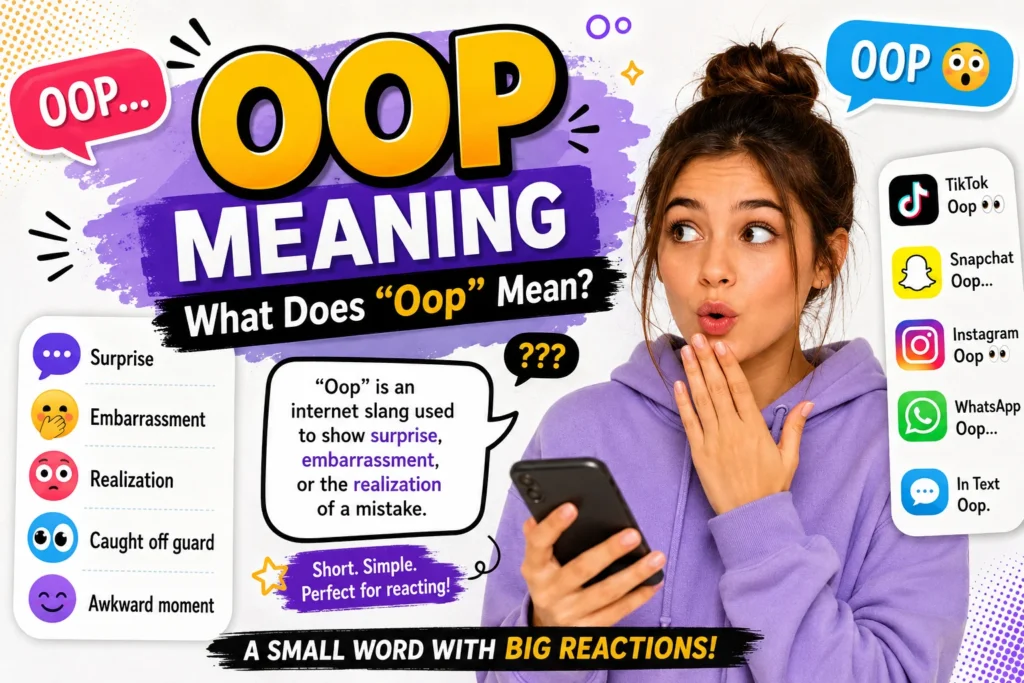

Oop is an internet slang expression used to show surprise, embarrassment, excitement, or the realization of a mistake. It is commonly seen in text messages, TikTok, Snapchat, Instagram, WhatsApp, and other social media platforms.
If you’ve ever received a message saying “oop” or noticed someone commenting “oop 👀” on TikTok or Instagram, you may have wondered what it means. Unlike many internet abbreviations, oop is not an acronym in its most common usage. Instead, it’s a short exclamation that expresses an immediate emotional reaction.
The popularity of “oop” exploded thanks to viral internet culture, memes, and TikTok trends. Today, millions of people use it to react to awkward moments, accidental mistakes, unexpected news, or dramatic situations. However, “OOP” can also have other meanings depending on the context, such as Original Original Poster on Reddit or Object-Oriented Programming in computer science.
This guide explains the oop meaning in text, oop slang meaning, what it means on Snapchat, Instagram, TikTok, and WhatsApp, how people use it in conversations, and when it’s appropriate to use.
What Does Oop Mean?
In internet slang, “oop” is an informal expression used when someone:
- Makes a mistake
- Notices something unexpected
- Feels embarrassed
- Is surprised
- Witnesses drama
- Reacts to shocking news
Think of it as the online version of saying:
- “Oops!”
- “Uh-oh!”
- “Well…”
- “Oh!”
- “Yikes!”
Quick Example
A: I accidentally sent the message to my boss instead of my friend.
B: Oop…
Here, oop shows surprise and sympathy for an awkward mistake.
Oop Meaning in Text
When used in text messages, oop is a casual reaction rather than a complete sentence.
People type it when something unexpected happens.
Example
A: I forgot today was our anniversary.
B: Oop…
The response immediately communicates:
- Surprise
- Mild shock
- Awkwardness
without needing a long explanation.
Because texting encourages short, expressive messages, oop has become a popular part of digital communication.
Oop Slang Meaning
As internet slang, oop expresses an emotional reaction.
Unlike abbreviations such as:
- LOL
- BRB
- IDK
“Oop” is simply an expressive sound people type.
It often replaces words like:
- Oops
- Oh no
- Wow
- Seriously?
- Well then
Example
Friend 1: She just exposed the group chat.
Friend 2: Oop 😬
The slang meaning here is:
“That just got awkward.”
What Does Oop Mean in Chat?
In online chat, oop often appears after:
- Unexpected news
- Funny mistakes
- Relationship drama
- Embarrassing moments
- Accidental messages
Example
A: I accidentally liked his photo from 2018.
B: Oop…
The reaction means:
“I understand how embarrassing that is.”
Another example:
A: My teacher caught me texting.
B: Oop 😅
Again, it expresses surprise mixed with humor.
Oop Meaning on Snapchat
Snapchat users frequently use oop because conversations are casual and fast.
Common situations include:
- Sending snaps to the wrong person
- Relationship gossip
- Funny accidents
- Embarrassing stories
Example
Snap Message
“I just called my teacher ‘Mom.'”
Reply:
“Oop 😂”
The response acknowledges the awkward situation while keeping the mood light.
Oop Meaning on Instagram
On Instagram, oop commonly appears in:
- Comment sections
- Story replies
- Reels
- Meme pages
Users often comment:
- Oop 👀
- Oop—
- Oop lol
These reactions usually mean:
- That’s surprising.
- Someone got exposed.
- Things just became interesting.
Example
A celebrity posts unexpected relationship news.
Top comment:
“Oop 👀”
The commenter is expressing surprise and curiosity.
Oop Meaning on TikTok
TikTok has played a huge role in making oop one of the internet’s most recognizable reactions.
People use it during:
- Storytime videos
- Drama discussions
- Funny clips
- Fail compilations
- Relationship content
Example
A creator accidentally drops their phone while recording.
Comments fill with:
“Oop 😂”
It acknowledges the accident in a playful way.
Oop Meaning on WhatsApp
On WhatsApp, oop is usually exchanged between friends.
It reacts to:
- Unexpected news
- Embarrassing screenshots
- Funny mistakes
- Relationship updates
Example
A: I accidentally sent my shopping list to the family group.
B: Oop 😭
The meaning is:
“That’s unfortunate—but also kind of funny.”
Is Oop an Acronym?
This is one of the biggest points of confusion.
No—Usually It Is Not an Acronym
In everyday texting and social media, oop is not an acronym.
It does not stand for a phrase.
Instead, it is simply an interjection, similar to:
- Oops
- Oh
- Uh-oh
People type it because it sounds natural in conversation.
Is Oop a Short Form?
Yes—sort of.
Many linguists consider oop to be a shortened written form of:
Oops
Instead of typing the entire word, users simply write:
“Oop.”
The shorter version feels quicker and often sounds funnier.
Is Oop a Phonetic Spelling?
Yes.
Unlike abbreviations such as LOL or BRB, oop is essentially a phonetic expression.
It represents the sound someone makes when reacting instantly.
Other examples include:
- Hmm
- Ugh
- Aww
- Eh
- Ooh
These are written versions of spoken reactions.
Is Oop a Typo Turned Slang?
No.
Although it looks like someone forgot to type the final “s” in “oops,” today’s slang usage is intentional.
People purposely write:
“Oop”
because internet culture has adopted it as its own expression.
Tone Variations of Oop
The exact meaning depends on the situation.
Funny Tone
One of the most common uses.
Example
A: I walked into the wrong classroom.
B: Oop 😂
The reaction is playful rather than judgmental.
Sarcastic Tone
Sometimes people use oop sarcastically after someone makes an obvious mistake.
Example
A: I ignored every warning sign.
B: Oop…
The response suggests:
“Well… that didn’t end well.”
Romantic Tone
Friends may jokingly use oop when someone flirts.
Example
A: He finally texted me back.
B: Oop 👀
This implies:
“Something interesting is happening.”
Angry Tone
Oop is rarely angry by itself.
However, context matters.
Example
A: She blamed me for everything.
B: Oop…
The reaction expresses disappointment and disbelief.
Playful Tone
This is probably the most common tone.
Example
A: Guess who forgot their own birthday party?
B: Oop 😂
The word keeps the conversation lighthearted.
Real-Life Mini Conversation Examples
Example 1
A: I dropped my phone in the sink.
B: Oop.
A: It still works somehow.
Example 2
A: I accidentally called my boss “Dad.”
B: Oop 😭
A: Worst day ever.
Example 3
A: She finally replied after three weeks.
B: Oop 👀
A: I wasn’t expecting that.
Example 4
A: I sent the wrong screenshot.
B: Oop…
A: There’s no recovering from this.
Example 5
A: I just won free concert tickets.
B: Oop! Congratulations!
A: Thanks!
Example 6
A: The teacher caught us laughing.
B: Oop 😂
A: We couldn’t stop.
Example 7
A: He proposed today.
B: Oop! That’s amazing!
A: I said yes.
Example 8
A: I forgot my wallet at home.
B: Oop…
A: Guess I’m going back.
Example 9
A: My dog ate my homework.
B: Oop 😂
A: Nobody believes me.
Example 10
A: I spilled coffee on my laptop.
B: Oop…
A: Please don’t remind me.
Grammar and Language Role of Oop
Although oop looks simple, it serves an important role in digital communication. It helps people express emotion quickly without writing a complete sentence. In texting, social media, and casual online conversations, it functions as an interjection rather than a traditional abbreviation.
Part of Speech
The word oop is primarily an interjection.
An interjection is a word or sound used to express an immediate feeling or reaction.
Similar interjections include:
- Oops!
- Wow!
- Oh!
- Yikes!
- Ouch!
- Aww!
Unlike nouns or verbs, interjections don’t describe actions or objects. Instead, they communicate emotions instantly.
Example
“Oop! I almost forgot my keys.”
Here, “oop” expresses sudden realization.
Sentence Position
“Oop” can appear almost anywhere in a conversation.
At the Beginning
Oop, I didn’t see your message.
In the Middle
That was, oop, a little awkward.
At the End
You accidentally sent it to everyone… oop.
As a Standalone Message
Sometimes, a single “oop” is enough.
A: I just texted my ex by mistake.
B: Oop.
The one-word reply communicates surprise, sympathy, and amusement all at once.
Can Oop Replace a Full Sentence?
Yes.
One reason oop became popular is because it can replace an entire reaction.
Instead of saying:
“Wow, that’s embarrassing.”
People simply write:
“Oop.”
The reader understands the emotional response immediately.
Tone Impact
The tone depends entirely on context.
Positive
A: I got promoted!
B: Oop! Congratulations!
Awkward
A: I forgot it was my friend’s birthday.
B: Oop…
Funny
A: I walked into the wrong classroom.
B: Oop 😂
Surprised
A: They’re getting married next week.
B: Oop 👀
Formal vs Informal Use
“Oop” is considered informal internet slang.
Appropriate Situations
✅ Text messages
✅ Snapchat
✅ TikTok
✅ Discord
✅ Casual conversations
Less Appropriate Situations
❌ Academic essays
❌ Business reports
❌ Professional emails
❌ Legal documents
In professional writing, it’s better to use complete expressions like:
- “Oops.”
- “I made a mistake.”
- “That’s surprising.”
15 Real Chat Examples of Oop
Below are realistic conversations that reflect how people actually use oop online.
Example 1
A: I accidentally liked a photo from 2017.
B: Oop…
A: Time to disappear forever.
Example 2
A: I just realized the test is tomorrow.
B: Oop 😅
A: Guess I’m studying all night.
Example 3
A: My little brother exposed my search history.
B: Oop 😂
A: I need a new family.
Example 4
A: She replied after six months.
B: Oop 👀
A: I wasn’t expecting that.
Example 5
A: I called my teacher “Mom.”
B: Oop…
A: I can never go back.
Example 6
A: Guess who broke their phone today?
B: Oop.
A: It was a painful moment.
Example 7
A: I spilled juice on my keyboard.
B: Oop 😭
A: Pray for my laptop.
Example 8
A: I accidentally sent my diary entry to the class group.
B: Oop…
A: My life is over.
Example 9
A: He finally confessed.
B: Oop! That’s exciting.
A: I still can’t believe it.
Example 10
A: We missed the train.
B: Oop.
A: Next one is in an hour.
Example 11
A: She blocked him after one message.
B: Oop 👀
A: That escalated quickly.
Example 12
A: I forgot to submit my homework.
B: Oop 😬
A: Wish me luck.
Example 13
A: My dog stole my sandwich.
B: Oop 😂
A: He looked proud too.
Example 14
A: Everyone heard what I said.
B: Oop…
A: I need a fresh start.
Example 15
A: I won free tickets!
B: Oop! That’s awesome.
A: Best day ever.
How to Reply When Someone Says “Oop”
If someone sends “oop”, your reply should match the mood of the conversation.
Funny Replies
Them: Oop 😂
You: Don’t worry, I embarrass myself professionally.
Them: Oop…
You: I’ll pretend that never happened.
Them: Oop 👀
You: Nothing to see here… maybe.
Serious Replies
Them: Oop.
You: Yeah, that wasn’t my best moment.
Them: Oop…
You: I know. It could’ve gone better.
Them: Oop.
You: Thanks for understanding.
Flirty Replies
Them: Oop 👀
You: Guess I got your attention.
Them: Oop…
You: Still thinking about me?
Them: Oop!
You: Hopefully in a good way.
Neutral Replies
Them: Oop.
You: It happens.
Them: Oop…
You: True.
Them: Oop.
You: Fair enough.
Oop vs Similar Internet Slang
Because oop is an emotional reaction, people sometimes confuse it with other internet slang terms.
| Term | Meaning | Usage Context | Tone | Popularity | Confusion Risk |
|---|---|---|---|---|---|
| Oop | Surprise, awkwardness, sudden realization | Texting, TikTok, Snapchat | Funny, playful | Very High | Low |
| Oops | Admitting a mistake | Everyday conversation | Neutral | Very High | Low |
| LOL | Laughing out loud | Texting, social media | Humorous | Very High | Very Low |
| OMG | Oh my God | Surprise or excitement | Emotional | Very High | Low |
| Yikes | Expressing concern or awkwardness | Casual conversations | Negative or humorous | High | Medium |
| Nice Try (Contrasting) | Used sarcastically when something fails | Online chats | Sarcastic | Medium | Low |
Oop vs Oops
Many people wonder whether these terms mean the same thing.
Oops
- Usually admits your own mistake.
- More traditional English expression.
- Common in speech and writing.
Oop
- Often reacts to someone else’s situation.
- Popular internet slang.
- More playful and meme-based.
Example
Oops: “Oops, I dropped my phone.”
Oop: “Oop… you really sent that?”
Who Uses the Term “Oop”?
“Oop” has become part of everyday internet language, but it’s especially popular among younger users and online communities.
Age Group
The term is most common among:
- Teenagers
- Young adults
- College students
- Social media users under 35
Older users may also recognize it because of its widespread use on TikTok and Instagram.
Gen Z vs Millennials
Gen Z
Gen Z uses oop frequently in:
- Text messages
- TikTok comments
- Snapchat chats
- Instagram Reels
- Discord servers
For many Gen Z users, “oop” is a natural reaction word.
Millennials
Millennials also use oop, although they may be more familiar with the older form, “oops.”
Many millennials adopted “oop” through meme culture and social media.
Regions Where Oop Is Popular
“Oop” is widely understood in English-speaking countries, including:
- United States
- Canada
- United Kingdom
- Australia
- New Zealand
Because of social media, it has also spread to international users who communicate in English.
Platforms Where Oop Is Most Common
You’re most likely to see oop on:
- TikTok
- Snapchat
- X (formerly Twitter)
- Discord
- Facebook comments
- YouTube comment sections
While the meaning remains consistent across platforms, TikTok and Instagram have played the biggest role in making oop a mainstream internet slang term.
Origin and Internet Culture Insight
The word “oop” may seem like a simple expression, but its rise to popularity is closely tied to internet culture, memes, and social media trends. Today, millions of people use it to react to awkward situations, surprising moments, or unexpected drama.
Where Did “Oop” Come From?
Before becoming internet slang, “oop” was simply a natural sound people made after making a mistake or reacting to something unexpected. It is closely related to the English word “oops,” which has been used for decades to express minor accidents or embarrassment.
However, oop became its own internet expression thanks to viral online culture.
The Viral “And I Oop—” Meme
The biggest reason “oop” became famous was the “And I oop—” meme.
In 2015, drag performer Jasmine Masters uploaded a video in which she suddenly stopped mid-sentence after accidentally hurting herself and exclaimed:
“And I oop—”
Although the clip was recorded years earlier, it went viral in 2019 across Twitter, TikTok, Instagram, YouTube, and meme pages.
People began using:
- Oop
- And I oop—
- Oop 👀
- Oop 😂
to react to awkward, funny, or unexpected situations.
Today, many younger internet users know the expression because of this meme, even if they have never seen the original video.
Why People Say “Oop” on TikTok
TikTok helped transform oop from a meme into an everyday internet slang term.
Creators often use it when:
- Someone gets exposed.
- A video takes an unexpected turn.
- A joke lands perfectly.
- Someone embarrasses themselves.
- Relationship drama unfolds.
Example
A creator accidentally reveals an embarrassing secret.
Top comments:
- “Oop 👀”
- “Oop… not the tea.”
- “And I oop 😂”
The word acts as an instant emotional reaction without requiring a long explanation.
VSCO Girl Culture
During 2019, VSCO girl culture also contributed to the popularity of “oop.”
The stereotype included phrases like:
- “And I oop—”
- “Sksksksk”
Although the trend eventually faded, oop remained part of internet vocabulary.
Even today, people still use it naturally in comments and text messages.
Meme Culture and Social Media
Internet memes spread quickly because they are easy to understand and imitate.
“Oop” became popular because it can express many emotions at once, including:
- Surprise
- Embarrassment
- Humor
- Curiosity
- Mild shock
Unlike longer reactions, it only takes three letters to communicate an entire feeling.
Fast Typing Culture
Modern digital communication favors short, expressive words.
Instead of typing:
- “Oops.”
- “Well, that’s awkward.”
- “I wasn’t expecting that.”
Many users simply type:
Oop.
It’s fast, recognizable, and instantly understood by most social media users.
Other Meanings of OOP
Although oop usually refers to the internet slang expression, OOP (written in capital letters) can have other meanings depending on the context.
Understanding these meanings helps avoid confusion.
1. OOP = Original Original Poster
In Reddit communities and repost forums, OOP stands for Original Original Poster.
It refers to the person who originally created a post before someone else shared or reposted it.
Example
“The OOP updated their story today.”
Here, OOP has nothing to do with surprise or slang.
2. OOP = Object-Oriented Programming
In computer science, OOP means Object-Oriented Programming.
It is a programming model based on objects, classes, inheritance, and encapsulation.
Languages that use OOP include:
- Java
- C++
- Python
- C#
- Kotlin
If you’re reading a programming tutorial, OOP almost always refers to Object-Oriented Programming.
3. Other Industry-Specific Meanings
Depending on the field, OOP may have additional meanings.
Examples include:
- Office of Procurement
- Out of Print
- Order of Protection
However, these meanings are far less common than the internet slang version or the computing term.
The correct meaning always depends on the context.
Is Oop Rude?
No.
“Oop” is generally considered a harmless internet expression.
People use it to react to:
- Funny moments
- Small mistakes
- Awkward situations
- Unexpected news
It is not intended as an insult.
However, tone matters.
If someone uses “oop…” after another person’s mistake, it may feel teasing depending on the relationship.
Is Oop a Bad Word?
No.
“Oop” is not profanity, offensive language, or a swear word.
It is considered family-friendly and suitable for most casual conversations.
Should You Use Oop at School or Work?
It depends on the situation.
Appropriate
- Texting classmates
- Casual conversations
- Social media
- Group chats
- Informal workplace chats
Less Appropriate
Avoid using “oop” in:
- Business emails
- Academic essays
- Professional reports
- Formal presentations
In formal writing, complete sentences are usually more appropriate.
Experience-Based Insight
In real online conversations, people rarely stop to think about the definition of “oop.” Instead, they use it instinctively as a quick emotional reaction.
Across TikTok comments, Instagram Reels, Snapchat messages, and WhatsApp chats, oop often appears after someone shares an embarrassing story, surprising announcement, or humorous mistake. Rather than replacing words like “sorry” or “wow,” it serves as a subtle reaction that signals, “I saw that,” “That’s awkward,” or “That escalated quickly.”
This flexibility is one reason the term has remained popular long after the original meme faded.
Frequently Asked Questions About Oop Meaning
What does oop mean in text?
In text messages, oop is an informal expression that shows surprise, embarrassment, or realization after something unexpected happens.
What does oop mean on Snapchat?
On Snapchat, oop is used to react to funny, awkward, or surprising snaps and chat messages. It usually carries a playful tone.
What does oop mean on TikTok?
On TikTok, oop often appears in comments reacting to unexpected moments, drama, or humorous situations. Its popularity grew from the viral “And I oop—” meme.
What does oop mean on Instagram?
Instagram users commonly comment “oop 👀” when reacting to shocking posts, relationship news, or entertaining content.
Is oop an acronym?
No. In everyday texting and social media, oop is not an acronym. It is an interjection or reaction word similar to “oops.”
Can adults use oop?
Yes. Although it is especially popular among Gen Z, people of all ages use oop in casual online conversations.
How do you reply to oop?
Your reply depends on the conversation.
Examples include:
- “It happens!”
- “I know, right?”
- “That was embarrassing.”
- “At least we can laugh about it.”
Is oop the same as oops?
Not exactly.
“Oops” usually admits your own mistake.
“Oop” is often used as a playful reaction to any surprising or awkward situation, whether it happened to you or someone else.
Why do people say “oop” online?
People say oop to react quickly to surprising, awkward, funny, or embarrassing situations without writing a full sentence.
Who made “And I oop” famous?
The phrase became widely recognized after a viral video featuring drag performer Jasmine Masters, and later gained mainstream popularity through memes and TikTok.
Is “oop” still popular?
Yes. While the original meme peaked in popularity around 2019, oop remains a common reaction on TikTok, Instagram, Snapchat, and texting apps.
Can “oop” be used in real conversations?
Yes. Many people say “oop” out loud as well as type it in text messages and social media comments.
Does “oop” always mean someone made a mistake?
No. It can also express surprise, excitement, curiosity, or reacting to unexpected news.
Is “oop” positive or negative?
It can be either. The meaning depends entirely on the context and tone of the conversation.
What’s the difference between “oop” and “OMG”?
Oop is usually a quick reaction to awkward or surprising moments, while OMG expresses stronger shock, excitement, or disbelief.
Is “oop” appropriate for children?
Yes. Since it is not a swear word or offensive slang, oop is generally considered suitable for all ages.
Final Thoughts
The oop meaning is simple but incredibly versatile. In modern internet slang, oop is an interjection used to express surprise, embarrassment, amusement, or the sudden realization that something unexpected has happened.
Whether you encounter it in a text message, on TikTok, Snapchat, Instagram, WhatsApp, or another social media platform, it usually carries the same playful meaning.
Although OOP can also stand for Original Original Poster on Reddit or Object-Oriented Programming in technology, these meanings depend on context. In everyday chats and social media conversations, people almost always use oop as a quick emotional reaction.
Quick Usage Tips
- ✅ Use oop in casual conversations with friends.
- ✅ Use it to react to funny, awkward, or surprising moments.
- ✅ It’s appropriate on TikTok, Snapchat, Instagram, WhatsApp, and in text messages.
- ❌ Avoid using it in formal emails, academic writing, or professional reports.
Common Mistakes to Avoid
- Don’t assume oop is an acronym in casual chats—it usually isn’t.
- Don’t confuse oop (internet slang) with OOP (Original Original Poster or Object-Oriented Programming).
- Don’t overuse it in situations that require clear or formal communication.
Understanding how oop is used will help you interpret online conversations more naturally and communicate like a confident social media user.