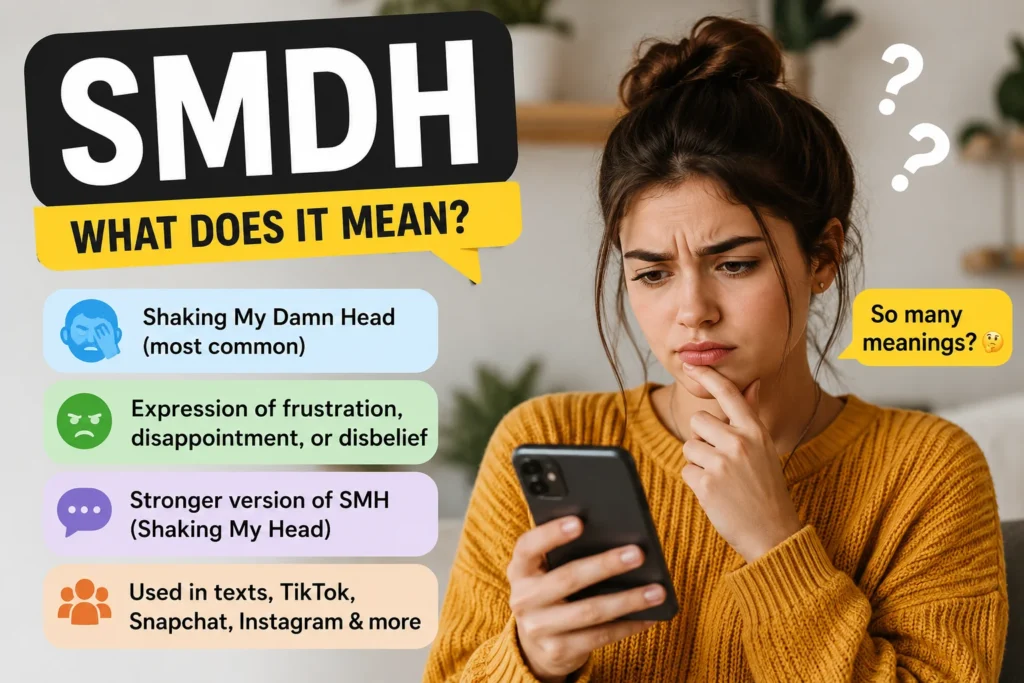

SMDH stands for “shaking my damn head.” It is a popular internet and texting acronym people use to express frustration, disappointment, disbelief, or annoyance. Compared with SMH (“shaking my head”), SMDH carries a stronger emotional tone and emphasizes a more intense reaction.
If you’ve seen someone type “SMDH” in a text message, TikTok comment, Instagram post, Snapchat chat, or WhatsApp conversation, you’re not alone. The abbreviation has become a common part of internet slang, especially among younger users who want to react quickly without typing a full sentence.
In most situations, SMDH is used when someone does or says something that seems foolish, unbelievable, disappointing, or simply frustrating. Instead of writing, “I can’t believe you did that,” people often respond with a simple “SMDH.”
This guide explains the SMDH meaning, how people use it across different social media platforms, when it’s appropriate to use, how it differs from SMH, and how to respond naturally when someone sends it.
What Does SMDH Mean?
SMDH stands for:
Shaking My Damn Head
It is an internet slang acronym used to express a stronger version of disbelief or disappointment.
People commonly use SMDH when they feel:
- Frustrated
- Annoyed
- Disappointed
- Embarrassed for someone else
- Shocked by someone’s decision
- Amazed by how unreasonable something sounds
Unlike many internet abbreviations, SMDH communicates emotion rather than information. It’s a reaction, similar to rolling your eyes or shaking your head in real life.
For example:
“You forgot your passport again? SMDH.”
The speaker is expressing frustration and disbelief at someone’s repeated mistake.
Another example:
“He stayed up gaming instead of studying. SMDH.”
Here, the acronym suggests the speaker thinks the decision was irresponsible or disappointing.
SMDH Meaning in Text
In text messages, SMDH is usually a quick way to show disappointment without starting an argument.
Examples include:
- SMDH, I told you that yesterday.
- You missed the meeting again? SMDH.
- You really believed that rumor? SMDH.
Instead of writing an entire sentence explaining frustration, users often send SMDH because it immediately communicates their reaction.
The tone can range from playful teasing among friends to genuine disappointment, depending on the conversation.
What Does SMDH Mean in Chat?
In online chats, SMDH functions as a reaction rather than a complete statement.
You’ll often see it after:
- A surprising opinion
- A careless mistake
- An unbelievable story
- A frustrating situation
- A disappointing outcome
Example:
Alex: I accidentally deleted the project.
Taylor: SMDH… Did you at least have a backup?
Here, SMDH shows frustration while still continuing the conversation.
SMDH Meaning on Snapchat
On Snapchat, SMDH is commonly used between close friends.
Someone might send:
- SMDH 😂
- Bro… SMDH
- Seriously? SMDH
The addition of laughing emojis often softens the meaning, making it playful rather than harsh.
Example:
Friend 1: I forgot my phone at home.
Friend 2: SMDH 😂 That’s so you.
Although the speaker is expressing disbelief, the conversation remains friendly.
SMDH Meaning on Instagram
Instagram users frequently use SMDH in:
- Comments
- Captions
- Stories
- Direct Messages
Example comment:
“People still fall for these fake giveaways… SMDH.”
Example caption:
“Missed my flight because I overslept. SMDH.”
In both cases, the abbreviation communicates disappointment while keeping the message short.
SMDH Meaning on TikTok
TikTok has helped popularize many internet abbreviations, including SMDH.
You’ll often find comments like:
- SMDH, that’s crazy.
- Y’all really believe this? SMDH.
- SMDH… people never learn.
Creators also use it in captions to react to trending topics or humorous situations.
On TikTok, SMDH often accompanies videos showing:
- Bad decisions
- Funny fails
- Embarrassing moments
- Controversial opinions
- Unexpected plot twists
SMDH Meaning on WhatsApp
WhatsApp conversations are usually more personal, so SMDH often appears between family members or close friends.
Example:
Sam: I left my laptop at work again.
Chris: SMDH 😂 You need a checklist.
Here, the abbreviation expresses mild frustration while keeping the conversation lighthearted.
Is SMDH an Acronym?
Yes.
SMDH is an acronym (more precisely, an initialism) formed from the first letters of:
- Shaking
- My
- Damn
- Head
Unlike ordinary words, each letter represents a separate word in the phrase.
Is SMDH a Short Form?
Yes.
SMDH is a shortened way of writing the complete phrase “shaking my damn head.”
Internet users created it to save time while texting and posting online.
Because it’s concise and expressive, it has become a widely recognized texting abbreviation.
Is SMDH a Phonetic Spelling?
No.
Unlike words such as finna, tryna, or gonna, SMDH is not based on pronunciation.
It is simply an acronym created from the initials of a longer phrase.
Is SMDH a Typo Turned Slang?
No.
SMDH was intentionally created as an internet abbreviation. It did not develop from a typing mistake or misspelling.
Instead, it evolved naturally alongside other popular online abbreviations like:
- SMH
- LOL
- IDK
- TBH
- IMO
Tone and Context Variations
Although SMDH always expresses some form of disappointment or disbelief, its exact meaning changes depending on the speaker’s tone.
Funny Tone
Friends often use SMDH while joking about harmless mistakes.
Emma: I locked my keys in the car again.
Liam: SMDH 😂 You need spare keys.
The tone is playful rather than critical.
Sarcastic Tone
Sometimes the abbreviation is used to mock an obviously unrealistic statement.
Chris: I’m going to finish a month’s work tonight.
Jordan: SMDH… sure you are.
The response expresses disbelief with sarcasm.
Romantic Tone
Partners may use SMDH to tease each other affectionately.
Taylor: You forgot our movie night again.
Alex: SMDH ❤️ I’ll make it up to you.
The heart emoji softens the criticism.
Angry Tone
During arguments, SMDH can sound much more serious.
Person A: I ignored every message you sent.
Person B: SMDH. That’s really disrespectful.
Here, the abbreviation reflects genuine disappointment rather than humor.
Playful Tone
Among friends, this is the most common usage.
Mia: I spent all my money on snacks.
Noah: SMDH 😂 No regrets though?
The conversation stays light while still expressing mild disbelief.
Grammar and Language Role
Although SMDH is an acronym, it behaves more like a reaction than a traditional word. It doesn’t follow normal grammar rules because it represents an emotional response rather than a noun or verb.
Understanding how people use it in sentences helps you recognize its meaning instantly.
Part of Speech
SMDH is best described as an interjection or internet reaction acronym.
Like expressions such as “wow,” “ugh,” or “seriously?”, it communicates emotion rather than adding grammatical information.
Examples:
- SMDH, I can’t believe that happened.
- You forgot your ticket again? SMDH.
Sentence Position
SMDH can appear almost anywhere in an informal message.
At the beginning
SMDH, you missed another deadline?
This immediately tells readers the speaker is disappointed.
In the middle
I was waiting for you, SMDH, and you never showed up.
Here it adds emotional emphasis.
At the end
You spent all your money on shoes again… SMDH.
Ending with SMDH is probably the most common usage because it works like a final reaction.
Can SMDH Replace a Full Sentence?
Yes.
In casual conversations, SMDH often stands alone.
Example:
Alex: I accidentally deleted the entire presentation.
Jordan: SMDH.
The acronym alone clearly communicates disappointment without needing additional explanation.
Tone Impact
The meaning of SMDH depends heavily on context.
It may sound:
- Lighthearted among friends.
- Sarcastic in debates.
- Disappointed between family members.
- Critical during arguments.
Adding emojis often changes the tone.
For example:
- SMDH 😂 → playful teasing.
- SMDH… → disappointment.
- SMDH 🤦 → frustration.
- SMDH 😑 → annoyance.
Formal vs. Informal Use
SMDH belongs to informal digital communication.
It’s appropriate for:
- Text messages
- Snapchat
- TikTok
- Discord
- Online gaming chats
Avoid using it in:
- Business emails
- Academic assignments
- Professional reports
- Formal presentations
- Job applications
In professional communication, writing the full thought is much clearer and more appropriate.
Real Chat Examples
Below are realistic conversations showing how people naturally use SMDH in everyday texting.
Conversation 1
A: I forgot my wallet at home again.
B: SMDH 😂 You seriously need a checklist.
A: I know… it’s becoming a habit.
Conversation 2
A: I stayed up until 3 AM watching videos.
B: SMDH. No wonder you’re tired.
A: Worth it… maybe.
Conversation 3
A: I missed the bus by ten seconds.
B: SMDH. That hurts.
A: Worst morning ever.
Conversation 4
A: I accidentally sent the message to my boss instead of my friend.
B: SMDH 😭 That’s rough.
A: I wanted to disappear.
Conversation 5
A: I left my charger at the hotel.
B: SMDH. You always leave something behind.
A: You’re not wrong.
Conversation 6
A: I bought concert tickets without checking the date.
B: SMDH 😂 Please tell me you’re joking.
A: I wish I was.
Conversation 7
A: I skipped breakfast and now I’m starving.
B: SMDH. That’s on you.
A: Lesson learned.
Conversation 8
A: I watched the movie before reading any reviews.
B: SMDH. Did you at least enjoy it?
A: Surprisingly, yes.
Conversation 9
A: I forgot our group meeting today.
B: SMDH. We were waiting for you.
A: I’m so sorry.
Conversation 10
A: I believed that fake giveaway post.
B: SMDH 😂 They trick people every week.
A: I definitely learned my lesson.
Conversation 11
A: I accidentally liked a photo from 2018.
B: SMDH 😭 That’s embarrassing.
A: I closed the app immediately.
Conversation 12
A: I spent all my paycheck in one weekend.
B: SMDH. Budgeting exists for a reason.
A: Next month will be different.
Conversation 13
A: I forgot my friend’s birthday.
B: SMDH. Better send a message now.
A: Already working on it.
Conversation 14
A: I started a TV series at midnight.
B: SMDH. Let me guess—you finished the whole season?
A: Don’t judge me.
Conversation 15
A: I lost my sunglasses five minutes after buying them.
B: SMDH 😂 That’s actually impressive.
A: I’m trying not to laugh.
How to Reply When Someone Says “SMDH”
If someone sends SMDH, your reply should match the conversation’s tone.
Funny Replies
- Fair enough 😂
- I deserved that.
- You caught me.
- I know, I know.
- Don’t remind me.
Serious Replies
- You’re right. I’ll do better.
- I understand why you’re frustrated.
- That’s my mistake.
- I appreciate the honesty.
- Thanks for pointing it out.
Flirty Replies
- Still like me though? 😉
- Don’t shake your head too hard 😅
- I’ll make it up to you.
- You know you can’t stay mad at me.
- I’ll behave next time.
Neutral Replies
- I get what you mean.
- That’s understandable.
- True.
- Good point.
- I’ll keep that in mind.
Comparison Table
| Slang Term | Meaning | Usage Context | Tone | Popularity | Confusion Risk |
|---|---|---|---|---|---|
| SMDH | Shaking my damn head; strong disappointment or disbelief | Texting, social media, comments | Strong, frustrated | High | Low |
| SMH | Shaking my head | Everyday online conversations | Mild disappointment | Very High | Very Low |
| IDK | I don’t know | Casual texting | Neutral | Very High | Very Low |
| TBH | To be honest | Opinions and honesty | Neutral | High | Low |
| OMG | Oh my God | Surprise or excitement | Emotional | Very High | Very Low |
| LMK | Let me know | Requests for information | Neutral | High | Very Low |
SMDH vs. SMH
Many people confuse SMDH and SMH because they’re closely related.
The difference is simple:
- SMH expresses disappointment or disbelief.
- SMDH expresses the same emotions but with stronger emphasis.
Think of SMDH as a more dramatic version of SMH.
Who Uses SMDH?
SMDH is widely recognized across the internet, but some groups use it more frequently than others.
Age Group
You’ll most commonly see SMDH used by:
- Teenagers
- College students
- Young adults
- Active social media users
Older adults may understand it but often prefer typing full words.
Gen Z vs. Millennials
Gen Z
- Uses SMDH regularly in comments and messages.
- Often combines it with emojis and memes.
Millennials
- More likely to alternate between SMH and SMDH.
- Commonly use it in texting and group chats.
Both generations understand the acronym, although Gen Z tends to use it more frequently.
Regional Usage
SMDH is most common in:
- United States
- Canada
- United Kingdom
- Australia
Because English-language internet culture spreads globally, you’ll also see it used in many other countries.
Platforms Where It’s Most Common
Today, SMDH appears on:
- TikTok
- Snapchat
- X (formerly Twitter)
- Discord
- YouTube comments
- Online gaming chats
The acronym has become part of everyday digital communication because it quickly expresses an emotional reaction without requiring a full explanation.
Origin and Internet Culture Insight
Understanding where SMDH came from helps explain why it remains one of the most recognizable internet slang terms today.
The Origin of SMDH
SMDH evolved from the more common abbreviation SMH, which stands for “shaking my head.” As online conversations became faster and more expressive, internet users added the word “damn” to emphasize a stronger emotional reaction.
Instead of simply expressing mild disappointment, SMDH communicates greater frustration, disbelief, or annoyance.
Unlike many viral slang words that begin on a single platform, SMDH spread naturally through:
- Text messaging
- Online forums
- Social media
- Chat rooms
- Gaming communities
Its popularity grew because it’s short, expressive, and easy to understand once you know what it stands for.
Why People Say SMDH on TikTok
Although SMDH existed long before TikTok, the platform introduced it to a much larger audience.
Today, TikTok users often comment:
- SMDH 😂
- Y’all really believe this? SMDH.
- Bro… SMDH.
Rather than typing a long explanation, viewers use the acronym to react instantly to:
- Funny mistakes
- Poor decisions
- Unexpected plot twists
- Viral challenges
- Controversial opinions
Because TikTok comments are intentionally brief, abbreviations like SMDH fit naturally into conversations.
Meme Culture and Online Communication
Modern internet culture rewards quick reactions.
Instead of writing:
“I can’t believe someone actually did that.”
Many people simply type:
SMDH
This makes conversations:
- Faster
- More expressive
- Easier to read
- More relatable
Memes, reaction images, and GIFs have also helped keep SMDH relevant, especially when paired with emojis such as 🤦, 😑, or 😂.
Fast Typing Culture
One reason internet slang survives is convenience.
Abbreviations like:
- LOL
- BRB
- IDK
- SMH
- SMDH
allow people to express complete thoughts in just a few characters.
SMDH is a perfect example of how digital communication continues to prioritize speed without losing emotional impact.
Is SMDH Rude?
Not usually.
On its own, SMDH is not considered offensive. It simply communicates frustration, disbelief, or disappointment.
However, context matters.
Among friends, it often feels playful:
“You forgot your keys again? SMDH 😂”
During an argument, the same acronym can sound more critical:
“SMDH. You never listen.”
The relationship between the people involved determines whether it feels humorous or disrespectful.
Is SMDH a Bad Word?
Not exactly.
The letter “D” represents the word “damn.”
Many English speakers consider damn to be mild profanity, while others don’t view it as offensive at all.
Because the word isn’t written out in the acronym, SMDH is generally considered less direct than spelling the full phrase.
Even so, it’s best to remember that some workplaces, schools, or families may prefer avoiding abbreviations that reference mild swear words.
Should You Use SMDH at School or Work?
For casual conversations with friends, SMDH is perfectly acceptable.
For professional or academic communication, it’s better to avoid it.
Appropriate
- Text messages
- Group chats
- TikTok comments
- Instagram replies
- Snapchat
- Discord
Better to Avoid
- Business emails
- School assignments
- Professional presentations
- Customer communication
- Formal reports
Choosing full words in professional settings helps maintain a respectful tone.
Experience-Based Insight
In everyday online conversations, SMDH is rarely used to insult someone. Instead, it usually reflects the same reaction someone might have in person by quietly shaking their head after hearing an unbelievable story or watching a friend make a questionable decision.
Across TikTok comments, group chats, Instagram threads, and texting conversations, it’s most commonly used as playful criticism rather than genuine anger. Most readers immediately understand it as a reaction, not a personal attack, especially when it’s paired with laughing emojis or lighthearted comments.
Frequently Asked Questions
What does SMDH mean in text?
SMDH stands for “shaking my damn head.” People use it in text messages to express frustration, disbelief, disappointment, or annoyance.
What does SMDH mean in chat?
In online chats, SMDH is a reaction showing that someone thinks another person’s words or actions are foolish, surprising, or frustrating.
What does SMDH mean on Snapchat?
On Snapchat, SMDH has the same meaning. Friends often use it while teasing each other about funny mistakes or unexpected situations.
What does SMDH mean on TikTok?
TikTok users commonly comment SMDH on videos that show unbelievable behavior, poor decisions, embarrassing moments, or controversial opinions.
Is SMDH rude?
Usually not.
Its tone depends on context. Among friends it’s often playful, while during arguments it can sound more critical.
Is SMDH the same as SMH?
Not exactly.
Both abbreviations express disappointment.
However, SMDH includes the word “damn,” making it a stronger and more emphatic version of SMH.
Can adults use SMDH?
Yes.
Although it’s especially popular among Gen Z and Millennials, anyone familiar with internet slang can use it in casual conversations.
How do you respond to SMDH?
Your reply depends on the situation.
Examples include:
- “You’re right 😂”
- “Fair point.”
- “I know, my mistake.”
- “I’ll do better.”
- “Don’t judge me 😅”
Does SMDH always mean something negative?
Generally, yes. It expresses disappointment, frustration, or disbelief, although it is often used humorously.
Is SMDH appropriate for professional communication?
No. It’s best reserved for informal conversations with friends and family.
Why do people use SMDH instead of typing the full phrase?
Because it’s faster, widely recognized, and communicates emotion instantly.
Can SMDH be used jokingly?
Absolutely. In fact, playful teasing is one of the most common ways people use it online.
What’s the difference between SMDH and OMG?
OMG expresses surprise or excitement, while SMDH expresses disappointment or disbelief.
Is SMDH still popular in 2026?
Yes. Although new slang appears every year, SMDH remains a well-known texting abbreviation across major social media platforms.
Conclusion
SMDH stands for “shaking my damn head,” and it’s one of the internet’s most recognizable reaction acronyms. Whether you see it in a text message, TikTok comment, Snapchat chat, Instagram post, or WhatsApp conversation, it usually expresses frustration, disappointment, or disbelief in response to something that seems foolish or unbelievable.
While it shares the same basic idea as SMH, the added word “damn” gives it stronger emotional emphasis. That’s why people often choose SMDH when a simple head shake doesn’t quite capture how they feel.
Usage Tips
- Use SMDH in casual conversations with friends.
- Pair it with emojis if you want to soften the tone.
- Remember that it expresses a reaction, not factual information.
- Choose SMH instead if you want a milder expression.
Common Mistakes
- Thinking SMDH means the same as IDK or TBH.
- Using it in formal emails or professional documents.
- Assuming it’s always rude—it often isn’t.
- Forgetting that tone and context influence how it’s interpreted.
When to Use It
Use SMDH when:
- Someone makes an unbelievable decision.
- You feel disappointed or frustrated.
- You’re reacting to a funny or ridiculous situation.
- You’re chatting informally on social media or messaging apps.
Avoid using it:
- In business communication.
- In academic writing.
- When speaking with people unfamiliar with internet slang.