
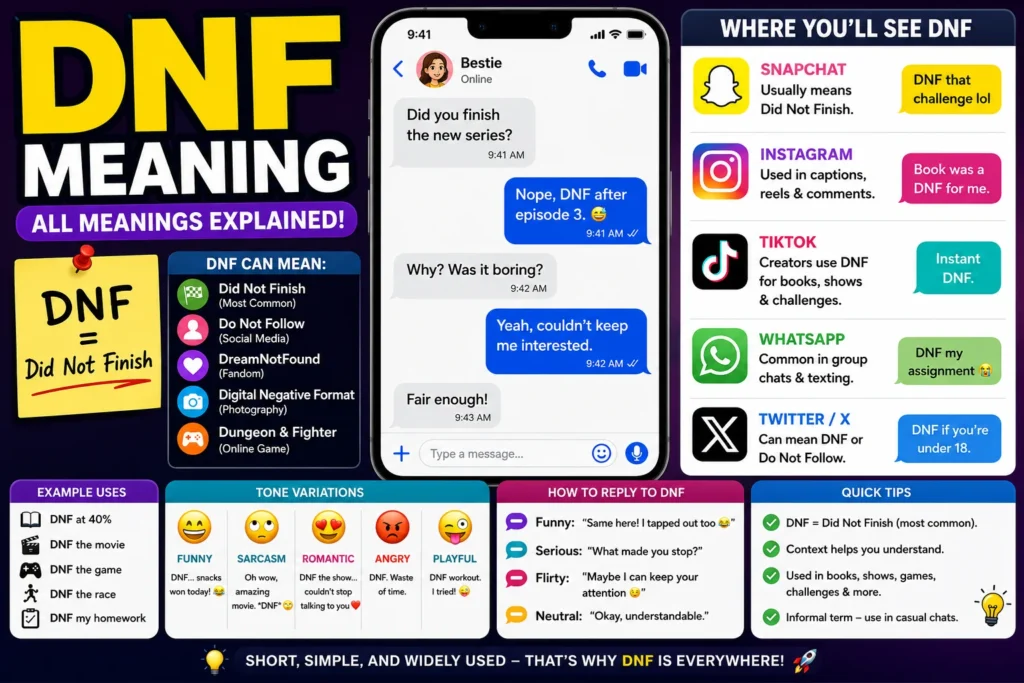

DNF most commonly means “Did Not Finish,” but depending on the context, it can also mean “Do Not Follow,” refer to a popular fandom pairing, a photography file format, or even a video game. Understanding the context solves most confusion.
If you’ve seen DNF in a text message, gaming discussion, TikTok comment, race results, or social media profile, you’re not alone. Many people search for the term because it has several meanings across different online communities. This guide explains every major meaning of DNF, how it’s used, where you’ll see it, and how to understand it correctly in conversations.
What Does DNF Mean?
The meaning of DNF depends entirely on the platform and situation.
Common meanings include:
- Did Not Finish (most common)
- Do Not Follow
- DreamNotFound (fandom term)
- Digital Negative Format
- Dungeon & Fighter
In texting and online conversations, Did Not Finish is usually the meaning people intend.
DNF Meaning in Text
In text messages, DNF often means:
Did Not Finish
People use it when talking about:
- Books
- TV shows
- Movies
- Games
- Tasks
- Challenges
Example
A: Did you finish that book?
B: Nope, DNF at chapter 5.
Here, DNF means the person stopped reading before finishing.
DNF Slang Meaning
As internet slang, DNF usually refers to quitting or stopping something before completion.
Examples:
- DNF a book
- DNF a Netflix series
- DNF a game
- DNF a workout challenge
It has become especially popular among:
- BookTok
- Bookstagram
- Gaming communities
- Reddit users
What Does DNF Mean in Chat?
In chat conversations, DNF often communicates:
“I started it but didn’t finish it.”
Example
A: Was the movie good?
B: Couldn’t tell you. DNF after 20 minutes.
DNF Meaning on Snapchat
On Snapchat, DNF usually means:
- Did Not Finish
- Occasionally DreamNotFound (among Minecraft fandom users)
Context determines the correct interpretation.
Example
“DNF that challenge lol”
Means:
“I didn’t finish that challenge.”
DNF Meaning on Instagram, TikTok, and WhatsApp
On Instagram
Commonly used in:
- Book reviews
- Reading accounts
- Movie discussions
Example:
“DNF at 30%”
Meaning:
The reader stopped reading at 30%.
On TikTok
BookTok creators frequently use DNF.
Example:
“This was an instant DNF.”
Meaning:
The creator quit reading almost immediately.
On WhatsApp
Friends commonly use it casually.
Example:
“DNF my assignment 😭”
Meaning:
“I didn’t finish my assignment.”
Is DNF an Acronym, Short Form, or Slang?
DNF is:
✅ An acronym
Because each letter represents a word:
D = Did
N = Not
F = Finish
It is also considered:
- Internet slang
- Online abbreviation
- Casual chat phrase
It is not:
- A phonetic spelling
- A typo turned slang
Meaning & Explanation of All Major DNF Definitions
Because DNF has multiple meanings, let’s explore each one.
DNF = Did Not Finish
This is the most common meaning.
Used in:
- Sports
- Reading
- Gaming
- Movies
- Challenges
Example
“I DNF’d the book.”
Meaning:
“I stopped reading before finishing.”
DNF = Do Not Follow
Popular on:
- Twitter/X
- Social media bios
People may write:
“DNF if you’re under 18.”
Meaning:
“Do Not Follow me if you’re under 18.”
DNF = DreamNotFound
In Minecraft fandom culture:
DNF refers to:
Dream + GeorgeNotFound
A fan-created ship name.
This meaning appears mostly in:
- TikTok fandoms
- Twitter/X fandom communities
- Fanfiction sites
DNF = Digital Negative Format
Photography professionals use DNF differently.
It stands for:
Digital Negative Format
An image file standard developed by Adobe.
This meaning rarely appears in texting.
DNF = Dungeon & Fighter
In gaming communities:
DNF may refer to:
Dungeon & Fighter
A popular online role-playing game.
Tone & Context Variations
The meaning and feeling behind DNF changes depending on tone.
Funny Tone
Example
A: Did you finish the 12-hour documentary?
B: DNF after 15 minutes 😂
The tone is humorous.
Sarcastic Tone
Example
A: Best movie ever.
B: Sure. DNF before the opening credits 🙄
Used to criticize something.
Romantic Tone
Example
A: Finished your favorite show?
B: DNF. I got distracted talking to you ❤️
Playful and affectionate.
Angry Tone
Example
A: Read the entire article.
B: DNF. It was terrible.
Shows frustration.
Playful Tone
Example
A: Did you finish cleaning?
B: DNF. Snacks happened.
Lighthearted and fun.
Real Chat Examples
Example 1
A: Did you finish the book?
B: Nope, DNF at chapter 10.
A: That bad?
Example 2
A: Watch the whole movie?
B: DNF after 30 minutes.
A: Wow.
Example 3
A: Did you finish your workout?
B: DNF. Legs gave up.
A: Fair enough 😂
Example 4
A: New series worth watching?
B: DNF.
A: That answers my question.
Example 5
A: Finished the challenge?
B: DNF.
A: Same.
Example 6
A: Read the article?
B: DNF halfway through.
A: Too long?
Example 7
A: Did you beat the game?
B: DNF at the final boss.
A: Ouch.
Example 8
A: How was the podcast?
B: DNF.
A: Boring?
Example 9
A: Finished your assignment?
B: DNF 😭
A: Deadline soon?
Example 10
A: Read that romance novel?
B: DNF.
A: Not your thing?
Example 11
A: Tried the workout plan?
B: DNF after day two.
A: Same 😂
Example 12
A: Finished the audiobook?
B: DNF at 40%.
A: Interesting.
Example 13
A: New Netflix show?
B: DNF.
A: Skip it then.
Example 14
A: Completed the race?
B: Officially DNF.
A: Better luck next time.
Example 15
A: Read all 800 pages?
B: DNF at page 120.
A: Understandable.
Grammar & Language Role
What Part of Speech Is DNF?
DNF functions as:
- Acronym
- Abbreviation
- Informal noun
- Informal verb
Examples
Noun:
“It was a DNF for me.”
Verb:
“I DNF’d the book.”
Sentence Position
DNF can appear:
Beginning:
“DNF. Couldn’t continue.”
Middle:
“I DNF’d the novel yesterday.”
End:
“That book became a DNF.”
Can DNF Replace a Full Sentence?
Yes.
Example:
A: Finished it?
B: DNF.
One acronym communicates the entire message.
Formal vs Informal Use
Informal
✅ Texting
✅ Social media
✅ Book reviews
✅ Forums
Formal
❌ Business emails
❌ Academic writing
❌ Professional reports
Comparison Table: DNF vs Similar Slang Terms
| Term | Meaning | Usage Context | Tone | Popularity | Confusion Risk |
|---|---|---|---|---|---|
| DNF | Did Not Finish | Books, games, movies, challenges | Neutral | High | Medium |
| IDK | I Don’t Know | General texting | Casual | Very High | Low |
| TBH | To Be Honest | Opinions and honesty | Casual | High | Low |
| IMO | In My Opinion | Sharing views | Casual | High | Low |
| NVM | Never Mind | Correcting or canceling | Casual | High | Low |
| FOMO | Fear Of Missing Out | Social situations | Emotional | High | Medium |
| Finished (Opposite) | Completed something | Any activity | Neutral | High | Low |
Who Uses This Term?
Age Groups
DNF is most commonly used by:
- Teenagers
- College students
- Young professionals
- Online readers
- Gamers
However, adults frequently use DNF in book communities and hobby groups.
Gen Z vs Millennials
Gen Z
Gen Z commonly uses DNF when discussing:
- TikTok recommendations
- Netflix shows
- Online challenges
- Gaming content
Example:
“DNF after episode two.”
Millennials
Millennials often use DNF in:
- Book clubs
- Goodreads reviews
- Facebook reading groups
Example:
“DNF at 40% because the story dragged.”
Regional Usage
DNF is widely recognized in:
- United States
- Canada
- United Kingdom
- Australia
- New Zealand
Because it is internet slang, it is understood globally.
Platforms Where DNF Is Most Common
You will frequently see DNF on:
- TikTok
- Snapchat
- Goodreads
- Discord
- Twitter/X
- Facebook groups
Origin & Internet Culture Insight
Where Did DNF Come From?
DNF originally became popular in sports.
In races and competitions, DNF meant:
Did Not Finish
Race results often listed participants as:
- Winner
- Finished
- DNF
Over time, internet communities adopted the abbreviation.
How Book Communities Changed the Meaning
Book lovers popularized DNF online.
Instead of saying:
“I stopped reading the book.”
People started saying:
“I DNF’d it.”
Today, DNF is one of the most common BookTok and Goodreads terms.
TikTok Influence
TikTok helped spread DNF beyond reading communities.
Creators frequently post:
- DNF book reviews
- DNF movie reviews
- DNF challenge videos
This exposure introduced the term to millions of users.
Meme Culture Role
Internet users often joke about quitting things.
Examples:
- DNF a workout
- DNF a TV series
- DNF a diet
The term became part of meme culture because it is short, funny, and relatable.
Fast Typing Culture
Like:
- LOL
- TBH
- IMO
- IDK
DNF survives because it saves typing time.
People can instantly communicate:
“I started it but didn’t finish.”
with only three letters.
Why People Say DNF on TikTok
TikTok creators use DNF because:
- It is concise
- Most viewers understand it
- It works well in captions
- It quickly communicates an opinion
For example:
“Popular opinion: this book was a DNF.”
Immediately tells viewers the creator quit reading.
Is DNF Rude or Offensive?
Is DNF Rude?
Generally, no.
DNF is usually neutral.
However, context matters.
Example:
“I DNF’d your recommendation.”
Could sound slightly rude depending on tone.
Is DNF a Bad Word?
No.
DNF is not profanity.
It is considered safe for:
- Schools
- Workplaces
- Social media
- Family-friendly content
Should You Use DNF at School?
Yes.
It is generally acceptable.
Example:
“I DNF’d the optional reading assignment.”
People will likely understand what you mean.
Should You Use DNF at Work?
Use caution.
Many coworkers may not know internet slang.
Instead of:
“I DNF’d the report.”
A professional alternative is:
“I wasn’t able to finish the report.”
Experience-Based Insight
In real-world online conversations, DNF is most commonly used when people discuss books, movies, and TV shows they lost interest in. Readers on Goodreads and BookTok especially use DNF as a quick way to explain that a book failed to keep their attention. In casual texting, younger users also use it humorously to describe quitting anything from workouts to long Netflix series.
FAQ
What does DNF mean in text?
DNF usually means Did Not Finish. It indicates someone started something but stopped before completing it.
What does DNF mean on Snapchat?
On Snapchat, DNF typically means Did Not Finish, though some fandom communities may use it differently.
What does DNF mean in chat?
In chat conversations, DNF means someone quit a task, book, movie, game, or activity before finishing.
Is DNF rude?
No. DNF is generally neutral and not considered rude. Tone and context determine whether it sounds negative.
Is DNF the same as IDK?
No.
- DNF = Did Not Finish
- IDK = I Don’t Know
They have completely different meanings.
Can adults use DNF?
Absolutely. Many adults use DNF in book reviews, gaming discussions, and online forums.
How do you respond to DNF?
Responses depend on context.
Examples:
- “Was it that bad?”
- “What made you stop?”
- “Fair enough.”
- “I couldn’t finish it either.”
What does DNF mean in books?
In reading communities, DNF means a reader stopped reading before finishing a book.
What does DNF stand for?
DNF most commonly stands for Did Not Finish.
Why do readers say DNF?
Readers use DNF when they stop reading a book before reaching the end.
What does DNF mean on TikTok?
On TikTok, DNF often refers to quitting a book, movie, challenge, or show before completion.
Is DNF positive or negative?
Usually neutral, though it often suggests disappointment.
What does DNF mean in racing?
In racing, DNF means a participant started the race but failed to complete it.
What does DNF mean on Goodreads?
On Goodreads, DNF indicates a reader abandoned a book before finishing it.
Final Summary
DNF most commonly means Did Not Finish, and it is widely used in texting, gaming, sports, reading communities, TikTok, Snapchat, Instagram, and WhatsApp. Depending on context, DNF can also mean Do Not Follow, DreamNotFound, Digital Negative Format, or Dungeon & Fighter.
The key is understanding where you saw it.
Usage Tips
✅ Use DNF when discussing unfinished books, games, movies, or tasks.
✅ Use it in casual conversations and social media posts.
✅ Consider the audience before using it in professional settings.
Common Mistakes
❌ Assuming DNF always means one thing.
❌ Using DNF in formal business communication.
❌ Confusing DNF with IDK or IMO.
When to Use and When to Avoid
Use DNF:
- Text messages
- Social media
- Book reviews
- Gaming discussions
- Casual chats
Avoid DNF:
- Formal emails
- Academic papers
- Professional reports
- Business presentations


