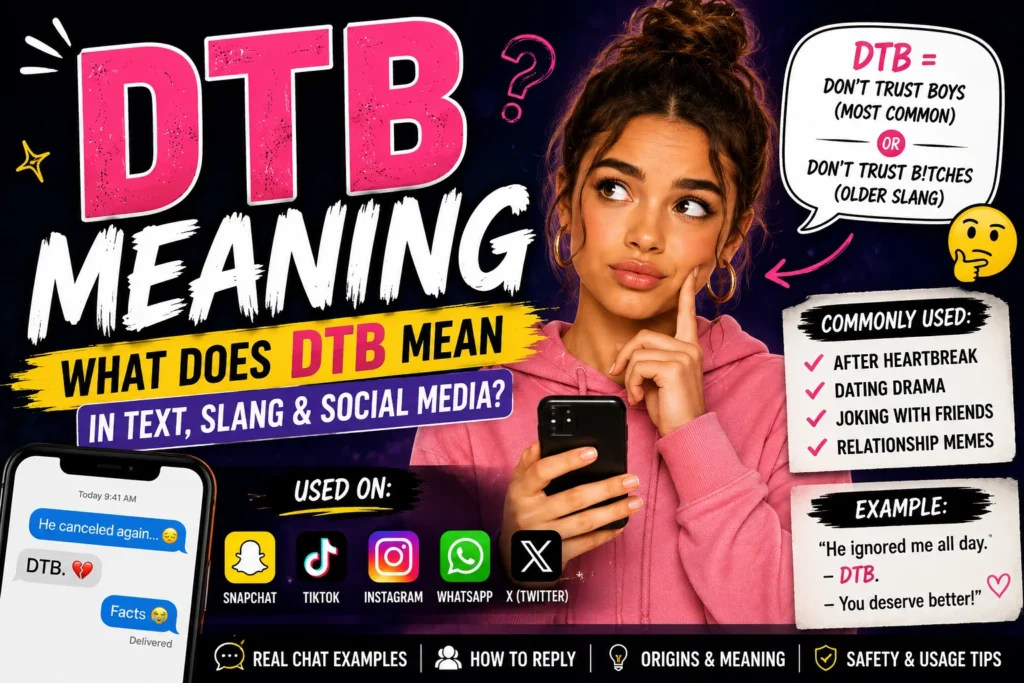

DTB most commonly means “Don’t Trust Boys” in modern texting and social media. However, depending on the context, it can also stand for “Don’t Trust Bitches,” an older and more explicit slang phrase. Understanding the conversation helps you interpret the correct meaning.
If you’ve seen DTB in a text message, TikTok comment, Snapchat story, Instagram caption, or WhatsApp chat, you’re not alone. The abbreviation has become increasingly popular on social media, especially among Gen Z users. While many people use it jokingly after a bad dating experience, others use it seriously or as part of trending memes. This guide explains every major meaning of DTB, when it’s appropriate to use, and how to understand it in different contexts.
What Does DTB Mean?
The abbreviation DTB has more than one meaning, but one definition is far more common today.
The Primary Meaning: “Don’t Trust Boys”
The most popular modern meaning of DTB is:
Don’t Trust Boys
People usually use this phrase after a disappointing relationship, heartbreak, or frustrating dating experience.
For example:
Emma: He canceled our date again.
Sophia: DTB 😭
In this conversation, “DTB” expresses frustration or disappointment rather than genuine hatred toward boys. It’s often exaggerated for humor.
Another Common Meaning: “Don’t Trust Bitches”
An older slang meaning of DTB is:
Don’t Trust Bitches
This version became popular in rap lyrics, internet slang, and certain online communities years before “Don’t Trust Boys” gained popularity.
Because this phrase contains profanity and can be offensive, many people now avoid using it in public conversations.
When you encounter DTB online, always consider the surrounding conversation before deciding which meaning applies.
DTB Meaning in Text
In text messages, DTB usually appears after someone talks about relationships, dating, or disappointment.
For example:
Alex: She left me on read again.
Ryan: DTB, bro.
or
Emma: He ghosted me.
Sarah: DTB 😭
Although the abbreviation is short, it communicates a strong emotional reaction in casual conversations.
DTB Slang Meaning
As internet slang, DTB is a texting abbreviation that expresses distrust toward a group of people based on a negative personal experience.
Most people don’t intend it literally.
Instead, it’s often used to say things like:
- “Dating is exhausting.”
- “I’ve had enough.”
- “People keep disappointing me.”
In many cases, the phrase is exaggerated for comedic effect.
What Does DTB Mean in Chat?
In online chats, the meaning depends on the discussion.
Relationship Conversations
Someone may use DTB after a breakup.
Example:
Taylor: He lied to me again.
Morgan: DTB.
Funny Conversations
Friends sometimes use it ironically.
Example:
Chris: My boyfriend forgot my birthday.
Jamie: DTB 😂
The laughter emoji suggests the phrase is playful rather than serious.
Meme Conversations
DTB frequently appears in memes about dating, heartbreak, and relationship advice.
Because meme culture often exaggerates emotions, the phrase is usually not meant literally.
DTB Meaning on Snapchat
On Snapchat, DTB commonly appears in:
- Stories
- Private chats
- Streak messages
- Relationship posts
Someone might post:
“DTB.”
without additional explanation after sharing a breakup story.
Followers generally understand it as:
“Don’t Trust Boys.”
DTB Meaning on Instagram
Instagram users often include DTB in:
- Captions
- Story posts
- Reels
- Relationship memes
Example:
New rule: DTB.
Many creators use it humorously rather than seriously.
DTB Meaning on TikTok
TikTok has made DTB one of the most recognizable dating abbreviations among Gen Z users.
The hashtag often appears alongside:
- Breakup stories
- Dating memes
- Relationship advice
- Comedy videos
- POV content
- Storytime videos
Because TikTok trends spread quickly, many users discover DTB there before seeing it anywhere else.
DTB Meaning on WhatsApp
On WhatsApp, DTB usually appears in private conversations between friends.
For example:
Friend 1: He said he’d call.
Friend 2: Did he?
Friend 1: Nope.
Friend 2: DTB.
Because WhatsApp conversations are often personal, the abbreviation tends to reflect recent experiences rather than general beliefs.
Is DTB an Acronym?
Yes.
Unlike words such as “redbone” or “bae,” DTB is an acronym.
Each letter represents a word.
Depending on the conversation, it usually stands for:
- Don’t Trust Boys (most common today)
- Don’t Trust Bitches (older and more explicit)
Context determines which version the speaker intends.
Is DTB a Short Form?
Yes.
DTB is a shortened version of a complete phrase.
People use it because it’s quicker to type than writing the entire sentence.
Like many internet abbreviations, it became popular through fast digital communication.
Is DTB a Phonetic Spelling?
No.
A phonetic spelling changes how a word is written to match pronunciation, such as:
- Gonna
- Wanna
- Ima
DTB is an acronym rather than a phonetic spelling.
Is DTB a Typo Turned Slang?
No.
The abbreviation was intentionally created as a shorthand phrase.
It did not originate from a typing mistake.
How the Meaning of DTB Changes with Tone
Although the definition stays the same, the emotional tone changes depending on how someone uses it.
Funny Tone
Friends often joke about dating.
Emma: He forgot my coffee order.
Sophia: DTB 😂
The phrase is clearly humorous.
Sarcastic Tone
Someone may exaggerate after a small inconvenience.
Ryan: She replied five minutes late.
Alex: DTB, I guess.
The sarcasm makes it obvious the speaker isn’t being serious.
Romantic Tone
Sometimes DTB appears after heartbreak.
Emma: I really liked him.
Sarah: DTB for now. You’ll find someone better.
Here, the friend is offering emotional support.
Angry Tone
Following betrayal or dishonesty, the abbreviation may express genuine frustration.
Chris: She lied to everyone.
Jake: DTB.
In this situation, the phrase carries stronger emotion.
Playful Tone
Friends frequently tease each other.
Taylor: He forgot to text goodnight.
Morgan: DTB! 😂
Neither person expects the phrase to be taken literally.
Real-Life Examples of DTB in Conversations
Example 1
Emma: He canceled again.
Sophia: DTB.
Example 2
Ryan: She ignored my messages.
Alex: DTB, man.
Example 3
Chris: TikTok keeps saying DTB.
Jamie: It’s everywhere lately.
Example 4
Taylor: What does DTB even mean?
Morgan: Usually “Don’t Trust Boys.”
Example 5
Emma: Is DTB always serious?
Sophia: Not really. Most people use it jokingly after dating fails.
Grammar and Language Role of DTB
Unlike regular words, DTB is a texting abbreviation that represents a complete phrase. People use it to quickly express an opinion, emotion, or reaction without typing an entire sentence.
In casual digital communication, DTB behaves differently from traditional nouns or verbs because it functions as an abbreviation with implied meaning.
Part of Speech
Grammatically, DTB is an initialism (acronym) rather than a standard part of speech.
In conversations, however, it usually acts as:
- An independent expression
- An interjection
- A complete statement
- A reaction to a situation
For example:
Emma: He canceled our date again.
Sophia: DTB.
Here, DTB replaces an entire sentence such as:
- “Don’t trust boys.”
- “You shouldn’t trust him.”
- “Dating can be frustrating.”
Sentence Position
DTB can appear almost anywhere in casual conversations.
At the Beginning
- DTB after everything that happened.
- DTB if he keeps lying.
In the Middle
- I was thinking DTB after hearing that story.
- My sister keeps saying DTB lately.
At the End
- He ghosted me… DTB.
- That’s why people say DTB.
The end of a sentence is the most common position because it works as a reaction.
Can DTB Replace a Full Sentence?
Yes.
Unlike many slang terms, DTB frequently replaces an entire sentence.
For example:
Instead of writing:
“Don’t trust boys after what happened.”
People simply write:
DTB.
The reader understands the intended meaning from the conversation.
Tone Impact
The abbreviation changes tone depending on the context.
It may sound:
- Funny
- Dramatic
- Frustrated
- Sarcastic
- Supportive
- Playful
The letters themselves don’t express emotion—the surrounding conversation does.
Formal vs. Informal Use
DTB is considered highly informal.
It is appropriate for:
- Text messages
- Snapchat
- TikTok
- X (Twitter)
- Discord
- Casual chats
Avoid using DTB in:
- Business emails
- Job applications
- Academic writing
- Professional presentations
- Customer communication
Outside informal conversations, write the complete phrase if necessary.
Real Chat Conversations
The following examples show how people naturally use DTB in everyday conversations.
Conversation 1
A: He canceled again.
B: DTB.
A: Seriously.
Conversation 2
A: She left me on read.
B: DTB, bro.
A: I should’ve known.
Conversation 3
A: Why does everyone say DTB?
B: Mostly after bad dating experiences.
A: Makes sense.
Conversation 4
A: He forgot our anniversary.
B: DTB 😭
A: You’re not helping.
Conversation 5
A: TikTok keeps showing breakup videos.
B: And every comment says DTB.
A: Facts.
Conversation 6
A: Is DTB always serious?
B: Usually not.
A: Good.
Conversation 7
A: He actually apologized.
B: Maybe don’t say DTB just yet.
A: Fair enough.
Conversation 8
A: I trusted him again.
B: DTB.
A: Lesson learned.
Conversation 9
A: My friend keeps saying DTB.
B: She’s probably joking.
A: Hopefully.
Conversation 10
A: What does DTB stand for?
B: Don’t Trust Boys.
A: I thought it meant something else.
Conversation 11
A: He replied after three days.
B: DTB 😂
A: You’re terrible.
Conversation 12
A: I think he likes me.
B: Maybe…
A: Not DTB this time?
B: We’ll see.
Conversation 13
A: Dating apps are exhausting.
B: DTB.
A: Honestly.
Conversation 14
A: She blocked him.
B: DTB season.
A: That’s wild.
Conversation 15
A: I finally found someone genuine.
B: Nice! Maybe DTB doesn’t always apply.
A: Exactly.
How to Reply When Someone Says DTB
Your response should match the mood of the conversation.
Funny Replies
Them: DTB.
You: Until the next cute guy texts you. 😂
Them: DTB forever.
You: Give it a week. 😆
Them: DTB.
You: Somebody had a rough date.
Serious Replies
Them: DTB.
You: I’m sorry that happened. You deserve better.
Them: DTB after today.
You: Take your time before trusting someone again.
Them: DTB.
You: Hopefully your next experience is much better.
Flirty Replies
Them: DTB.
You: Maybe… but give me a chance first. 😉
Them: DTB.
You: I promise not everyone is the same.
Them: DTB forever.
You: Challenge accepted. 😄
Neutral Replies
Them: DTB.
You: Sounds like you’ve had a bad day.
Them: DTB.
You: Hopefully things get better soon.
Them: DTB.
You: That’s a common phrase on TikTok lately.
Comparison Table
| Term | Meaning | Usage Context | Tone | Popularity | Confusion Risk |
|---|---|---|---|---|---|
| DTB | Don’t Trust Boys / Don’t Trust Bitches | Dating, texting, TikTok | Frustrated, funny | Very High | Medium |
| IDK | I Don’t Know | General texting | Neutral | Very High | Very Low |
| SMH | Shaking My Head | Disappointment | Frustrated | Very High | Low |
| FML | Expresses frustration after something goes wrong | Casual texting | Dramatic | High | Low |
| TBH | To Be Honest | Opinions and honesty | Neutral | Very High | Low |
| ILY (Contrasting) | I Love You | Affection | Positive | Very High | Very Low |
DTB vs FML
Although both express frustration, they are different.
DTB
- Specifically relates to dating or trust.
- Usually appears after relationship problems.
- Often used humorously.
FML
- Refers to any frustrating situation.
- Not limited to relationships.
- More general expression of disappointment.
Who Uses DTB?
Age Group
DTB is most popular among:
- Teenagers
- High school students
- College students
- Young adults
Older adults may understand the phrase, but they generally use it less frequently.
Gen Z vs Millennials
Gen Z
Gen Z has made DTB especially popular through:
- TikTok
- Snapchat
- Instagram Reels
- Relationship memes
- Storytime videos
Many younger users encounter DTB as part of viral dating humor.
Millennials
Millennials are familiar with DTB, especially those active on social media, but they are generally less likely to use it regularly compared to Gen Z.
Regional Popularity
DTB is most common in:
- United States
- Canada
- United Kingdom
- Australia
Because English-language social media spreads trends globally, the abbreviation is now recognized in many other countries as well.
Platforms Where DTB Is Most Common
You’ll most often see DTB on:
- TikTok
- Snapchat
- X (Twitter)
- Discord
Among these platforms, TikTok has contributed the most to DTB’s recent popularity, especially through relationship memes, viral audio clips, and humorous dating content.
Origin and Internet Culture Insight
Unlike newer slang terms that originated entirely on TikTok, DTB has been part of internet culture for several years. Its meaning has evolved over time, and today it is interpreted differently depending on the platform and the audience.
Understanding where DTB came from helps explain why some people use it humorously while others take it more seriously.
The Early Origins of DTB
The abbreviation DTB first gained attention in online communities and hip-hop culture as a shortened form of “Don’t Trust Bitches.” It appeared in song lyrics, internet forums, memes, and social media posts, often expressing distrust after negative relationship experiences.
Because this version contains profanity and can be considered offensive, many users gradually began replacing it with a more socially acceptable phrase:
Don’t Trust Boys
This newer interpretation became especially popular among younger users on TikTok and Instagram.
Today, when someone simply writes DTB, they are most likely referring to “Don’t Trust Boys.”
The Role of TikTok in Popularizing DTB
TikTok has played the biggest role in making DTB a mainstream slang term.
The abbreviation frequently appears in:
- Breakup storytime videos
- Dating advice clips
- POV relationship content
- Comedy skits
- Meme compilations
- Emotional edits
Creators often add #DTB to videos about disappointing dating experiences, making the abbreviation instantly recognizable to millions of users.
Why People Say DTB on TikTok
On TikTok, DTB is rarely used as a literal statement.
Instead, it often expresses emotions such as:
- Frustration
- Disappointment
- Heartbreak
- Sarcasm
- Self-deprecating humor
For example, after sharing a funny story about a failed date, a creator might end the video with:
“DTB 😭”
In this context, the abbreviation acts more like a humorous punchline than serious advice.
Meme Culture and Viral Trends
Internet meme culture thrives on exaggerated reactions, and DTB fits perfectly into that style.
People often use it after:
- Being left on read
- Getting ghosted
- Cancelled dates
- Awkward first dates
- Relationship disappointments
Even when the situation is relatively minor, the dramatic abbreviation adds humor to the story.
Because of this, many users treat DTB as a meme rather than a genuine belief.
Fast-Typing Culture
DTB is also a product of fast digital communication.
Instead of typing:
- “Don’t trust boys.”
- “I’m done with dating.”
- “Relationships are exhausting.”
Users simply write:
DTB.
Like LOL, IDK, and SMH, it saves time while instantly communicating emotion.
Is DTB Rude?
Not necessarily.
The phrase “Don’t Trust Boys” is generally viewed as casual internet slang and is often used jokingly among friends.
However, context matters.
If someone uses DTB to stereotype or insult an entire group, it may come across as disrespectful or immature.
The older meaning, “Don’t Trust Bitches,” is much more offensive because it includes profanity and targets a group of people using derogatory language.
Whenever possible, avoid using the explicit version in public or professional settings.
Is DTB a Bad Word?
The abbreviation DTB itself is not a bad word.
However, one of its meanings expands into a phrase containing profanity.
Because readers may interpret DTB differently depending on their background, it’s always wise to consider your audience before using it.
Should You Use DTB at School or Work?
In most cases, no.
Although the abbreviation is common online, it is best reserved for informal conversations with friends.
Avoid using DTB in:
- School assignments
- Classroom discussions
- Workplace chats
- Business emails
- Professional presentations
- Customer communication
If you’re discussing the term academically or explaining internet slang, write out the meaning and provide context instead of using it casually.
Experience-Based Insight
From observing how DTB is used across TikTok, Instagram, Snapchat, and other social platforms, one pattern is clear: most people don’t use it literally.
Instead, it has become a humorous way to express frustration after a disappointing dating experience.
For many Gen Z users, saying DTB is similar to saying:
- “Dating is exhausting.”
- “I can’t believe that happened.”
- “Here we go again.”
While the phrase sounds dramatic, it is often intended as a joke shared among friends rather than a serious life philosophy.
Understanding this helps you interpret the tone correctly and avoid misunderstandings.
Frequently Asked Questions
What does DTB mean in text?
In most text messages, DTB means “Don’t Trust Boys.” In some older contexts, it can also mean “Don’t Trust Bitches.”
What does DTB mean on Snapchat?
On Snapchat, DTB usually appears after relationship drama, heartbreak, or dating jokes. Most users intend it to mean “Don’t Trust Boys.”
What does DTB mean on Instagram?
Instagram users often include DTB in captions, stories, reels, and memes related to dating and relationships.
What does DTB mean on TikTok?
On TikTok, DTB is a popular slang abbreviation used in breakup stories, dating memes, comedy videos, and relationship advice content.
Is DTB an acronym?
Yes.
DTB is an acronym made from the first letter of each word in the phrase it represents.
Is DTB the same as IDK?
No.
IDK means “I Don’t Know,” while DTB refers to a relationship-related slang phrase.
Can adults use DTB?
Yes, although adults generally use the abbreviation less frequently than teenagers and young adults.
How do you respond when someone says DTB?
The best response depends on the tone.
If they’re joking, respond playfully.
If they’re genuinely upset, offer empathy and support.
What is the full form of DTB?
The most common modern full form is “Don’t Trust Boys.” An older version is “Don’t Trust Bitches.”
Why do people say DTB?
People usually say DTB after a frustrating dating experience, a breakup, or as part of humorous relationship memes.
Is DTB popular on TikTok?
Yes.
TikTok has significantly increased the popularity of DTB through viral relationship content and dating humor.
Does DTB always mean “Don’t Trust Boys”?
No.
Although that’s the most common meaning today, older internet slang sometimes uses DTB to mean “Don’t Trust Bitches.”
Is DTB offensive?
The modern phrase “Don’t Trust Boys” is generally considered mild internet slang.
The older version containing profanity may offend some readers and should be used with caution.
Can DTB be used as a joke?
Absolutely.
Many TikTok creators and social media users use DTB humorously after minor dating mishaps or funny relationship stories.
Is DTB appropriate for professional communication?
No.
Because it is informal slang, DTB should generally be avoided in professional, academic, or business settings.
Why is DTB trending?
DTB continues to trend because relationship memes, dating advice videos, and breakup stories remain popular across TikTok, Instagram, and Snapchat.
Conclusion
The DTB meaning depends on the context, but today it most commonly stands for “Don’t Trust Boys.” It has become a popular internet slang expression on TikTok, Snapchat, Instagram, and WhatsApp, where users often share it after funny dating stories, breakups, or disappointing relationship experiences.
An older meaning, “Don’t Trust Bitches,” still exists, but it is less common today and contains profanity, making it less appropriate for general use.
As with many internet slang terms, context is everything. Understanding the conversation, platform, and tone helps you interpret DTB correctly and avoid misunderstandings.
Usage Tips
- Remember that “Don’t Trust Boys” is the most common meaning today.
- Consider the conversation before assuming which definition applies.
- Use DTB only in casual conversations with people who understand internet slang.
- Be mindful that some people may find the phrase immature or overly dramatic.
Common Mistakes to Avoid
- Assuming DTB always has only one meaning.
- Confusing DTB with unrelated abbreviations like IDK or TBH.
- Using the older explicit meaning without realizing it may offend others.
- Including DTB in formal writing or professional communication.
When to Use and When to Avoid
Use DTB when:
- Chatting with friends.
- Responding to relationship memes.
- Posting humorous dating content.
- Discussing internet slang or TikTok trends.
Avoid DTB when:
- Writing professional emails.
- Completing school or academic work.
- Speaking in formal settings.
- Communicating with people who may not understand internet slang.