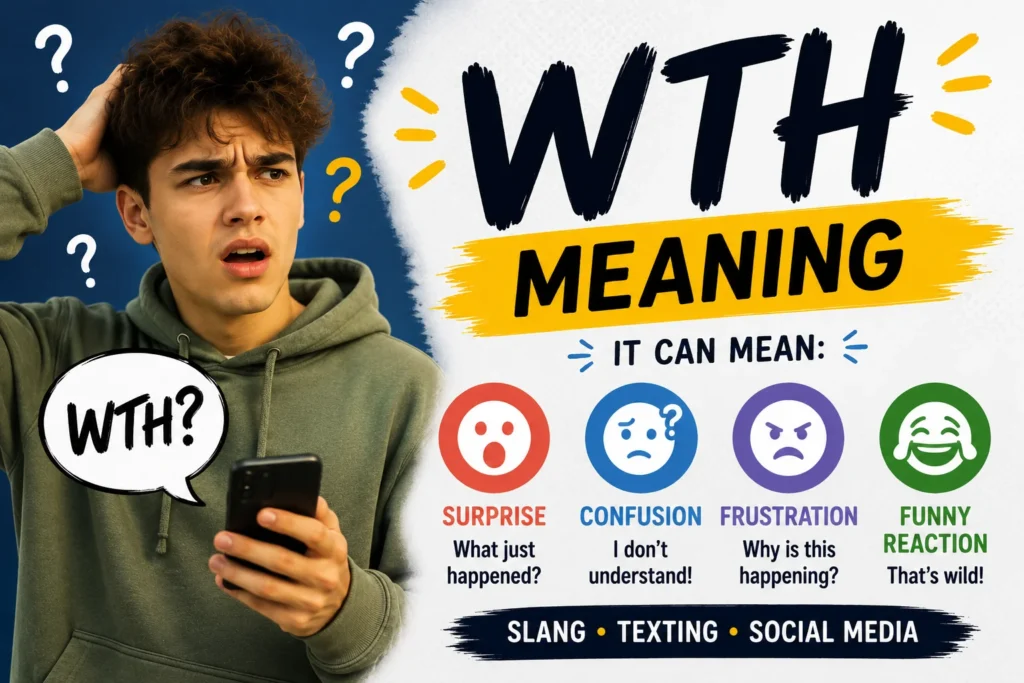

WTH stands for “What the Hell?” It’s a popular internet abbreviation people use in texts, social media, and online chats to express surprise, confusion, frustration, or disbelief. Because it softens the full phrase, many people consider it a less direct alternative to writing it out.
If you’ve seen WTH in a text message, TikTok comment, Snapchat chat, or Instagram DM, you may wonder whether it’s rude, sarcastic, or simply another internet slang term. The answer depends on the conversation and the speaker’s tone. While WTH almost always expresses a strong reaction, it can range from lighthearted surprise to genuine annoyance. This guide explains every major meaning, how it’s used across different platforms, when it’s appropriate, and how to respond naturally.
Meaning & Explanation
What Does WTH Mean?
The most common meaning of WTH is:
What the Hell?
People use it when something seems:
- Unexpected
- Confusing
- Shocking
- Strange
- Frustrating
- Hard to believe
Unlike many texting abbreviations that simply shorten common phrases, WTH conveys emotion. It tells the reader that the speaker is reacting strongly to what they just saw, heard, or experienced.
For example:
A: Someone parked across three parking spaces.
B: WTH?
Here, WTH expresses surprise and disbelief rather than asking a literal question.
Although “What the Hell?” is the standard expansion, some people interpret it more mildly as:
- What on earth?
- What’s going on?
- Seriously?
- What happened?
These alternatives carry the same basic idea while sounding less forceful.
Is WTH an Acronym, Abbreviation, or Slang?
WTH is best described as an internet acronym and a texting abbreviation.
Each letter represents one word:
- W = What
- T = The
- H = Hell
Because it’s used primarily in digital communication and casual conversations, WTH is also considered internet slang.
Unlike words that evolved naturally through spoken English, WTH was created specifically as a written shortcut during the early years of online messaging and text communication.
Today, it’s recognized worldwide as one of the most common reaction abbreviations.
WTH Meaning in Text Messages
In text conversations, WTH almost always expresses an emotional reaction.
Depending on the situation, it can mean:
- “What just happened?”
- “I can’t believe this.”
- “Seriously?”
- “Why would someone do that?”
- “This doesn’t make any sense.”
For example:
A: They canceled the concert an hour before it started.
B: WTH? I already drove there.
Here, WTH communicates immediate surprise and frustration.
Another example:
A: I accidentally sent the email to everyone.
B: WTH 😂
In this case, the laughing emoji changes the tone from frustration to playful disbelief.
Is WTH Considered Profanity?
This is one of the biggest questions people ask.
Technically, WTH stands for a phrase containing the word “hell.”
However, because it appears only as initials, many people consider it much milder than writing the full phrase.
In everyday texting, WTH is often treated as a softened reaction rather than explicit profanity.
That said, some workplaces, schools, and professional environments may still discourage its use because readers understand what the letters represent.
WTH Meaning in Chat
In online chats, WTH usually functions as a quick emotional response rather than a complete sentence.
Examples include:
- WTH happened?
- WTH is going on?
- WTH 😂
- WTH was that?
Gamers, friends, classmates, and coworkers often use it when reacting instantly to unexpected events.
Because chat conversations move quickly, abbreviations like WTH help express emotion without typing a full sentence.
What Does WTH Mean on TikTok?
On TikTok, WTH frequently appears in:
- Video comments
- Captions
- Replies
- Live chat messages
Users often write WTH after watching:
- Unexpected plot twists
- Funny fails
- Surprising transformations
- Viral challenges
- Shocking news
Example:
“WTH did I just watch? 😂”
In this context, WTH communicates amused confusion rather than genuine anger.
TikTok’s fast-paced content encourages short emotional reactions, making abbreviations like WTH especially popular.
What Does WTH Mean on Instagram?
Instagram users commonly use WTH in comments and direct messages to react to surprising photos, videos, or Stories.
Examples include:
- “WTH happened here?”
- “WTH 😂😂”
- “WTH, that’s amazing.”
Depending on the emojis or surrounding text, the abbreviation can express:
- Shock
- Excitement
- Confusion
- Playful disbelief
Because Instagram conversations tend to be informal, WTH feels natural among friends and followers.
What Does WTH Mean on Snapchat?
On Snapchat, WTH usually appears after someone receives an unexpected Snap or message.
For example:
Friend: sends a photo wearing a ridiculous costume
You: WTH 😂
The abbreviation often replaces longer reactions because Snapchat conversations are quick and conversational.
Most Snapchat users interpret WTH as humorous surprise unless the surrounding conversation suggests frustration.
What Does WTH Mean on WhatsApp?
On WhatsApp, WTH is commonly used among friends, family members, classmates, and coworkers.
Typical examples include:
- “WTH happened?”
- “WTH are you doing?”
- “WTH 😂”
Because WhatsApp supports longer conversations, users often follow WTH with a question explaining their confusion.
For example:
A: I accidentally booked flights for the wrong month.
B: WTH? How did that happen?
What Does WTH Mean on X (Formerly Twitter)?
On X, WTH is widely used in reaction posts and replies.
People often use it while commenting on:
- Breaking news
- Sports
- Politics
- Celebrity moments
- Viral videos
- Internet drama
Example:
“WTH was that ending?”
Because X encourages short posts, abbreviations like WTH fit naturally into conversations without taking up valuable character space.
Are There Any Other Meanings of WTH?
For most people, WTH overwhelmingly means “What the Hell?”
However, in specialized fields, the abbreviation can occasionally represent organization names, technical terms, or internal company abbreviations.
These uses are uncommon and highly context-dependent. Unless you’re reading industry-specific documents, WTH almost certainly refers to the informal expression “What the Hell?”
For everyday communication, texting, social media, and internet slang, this is the only meaning most users need to know.
Tone & Context Variations
Funny Tone
In humorous conversations, WTH is often used to react to something ridiculous, unexpected, or intentionally silly. The goal isn’t to criticize anyone but to show amused disbelief.
Example:
A: I accidentally wore two different sneakers to school today.
B: WTH? 😂 How did you not notice?
A: I was half asleep this morning.
B: Honestly, that’s kind of impressive.
Sarcastic Tone
When used sarcastically, WTH suggests that something is obviously wrong, unnecessary, or frustrating. The speaker may not actually expect an answer.
Example:
A: They scheduled another meeting about the meeting.
B: WTH… because one meeting clearly wasn’t enough.
A: Exactly.
B: Corporate logic at its finest.
Playful Tone
Friends often use WTH while teasing each other about harmless mistakes or funny situations.
Example:
A: I just spent twenty minutes looking for my glasses.
B: WTH?
A: They were on my head the whole time.
B: That sounds exactly like you.
Serious Tone
Sometimes WTH reflects genuine concern or confusion, especially when something unexpected happens.
Example:
A: Someone tried to access my account last night.
B: WTH? Did you change your password?
A: Yes, and I enabled two-factor authentication.
B: Good move.
Real Chat Examples
Example 1
A: My phone battery dropped from 40% to 1% in five minutes.
B: WTH?
A: I think I need a new battery.
B: Definitely.
Example 2
A: They closed the restaurant right before we arrived.
B: WTH?
A: We drove thirty minutes.
B: That’s so unlucky.
Example 3
A: I accidentally sent my homework to the family group chat.
B: WTH 😂
A: My grandparents were very confused.
B: I’d pay to see their reactions.
Example 4
A: Someone left a shopping cart on top of the parking barrier.
B: WTH?
A: I have so many questions.
B: Me too.
Example 5
A: My cat somehow turned on the TV.
B: WTH 😂
A: She also changed the channel.
B: She’s smarter than I am.
Example 6
A: The weather app said sunshine.
B: And?
A: It’s pouring rain.
B: WTH…
Example 7
A: I ordered one pizza.
B: Okay.
A: They delivered six.
B: WTH? That’s the best mistake ever.
Example 8
A: Someone finished the entire office coffee before 9 AM.
B: WTH…
A: Mondays are dangerous.
B: Apparently.
Example 9
A: My alarm never went off.
B: WTH happened?
A: I forgot to turn it on.
B: That explains it.
Example 10
A: The movie ended with “To be continued.”
B: WTH?!
A: I wasn’t expecting that either.
B: Now I have to wait another year.
Example 11
A: My little brother beat my high score.
B: WTH 😂
A: I trained for weeks.
B: That’s got to hurt.
Example 12
A: I forgot today was a holiday.
B: WTH? Lucky you.
A: I almost drove to work.
B: At least you figured it out in time.
Grammar & Language Role
Part of Speech
WTH functions primarily as an interjection. It expresses an immediate emotional reaction rather than describing an action or object.
Like expressions such as “Wow!”, “Seriously?”, or “No way!”, it communicates surprise, disbelief, annoyance, or confusion.
Examples:
- WTH?!
- WTH is happening?
- WTH was that?
Sentence Position
One reason WTH is so common online is its flexibility.
It can appear:
At the beginning
- WTH happened here?
- WTH are you doing?
As a complete response
- WTH?
In the middle
- That’s, WTH, the weirdest thing I’ve seen today.
Although possible, the middle position is much less common.
Can WTH Replace a Full Sentence?
Yes.
In texting and social media, WTH often stands alone because readers immediately understand the emotion being expressed.
For example:
A: I accidentally deleted the entire project.
B: WTH?
That single abbreviation communicates surprise, concern, and confusion without needing additional words.
Formal vs Informal Register
| Context | Appropriate? |
|---|---|
| Text Messages | ✅ Yes |
| ✅ Yes | |
| Snapchat | ✅ Yes |
| TikTok Comments | ✅ Yes |
| Instagram DMs | ✅ Yes |
| Discord | ✅ Yes |
| Casual Conversations | ✅ Yes |
| Workplace Team Chat | ⚠️ Sometimes |
| Business Emails | ❌ No |
| Academic Writing | ❌ No |
| Official Documents | ❌ No |
Because WTH represents an expression containing “hell,” it’s considered informal. While many people view it as milder than writing the full phrase, it’s still best avoided in professional writing or formal communication.
How to Reply When Someone Says “WTH”
The right response depends on why the other person said WTH. Sometimes they’re genuinely confused, sometimes they’re joking, and other times they’re reacting to surprising news. Understanding the tone makes it easier to reply naturally.
Funny Reply
If someone says WTH after hearing something ridiculous or unexpected, keep the conversation light.
Examples:
- “I know, right? 😂”
- “You can’t make this stuff up.”
- “It gets even crazier!”
- “That’s exactly what I said.”
- “Welcome to my life.”
Serious Reply
If WTH is expressing genuine concern or confusion, answer calmly and explain the situation.
Examples:
- “Let me explain what happened.”
- “It’s not as bad as it looks.”
- “I’ll tell you the whole story.”
- “I was surprised too.”
- “Everything’s under control now.”
Flirty Reply
Although WTH isn’t usually romantic, you can keep the conversation playful if you’re chatting with someone you like.
Examples:
- “You’ll understand when you see me. 😉”
- “Curious now?”
- “I’ll explain over coffee.”
- “Guess you’ll have to stick around.”
- “You’re cute when you’re confused.”
Neutral Reply
If you simply want to keep the conversation moving:
- “Exactly.”
- “I know.”
- “Right?”
- “That’s what surprised me too.”
- “Pretty unexpected.”
Comparison Table
| Term | Meaning | Usage Context | Tone | Popularity | Confusion Risk |
|---|---|---|---|---|---|
| WTH | What the Hell? | Texting, social media, casual chat | Surprise, disbelief | Very High | Low |
| WTF | What the F***? | Casual texting, memes | Stronger, more explicit | Very High | Medium |
| SMH | Shaking My Head | Reacting to disappointment | Frustrated | Very High | Low |
| OMG | Oh My God | Surprise or excitement | Emotional | Very High | Low |
| BRUH | Seriously? / Really? | Casual conversation, memes | Playful | High | Medium |
| OK | Agreement or acknowledgment | Everyday communication | Neutral | Extremely High | Very Low |
Who Uses This Term?
Age Group Breakdown
WTH is widely recognized across several generations, although usage varies.
It is most common among:
- Teenagers
- College students
- Young adults
- Millennials
Older adults generally recognize the abbreviation but are more likely to write the full phrase instead.
Gen Z vs Millennials
Gen Z
Gen Z frequently uses WTH in:
- TikTok comments
- Snapchat conversations
- Instagram DMs
- Discord chats
- Gaming communities
They often combine it with emojis or GIFs to make the tone clearer.
Examples:
- WTH 😂
- WTH 💀
- WTH bro
Millennials
Millennials commonly use WTH in:
- Text messages
- Facebook Messenger
- Workplace chats with friends
- Group conversations
Compared to Gen Z, Millennials are slightly more likely to use punctuation, such as:
- WTH?
- WTH?!
Regional Usage
WTH is understood throughout the English-speaking world.
You’ll commonly see it used in:
- United States
- Canada
- United Kingdom
- Australia
- New Zealand
Because English-language social media reaches global audiences, the abbreviation is also familiar to many people who speak English as a second language.
Platforms Where It Appears Most
You’ll frequently encounter WTH on:
- TikTok
- Snapchat
- X (formerly Twitter)
- Discord
- Facebook Messenger
- SMS text messages
Although the abbreviation appears almost everywhere online, it tends to be most common on fast-paced platforms where short reactions are preferred.
Origin & Internet Culture
Where Did WTH Come From?
WTH emerged during the early days of internet chat rooms, online forums, and SMS texting in the late 1990s and early 2000s.
At a time when text messages had strict character limits, users shortened common expressions to save space.
Instead of typing:
“What the Hell?”
people simply wrote:
WTH
The abbreviation quickly became one of the internet’s most recognizable reaction phrases.
Why People Prefer WTH Over the Full Phrase
Many users choose WTH because it softens the original expression.
Although most readers understand what the letters stand for, the abbreviation feels less direct than writing the words in full.
This makes it suitable for:
- Family group chats
- Casual workplaces
- Public comments
- General social media conversations
while still conveying surprise or disbelief.
WTH in Meme Culture
Memes helped make WTH even more popular.
You’ll often see captions like:
- WTH did I just watch?
- WTH is happening?
- WTH 😂
These reactions work especially well because they’re short, expressive, and instantly recognizable.
Reaction videos, viral clips, and unexpected moments frequently attract thousands of comments containing nothing more than “WTH” and an emoji.
How WTH Evolved
Originally, WTH mostly expressed frustration.
Today, it’s used much more broadly.
Modern meanings include:
- Surprise
- Confusion
- Disbelief
- Amusement
- Mild frustration
- Curiosity
In many situations, the abbreviation isn’t angry at all—it simply shows that something unexpected happened.
This flexibility explains why WTH has remained popular even as countless internet slang terms have disappeared.
Safety & Appropriateness
Is WTH Rude?
Not usually.
Most people consider WTH a mild expression of surprise or frustration rather than an insult.
However, because it represents “What the Hell?”, some readers may still view it as slightly impolite.
Is WTH Offensive?
Generally, no.
Unlike abbreviations that contain explicit profanity, WTH is considered relatively mild.
Most people understand it as a softened reaction rather than offensive language.
Does WTH Contain Profanity?
Indirectly.
The abbreviation represents a phrase containing the word “hell.”
Because the actual word isn’t written out, many people see WTH as a toned-down alternative.
Still, it’s worth remembering that not everyone interprets it the same way.
Is It Appropriate for School?
In informal conversations between friends, WTH is common.
However, students should avoid using it in:
- Essays
- Assignments
- Emails to teachers
- Formal presentations
Using complete, respectful language is usually the better choice in educational settings.
Is It Appropriate for Work?
In casual workplace chats among coworkers, WTH may occasionally appear.
However, avoid using it in:
- Client emails
- Professional reports
- Business proposals
- Official company communications
Replacing it with phrases like “What happened?” or “Could you clarify?” creates a more professional impression.
Cultural Sensitivity Notes
WTH is a mainstream internet abbreviation and is not tied to a specific cultural community or dialect. It is widely recognized across English-speaking regions and generally understood as an informal reaction to something surprising or confusing.
Because it abbreviates a phrase that some people consider mildly profane, it’s still important to consider your audience before using it in formal or mixed-age settings.
Real-World Observation
One reason WTH has remained popular for so many years is its balance between emotion and brevity. It lets people express surprise, confusion, or frustration in just three letters without sounding as harsh as stronger alternatives. In real conversations, it’s often less about literal anger and more about reacting to unexpected moments—whether that’s a funny video, surprising news, or a friend’s unbelievable story. Its flexibility keeps it relevant across texting, social media, and everyday digital communication.
Frequently Asked Questions
What Does WTH Mean in Text?
In text messages, WTH almost always means “What the Hell?” People use it to express surprise, confusion, frustration, or disbelief after reading something unexpected. Depending on the conversation, it can sound serious, sarcastic, or humorous, making context the key to understanding the intended tone.
What Does WTH Mean on Snapchat?
On Snapchat, WTH is commonly used in chats and replies to react to surprising photos, videos, or messages. Most users mean “What the Hell?” in a playful or shocked way rather than as an insult. Emojis often help clarify whether the reaction is funny, confused, or genuinely annoyed.
What Does WTH Mean on TikTok?
On TikTok, WTH frequently appears in comments under viral videos, unexpected plot twists, and funny clips. It’s a quick way for viewers to express disbelief or amusement without writing a full sentence. You’ll often see comments like “WTH did I just watch?” or “WTH 😂” under trending content.
Is WTH the Same as WTF?
No. Although both abbreviations express surprise or frustration, WTH is generally considered much milder. WTF contains explicit profanity and is stronger in tone, while WTH replaces the stronger word with “hell,” making it more acceptable in many casual conversations.
Is WTH Rude?
Not necessarily. Most people use WTH as an emotional reaction rather than an insult. However, because it represents “What the Hell?”, it may sound slightly impolite in formal conversations or when speaking to someone who prefers more respectful language. Consider your audience before using it.
Can Adults Use WTH?
Absolutely. Although younger internet users frequently use WTH, it’s understood by people of all ages. Adults often use it in text messages, social media comments, or casual conversations when reacting to surprising situations.
How Do You Respond to WTH?
Your response should match the reason the person said it. If they’re confused, explain what happened. If they’re joking, respond with humor. If they’re frustrated, provide clarification or reassurance to keep the conversation moving naturally.
Is WTH Appropriate at Work?
In casual chats with coworkers, WTH may occasionally be acceptable, depending on workplace culture. However, it should be avoided in formal emails, client communication, presentations, and professional documents. Neutral alternatives like “What happened?” or “Could you clarify?” create a more polished impression.
Why Do People Say WTH Instead of Writing the Full Phrase?
Most people use WTH because it’s faster to type and feels less harsh than writing “What the Hell?” The abbreviation communicates the same emotion while softening the language, making it more suitable for everyday texting and social media.
Does WTH Always Express Anger?
No. Although WTH can show frustration, it’s just as commonly used to express surprise, confusion, or amusement. A funny story, an unbelievable photo, or an unexpected event can all trigger a WTH reaction without any real anger.
Is WTH an Internet Slang Term?
Yes. WTH is an internet slang abbreviation that became popular during the early years of texting and online messaging. Today, it’s recognized across nearly every major social media platform and messaging app.
Should You Use WTH in Professional Emails?
Generally, no. Professional communication should avoid informal abbreviations like WTH. Using complete, neutral language helps maintain a respectful and polished tone when communicating with clients, managers, teachers, or colleagues.
Conclusion
WTH is one of the internet’s most recognizable abbreviations, standing for “What the Hell?” It’s used to express surprise, confusion, disbelief, or mild frustration in text messages, social media comments, and everyday online conversations. While the abbreviation softens the original phrase, it still carries an emotional reaction, so context and audience always matter.
Unlike many internet slang terms that quickly fade away, WTH has remained popular because it’s short, expressive, and easy to understand. Whether you’re reacting to unexpected news, a funny video, or a confusing situation, it’s a simple way to show your immediate response without typing a full sentence.
Usage Tips
- Use WTH in casual conversations with friends and family.
- Let emojis help clarify whether your tone is funny, playful, or serious.
- Consider your audience before using it in mixed-age or public conversations.
- Choose more formal wording in professional or academic settings.
Common Mistakes
- Assuming WTH always expresses anger.
- Confusing WTH with the stronger abbreviation WTF.
- Using it in formal emails or official documents.
- Ignoring the surrounding context when interpreting its meaning.
When to Use WTH
- Text messages
- WhatsApp chats
- Snapchat conversations
- TikTok comments
- Instagram DMs
- Casual online discussions
- Friendly group chats
When to Avoid WTH
- Business emails
- Academic writing
- Professional presentations
- Legal or official documents
- Conversations where formal language is expected