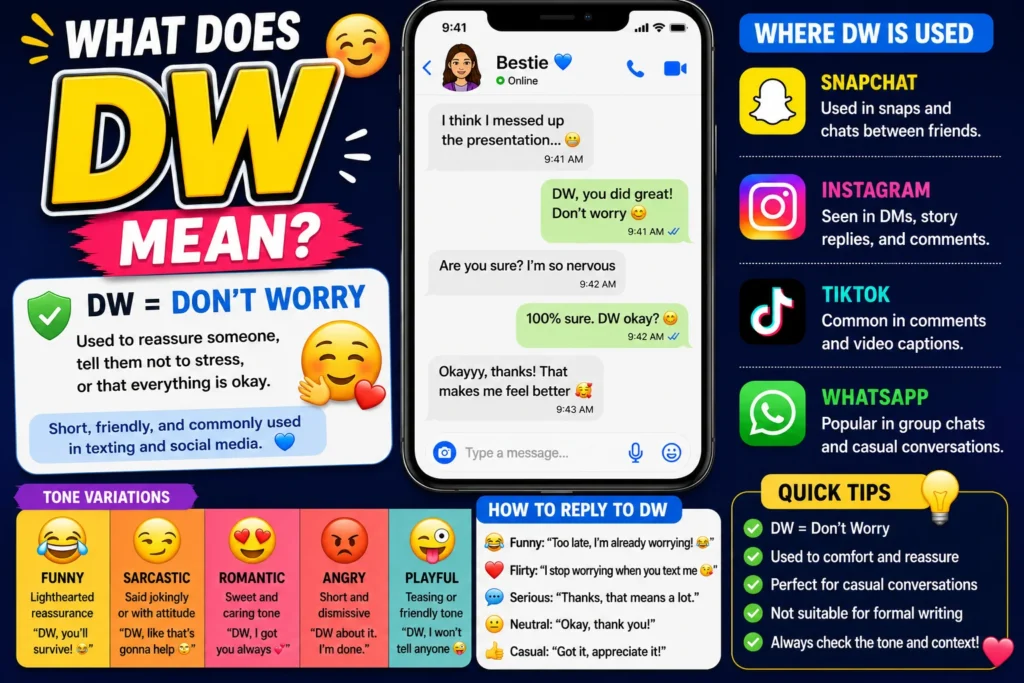

DW means “Don’t Worry.” In texting, social media, and online chats, people use DW to reassure someone, reduce concern, or tell another person that everything is okay.
If you’ve seen DW in a text message, Snapchat, TikTok comment, Instagram DM, or WhatsApp conversation, it usually carries a friendly and comforting tone. Many people search for the term because internet slang evolves quickly, and abbreviations can have different meanings depending on the platform and context.
DW is one of the most commonly used texting abbreviations today because it saves time while conveying reassurance in a casual and natural way.
What Does DW Mean in Slang?
The most common DW meaning in slang is:
DW = Don’t Worry
It is a shorthand phrase used in digital communication to tell someone not to stress, panic, or be concerned about something.
Examples
- “DW, I already finished the assignment.”
- “DW about the bill, I paid it.”
- “DW, you’ll do great.”
The phrase is widely recognized across age groups and platforms.
Is DW an Acronym?
Yes.
DW is an acronym made from the first letters of:
D = Don’t
W = Worry
It is not:
- A typo
- A phonetic spelling
- A meme word
Instead, it is a straightforward texting abbreviation.
DW Meaning in Text
When discussing DW meaning in text, the abbreviation almost always means Don’t Worry.
Text messages often prioritize speed and convenience, which is why people shorten common phrases.
Example
A: Sorry I’m running late.
B: DW, I’m still getting ready too.
Here, DW reassures the other person that the delay isn’t a problem.
What Does DW Mean in Chat?
If you’re wondering what does DW mean in chat, the answer remains largely the same.
In online chats, DW is used to:
- Reassure someone
- Reduce stress
- Calm a situation
- Show kindness
- Keep conversations casual
Example
A: I think I messed everything up.
B: DW, it’s not as bad as you think.
DW Meaning on Snapchat
On Snapchat, DW usually means Don’t Worry.
Because Snapchat conversations are fast and casual, users frequently shorten phrases.
Snapchat Example
A: Sorry for leaving you on delivered.
B: DW lol.
The reply shows that the person isn’t upset.
DW Meaning on Instagram
Instagram users often use DW in:
- DMs
- Story replies
- Comment sections
- Group chats
Example
A: Sorry I didn’t reply earlier.
B: DW, I was busy too.
The abbreviation creates a relaxed and friendly tone.
DW Meaning on TikTok
TikTok users frequently use DW in comments and direct messages.
Example
“DW, everyone thought the same thing.”
It helps make conversations feel casual and supportive.
DW Meaning on WhatsApp
WhatsApp conversations commonly include DW because it is faster than typing “Don’t Worry.”
Example
A: I forgot to bring the notes.
B: DW, I have copies.
Tone Variations of DW
Although DW always means “Don’t Worry,” the tone changes based on context.
Funny Tone
DW can be used humorously when something silly happens.
A: I accidentally sent the meme to my boss.
B: DW, maybe they’ll laugh too.
Sarcastic Tone
Sometimes DW is used sarcastically.
A: I just spilled coffee all over my laptop.
B: DW, that’s totally fine. 🙃
The sarcasm is obvious because the situation isn’t actually fine.
Romantic Tone
DW can sound caring and affectionate.
A: I hope I didn’t bother you.
B: DW, I love hearing from you.
This creates warmth and reassurance.
Angry Tone
Occasionally DW appears during frustration.
A: Are you mad?
B: DW about it.
The tone here may sound dismissive.
Playful Tone
Friends often use DW playfully.
A: You better not beat me again.
B: DW, I’ll try to go easy on you.
Real Chat Examples Using DW
Example 1
A: I forgot my homework.
B: DW, the teacher moved the deadline.
A: Seriously?
Example 2
A: I’m nervous about the interview.
B: DW, you’ve prepared well.
A: Thanks.
Example 3
A: Sorry I missed your call.
B: DW, I’ll call later.
A: Sounds good.
Example 4
A: I think I got the wrong answer.
B: DW, most people did.
A: That’s reassuring.
Example 5
A: I accidentally spoiled the movie.
B: DW, I already knew.
A: Lucky me.
Example 6
A: My train is delayed.
B: DW, I’m running late too.
A: Perfect.
Example 7
A: Sorry for texting so much.
B: DW, I enjoy our chats.
A: That’s sweet.
Example 8
A: I forgot your birthday.
B: DW, it happens.
A: Thank you.
Example 9
A: I spilled juice everywhere.
B: DW, I’ve done worse.
A: Glad I’m not alone.
Example 10
A: I think everyone noticed my mistake.
B: DW, people forget quickly.
A: True.
Example 11
A: I’m worried about tomorrow.
B: DW, you’ll be fine.
A: I hope so.
Example 12
A: Sorry for canceling.
B: DW, we can reschedule.
A: Thanks.
Example 13
A: I lost the game.
B: DW, you’ll win next time.
A: Maybe.
Example 14
A: I think I embarrassed myself.
B: DW, nobody noticed.
A: Good.
Example 15
A: Sorry for being late.
B: DW, I just got here too.
A: Great.
Grammar and Language Role of DW
Part of Speech
DW functions as a shortened phrase rather than a traditional part of speech.
It replaces the phrase:
“Don’t worry.”
Sentence Position
DW can appear:
- At the beginning
- In the middle
- At the end
Examples
Beginning:
- DW, everything is okay.
Middle:
- You can DW about that now.
End:
- Everything’s handled, DW.
Can DW Replace a Full Sentence?
Yes.
Many people send simply:
“DW”
This alone communicates:
“Don’t worry about it.”
Tone Impact
DW makes communication:
- Softer
- Friendlier
- More casual
- Less stressful
Formal vs Informal Use
| Context | Appropriate? |
|---|---|
| Texting | Yes |
| Snapchat | Yes |
| TikTok | Yes |
| Friends | Yes |
| Work Chat | Sometimes |
| Academic Writing | No |
| Business Reports | No |
How to Reply When Someone Says DW
Funny Reply
- “Too late, I’m already worrying.”
- “My specialty is worrying though.”
- “I’ll try my best.”
Serious Reply
- “Thank you, I appreciate it.”
- “That makes me feel better.”
- “Thanks for letting me know.”
Flirty Reply
- “I only stop worrying when you’re around.”
- “You always know how to calm me down.”
- “Now I’m smiling.”
Neutral Reply
- “Okay, thanks.”
- “Got it.”
- “Sounds good.”
Comparison Table
| Term | Meaning | Usage Context | Tone | Popularity | Confusion Risk |
|---|---|---|---|---|---|
| DW | Don’t Worry | Reassurance | Friendly | Very High | Low |
| NVM | Never Mind | Ending topic | Neutral | High | Medium |
| IDC | I Don’t Care | Indifference | Blunt | High | Medium |
| IDK | I Don’t Know | Uncertainty | Neutral | Very High | Low |
| TBH | To Be Honest | Honest opinion | Casual | High | Medium |
| OMG | Oh My God | Surprise | Emotional | Very High | Low |
| Worry | Concern or stress | Opposite concept | Serious | High | Low |
Who Uses DW?
Age Groups
DW is common among:
- Teens
- Gen Z
- Millennials
- Adults
Gen Z vs Millennials
Gen Z often uses DW in:
- TikTok
- Snapchat
- Discord
Millennials commonly use it in:
- Text messages
- Facebook Messenger
Regional Usage
DW is recognized across:
- United States
- United Kingdom
- Canada
- Australia
- Global English-speaking communities
Most Common Platforms
- Snapchat
- TikTok
- Messenger
- Discord
- SMS texting
Origin and Internet Culture Insight
DW emerged naturally from early texting culture.
As mobile phones became popular, users looked for faster ways to type common phrases.
“Don’t worry” was frequently shortened to DW because:
- It saves time
- It is easy to understand
- It works in many situations
Why People Say DW on TikTok
TikTok comments move quickly.
Users prefer short expressions that communicate emotion immediately.
DW is popular because it:
- Reassures people quickly
- Fits character limits
- Feels casual
- Is universally understood
Meme Culture Influence
Meme culture often uses DW to calm exaggerated situations.
Example:
“I accidentally spent 4 hours watching videos.”
“DW, we’ve all been there.”
Fast Typing Culture
DW reflects modern internet habits:
- Shorter messages
- Faster responses
- Mobile-first communication
Is DW Rude?
Generally, no.
DW is usually polite and supportive.
However, tone matters.
Friendly
“DW, I fixed it.”
Potentially Dismissive
“DW about it.”
The second example may sound less caring depending on context.
Is DW a Bad Word?
No.
DW is not offensive.
It is considered a safe and family-friendly abbreviation.
Should You Use DW at School or Work?
School
Yes.
DW is widely accepted in casual communication.
Workplace
Use caution.
In informal workplace chats, DW is usually fine.
For formal emails, writing:
“Don’t worry”
looks more professional.
Experience-Based Insight
In real-world digital conversations, DW is most often used when someone apologizes, expresses concern, or feels nervous. People use it because it instantly reassures others without requiring a long explanation. Across texting apps and social media platforms, DW remains one of the most positive and helpful internet slang terms because it reduces tension and keeps conversations friendly.
Frequently Asked Questions
What does DW mean in text?
DW means Don’t Worry and is used to reassure someone.
What does DW mean on Snapchat?
On Snapchat, DW almost always means Don’t Worry.
Is DW rude?
No. DW is generally friendly and supportive.
Is DW the same as IDK?
No.
- DW = Don’t Worry
- IDK = I Don’t Know
They have completely different meanings.
Can adults use DW?
Yes. Adults, Millennials, and Gen Z all use DW regularly.
How do you respond to DW?
You can reply:
- “Thanks.”
- “I appreciate it.”
- “Okay, sounds good.”
What does DW mean on TikTok?
It usually means Don’t Worry and is often used in comments and messages.
Is DW professional?
Not usually. Writing “Don’t worry” is more appropriate in formal communication.
Why do people say DW instead of don’t worry?
Because it is faster to type and widely understood online.
Does DW always mean don’t worry?
Almost always, although context can slightly change its tone.
Is DW positive or negative?
It is generally positive because it reassures someone.
Can DW be sarcastic?
Yes. Tone and context can make it sarcastic.
Is DW used worldwide?
Yes, especially in English-speaking online communities.
When should you avoid using DW?
Avoid it in formal reports, academic papers, or professional business documents.
Final Thoughts
DW is one of the most common texting abbreviations used today, and its primary meaning is Don’t Worry. Whether you see it on Snapchat, TikTok, Instagram, WhatsApp, or in a regular text message, it usually serves as a quick way to reassure someone.
Usage Tips
- Use DW to comfort or reassure people.
- Use it in casual conversations.
- Keep the tone friendly and supportive.
Common Mistakes
- Assuming DW has a negative meaning.
- Using it in highly formal writing.
- Confusing it with other abbreviations like IDK or NVM.
When to Use DW
✅ Text messages
✅ Social media chats
✅ Casual conversations
✅ Friend groups
When to Avoid DW
❌ Formal business reports
❌ Academic papers
❌ Professional documentation