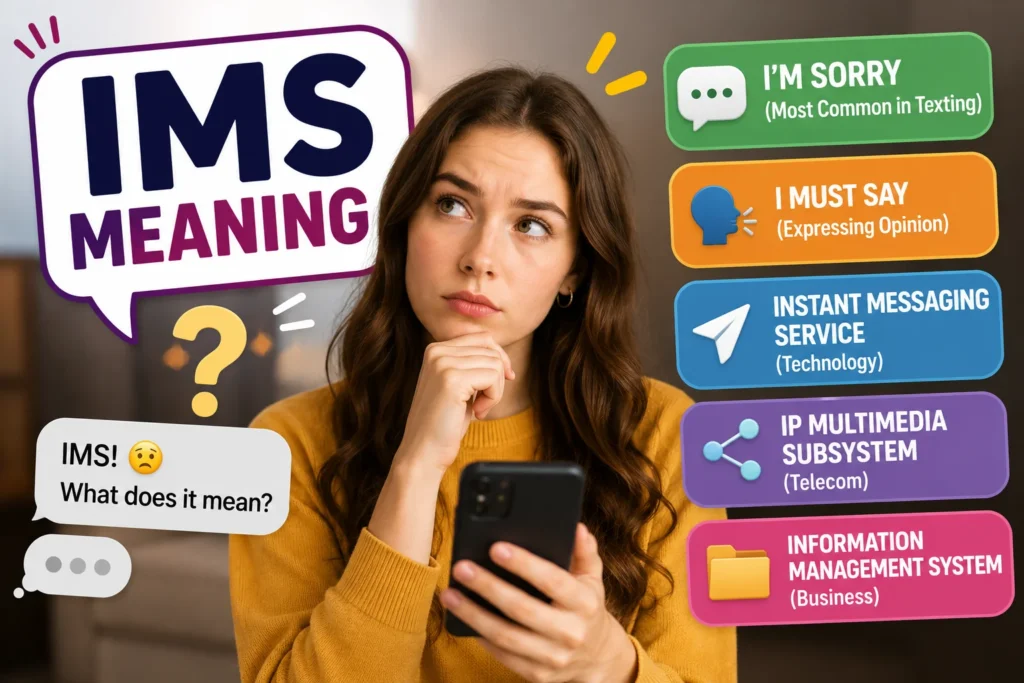

IMS most commonly means “I’m Sorry” in texting and online slang. However, IMS can also stand for “I Must Say,” “Instant Messaging Service,” and several technical terms depending on the context. People search for IMS meaning because the abbreviation appears in texts, Snapchat messages, TikTok comments, and social media conversations with different interpretations.
When someone sends “IMS” in a chat, they are usually apologizing quickly or expressing regret. However, context matters because IMS has multiple legitimate meanings in internet culture, technology, and professional settings.
IMS Meaning & Explanation
What Does IMS Mean in Slang?
In modern texting slang, IMS usually stands for “I’m Sorry.”
People use it as a quick shorthand when:
- Apologizing for a mistake
- Responding to bad news
- Expressing sympathy
- Showing regret
Examples:
- “IMS, I totally forgot your birthday.”
- “IMS for replying late.”
- “IMS, I didn’t mean to upset you.”
This usage is common because internet users often shorten frequently used phrases to save time while texting.
Is IMS an Acronym, Abbreviation, or Slang?
IMS is primarily:
- An abbreviation in texting
- An acronym in some technical fields
- Internet slang when used casually in chats
The meaning depends entirely on the conversation.
Other Genuine Meanings of IMS
I Must Say
Some users use IMS to mean:
“I Must Say.”
Examples:
- “IMS, that movie was better than expected.”
- “IMS, your presentation was impressive.”
This usage is less common than “I’m Sorry” but still appears in online discussions.
Instant Messaging Service
In technology discussions, IMS can refer to:
Instant Messaging Service
Examples:
- “Our company upgraded its IMS platform.”
- “The IMS supports group communication.”
IP Multimedia Subsystem
In telecommunications, IMS often stands for:
IP Multimedia Subsystem
This is a technical networking architecture used by telecom providers.
Information Management System
Businesses and organizations sometimes use IMS for:
Information Management System
This meaning is rarely intended in social media conversations.
IMS on Different Social Media Platforms
IMS on TikTok
On TikTok, IMS most commonly means:
- “I’m Sorry”
- Occasionally “I Must Say”
Users often place it in comments after:
- Jokes that went too far
- Embarrassing videos
- Emotional stories
Example:
“IMS but this made me cry 😭”
IMS on Instagram
Instagram users commonly use IMS in:
- Direct messages
- Story replies
- Comment sections
The meaning is usually:
- “I’m Sorry”
- “I Must Say”
Example:
“IMS for missing your post yesterday.”
IMS on Snapchat
Snapchat conversations tend to be fast and informal.
Here IMS almost always means:
“I’m Sorry.”
Example:
“IMS, my phone died.”
IMS on WhatsApp
WhatsApp users frequently use abbreviations.
Common meaning:
“I’m Sorry.”
Example:
“IMS, I was in a meeting.”
IMS on X (Twitter)
On X, IMS appears less often than on Snapchat or WhatsApp.
When it does appear, it usually means:
- “I’m Sorry”
- “I Must Say”
Context normally makes the meaning obvious.
Tone & Context Variations
Funny Tone
A: I accidentally sent my grocery list to the company group chat.
B: Seriously?
A: Including the cat food order.
B: IMS but that’s hilarious.
Sarcastic Tone
A: I forgot our plans again.
B: Again?
A: My bad.
B: IMS seems to be your favorite phrase.
Playful Tone
A: I ate the last cookie.
B: That was mine.
A: IMS 😅
B: You’re lucky I like you.
Serious Tone
A: I didn’t realize my comment hurt you.
B: It did, honestly.
A: IMS. That wasn’t my intention.
B: Thanks for apologizing.
Real Chat Examples
Example 1: Friends
A: You never replied yesterday.
B: IMS, I fell asleep early.
A: Fair enough.
B: I’ll answer next time.
Example 2: Classmates
A: Did you finish the assignment?
B: Yes, but I forgot to send it.
A: The deadline passed.
B: IMS.
Example 3: Gaming Chat
A: You left the match.
B: My internet crashed.
A: That’s unfortunate.
B: IMS for the loss.
Example 4: Family Group
A: You missed dinner.
B: IMS, work ran late.
A: We saved some food.
B: Thanks.
Example 5: Instagram DM
A: Did you see my story?
B: IMS, I missed it.
A: No worries.
B: I’ll check now.
Example 6: Work Chat
A: The file wasn’t attached.
B: IMS.
A: Can you resend it?
B: Sending now.
Example 7: TikTok Comment
A: This video made me cry.
B: Same.
A: IMS but it’s adorable.
B: Definitely.
Example 8: Roommates
A: Someone finished the milk.
B: IMS.
A: I knew it.
B: I’ll buy more.
Example 9: Travel Plans
A: The flight got delayed.
B: IMS.
A: It happens.
B: Hope it leaves soon.
Example 10: Birthday Message
A: You forgot my birthday.
B: IMS.
A: I’ll forgive you.
B: Thank you.
Example 11: Online Forum
A: I disagree with your point.
B: That’s okay.
A: IMS if I sounded rude.
B: No problem.
Example 12: Sports Group
A: We lost again.
B: IMS.
A: Tough season.
B: We’ll improve.
Grammar & Language Role
Part of Speech
IMS functions as an abbreviation representing a complete phrase.
Usually:
- “I’m Sorry”
- “I Must Say”
Sentence Position
IMS can appear:
At the beginning
- “IMS, I forgot.”
In the middle
- “I was busy, IMS.”
At the end
- “I missed it, IMS.”
Can IMS Replace a Full Sentence?
Yes.
Examples:
- “IMS.”
- “IMS 😅”
- “IMS, my mistake.”
Many users send it alone when the context is obvious.
Formal vs Informal Register
| Usage | Appropriate? |
|---|---|
| Texting | Yes |
| Snapchat | Yes |
| TikTok | Yes |
| Yes | |
| Academic writing | No |
| Business reports | No |
| Professional emails | Usually no |
How to Reply When Someone Says IMS
Funny Reply
- “I’ll allow it this time.”
- “Your apology has been reviewed.”
- “The court accepts your IMS.”
Serious Reply
- “Thank you for apologizing.”
- “I appreciate that.”
- “No problem.”
Flirty Reply
- “I’ll forgive you if you buy coffee.”
- “Apology accepted 😉”
- “You’re lucky you’re cute.”
Neutral Reply
- “Okay.”
- “No worries.”
- “It happens.”
- “All good.”
Comparison Table
| Term | Meaning | Usage Context | Tone | Popularity | Confusion Risk |
|---|---|---|---|---|---|
| IMS | I’m Sorry | Texting and social media | Apologetic | Medium | High |
| IMO | In My Opinion | Discussions | Neutral | Very High | Low |
| IDC | I Don’t Care | Casual chats | Dismissive | High | Low |
| TBH | To Be Honest | Opinions | Honest | Very High | Low |
| SMH | Shaking My Head | Disapproval | Negative | Very High | Low |
| NVM | Never Mind | Opposite response direction | Neutral | High | Medium |
Who Uses This Term?
Age Group Breakdown
Teens (13–19)
Most likely to use IMS as texting shorthand.
Young Adults (20–35)
Common among active social media users.
Adults (35+)
Less frequent but still understood.
Gen Z vs Millennials
Gen Z
- Uses IMS in quick chats.
- Often pairs it with emojis.
- More likely to use abbreviations heavily.
Millennials
- Understand IMS.
- More likely to type the full phrase “I’m sorry.”
Regional Usage
United States
Most common in texting culture.
United Kingdom
Recognized but less widespread.
Global English Users
Appears anywhere English texting culture exists.
Platform Differences
| Platform | Typical Meaning |
|---|---|
| TikTok | I’m Sorry |
| I’m Sorry / I Must Say | |
| Snapchat | I’m Sorry |
| I’m Sorry | |
| X | I’m Sorry / I Must Say |
Origin & Internet Culture
IMS emerged from the broader internet trend of shortening common phrases.
As texting became popular in the late 1990s and early 2000s, users created abbreviations to communicate faster.
Examples include:
- LOL
- BRB
- IMO
- TBH
IMS followed the same pattern.
Unlike some slang terms, IMS does not come from AAVE and has no specific cultural community origin. Instead, it developed through general internet messaging habits.
TikTok and Snapchat helped keep abbreviations alive by encouraging fast, short communication.
While many abbreviations disappear over time, practical ones like IMS remain useful because they save effort while conveying a clear message.
Safety & Appropriateness
Is IMS Offensive?
No.
IMS is generally considered polite and harmless.
Does It Contain Profanity?
No.
There is no profanity associated with the slang meaning.
Is It Appropriate for School?
Yes.
Teachers and students can generally understand it without concern.
Is It Appropriate for Work?
Usually not in formal communication.
Writing “I’m sorry” is often more professional.
Cultural Sensitivity Notes
There are no major cultural sensitivities associated with IMS.
Real-World Observation
In real conversations, IMS works because people often apologize quickly while continuing a discussion. Rather than typing a full sentence, users send IMS to acknowledge a mistake and move on. Its continued use reflects a broader internet habit: shortening emotionally familiar phrases into compact abbreviations that fit naturally into fast-paced messaging.
Frequently Asked Questions
What does IMS mean in text messages?
IMS most commonly means “I’m Sorry.” People use it when apologizing for mistakes, delays, misunderstandings, or minor issues. The meaning is usually easy to recognize from context.
What does IMS mean on Snapchat?
On Snapchat, IMS almost always means “I’m Sorry.” Because conversations are brief and casual, users often prefer abbreviations instead of typing the full phrase.
Is IMS slang?
Yes. In texting culture, IMS functions as internet slang and an abbreviation. However, it also has legitimate technical meanings in telecommunications and business.
What does IMS mean on TikTok?
TikTok users generally use IMS to mean “I’m Sorry.” It appears in comments, replies, and discussions about emotional, funny, or embarrassing content.
Does IMS mean I Must Say?
Yes. Although less common, some people use IMS for “I Must Say.” Context usually makes this meaning obvious.
Is IMS rude?
No. In fact, the most common meaning is an apology. It is generally considered polite rather than rude.
Can IMS have professional meanings?
Yes. IMS can mean IP Multimedia Subsystem, Information Management System, or Instant Messaging Service in professional and technical contexts.
Should I use IMS in work emails?
Generally no. Writing “I’m sorry” is clearer and more professional than using an abbreviation.
Conclusion
IMS meaning most commonly refers to “I’m Sorry” in texting, Snapchat, TikTok, Instagram, and WhatsApp conversations. While the abbreviation also has technical meanings, internet users typically use it as a quick apology or expression of regret.
Usage Tips
- Use IMS in casual conversations.
- Consider the context before interpreting it.
- Use it when apologizing briefly.
- Pair it with additional explanation when needed.
Common Mistakes
- Assuming IMS has only one meaning.
- Using it in professional documents.
- Confusing it with technical IMS acronyms.
- Expecting everyone to recognize the abbreviation.
When to Use IMS
✅ Text messages
✅ Snapchat chats
✅ TikTok comments
✅ Casual social media conversations
When to Avoid IMS
❌ Formal emails
❌ Academic writing
❌ Professional reports
❌ Official business communication