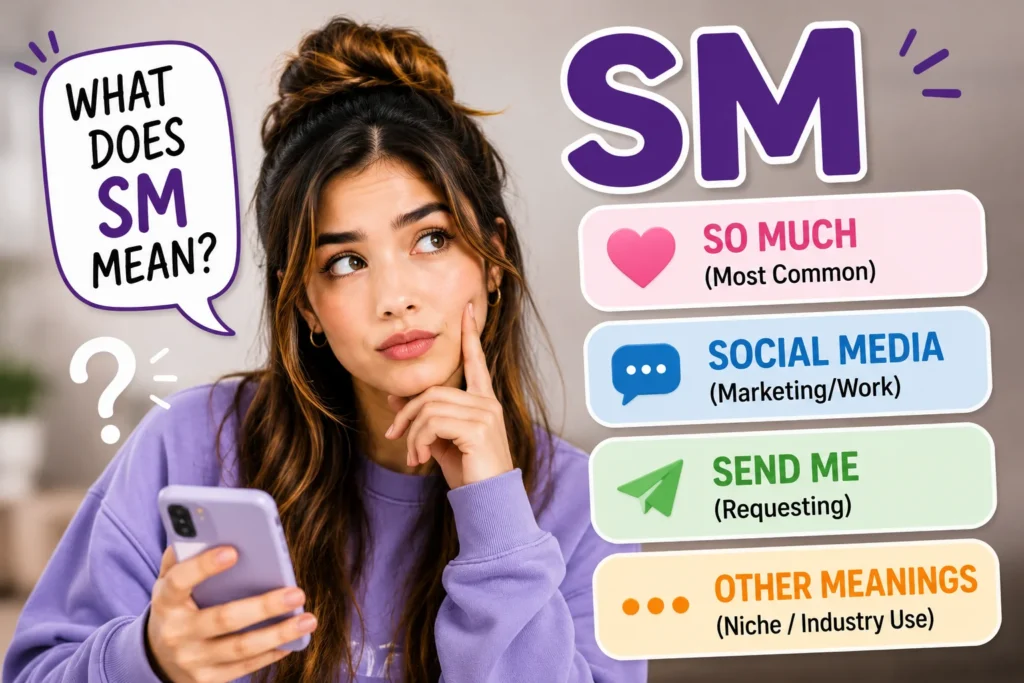

SM most commonly means “so much” in texting and social media. However, depending on context, SM can also mean “social media,” “send me,” or refer to other niche abbreviations. People search “what does SM mean” because the same two letters can have multiple meanings online.
If someone texts, “I miss you sm,” they usually mean “I miss you so much.” But if a creator says, “I work in SM,” they’re likely referring to social media. Understanding the context solves most of the confusion.
Table of Contents
- What Does SM Mean?
- Meaning & Explanation
- SM = So Much
- SM = Social Media
- SM = Send Me
- Other Less Common Meanings
- Platform Breakdown
- Tone & Context Variations
- Real Chat Examples
- Grammar & Language Role
- How to Reply to SM
- Comparison Table
- Who Uses SM?
- Origin & Internet Culture
- Safety & Appropriateness
- Real-World Observation
- FAQ Section
- Conclusion
- Meta Title & Meta Description
What Does SM Mean?
The most common meaning of SM in texting is “so much.” It’s a shorthand abbreviation used to express strong feelings, appreciation, excitement, or emphasis.
Examples:
- “Thank you sm!”
- “I love this song sm.”
- “I miss you sm.”
Because typing habits favor speed and convenience, SM became a popular shortcut across texting apps and social platforms.
Meaning & Explanation
SM = So Much (Most Common Meaning)
This is by far the most searched and recognized meaning.
People use SM to replace the phrase “so much.”
Examples:
- “Thanks sm for helping.”
- “That movie made me laugh sm.”
- “I appreciate it sm.”
In these examples, SM acts as an abbreviation rather than slang. The meaning stays exactly the same as the full phrase.
SM = Social Media
In professional or creator-focused conversations, SM often stands for social media.
Examples:
- “I work in SM marketing.”
- “Our SM strategy changed.”
- “She manages the company’s SM accounts.”
This usage is common in business discussions, digital marketing, and creator communities.
SM = Send Me
Less commonly, people use SM as shorthand for send me.
Examples:
- “SM the link.”
- “SM your playlist.”
- “SM the details later.”
This meaning depends heavily on context and is much less common than “so much.”
Other Less Common Meanings
Depending on the industry or niche, SM can occasionally mean:
- Service Mark
- Sales Manager
- Senior Member
- Session Manager
These meanings are generally unrelated to texting slang and are rarely the intent when someone asks, “What does SM mean?”
Platform Breakdown
TikTok
On TikTok, SM most commonly means so much.
Examples:
- “I love this creator sm.”
- “This trend makes me laugh sm.”
Users often place SM at the end of comments.
Instagram users frequently use SM in:
- Captions
- Story replies
- Comments
- Direct messages
Examples:
- “Miss you sm.”
- “Thank you sm for the support.”
Snapchat
Snapchat conversations heavily favor abbreviations, making SM very common.
Examples:
- “I miss you sm.”
- “That was funny sm.”
WhatsApp users frequently use SM during casual conversations.
Examples:
- “Thanks sm.”
- “I appreciate it sm.”
X (Formerly Twitter)
On X, SM can mean either:
- So much
- Social media
Context determines which meaning is intended.
Examples:
- “I love this song sm.”
- “The SM industry changes fast.”
Tone & Context Variations
Funny Tone
A: Did you really eat an entire pizza?
B: Maybe.
A: By yourself?
B: I love pizza sm.
Sarcastic Tone
A: Another Monday meeting.
B: Great.
A: Excited?
B: Oh yeah, sm.
Playful Tone
A: Guess who watched that show again?
B: You?
A: I love it sm.
B: Clearly.
Serious Tone
A: Thanks for helping during a difficult week.
B: Of course.
A: It meant sm to me.
B: I’m glad I could help.
Real Chat Examples
Example 1
A: Thanks for the gift.
B: You’re welcome.
A: I love it sm.
B: Glad you liked it.
Example 2
A: Did you see the concert clips?
B: Yes.
A: I wish I went sm.
B: Same here.
Example 3
A: Miss you.
B: Miss you too.
A: Seriously sm.
B: Let’s meet soon.
Example 4
A: Your advice helped.
B: Happy to hear that.
A: Thanks sm.
B: Anytime.
Example 5
A: This restaurant is amazing.
B: Really?
A: I like it sm.
B: I’ll try it.
Example 6
A: Can you SM the photos?
B: Sure.
A: Thanks.
B: Sending them now.
Example 7
A: I love this new album.
B: Same.
A: I’ve listened to it sm already.
B: Me too.
Example 8
A: Who handles marketing?
B: Sarah.
A: The SM accounts too?
B: Yes.
Example 9
A: That joke was terrible.
B: Yet you laughed.
A: Way sm.
B: Exactly.
Example 10
A: Are you okay?
B: Better now.
A: I worried sm.
B: I appreciate that.
Example 11
A: Did your post perform well?
B: Yes.
A: Social media helped?
B: Our SM team did great.
Example 12
A: Thank you for showing up.
B: Of course.
A: It meant sm.
B: Anytime.
Grammar & Language Role
Part of Speech
SM functions as an abbreviation.
Its grammatical role depends on what it replaces.
Most commonly:
- “So much” (adverbial phrase)
Example:
- “I like it sm.”
Sentence Position
SM typically appears:
- At the end of sentences
- After emotional statements
- Following appreciation
Examples:
- “Thanks sm.”
- “I miss you sm.”
Can It Replace a Full Sentence?
Usually no.
Incorrect:
- “SM.”
Correct:
- “I appreciate you sm.”
Formal vs Informal Register
SM is highly informal.
Appropriate for:
- Text messages
- Social media
- Friends
- Family
Not ideal for:
- Academic papers
- Professional reports
- Formal correspondence
How to Reply to SM
Funny Reply
“Only sm? I expected even more.”
Serious Reply
“You’re welcome. I’m happy I could help.”
Flirty Reply
“Aww, I like you sm too.”
Neutral Reply
“Glad to hear that.”
Comparison Table
| Term | Meaning | Usage Context | Tone | Popularity | Confusion Risk |
|---|---|---|---|---|---|
| SM | So Much | Texting, social media | Positive | Very High | Medium |
| TYSM | Thank You So Much | Gratitude | Positive | Very High | Low |
| ILYSM | I Love You So Much | Affection | Positive | Very High | Low |
| TSM | Too Much | Reactions, opinions | Neutral | Medium | High |
| OMG | Oh My God | Surprise | Emotional | Very High | Low |
| IDC | I Don’t Care | Opposite emotional emphasis | Detached | High | Low |
Who Uses SM?
Teenagers
Gen Z uses SM heavily in:
- TikTok comments
- Snapchat chats
- Instagram DMs
Young Adults
Millennials commonly use SM in:
- Text messages
- Casual online conversations
Content Creators
Creators often use SM in captions and comments.
Professionals
Professionals may use SM to mean social media rather than so much.
Regional Usage
United States
Extremely common.
United Kingdom
Widely recognized in texting.
Global English Speakers
Frequently understood wherever English internet slang is used.
Origin & Internet Culture
Early Texting Era
SM emerged from early SMS culture when users had character limits and keypad typing was slow.
Shortening “so much” to SM saved time and space.
Social Media Expansion
As platforms like Twitter, Instagram, Snapchat, and TikTok grew, SM became even more common.
People increasingly used abbreviated language to communicate quickly.
Why It Stayed Popular
Unlike some internet slang that disappears quickly, SM remains useful because:
- It saves typing
- It’s easy to understand
- It expresses emotion efficiently
Meme and TikTok Culture
TikTok comments helped reinforce SM’s popularity.
Comments like:
- “I love this sm.”
- “This made me laugh sm.”
appear thousands of times daily across the platform.
Safety & Appropriateness
Is SM Offensive?
No.
Is It Profanity?
No.
Does It Contain Explicit Language?
No.
School Appropriate?
Yes.
Workplace Appropriate?
Only in informal internal chats.
Cultural Sensitivity Concerns?
None.
SM is generally considered harmless internet shorthand.
Real-World Observation
One reason SM remains popular is that it communicates emotion efficiently without sounding overly dramatic. People often want to show appreciation, excitement, or affection quickly. Writing “thanks sm” feels more personal than a simple “thanks” but takes almost no extra effort. That balance between convenience and emotional expression helps explain why the abbreviation continues to thrive across generations of internet users.
FAQ
What does SM mean in texting?
In texting, SM usually means “so much.” People use it to emphasize appreciation, affection, excitement, or other emotions. Examples include “Thanks sm” and “I miss you sm.”
What does SM mean on Snapchat?
On Snapchat, SM most often means “so much.” Users frequently include it in casual conversations because Snapchat encourages quick, abbreviated communication.
What does SM mean on TikTok?
TikTok users generally use SM to mean “so much.” It commonly appears in comments, captions, and replies expressing enthusiasm or support.
Does SM mean social media?
Yes, in professional and marketing contexts, SM often stands for social media. Context is important because this meaning differs completely from texting slang.
Is SM slang or an abbreviation?
SM is primarily an abbreviation. It shortens existing phrases like “so much” rather than creating a new slang word with a different meaning.
What does “I love you sm” mean?
It means “I love you so much.” The abbreviation emphasizes strong affection while keeping the message short and casual.
What does “thanks sm” mean?
It means “thanks so much.” People use it as a quick and friendly way to express gratitude online.
Can SM have different meanings?
Yes. Depending on context, SM can mean so much, social media, send me, or other niche terms. The surrounding conversation usually makes the intended meaning obvious.
Conclusion
SM most commonly means “so much” in texting, social media, and online conversations. It can also mean social media or send me in specific contexts, but the emotional “so much” meaning is by far the most popular.
Usage Tips
- Use SM to replace “so much” in casual conversations.
- Check context before assuming the meaning.
- Remember that professionals may use SM for social media.
- Use it naturally in texts and DMs.
Common Mistakes
- Assuming SM always means social media.
- Using it in formal documents.
- Misreading business discussions.
- Ignoring the surrounding context.
When to Use It
Use SM when:
- Texting friends
- Commenting on social media
- Expressing appreciation
- Showing affection casually
Avoid it when:
- Writing formal emails
- Creating academic content
- Communicating in professional reports