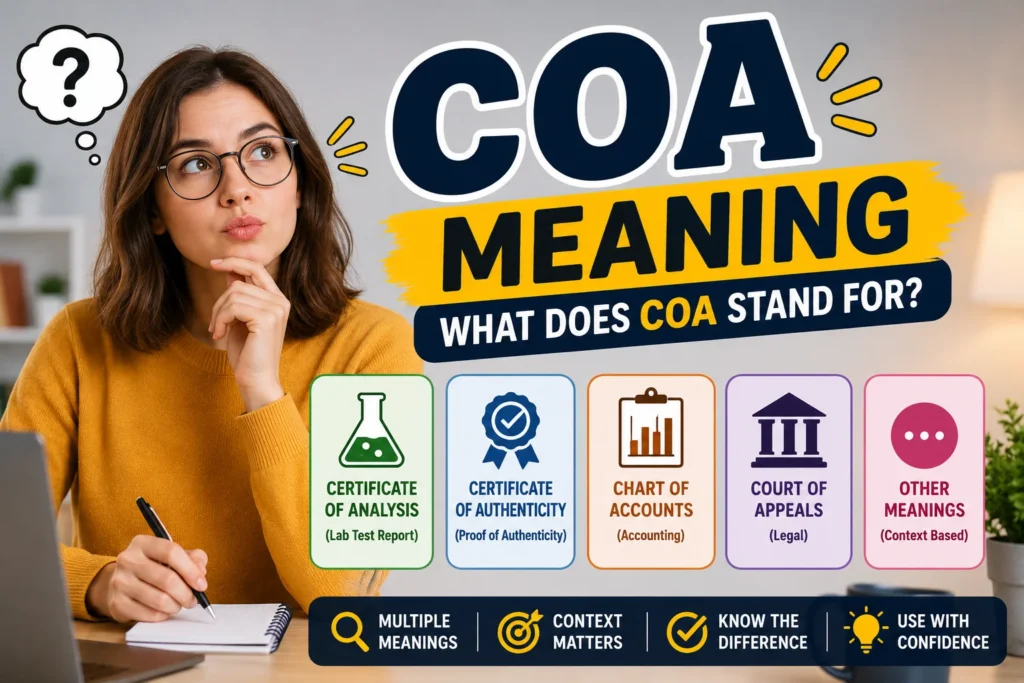

COA most commonly stands for “Certificate of Analysis,” a document that verifies a product has been tested by an independent laboratory. However, depending on the context, COA can also mean Certificate of Authenticity, Chart of Accounts, Court of Appeals, and several other legitimate terms. Understanding the context helps eliminate confusion and ensures you’re interpreting the abbreviation correctly.
Whether you’ve seen COA on a CBD product, an artwork listing, an accounting document, or in a legal discussion, this guide explains every major meaning, when it’s used, and why it matters.
Table of Contents
- What Does COA Mean?
- The Most Common Meaning: Certificate of Analysis
- Other Popular Meanings of COA
- Is COA an Acronym, Abbreviation, or Slang?
- How COA Appears on TikTok, Instagram, Snapchat, WhatsApp, and X
- Tone and Context Variations
- Real Chat Examples
- Grammar and Language Role
- How to Reply When Someone Says COA
- COA Comparison Table
- Who Uses the Term COA?
- Origin and Evolution of COA
- Safety and Appropriateness
- Real-World Observation
- Frequently Asked Questions
- People Also Ask
- Conclusion
- Meta Title & Meta Description
What Does COA Mean?
The abbreviation COA has several legitimate meanings, but the correct interpretation depends entirely on the subject being discussed.
Today, the most frequently searched meanings include:
| Meaning | Common Industry |
|---|---|
| Certificate of Analysis | Laboratory testing, CBD, supplements, cosmetics, food |
| Certificate of Authenticity | Art, collectibles, luxury goods, electronics |
| Chart of Accounts | Accounting and bookkeeping |
| Court of Appeals | Legal system |
| Other organization-specific meanings | Government, education, healthcare |
Unlike abbreviations such as LOL, OMG, or WTH, COA is not considered internet slang. Instead, it is a professional abbreviation used across multiple industries.
Meaning & Explanation
Certificate of Analysis (Most Common Meaning)
The most common meaning of COA is Certificate of Analysis.
A Certificate of Analysis is an official laboratory document that confirms a product has been tested for specific characteristics such as quality, purity, safety, potency, or ingredient content.
Manufacturers often provide a COA to show customers that an independent laboratory has verified the product.
You’ll commonly find Certificates of Analysis with:
- CBD products
- Hemp products
- Dietary supplements
- Vitamins
- Cosmetics
- Essential oils
- Laboratory chemicals
- Food ingredients
- Pharmaceutical products
A typical Certificate of Analysis may include:
- Laboratory name
- Product identification
- Batch or lot number
- Testing date
- Cannabinoid profile (for CBD)
- Heavy metal screening
- Pesticide testing
- Microbial testing
- Pass/Fail results
For consumers, a COA provides confidence that the product matches what the manufacturer claims.
Certificate of Authenticity
The second most common meaning is Certificate of Authenticity.
This document proves that an item is genuine rather than counterfeit.
Certificates of Authenticity are common with:
- Paintings
- Limited-edition prints
- Sports memorabilia
- Trading cards
- Luxury handbags
- Watches
- Designer products
- Autographed collectibles
- Fine jewelry
For example, someone purchasing a signed sports jersey may receive a COA confirming the autograph has been professionally authenticated.
Without a Certificate of Authenticity, many collectibles lose significant resale value.
Chart of Accounts
In accounting, COA stands for Chart of Accounts.
A Chart of Accounts is an organized list of every financial account a business uses to record transactions.
Typical account categories include:
- Assets
- Liabilities
- Equity
- Revenue
- Expenses
Every accounting system uses some form of Chart of Accounts because it creates consistency in financial reporting.
Accountants, auditors, bookkeepers, and business owners use this definition regularly.
Court of Appeals
Legal professionals often use COA to mean Court of Appeals.
The Court of Appeals reviews decisions made by lower courts to determine whether legal errors affected the outcome of a case.
You’ll encounter this abbreviation in:
- Legal documents
- Court opinions
- Judicial news
- Law school materials
- Government publications
Outside legal discussions, however, this meaning is much less common.
Other Legitimate Meanings
Although searched less frequently, COA can also represent:
- Council on Accreditation
- Cost of Attendance (education)
- City of Austin (internal abbreviations)
- Center of Attention (casual shorthand)
- Conditions of Approval (planning and development)
These meanings are highly dependent on industry and context.
Is COA an Acronym, Abbreviation, or Slang?
COA is an acronym.
Each letter represents the first letter of a longer phrase.
Examples include:
- Certificate of Analysis
- Certificate of Authenticity
- Chart of Accounts
- Court of Appeals
Unlike internet slang abbreviations such as BRB, SMH, or IMO, COA is primarily used in professional, educational, commercial, scientific, and legal environments.
People rarely use COA as a casual texting shortcut unless they’re specifically discussing products, business documents, accounting, or legal matters.
How COA Appears on Different Platforms
TikTok
On TikTok, COA usually refers to a Certificate of Analysis when creators review CBD products, supplements, skincare items, or laboratory-tested goods.
Some creators encourage viewers to “always check the COA” before buying wellness products to verify quality and safety.
Beauty brands, supplement companies, and small businesses often mention COAs in product descriptions or educational posts.
Luxury resale accounts may also refer to a Certificate of Authenticity when listing designer items or collectibles.
Snapchat
COA rarely appears in everyday Snapchat conversations.
When it does, it’s typically between friends discussing purchases, laboratory results, or authentication documents—not as slang.
Business owners, suppliers, and customers frequently exchange COAs through WhatsApp to verify products before shipping or purchasing.
For example, wholesalers may send a PDF Certificate of Analysis during product negotiations.
X (formerly Twitter)
On X, you’ll mostly encounter COA in discussions related to:
- Laboratory testing
- CBD regulations
- Food safety
- Financial accounting
- Legal news
It is generally used in its professional sense rather than as an internet expression.
Tone & Context Variations
Because COA has several legitimate meanings, its tone depends entirely on the conversation. In most situations, it isn’t emotional or humorous by itself—it’s simply a professional acronym. However, people discussing products, collectibles, accounting, or legal matters may use it casually in everyday conversations.
Serious Context (Certificate of Analysis)
This is the most common way people use COA today, especially when discussing product safety and quality.
A: I’m thinking about buying this CBD oil.
B: Did you check the COA first?
A: Not yet. Why?
B: It shows whether an independent lab actually tested the product.
Professional Context (Chart of Accounts)
Accountants and finance professionals use COA regularly in business conversations.
A: The new accounting software is ready.
B: Great. Did you import the COA?
A: Yes, all account categories have been mapped correctly.
B: Perfect. We can start recording transactions now.
Helpful Context (Certificate of Authenticity)
Collectors often mention a COA when verifying expensive purchases.
A: That signed baseball looks amazing.
B: It came with a COA.
A: That’s good. It’ll help prove it’s authentic if you ever sell it.
Playful Context
Friends sometimes use COA jokingly when talking about collectibles or expensive purchases.
A: I finally bought those limited-edition sneakers.
B: Nice! Did they come with a COA?
A: Yep—and now I’m scared to even wear them.
B: I’d probably frame them instead!
Real Chat Examples
Below are realistic conversations showing how people naturally use COA in different situations.
Example 1 – Shopping for CBD
A: Is this CBD brand trustworthy?
B: Check their COA.
A: They actually linked it on their website.
B: That’s usually a good sign.
Example 2 – Buying Supplements
A: These vitamins are really cheap.
B: Cheap isn’t always better.
A: What should I check?
B: See if they provide a recent COA.
Example 3 – Art Collection
A: I found a signed print online.
B: Does it include a COA?
A: Yes, from the gallery.
B: Then it’s much more valuable.
Example 4 – Sports Memorabilia
A: I’m buying an autographed football.
B: Make sure it has a COA.
A: It comes from a reputable authentication company.
B: Sounds much safer.
Example 5 – Accounting Office
A: Where are the expense accounts?
B: They’re listed in the COA.
A: Thanks, I couldn’t find them.
B: Check the operating expenses section.
Example 6 – Small Business
A: The accountant asked for the COA.
B: The Chart of Accounts?
A: Exactly.
B: I’ll send the updated file.
Example 7 – Cosmetics
A: This skincare brand says it’s dermatologist tested.
B: Did you see the COA?
A: Yes, they published the lab report.
B: That’s reassuring.
Example 8 – Online Marketplace
A: This luxury handbag is expensive.
B: Does it include a Certificate of Authenticity?
A: Yes, the seller uploaded the COA.
B: That makes me feel much better.
Example 9 – Laboratory Testing
A: The shipment just arrived.
B: Did the supplier include the COA?
A: Yes, it came with every batch.
B: Great. Quality control can approve it.
Example 10 – Legal Discussion
A: The case is moving to the COA.
B: The Court of Appeals?
A: Yes, they’re appealing the decision.
B: It’ll probably take several months.
Example 11 – Trading Cards
A: This Pokémon card looks real.
B: Does it have a COA?
A: Yes, from the authentication service.
B: Then collectors will trust it more.
Example 12 – Wholesale Purchase
A: Before we place the order, we’d like the COA.
B: No problem.
A: Please email the latest laboratory report.
B: I’ll send it today.
Grammar & Language Role
Part of Speech
COA functions as a noun because it represents a specific document, system, institution, or concept.
Examples:
- “The COA is available online.”
- “Please send the COA before shipping.”
Sentence Position
COA usually appears:
- As the subject
- As the object
- After verbs like check, send, review, verify, or receive
Examples:
- “The COA confirms the test results.”
- “Can you email me the COA?”
- “We reviewed the COA yesterday.”
Can COA Replace a Full Sentence?
No.
Unlike internet abbreviations such as LOL, OMG, or SMH, COA cannot stand alone as a complete reaction.
Instead, it refers to a specific document or concept.
Correct:
- “Please send the COA.”
Not natural:
- “COA!”
Formal vs. Informal Register
One interesting feature of COA is that it works in both formal and informal communication.
Formal:
- Laboratory reports
- Business emails
- Accounting records
- Legal documents
Informal:
- Product discussions
- Online shopping
- Collector forums
- Text messages about purchases
Unlike many abbreviations, COA doesn’t become inappropriate simply because it’s shortened. Professionals use the acronym routinely instead of writing the full phrase every time.
How to Reply When Someone Says “COA”
The best response depends on which meaning of COA the other person is referring to.
Funny Reply
If someone jokingly asks about a COA for an expensive purchase:
- “Only if you’re planning to put it in a museum!”
- “It’s officially certified awesome.”
- “Guess it’s collector’s item status now.”
- “Better frame the certificate too!”
Serious Reply
When discussing product testing or authenticity:
- “I’ll send you the COA right away.”
- “The laboratory completed the testing yesterday.”
- “You can download the COA from the manufacturer’s website.”
- “Always verify the COA before purchasing.”
Neutral Reply
For everyday conversations:
- “Thanks, I’ll check it.”
- “Good idea.”
- “I’ll review the document.”
- “That makes sense.”
Flirty Reply
Since COA isn’t romantic slang, flirty replies are generally not appropriate. If the conversation is already playful, you might say:
- “If I bring the COA, do I get bonus points? 😄”
However, in most situations, keeping the conversation straightforward is the better choice.
Comparison Table
Because COA has multiple legitimate meanings across different industries, it’s often confused with other abbreviations that relate to testing, authenticity, or business documentation. The table below compares the most common meanings and similar terms people frequently encounter.
| Term | Meaning | Usage Context | Tone | Popularity | Confusion Risk |
|---|---|---|---|---|---|
| COA | Certificate of Analysis (most common), Certificate of Authenticity, Chart of Accounts, Court of Appeals | Laboratory testing, product verification, accounting, legal documents | Professional | Very High | High |
| COC | Certificate of Conformity | Manufacturing, exports, product compliance | Professional | High | High |
| COI | Certificate of Insurance | Insurance and business contracts | Professional | High | Medium |
| MSDS / SDS | Material Safety Data Sheet / Safety Data Sheet | Chemicals, laboratories, workplace safety | Professional | High | Medium |
| QA | Quality Assurance | Manufacturing, software, product development | Professional | Very High | Low |
| Fake Certificate (Contrasting concept) | Document without official verification | Counterfeit products and scams | Negative | Medium | Low |
How These Terms Differ
Although these abbreviations often appear together, they serve different purposes:
- COA (Certificate of Analysis) verifies laboratory test results.
- Certificate of Authenticity proves an item is genuine.
- COC confirms a product meets specific standards or regulations.
- COI proves insurance coverage.
- SDS explains chemical safety information.
- QA focuses on maintaining product quality throughout production.
Knowing these differences helps avoid misunderstandings when buying products or reviewing business documents.
Who Uses the Term COA?
Unlike internet slang that spreads mainly through texting, COA is widely used by professionals, businesses, collectors, and informed consumers. Different industries rely on different meanings of the abbreviation.
Age Group Breakdown
18–24 Years
Younger adults most often encounter COA while shopping online for:
- CBD products
- Supplements
- Skincare
- Collectibles
- Sneakers
- Trading cards
Many first learn about Certificates of Analysis from social media reviews or product recommendation videos.
25–40 Years
This group uses COA most frequently in:
- Business
- E-commerce
- Accounting
- Product sourcing
- Health and wellness purchases
Professionals are also more likely to recognize Chart of Accounts in workplace settings.
40+ Years
Older adults typically encounter COA in:
- Accounting
- Legal documents
- Pharmaceutical products
- Laboratory reports
- Fine art
- Luxury collectibles
Their familiarity often comes from professional experience rather than social media.
Gen Z vs Millennials
Gen Z
Gen Z usually associates COA with:
- CBD products
- TikTok product reviews
- Skincare
- Online shopping
- Sneakers
- Trading cards
Many younger consumers have learned to ask for a COA before purchasing wellness products online.
Millennials
Millennials encounter COA across a wider range of industries.
They commonly recognize:
- Certificate of Analysis
- Certificate of Authenticity
- Chart of Accounts
Millennials running businesses or working in finance may use the abbreviation almost daily.
Regional Usage
United States
The United States sees the widest use of COA because of:
- CBD regulation
- Laboratory testing
- Accounting
- Court of Appeals
- Collectibles market
The U.S. is where most online searches for “COA meaning” originate.
United Kingdom
In the UK, COA appears mainly in:
- Scientific laboratories
- Manufacturing
- Accounting
- Authentication services
Legal terminology differs slightly, so “Court of Appeals” is less common than in the U.S.
Canada
Canadian businesses regularly use COA for:
- Product testing
- Manufacturing
- Import/export documentation
- Accounting
Australia
Australian consumers most often encounter COA while purchasing:
- Supplements
- Laboratory-tested products
- Medical goods
- Industrial chemicals
Global Usage
Worldwide, the most recognized definition remains:
Certificate of Analysis
Its importance continues growing because more consumers now expect transparency before buying health and wellness products.
Platforms Where COA Appears
Unlike internet slang, COA appears differently depending on the platform.
Company Websites
This is where COA is most commonly found.
Brands often publish downloadable Certificates of Analysis so customers can verify laboratory results.
Online Stores
Many premium sellers include COAs to increase buyer confidence, especially for:
- Supplements
- CBD
- Luxury goods
- Collectibles
Professionals discuss:
- Chart of Accounts
- Laboratory testing
- Compliance
- Manufacturing standards
Communities frequently recommend checking a COA before purchasing products such as CBD oils or nutritional supplements.
TikTok
TikTok creators often remind viewers to:
“Always check the COA before buying.”
These videos usually focus on educating consumers about product safety rather than using COA as slang.
Origin & Internet Culture
Real Origin
The abbreviation COA developed naturally as industries sought shorter ways to reference lengthy technical phrases.
Each major meaning emerged independently:
- Certificate of Analysis became common in laboratory and manufacturing environments.
- Certificate of Authenticity grew alongside art, collectibles, and luxury markets.
- Chart of Accounts has long been standard accounting terminology.
- Court of Appeals originated within legal systems.
Unlike many internet abbreviations, COA did not begin on social media or in texting culture.
How Certificate of Analysis Became the Dominant Meaning
As online shopping expanded, consumers wanted greater transparency about product quality.
Manufacturers responded by publishing laboratory reports that became known simply as COAs.
Today, asking for a COA has become standard advice among experienced buyers of:
- CBD products
- Supplements
- Cosmetics
- Wellness products
- Laboratory-tested goods
COA and Social Media
Although COA didn’t originate online, social media significantly increased public awareness.
Educational creators frequently explain:
- Why laboratory testing matters
- How to read a COA
- Which brands publish genuine reports
- How fake certificates can mislead buyers
Rather than becoming internet slang, COA became part of consumer education.
Meme Culture
COA has almost no role in meme culture.
Unlike abbreviations such as LOL, SMH, or WTH, COA isn’t used as an emotional reaction.
Instead, it appears in informative content where creators teach viewers how to make safer purchasing decisions.
Evolution Over Time
Originally, COA was mostly used by:
- Scientists
- Manufacturers
- Accountants
- Lawyers
Today, everyday consumers recognize it because online shopping has made laboratory transparency far more important than it was a decade ago.
As awareness of product quality grows, COA is becoming increasingly familiar outside professional industries.
Safety & Appropriateness
One reason COA is widely accepted is that it carries no offensive or explicit meaning.
Is COA Rude?
No.
COA is a neutral professional abbreviation with no insulting or disrespectful meaning.
Does COA Contain Profanity?
No.
Unlike many internet abbreviations, COA contains no profanity or inappropriate language.
Is It Safe for School?
Yes.
Students studying:
- Science
- Chemistry
- Accounting
- Business
- Economics
may regularly encounter COA in textbooks or coursework.
Is It Appropriate at Work?
Absolutely.
COA is commonly used in:
- Business emails
- Accounting reports
- Laboratory documentation
- Manufacturing
- Product compliance
- Legal communication
Using the abbreviation is standard professional practice.
Cultural Sensitivity
COA has no known cultural, political, or social sensitivity issues.
Its meaning depends entirely on industry rather than identity or community.
Real-World Observation
In everyday life, COA has become increasingly visible because consumers now expect proof rather than promises. Whether someone is buying CBD oil, a luxury handbag, a signed collectible, or reviewing financial records, asking for the COA signals a growing emphasis on transparency and verification. Unlike internet slang that comes and goes with online trends, COA has remained relevant because it serves a practical purpose—helping people make informed decisions based on documented evidence rather than marketing claims.
Frequently Asked Questions
What Does COA Mean?
COA most commonly stands for Certificate of Analysis, a laboratory report that verifies a product has been tested for quality, purity, and safety. Depending on the industry, however, it can also mean Certificate of Authenticity, Chart of Accounts, or Court of Appeals. Always use the surrounding context to determine which meaning is intended.
What Is a Certificate of Analysis (COA)?
A Certificate of Analysis is a document issued by a laboratory after testing a product. It typically lists test results, batch numbers, testing methods, and whether the product passed quality standards. Consumers often review COAs before purchasing CBD products, dietary supplements, cosmetics, food ingredients, and laboratory-tested goods.
What Is the Difference Between a Certificate of Analysis and a Certificate of Authenticity?
Although both abbreviate to COA, they serve different purposes.
A Certificate of Analysis verifies the composition, quality, or safety of a product through laboratory testing. A Certificate of Authenticity, on the other hand, confirms that an item—such as artwork, collectibles, or luxury goods—is genuine and not counterfeit. The context usually makes it clear which definition applies.
Is COA an Acronym or an Abbreviation?
COA is an acronym formed from the initial letters of a longer phrase. Depending on the subject, it may stand for Certificate of Analysis, Certificate of Authenticity, Chart of Accounts, or another recognized term. It is not considered internet slang.
Is COA Used in Text Messages?
Occasionally, yes—but only when people are discussing products, accounting, legal matters, or collectibles. Unlike abbreviations such as LOL, BRB, or OMG, COA is not commonly used as a casual texting expression. Most text conversations use it in its professional meaning.
Why Do CBD Products Have a COA?
Reputable CBD companies publish a Certificate of Analysis so customers can verify that the product has been independently tested. A COA typically confirms cannabinoid content and checks for contaminants such as heavy metals, pesticides, solvents, and harmful microbes. Reviewing the COA helps consumers make safer purchasing decisions.
What Does COA Mean in Accounting?
In accounting, COA stands for Chart of Accounts. It is the structured list of all financial accounts a business uses to organize transactions and prepare financial statements. Every accounting system relies on a well-designed Chart of Accounts to maintain accurate records.
Is COA Important When Buying Collectibles?
Yes. When purchasing artwork, sports memorabilia, trading cards, or luxury items, a Certificate of Authenticity helps prove the item is genuine. While a COA does not guarantee authenticity by itself, one issued by a reputable authentication organization can significantly increase buyer confidence and resale value.
Why Should You Check a COA Before Buying a Product?
Checking a COA helps confirm that a product has been independently tested rather than relying solely on marketing claims. It allows buyers to verify ingredient levels, purity, and safety information before making a purchase. This is especially important for wellness products, supplements, and CBD items.
Does Every Product Need a COA?
No. Products such as laboratory-tested supplements, CBD products, cosmetics, pharmaceuticals, and industrial chemicals commonly include COAs. Everyday consumer products that don’t require laboratory verification may not provide one.
Can a COA Be Fake?
Unfortunately, yes. Some dishonest sellers publish outdated, altered, or fabricated Certificates of Analysis. Buyers should verify that the COA comes from an independent laboratory, includes a matching batch number, and reflects recent testing whenever possible.
Is COA a Legal Requirement?
The answer depends on the product category and local regulations. In some industries, Certificates of Analysis are required for compliance, while in others they are provided voluntarily to improve transparency and customer trust.
Conclusion
COA is an important professional acronym with several legitimate meanings, but Certificate of Analysis is the definition most people search for today. It plays a vital role in helping consumers verify the quality and safety of products through independent laboratory testing. In other contexts, COA may refer to a Certificate of Authenticity, Chart of Accounts, or Court of Appeals, making context essential for accurate interpretation.
Rather than being internet slang, COA is a trusted abbreviation used across science, manufacturing, accounting, law, retail, and collecting. As consumers increasingly demand transparency, understanding what a COA means—and how to read one—has become more valuable than ever.
Usage Tips
- Identify the industry before assuming what COA means.
- Always review a recent Certificate of Analysis when purchasing laboratory-tested products.
- Check that batch numbers on the COA match the product you’re buying.
- In accounting and legal documents, interpret COA according to the professional context.
Common Mistakes
- Assuming COA always means Certificate of Analysis.
- Confusing a Certificate of Analysis with a Certificate of Authenticity.
- Trusting a COA without confirming it comes from an independent laboratory.
- Treating COA as internet slang when it is actually a professional acronym.
When to Use COA
Use COA when discussing:
- Laboratory testing
- Product quality verification
- CBD and dietary supplements
- Cosmetics and food safety
- Accounting systems
- Legal documents
- Collectibles and authentication
When to Avoid COA
Avoid using the abbreviation if your audience may not understand it. In consumer-facing content or conversations with beginners, writing the full phrase—such as Certificate of Analysis or Certificate of Authenticity—can improve clarity.